%20scale(.87)'%3e%3cg%20transform='rotate(-3%2032%2034)'%3e%3cpath%20d='M10.5%2019.5c7.65-2.35%2014.8-.45%2021.5%205.7%206.7-6.15%2013.85-8.05%2021.5-5.7v27.2c-7.65-2.15-14.8-.45-21.5%205.1-6.7-5.55-13.85-7.25-21.5-5.1V19.5Z'%20fill='%23fff'%20stroke='%23171528'%20stroke-width='4.5'%20stroke-linejoin='round'/%3e%3cpath%20d='M32%2025.2v26.6'%20stroke='%23171528'%20stroke-width='4'%20stroke-linecap='round'/%3e%3cpath%20d='M17.5%2034.5h9M22%2030v9'%20stroke='%23171528'%20stroke-width='3.75'%20stroke-linecap='round'/%3e%3ccircle%20cx='41.5'%20cy='32.5'%20r='2.5'%20fill='%23171528'/%3e%3ccircle%20cx='46.5'%20cy='38'%20r='2.5'%20fill='%23171528'/%3e%3c/g%3e%3c/g%3e%3c/svg%3e)
The quick answer
Who was Samson in the Bible?
Samson was a judge of Israel from the tribe of Dan. His father was Manoah of Zorah; his mother, who received the announcement of his birth, is not named. Set apart for God as a Nazirite from the womb, Samson was to begin saving Israel from Philistine rule. Judges 13–16 follows his extraordinary strength, troubled marriage at Timnah, conflicts with the Philistines, and betrayal by Delilah. He judged Israel for twenty years and died when he brought down a Philistine temple in Gaza.
Why was Samson a Nazirite?
The announcement comes first to Samson’s mother, before she conceives. The angel tells her to avoid wine, strong drink, and unclean food, and says that no razor is to touch her son’s head. He will be a Nazirite to God from the womb and begin rescuing Israel from the Philistines.
Numbers 6 describes a Nazirite vow that a man or woman could choose to take for a period of dedication to God. Samson’s calling is different: it is announced before his birth, and his mother reports that it will last until his death. “Nazirite” means someone set apart for God; it does not mean a person from Nazareth.
His uncut hair belongs to that calling. Several feats of strength are explicitly attributed to Yahweh’s Spirit, including the lion at Timnah and the breaking of his bonds at Lehi. The hair is important in the account, but Samson is not portrayed as powerful apart from God.
What happened to Samson’s wife at Timnah?
Samson insists on marrying a Philistine woman despite his parents’ objections. Judges 14:4 says they do not know that the situation is from Yahweh, as an occasion against the Philistines. That comment about God’s purpose does not make everything that follows good or harmless.
At the wedding, Samson poses a riddle about honey he found in the carcass of a lion he had killed. The men threaten to burn his wife and her father’s household unless she gets the answer. She presses Samson, learns it, and tells them. Unlike Delilah’s later dealings with the rulers, her actions take place under a threat to her life.
Samson kills thirty men at Ashkelon and takes their clothing to settle the wager. He returns to his father’s house, and his wife is given to his companion. When Samson discovers this and burns Philistine crops, the Philistines burn her and her father to death. His next attack continues the retaliation. Judges never names this woman; she is not Delilah.
The jawbone victory—and a prayer for water
Three thousand men of Judah come to hand Samson over to the Philistines. They agree not to kill him themselves and bind him with new ropes. At Lehi, Yahweh’s Spirit comes upon him, the ropes break, and he kills a thousand men with a fresh donkey’s jawbone.
Afterward, Samson is so thirsty that he fears he will die. He calls on Yahweh, acknowledging the deliverance he has received, and God provides water. The man who has just defeated a great force still needs help to survive. Judges 15:20 records twenty years as judge during Philistine rule; the same figure at 16:31 does not add another twenty years.
How should we understand Samson’s final act?
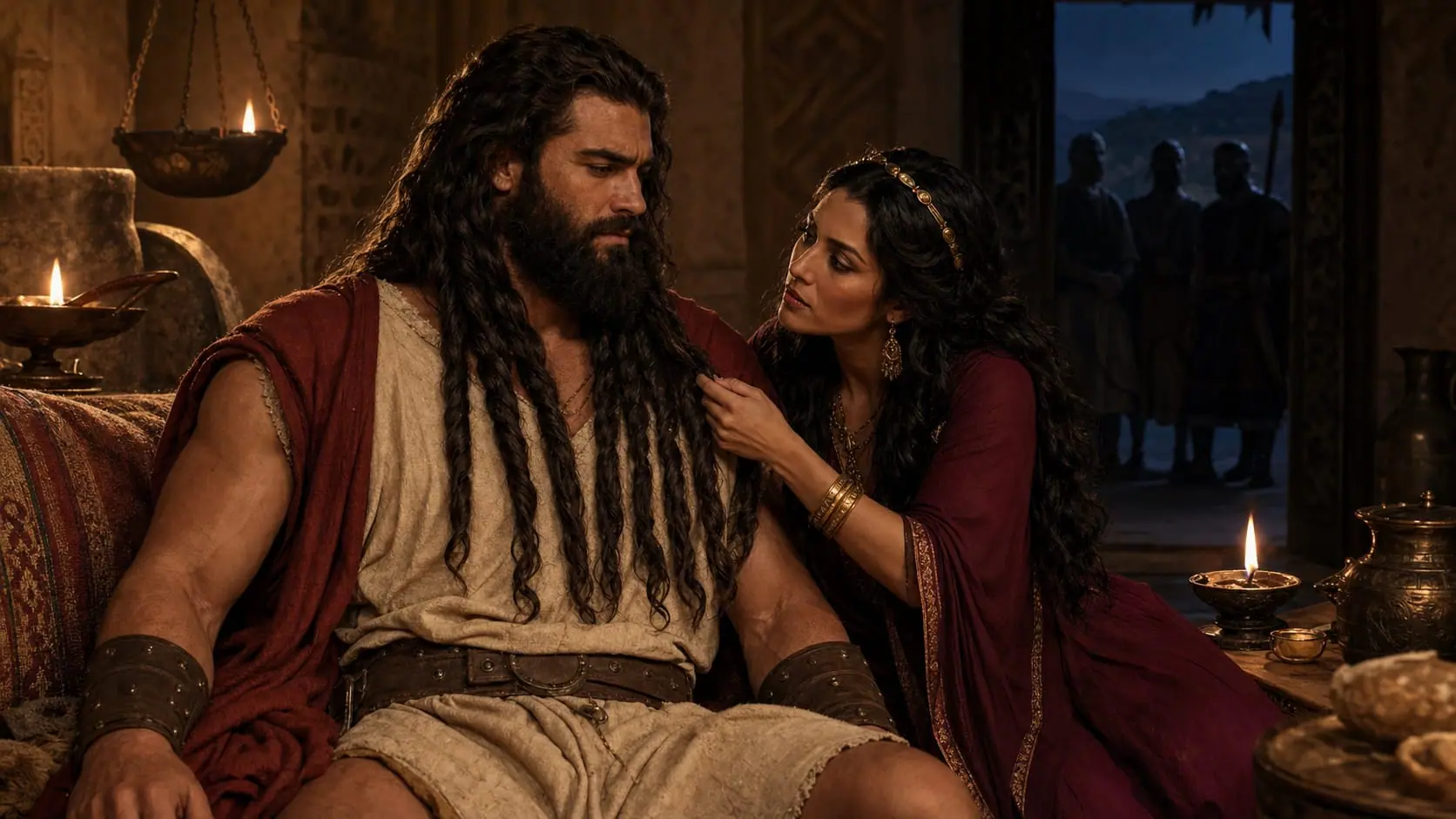
Delilah learns about Samson’s uncut hair, and he is captured after it is shaved while he sleeps. Judges says that Yahweh has left him, something Samson does not know when he tries to escape. His hair later begins to grow, but the account does not say that its length automatically restores his strength.
In the temple, Samson asks God for strength and for revenge for his eyes. He then says he is willing to die with the Philistines and brings the building down. Reading the whole prayer matters: this is a violent ending to a life of conflict, not simply a reassuring story about starting again.
Hebrews 11 names Samson among people of faith; it does not offer his last act as an instruction to seek revenge or harm oneself or others. Romans 12:17–21 explicitly tells Christians not to take personal revenge.
Judges 16:17–31; Hebrews 11:32–34; Romans 12:17–21 · Read the final encounter with Delilah and the temple scene →
A Hebrew name associated with the sun
What does the name Samson mean?
Samson’s mother gives him his name in Judges 13:24. The Hebrew form, Shimshon, is related to shemesh, “sun”; Strong’s concordance gives the meaning “sunlight.” Judges does not explain why his mother chose it. The name’s meaning is a lexical explanation, not a statement that Samson worshiped the sun.
The life arc in Scripture
Samson’s life in brief
Judges 13:2–25
Samson is set apart before birth
Judges 14:1–20
A lion, a riddle, and a wedding at Timnah
Judges 15:1–20
Retaliation and the battle at Lehi
Judges 16:1–3
Samson carries away Gaza’s gates
Judges 16:4–31
Capture, final prayer, and death
Family and companions
Samson’s family and relationships
Judges names Samson’s father but not his mother, his Timnite wife, or the woman at Gaza. Delilah is named, but the text never calls her Samson’s wife.
Manoah
A man from Zorah who seeks instruction about raising the promised child.
Unnamed wife of Manoah
The angel appears to her twice. When Manoah fears they will die, she reasons that God would not have accepted their offering and promised a child if he meant to kill them.
Unnamed woman of Timnah
Threatened by the wedding guests, she reveals Samson’s riddle. Her father later gives her to his companion; the Philistines eventually kill her and her father.
Delilah
Samson loves her. Philistine rulers offer her silver to discover how he can be captured, and she repeatedly questions him.
What the text says—and does not say
Common questions about Samson
Samson was a Nazirite from the womb
His calling began before birth and included the sign that no razor should pass over his head.
Judges 13:5, 7; 16:17His mother is important but unnamed
She receives and understands the announcement, but Judges identifies her only through marriage to Manoah.
Judges 13:2–24Delilah is never called Samson’s wife
Judges says Samson loved her. It does not describe a marriage between them.
Judges 16:4Samson’s age is unknown
The text records twenty years of judging but does not give his age at the beginning or at death.
Judges 15:20; 16:31Follow the biblical accounts