%20scale(.87)'%3e%3cg%20transform='rotate(-3%2032%2034)'%3e%3cpath%20d='M10.5%2019.5c7.65-2.35%2014.8-.45%2021.5%205.7%206.7-6.15%2013.85-8.05%2021.5-5.7v27.2c-7.65-2.15-14.8-.45-21.5%205.1-6.7-5.55-13.85-7.25-21.5-5.1V19.5Z'%20fill='%23fff'%20stroke='%23171528'%20stroke-width='4.5'%20stroke-linejoin='round'/%3e%3cpath%20d='M32%2025.2v26.6'%20stroke='%23171528'%20stroke-width='4'%20stroke-linecap='round'/%3e%3cpath%20d='M17.5%2034.5h9M22%2030v9'%20stroke='%23171528'%20stroke-width='3.75'%20stroke-linecap='round'/%3e%3ccircle%20cx='41.5'%20cy='32.5'%20r='2.5'%20fill='%23171528'/%3e%3ccircle%20cx='46.5'%20cy='38'%20r='2.5'%20fill='%23171528'/%3e%3c/g%3e%3c/g%3e%3c/svg%3e)
Small group4–12 people
Bible Who Am I?
Phone or laptop · no prep
Play nowPlay free online Bible games for church groups, adults, youth, Sunday school, and families—with clear setup, timing, and Scripture follow-up.

A useful group Bible game begins with the room rather than the format. Younger children may need familiar names, visual clues, and shorter rounds. A youth group may want teams, movement, and a visible score. A family may need one activity that lets several ages contribute without turning the evening into a test.
Use the quick-match guide to choose by group size and device, or browse by audience. Every recommendation opens a complete online game with clear rules, practical leader notes, and a route back to Scripture.
Choose in 30 seconds
Games that fit the moment

Host a category-and-points Bible challenge for up to four teams, with scoring, timers, and steals.
Choose a board, set teams and a timer, then let teams select category values, answer, score, pass, or steal.
Name one scorekeeper and explain wrong-answer deductions before the first clue.
Use a high-value missed clue as the transition into a passage discussion.

Explore key events, then arrange story cards in broad biblical order across three difficulty levels.
Explore the event sequence, then arrange story cards in broad biblical order at the chosen difficulty.
Let groups defend the placement of one uncertain card before checking it.
Connect adjacent events and ask what changed between the two moments.

Listen to Bible clues, discuss possible answers, and mark a shared card with three difficulty choices.
Read the current Scripture clue, agree on the answer, and tap the matching square until five marked spaces form a line.
Rotate the person who taps each answer so every child gets a visible turn.
Pause on a completed square to read its reference or recall the related Bible event.

Act out 300 Scripture-connected prompts using quick cards or a timed team game. The host marks successful guesses.
Choose quick cards or team mode. One player privately reads the prompt and acts silently. In team mode, the host taps Guessed It to award a point or Skip to move on.
Use Easy prompts first and skip any card that does not fit your room or players.
After the reveal, read the prompt’s reference and retell the action in its original story.
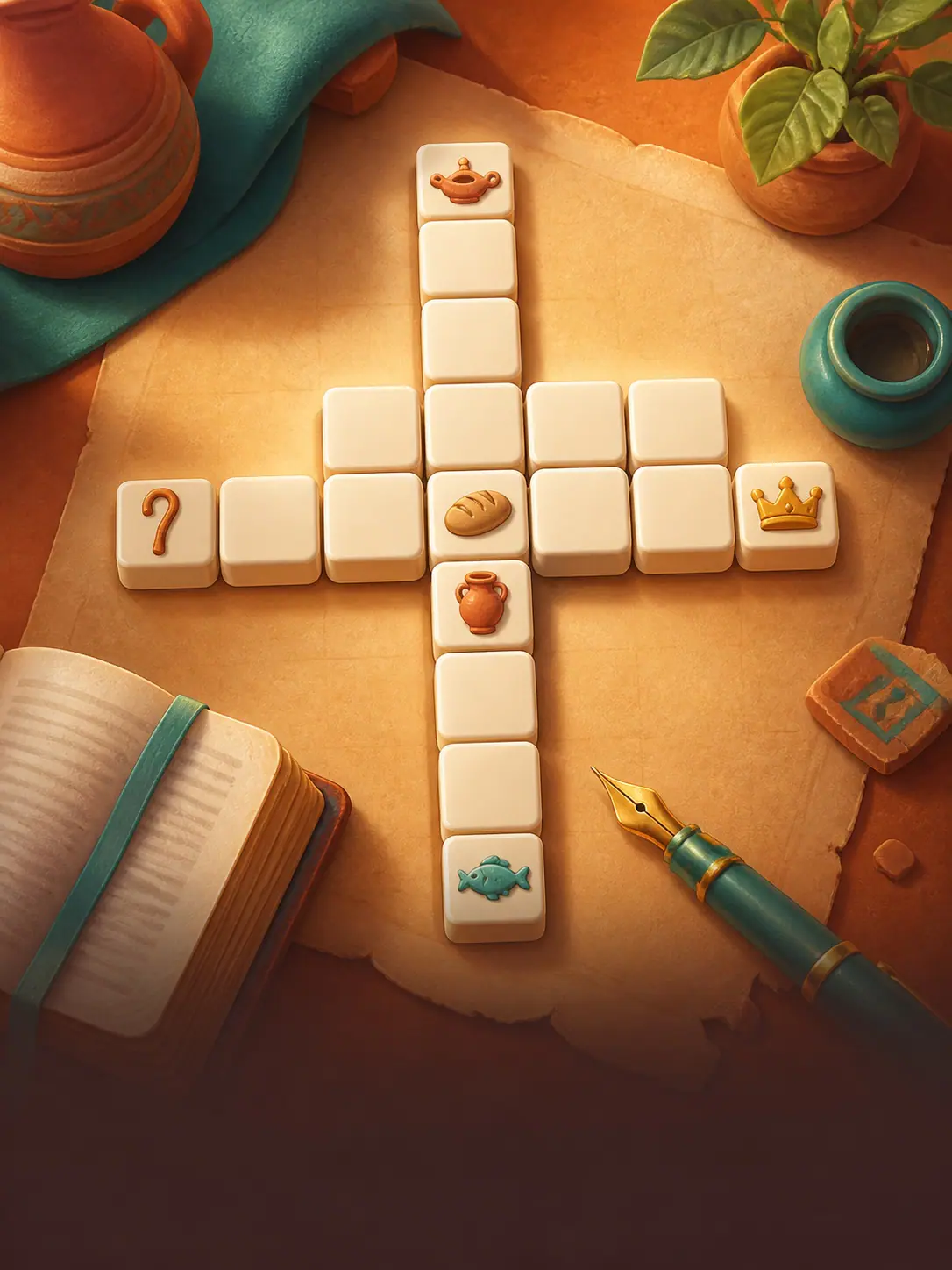
Solve referenced clues across Bible books and themes with easy, medium, and hard grids.
Choose a book or theme, select a difficulty, and solve the referenced across and down clues.
Use pairs for hard grids so the activity stays collaborative rather than silent.
Look up one unfamiliar clue reference and summarize what happens around it.
Practice a verse through missing words, phrase ordering, and active recall in WEB or KJV.
Choose a verse and practice it through missing words, phrase ordering, and active-recall rounds.
Say the complete verse together once before hiding words.
Discuss one key word in the verse and how the surrounding passage uses it.
Find suggestions for your group’s reading needs, room size, pace, and screen setup. Ages, group sizes, and times below are planning guides.
More group settings
Choose medium or hard Quiz, Crossword, or Timeline rounds for 6–20 players, then leave time to discuss the references behind difficult answers.
Use Bible Game Show, Bingo, or Charades on a projector for 10–40+ people. Set teams and turn order before play begins.
Use Who Am I, Memory Game, or an untimed Quiz for 4–12 people when conversation and Scripture follow-up matter more than speed.
Practical answers before you begin.
Yes. The games listed here can be played in a web browser without creating an account. Choose a group page, open a recommended game, and begin with the settings that fit your room.
Yes. Most games work well on phones and tablets. Team formats such as Bible Game Show are easier to host from a laptop connected to a classroom screen or projector.
Start with the youngest participants, the number of people, the available screen, and the time you have. Then choose a game whose pace and difficulty let everyone participate.
Yes. Sunday school and youth-group pages highlight games that work well on a shared screen. Leaders can pause after an answer to read the reference or connect it to the lesson.
Quick puzzles can take five to fifteen minutes. Team formats such as Charades and Bible Game Show can fill twenty to forty-five minutes depending on rounds and discussion.