Weird Bible Facts: 10 Examples & a 40-Fact Library
Read 10 unusual Bible facts with context and references, then explore the 40-fact interactive collection in 10-fact rounds.
Weird, but not out of context
Forty surprising passages worth a closer look.
40 facts in the library
Exact Bible references
Short context notes
No sign-up
Strange and Surprising Bible Facts
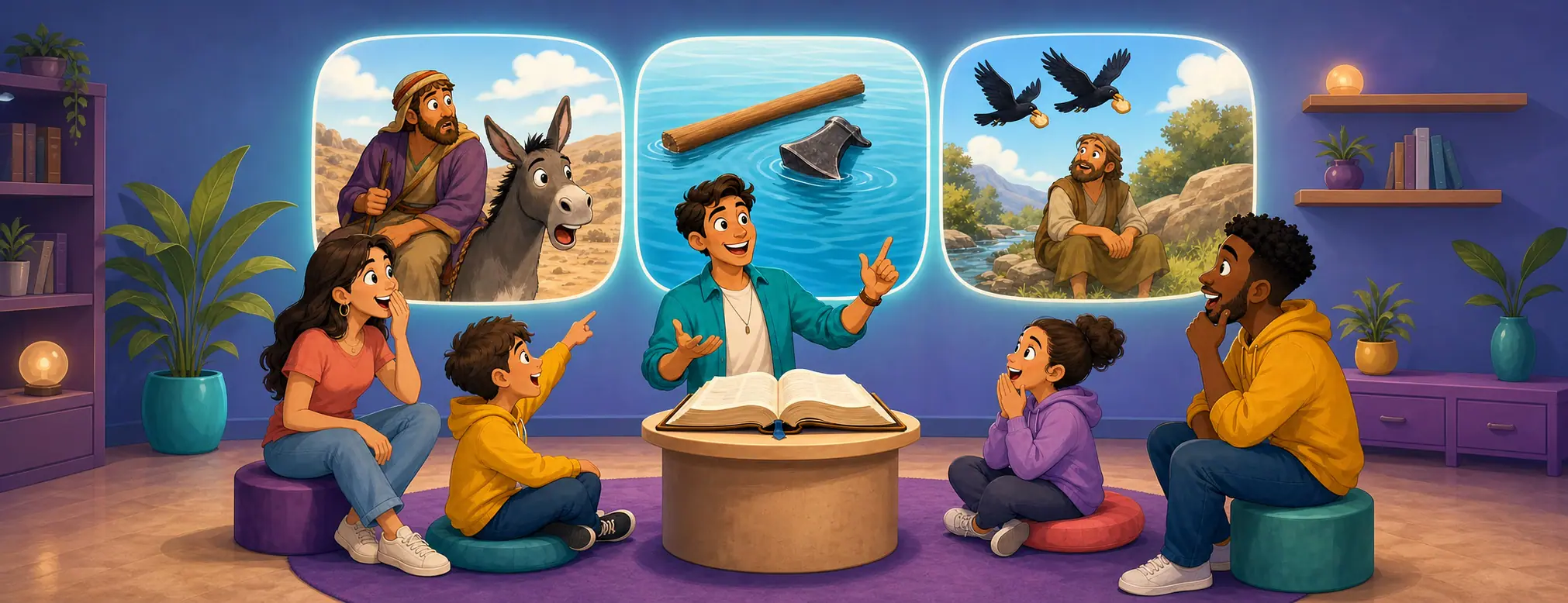
A floating axe head, a ruined belt, and an unexpected interruption.
Why did Elisha make a borrowed tool float? What did Jeremiah’s ruined belt mean? The examples below explain what happens around each unusual detail and give you the passage to read next. For facts about people, places, and manuscripts too, browse the complete Bible Facts collection.
All found in the biblical text
10 weird Bible facts with exact references
Open any of these 10 examples for context and its Bible reference. You can also use Explore Weird Bible Facts to read the interactive collection in 10-fact rounds. Its 40 facts overlap with this article, but do not include every example below.
Unusual sign#1
Gideon asked for dew to soak a fleece while the ground stayed dry—and then asked for the reverse.
What is the context?
Gideon requested two signs before leading Israel against Midian. On the second morning, the fleece was dry while dew covered the ground.
A king’s servants waited outside because they thought he was using the bathroom.
What is the context?
After Ehud left King Eglon’s private room, the servants found the doors locked. They delayed entering because they assumed the king was relieving himself.
A young man fell asleep during Paul’s long speech and fell from a third-story window.
What is the context?
Eutychus fell while Paul continued speaking late into the night. He was taken up dead, but Paul embraced him. Acts later says the people brought the young man in alive and were greatly comforted.
Jeremiah hid a linen belt until it was ruined, then used it as a message for Judah.
What is the context?
Jeremiah first wore the belt, then hid it as instructed. God compared its ruined condition with Judah and Jerusalem’s pride and their refusal to listen to him.
A Philistine idol repeatedly fell face down in front of the ark of God.
What is the context?
The people of Ashdod placed the captured ark in Dagon’s temple. The next morning the statue had fallen, and after it was set up again, it fell with its head and hands broken off.
Modern readers enter stories written in ancient languages and cultures. A detail may be genuinely unusual, but its purpose becomes clearer when you identify the genre, speaker, historical setting, and surrounding passage.
Ancient daily lifeWork, hospitality, travel, warfare, and social customs can be unfamiliar now.
Prophetic symbolismProphets sometimes performed memorable actions to embody their message.
Miracles and visionsThe text presents some events as signs rather than ordinary experience.
Translation wordingOlder English expressions can sound stranger than their meaning in context.
Four kinds of weird Bible facts in the collection
Some details come from everyday life; others belong to a miracle or vision. Notice which kind of passage you are reading before drawing a conclusion from a single sentence.
Unexpected detailsSmall, vivid moments that shortened retellings usually leave out.
Unusual signsObjects and actions used to communicate a larger message.
Animal encountersRavens, fish, donkeys, lions, and other animals in unexpected roles.
Strange miraclesEvents involving food, bodies, tools, weather, and physical signs.
Read before repeating
A strange detail needs more than a one-line caption
First
Check the passage
Read before and after the cited verse. Identify who is acting, whether the scene is history, poetry, vision, parable, or prophetic sign, and how the passage explains itself.
Then
Check the wording
Compare WEB and KJV when an older phrase sounds especially odd. The difference may be an unfamiliar expression, but it can also affect how a detail is understood. Check the explanation rather than assuming every difference is just old-fashioned English.
The complete Weird & Surprising collection follows this same pattern: concise fact, short context, and an exact place to continue reading.
Weird Bible Facts FAQ
Are these weird Bible facts really in Scripture?
Yes. Every example on this page includes an exact Bible reference. The explanation keeps the unusual detail connected to the event, vision, miracle, or prophetic sign in which it appears.
Why are some Bible passages so strange?
The Bible includes ancient customs, symbolic prophetic actions, visions, miracles, humor, conflict, and details that feel unexpected to modern readers. Genre and surrounding context help explain what a passage is doing.
Do WEB and KJV describe every strange detail the same way?
Not always. Some differences are older English expressions; others affect how a detail is understood. For example, the KJV describes the fourth figure in Daniel’s furnace as “like the Son of God,” while the WEB says “like a son of the gods.” These are the king’s words. Read the selected translation and its context rather than treating the two phrases as identical.
Are weird Bible facts appropriate for children?
Some are suitable for younger readers, but others involve violence, death or adult situations. An adult should read the facts before sharing them with children. Topic labels describe the subject; they are not age ratings.
How many weird Bible facts are in the collection?
This article explains 10 unusual Bible passages. The interactive Weird & Surprising topic contains 40 sourced facts, but its selection differs from this article. The complete Bible Facts library contains 310 facts across six topics.
Forty surprising passages
Ready to discover another weird Bible fact?
Explore unusual details one at a time, reveal the context, and follow the exact Scripture reference—free, with no sign-up.
Continue in context
Explore the surprising details in context
Use these unusual details as an invitation to see the wider text, its structure, and related Bible knowledge.
'%20fill-opacity='0.4'/%3e%3cdefs%3e%3cradialGradient%20id='paint0_radial_0_4'%20cx='0'%20cy='0'%20r='1'%20gradientTransform='matrix(6.50003%20-430.975%20892.955%2011.8475%20814.5%20695)'%20gradientUnits='userSpaceOnUse'%3e%3cstop%20offset='0.278846'%20stop-color='%23300E7D'/%3e%3cstop%20offset='1'%20stop-color='%2391229B'/%3e%3c/radialGradient%3e%3c/defs%3e%3c/svg%3e)
%20scale(.87)'%3e%3cg%20transform='rotate(-3%2032%2034)'%3e%3cpath%20d='M10.5%2019.5c7.65-2.35%2014.8-.45%2021.5%205.7%206.7-6.15%2013.85-8.05%2021.5-5.7v27.2c-7.65-2.15-14.8-.45-21.5%205.1-6.7-5.55-13.85-7.25-21.5-5.1V19.5Z'%20fill='%23fff'%20stroke='%23171528'%20stroke-width='4.5'%20stroke-linejoin='round'/%3e%3cpath%20d='M32%2025.2v26.6'%20stroke='%23171528'%20stroke-width='4'%20stroke-linecap='round'/%3e%3cpath%20d='M17.5%2034.5h9M22%2030v9'%20stroke='%23171528'%20stroke-width='3.75'%20stroke-linecap='round'/%3e%3ccircle%20cx='41.5'%20cy='32.5'%20r='2.5'%20fill='%23171528'/%3e%3ccircle%20cx='46.5'%20cy='38'%20r='2.5'%20fill='%23171528'/%3e%3c/g%3e%3c/g%3e%3c/svg%3e)