%20scale(.87)'%3e%3cg%20transform='rotate(-3%2032%2034)'%3e%3cpath%20d='M10.5%2019.5c7.65-2.35%2014.8-.45%2021.5%205.7%206.7-6.15%2013.85-8.05%2021.5-5.7v27.2c-7.65-2.15-14.8-.45-21.5%205.1-6.7-5.55-13.85-7.25-21.5-5.1V19.5Z'%20fill='%23fff'%20stroke='%23171528'%20stroke-width='4.5'%20stroke-linejoin='round'/%3e%3cpath%20d='M32%2025.2v26.6'%20stroke='%23171528'%20stroke-width='4'%20stroke-linecap='round'/%3e%3cpath%20d='M17.5%2034.5h9M22%2030v9'%20stroke='%23171528'%20stroke-width='3.75'%20stroke-linecap='round'/%3e%3ccircle%20cx='41.5'%20cy='32.5'%20r='2.5'%20fill='%23171528'/%3e%3ccircle%20cx='46.5'%20cy='38'%20r='2.5'%20fill='%23171528'/%3e%3c/g%3e%3c/g%3e%3c/svg%3e)
The quick answer
What happened in the Abraham and Isaac story?
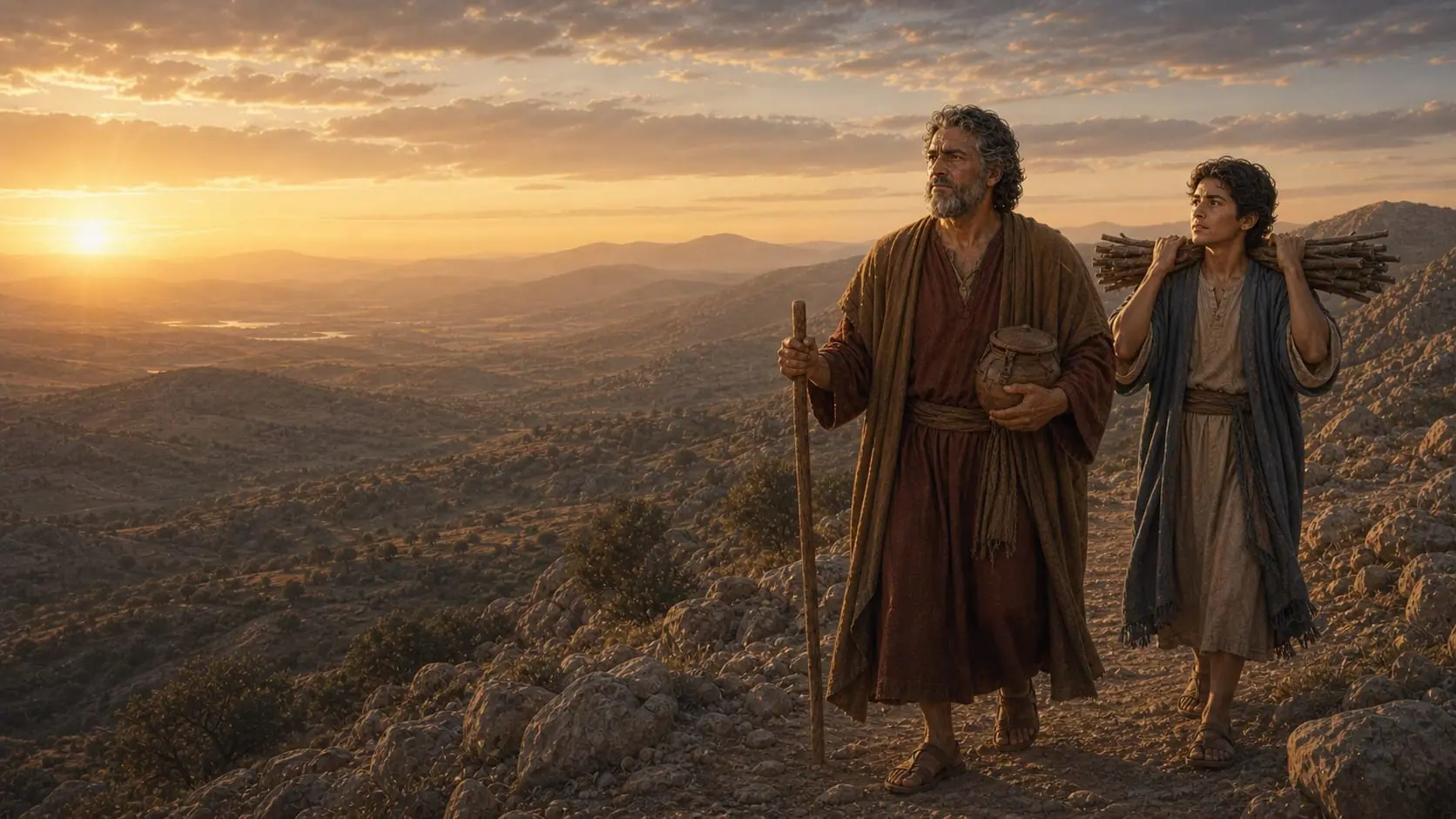
Genesis 22 says that God tested Abraham by telling him to take Isaac, the son he loved, to the land of Moriah and offer him there. Abraham traveled with Isaac, two servants, and a donkey. On the third day he saw the place, left the servants behind, and continued with Isaac.
Isaac carried the wood and asked where the lamb was. Abraham answered that God would provide. After Abraham built the altar and bound Isaac, Yahweh’s angel stopped him from killing his son. Abraham found a ram caught in a thicket and offered it instead. He named the place “Yahweh Will Provide,” and the covenant blessing was reaffirmed.
The full story
The Test, the Mountain, and the Ram
God tests Abraham
Genesis introduces the episode as a test of Abraham. God called his name, and Abraham answered, “Here I am.” God told him to take Isaac—the son whom he loved—to the land of Moriah and offer him on a mountain God would identify.
Isaac was the child through whom God had said Abraham’s offspring would be named. The command therefore placed the promised future and Abraham’s trust in God in a painful tension. Genesis 21:12; 22:1–2
After these things, God tested Abraham, and said to him, ‘Abraham!’ He said, ‘Here I am.’ He said, ‘Now take your son, your only son, Isaac, whom you love, and go into the land of Moriah. Offer him there as a burnt offering on one of the mountains which I will tell you of.’
The journey to Moriah
Abraham rose early, saddled his donkey, split wood for the offering, and left with Isaac and two young men. Genesis does not record a discussion with Sarah or describe what Abraham felt during the journey. It keeps attention on his actions and the words spoken on the mountain.
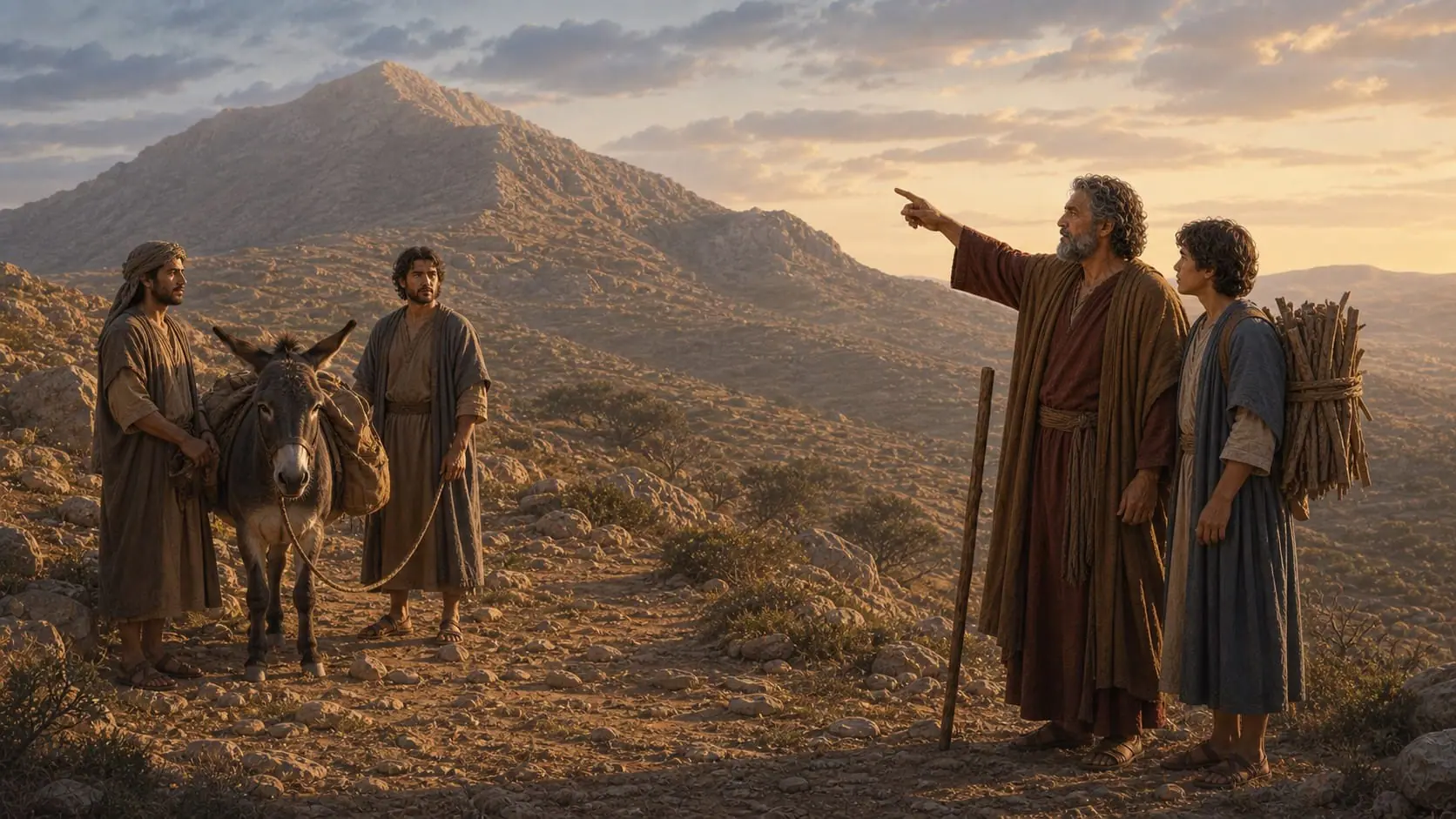
On the third day Abraham saw the place from far away. He told the servants to remain with the donkey while he and the boy went to worship. His words used the plural: “We will worship, and come back to you.” Genesis 22:3–5
“Where is the lamb?”
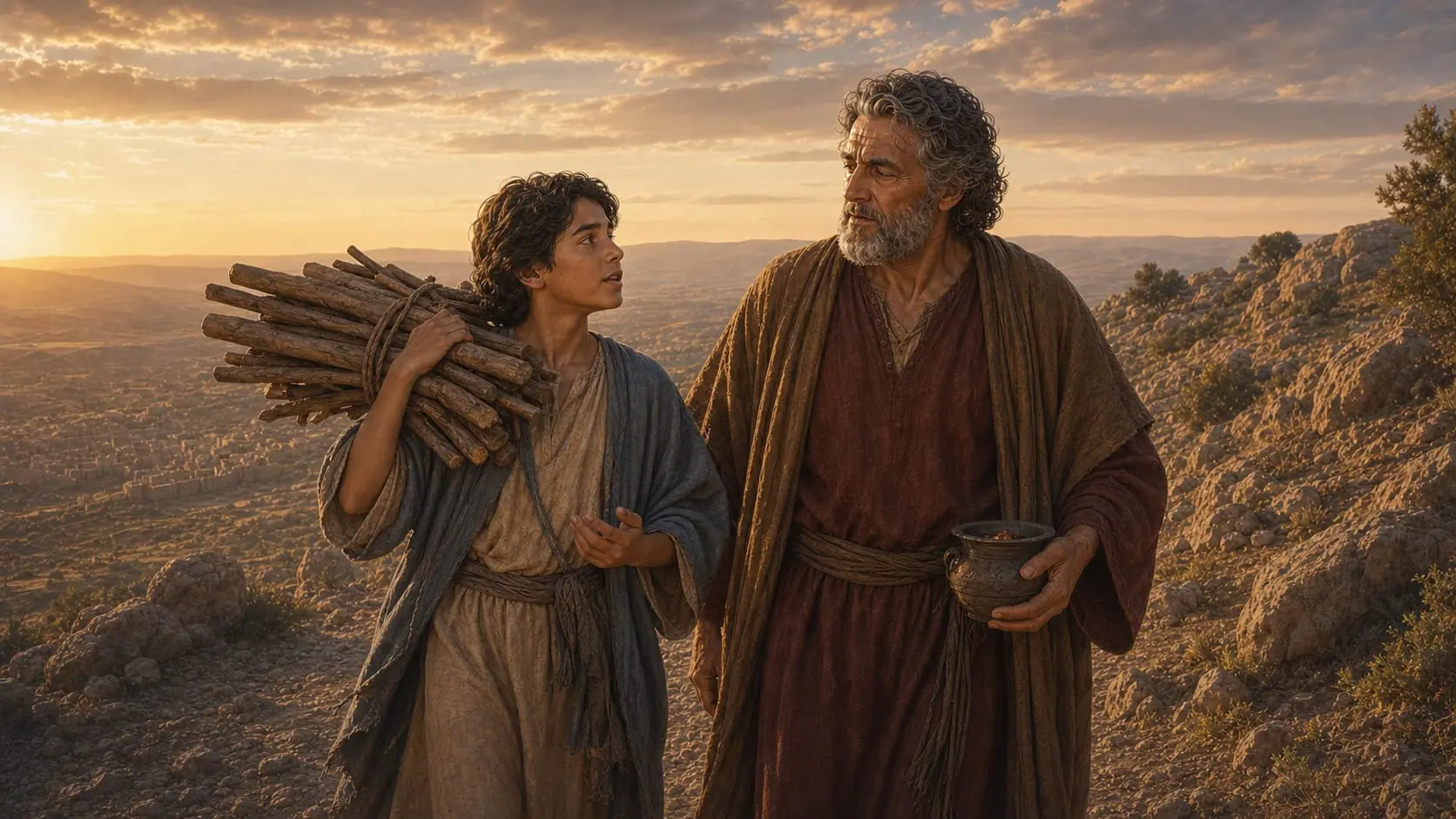
Abraham placed the offering wood on Isaac. Abraham carried the fire and the knife, and father and son went together. Isaac called, “My father?” Abraham answered, “Here I am, my son.”
Isaac saw the fire and wood but no animal. Abraham replied that God would provide the lamb. Genesis repeats that the two continued together, holding Isaac’s question and Abraham’s answer at the center of the story. Genesis 22:6–8
Isaac spoke to Abraham his father, and said, ‘My father?’ He said, ‘Here I am, my son.’ He said, ‘Here is the fire and the wood, but where is the lamb for a burnt offering?’ Abraham said, ‘God will provide himself the lamb for a burnt offering, my son.’ So they both went together.
The angel stops Abraham
At the place God had shown him, Abraham built an altar, arranged the wood, bound Isaac, and laid him on it. Abraham took the knife to kill his son, but Yahweh’s angel called his name twice from the sky.
The command was immediate and clear: Abraham must not lay his hand on the boy or do anything to him. Isaac was not killed. The angel declared that the test had shown Abraham’s fear of God because he had not withheld his son. Genesis 22:9–12
Yahweh’s angel called to him out of the sky, and said, ‘Abraham, Abraham!’ He said, ‘Here I am.’ He said, ‘Don’t lay your hand on the boy or do anything to him. For now I know that you fear God, since you have not withheld your son, your only son, from me.’
A ram is provided instead of Isaac
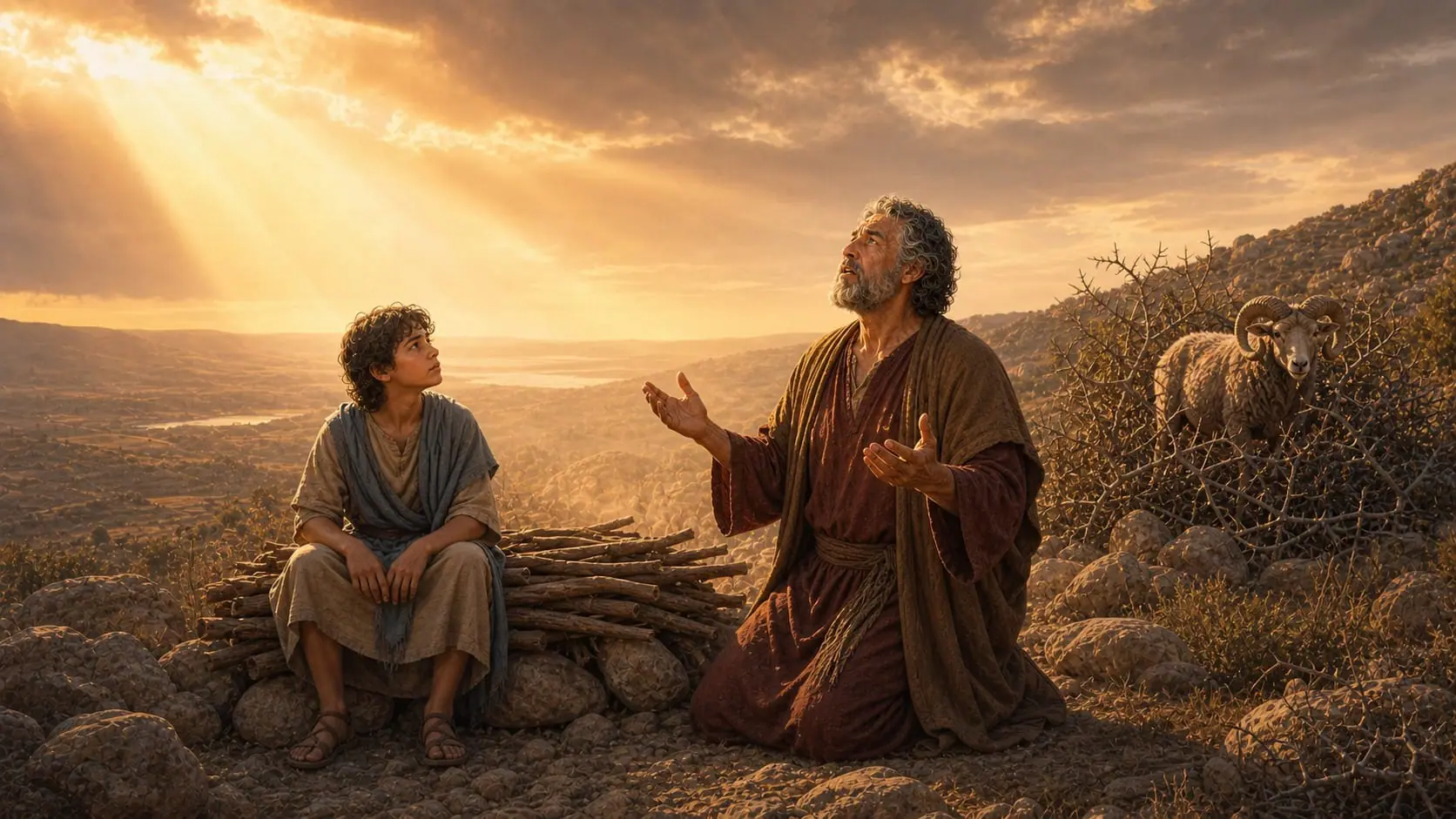
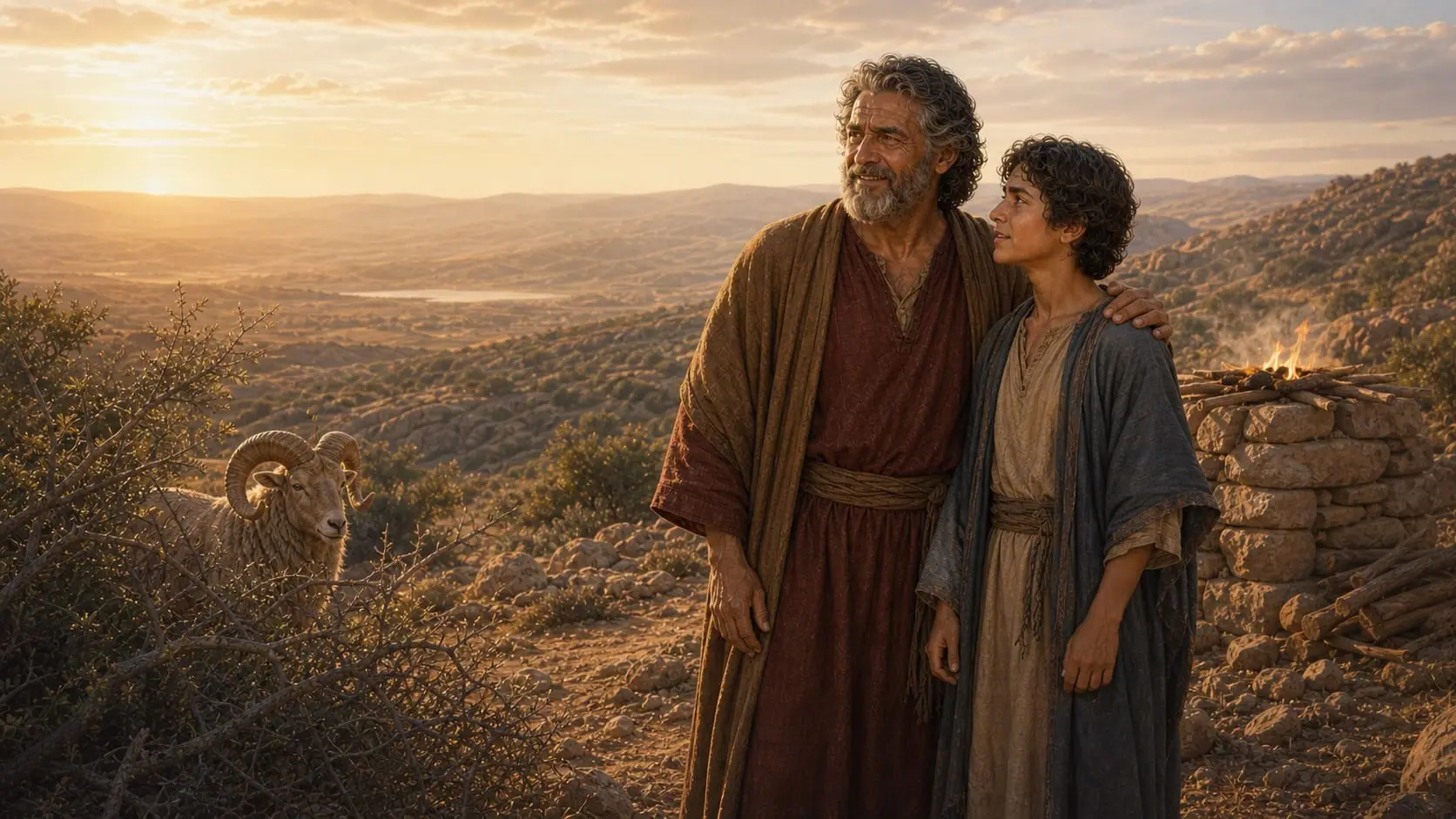
Abraham looked up and saw a ram behind him, caught by its horns in a thicket. He took the ram and offered it as a burnt offering instead of his son. Isaac, who had been bound on the altar, was spared.
Abraham named the place “Yahweh Will Provide.” Yahweh’s angel then reaffirmed the blessing of numerous offspring and blessing for all nations. Abraham returned to the servants, and the group went to Beersheba. Genesis 22:13–19
Abraham lifted up his eyes, and looked, and saw that behind him was a ram caught in the thicket by his horns. Abraham went and took the ram, and offered him up for a burnt offering instead of his son. Abraham called the name of that place ‘Yahweh Will Provide’. As it is said to this day, ‘On Yahweh’s mountain, it will be provided.’
A difficult question
Why Did God Ask Abraham to Sacrifice Isaac?
Genesis answers first by calling the event a test. Isaac was both Abraham’s beloved son and the named bearer of the promise. Abraham was therefore asked to entrust even the promised future to the God who had given it. The story reaches its decisive point when God stops the act and provides another offering.
The words “your only son” do not erase Ishmael from Abraham’s family. Genesis has already told of Ishmael’s birth and God’s promise to bless him. Isaac is the son God specifically names as the one with whom he will establish the covenant. Genesis 16:15; 17:19–21; 22:2
Hebrews 11 interprets Abraham’s action as faith that God could raise the dead. James 2 uses it to show faith working together with deeds. Compare those passages in the guide to Bible verses about faith, trust, and faithful action. Neither passage turns Genesis 22 into a general command: it is a singular biblical test, and Isaac is spared. Hebrews 11:17–19; James 2:21–23
This story is not permission to harm a child in God’s name. Elsewhere, Deuteronomy explicitly condemns burning sons and daughters as offerings to gods. Deuteronomy 12:31
By faith, Abraham, being tested, offered up Isaac. Yes, he who had gladly received the promises was offering up his only born son, to whom it was said, ‘Your offspring will be accounted as from Isaac,’ concluding that God is able to raise up even from the dead. Figuratively speaking, he also did receive him back from the dead.
What the Bible does not say
How Old Was Isaac When Abraham Was Told to Sacrifice Him?
Genesis 22 never gives Isaac’s age. He could carry the wood and could speak clearly with Abraham, but those details only show that he was not an infant. The word translated “boy” or “young man” can cover a range of ages and cannot settle the question by itself.
Genesis 23 gives Sarah’s age at death as 127, but it does not say how much time passed between this test and her death. Subtracting her age at Isaac’s birth cannot establish his age on the mountain. The illustrations on this page imagine his appearance; they are not evidence of how old he was.
The Lord will provide
What Does Jehovah Jireh Mean?
“Jehovah Jireh” is the familiar traditional English form of the name in Genesis 22:14. The World English Bible renders it “Yahweh Will Provide” and also notes “Yahweh-Jireh” or “Yahweh-Seeing.” The name remembers that a ram was provided when Isaac was spared.
Abraham gives the place this name after finding the ram. The saying attached to the location is, “On Yahweh’s mountain, it will be provided.” Genesis 22:13–14
Place and tradition
Where Was Mount Moriah?
Genesis 22:2 names the land of Moriah and says that God would show Abraham one of its mountains. It does not name a city or give a more precise location.
Second Chronicles 3:1 names Mount Moriah in Jerusalem as the place where Solomon began building the temple. That passage is the basis for connecting Abraham’s journey with the later temple site. Genesis 22:2–4; 2 Chronicles 3:1