%20scale(.87)'%3e%3cg%20transform='rotate(-3%2032%2034)'%3e%3cpath%20d='M10.5%2019.5c7.65-2.35%2014.8-.45%2021.5%205.7%206.7-6.15%2013.85-8.05%2021.5-5.7v27.2c-7.65-2.15-14.8-.45-21.5%205.1-6.7-5.55-13.85-7.25-21.5-5.1V19.5Z'%20fill='%23fff'%20stroke='%23171528'%20stroke-width='4.5'%20stroke-linejoin='round'/%3e%3cpath%20d='M32%2025.2v26.6'%20stroke='%23171528'%20stroke-width='4'%20stroke-linecap='round'/%3e%3cpath%20d='M17.5%2034.5h9M22%2030v9'%20stroke='%23171528'%20stroke-width='3.75'%20stroke-linecap='round'/%3e%3ccircle%20cx='41.5'%20cy='32.5'%20r='2.5'%20fill='%23171528'/%3e%3ccircle%20cx='46.5'%20cy='38'%20r='2.5'%20fill='%23171528'/%3e%3c/g%3e%3c/g%3e%3c/svg%3e)
The quick answer
What happened in the Birth of Jesus Bible story?
Matthew and Luke present Jesus’ conception as the work of the Holy Spirit. Luke records Gabriel’s announcement to Mary; Matthew records an angel reassuring Joseph in a dream. Luke then follows Mary and Joseph from Nazareth to Bethlehem, where Mary gives birth, wraps Jesus in cloth, and lays him in a feeding trough because there is no room in the lodging place.
Luke describes shepherds visiting after an angel announces the birth. Matthew describes a separate visit by magi, Herod’s threat, and the family’s flight to Egypt. Both accounts place Jesus’ childhood in Nazareth. These events are often called the Nativity or Christmas story, although neither Gospel gives a December date.
The date Scripture gives—and does not give
When Was Jesus Born?
The Bible does not provide an exact date for Jesus’ birth. Matthew places it during Herod the Great’s reign, whose end is usually dated to 4 BC. Luke associates the journey to Bethlehem with a registration under Quirinius, whose well-attested census took place in AD 6–7. That gap is a real historical question, not a precise birthday calculation.
Luke 1:5 also begins during Herod’s reign. Suggestions of an earlier registration or a different translation of Luke 2:2 remain disputed; see New Testament scholar Daniel Wallace’s discussion of the census chronology. The evidence does not establish one uncontested modern calendar year.
December 25 is the traditional date of Christmas, not a date stated in Matthew or Luke. Details such as shepherds being outdoors at night have inspired seasonal proposals, but they cannot establish a precise birthday.
Bethlehem, not Nazareth
Where Was Jesus Born?
Both Matthew and Luke identify Bethlehem in Judea as Jesus’ birthplace. Luke calls it David’s city and says Joseph went there because he belonged to David’s house and family line. Matthew connects Bethlehem with the ruler promised in Micah 5:2.
Jesus was later raised in Nazareth in Galilee. “Jesus of Nazareth” describes the place where he grew up, not the place where he was born.
The full story
The Birth and Early Childhood of Jesus
The following scenes identify their Gospel sources. Matthew and Luke do not provide a single, fully synchronized itinerary of the family’s early years.
Gabriel announces that Mary will bear Jesus
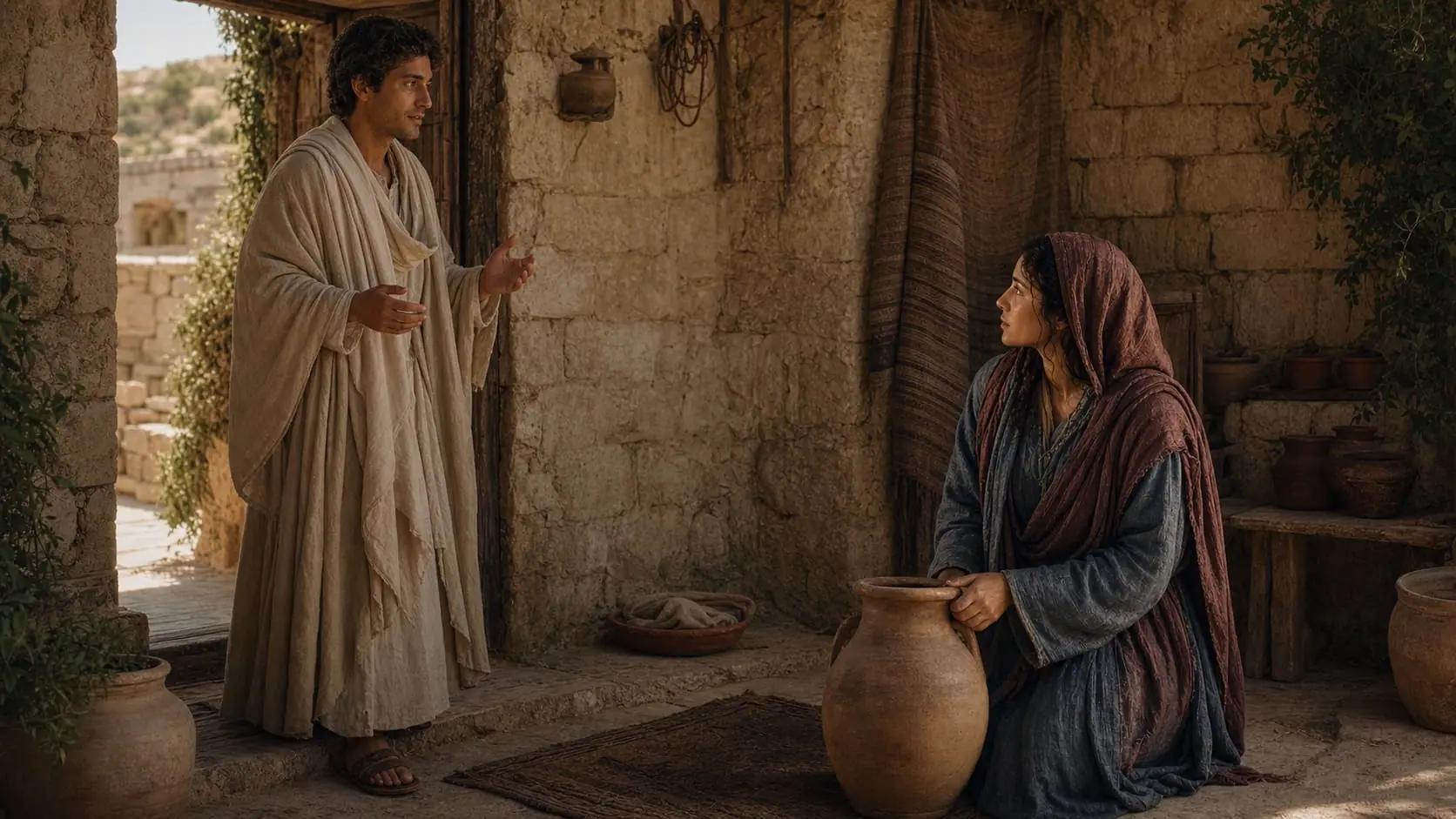
In Nazareth, the angel Gabriel came to Mary, a virgin pledged to Joseph. Gabriel told her not to be afraid: she had found favor with God and would bear a son named Jesus. He would be called great, receive David’s throne, and reign forever.
Mary asked how this could happen. Gabriel answered that the Holy Spirit would come upon her and that the holy child would be called the Son of God. Mary responded with willing trust. Luke 1:26–38
The angel said to her, “Don’t be afraid, Mary, for you have found favor with God. Behold, you will conceive in your womb and give birth to a son, and shall name him ‘Jesus.’ He will be great and will be called the Son of the Most High. The Lord God will give him the throne of his father David, and he will reign over the house of Jacob forever. There will be no end to his Kingdom.”
Joseph receives an answer in a dream
When Joseph learned Mary was pregnant, he planned to end their betrothal quietly rather than expose her to public disgrace. An angel of the Lord appeared to him in a dream and told him not to fear taking Mary as his wife, because the child had been conceived by the Holy Spirit.
Joseph was told to name the child Jesus, “for it is he who shall save his people from their sins.” Matthew connects the event with Isaiah’s promise of Immanuel—“God with us.” Joseph obeyed. Matthew 1:18–25
Mary and Joseph travel to Bethlehem
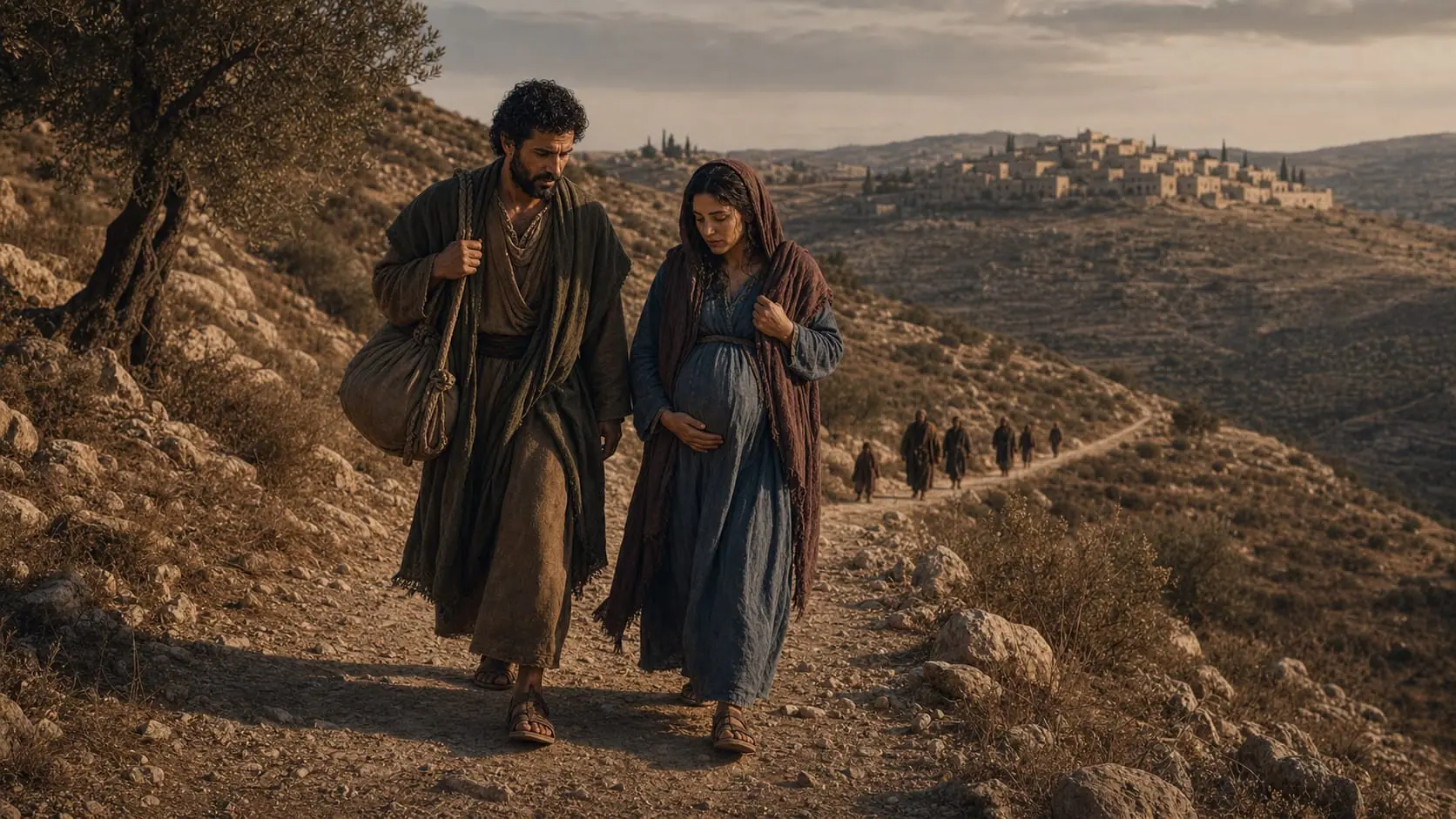
Luke says Caesar Augustus ordered a registration, and Joseph traveled from Nazareth to Bethlehem because he was descended from David. Mary went with him while expecting Jesus. Scripture does not say they traveled on a donkey, even though that detail often appears in Nativity art.
The journey brings Mary and Joseph from their Galilean home to the town named by both Gospel birth accounts. Luke 2:1–5
Jesus is born and laid in a feeding trough
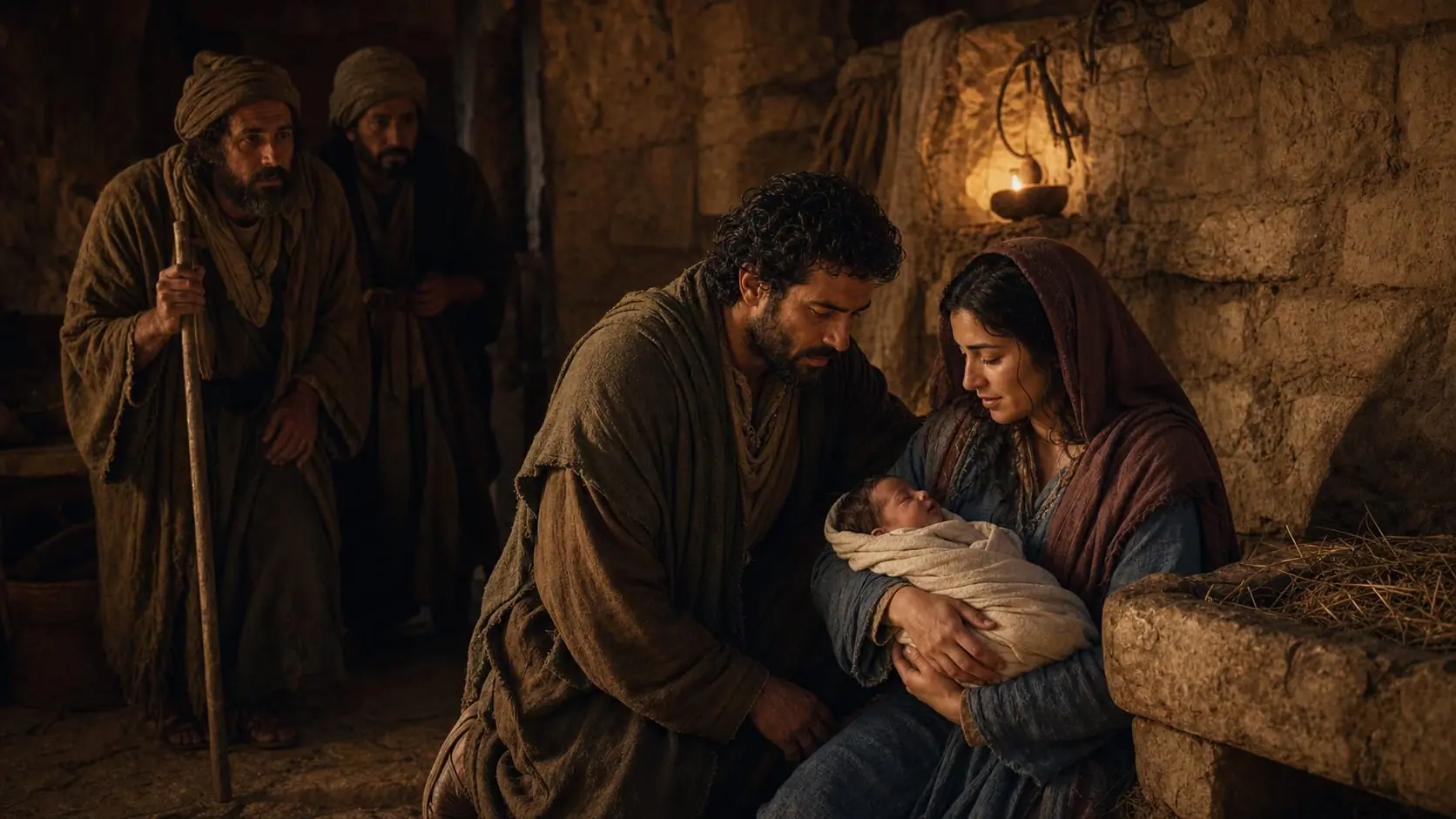
While they were in Bethlehem, the time came for Mary to give birth. She bore her firstborn son, wrapped him in cloth, and laid him in a feeding trough because there was no room for them in the lodging place.
Luke mentions no innkeeper and does not explicitly describe a detached wooden stable. The Greek word translated “inn” in the WEB can also mean a lodging or guest room. Luke names the feeding trough but leaves the building’s layout undescribed. Luke 2:6–7
She gave birth to her firstborn son. She wrapped him in bands of cloth and laid him in a feeding trough, because there was no room for them in the inn.
Angels announce good news to shepherds
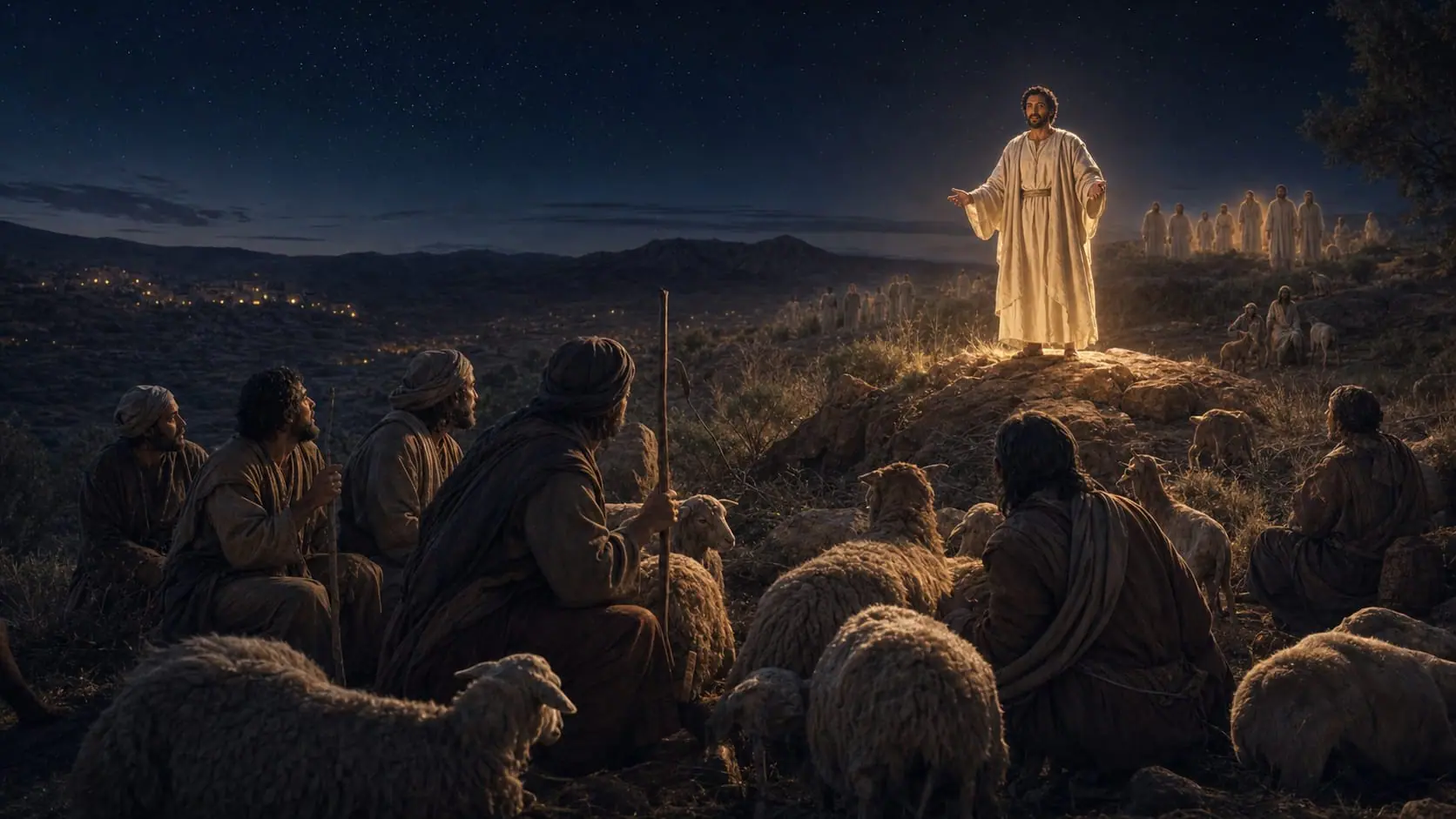
That night, shepherds were watching their flock in nearby fields. An angel of the Lord appeared, and God’s glory shone around them. The frightened shepherds heard good news: a Savior, Christ the Lord, had been born in David’s city. Their sign would be a baby wrapped in cloth and lying in a feeding trough.
A heavenly army praised God. The shepherds hurried to Bethlehem, found Mary, Joseph, and the baby, and then spread the message they had received. They returned praising God. Luke 2:8–20
The angel said to them, “Don’t be afraid, for behold, I bring you good news of great joy which will be to all the people. For there is born to you today, in David’s city, a Savior, who is Christ the Lord. This is the sign to you: you will find a baby wrapped in strips of cloth, lying in a feeding trough.”
Simeon and Anna welcome Jesus at the temple
Jesus was circumcised and named on the eighth day. After the prescribed purification period, Mary and Joseph brought him to Jerusalem to present him to the Lord and offered a pair of birds, as the law allowed. Luke places these actions within Israel’s worship and law, not a later Christian ceremony. Luke 2:21–24; Leviticus 12:1–8
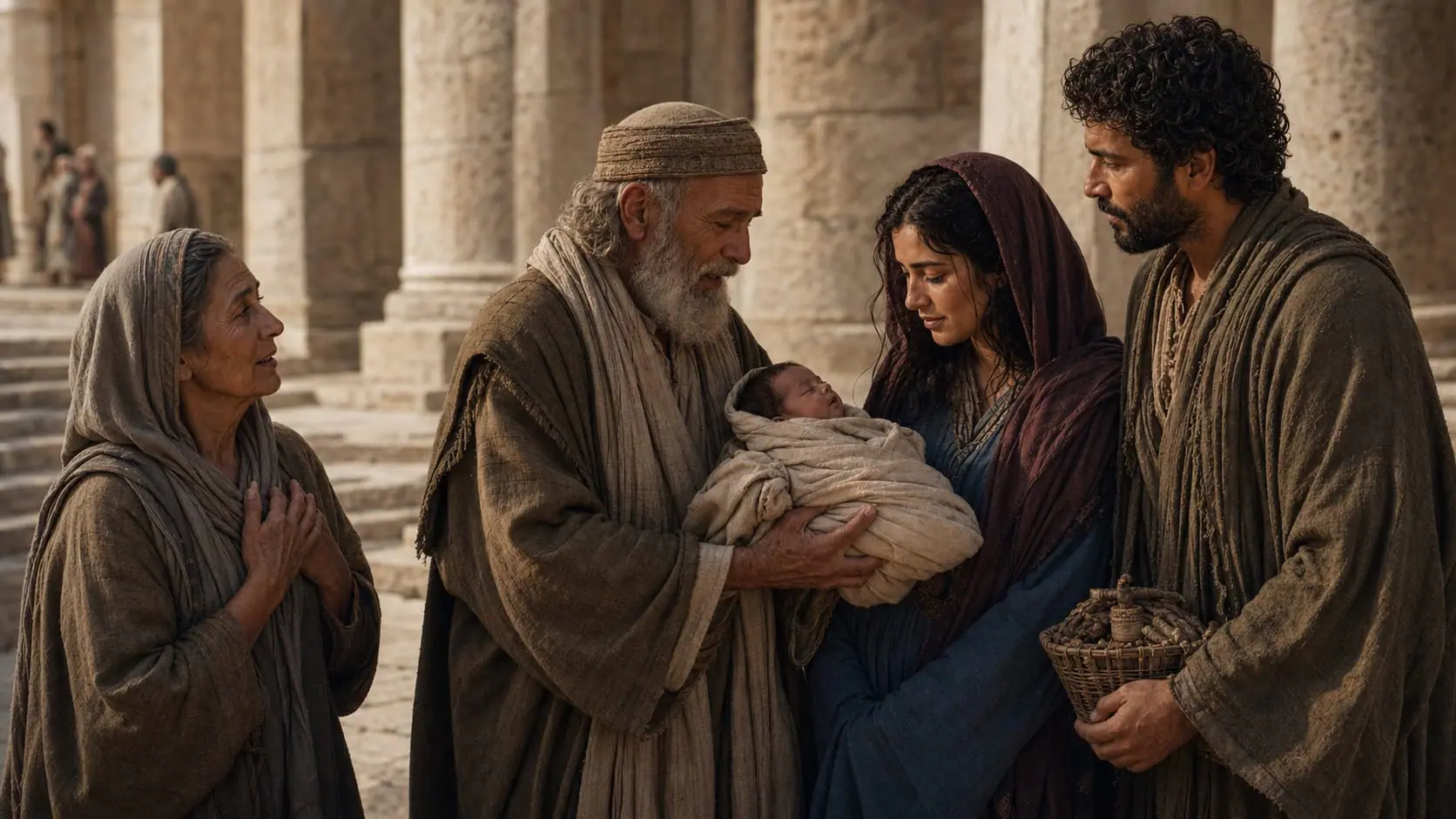
Simeon, guided by the Spirit, took Jesus in his arms and praised God. He called the child God’s salvation, a light for the nations, and Israel’s glory. Luke describes Simeon as righteous and devout, not as a priest.
The prophet Anna also came near, gave thanks to God, and spoke about the child to those awaiting Jerusalem’s redemption. Their words widen the story beyond one family or one town. Luke 2:21–38
then he received him into his arms and blessed God, and said, “Now you are releasing your servant, Master, according to your word, in peace; for my eyes have seen your salvation, which you have prepared before the face of all peoples; a light for revelation to the nations, and the glory of your people Israel.”
Two visits, two Gospel accounts
The Shepherds, Wise Men, and Star of Bethlehem
Luke’s shepherds find the newborn in a feeding trough after the nighttime announcement. Matthew’s magi come from the east to Jerusalem because they have seen the star of the king of the Jews. After meeting Herod, they head toward Bethlehem, and Matthew describes the star going before them to the child. The text does not describe a continuous star-led journey all the way from their homeland.
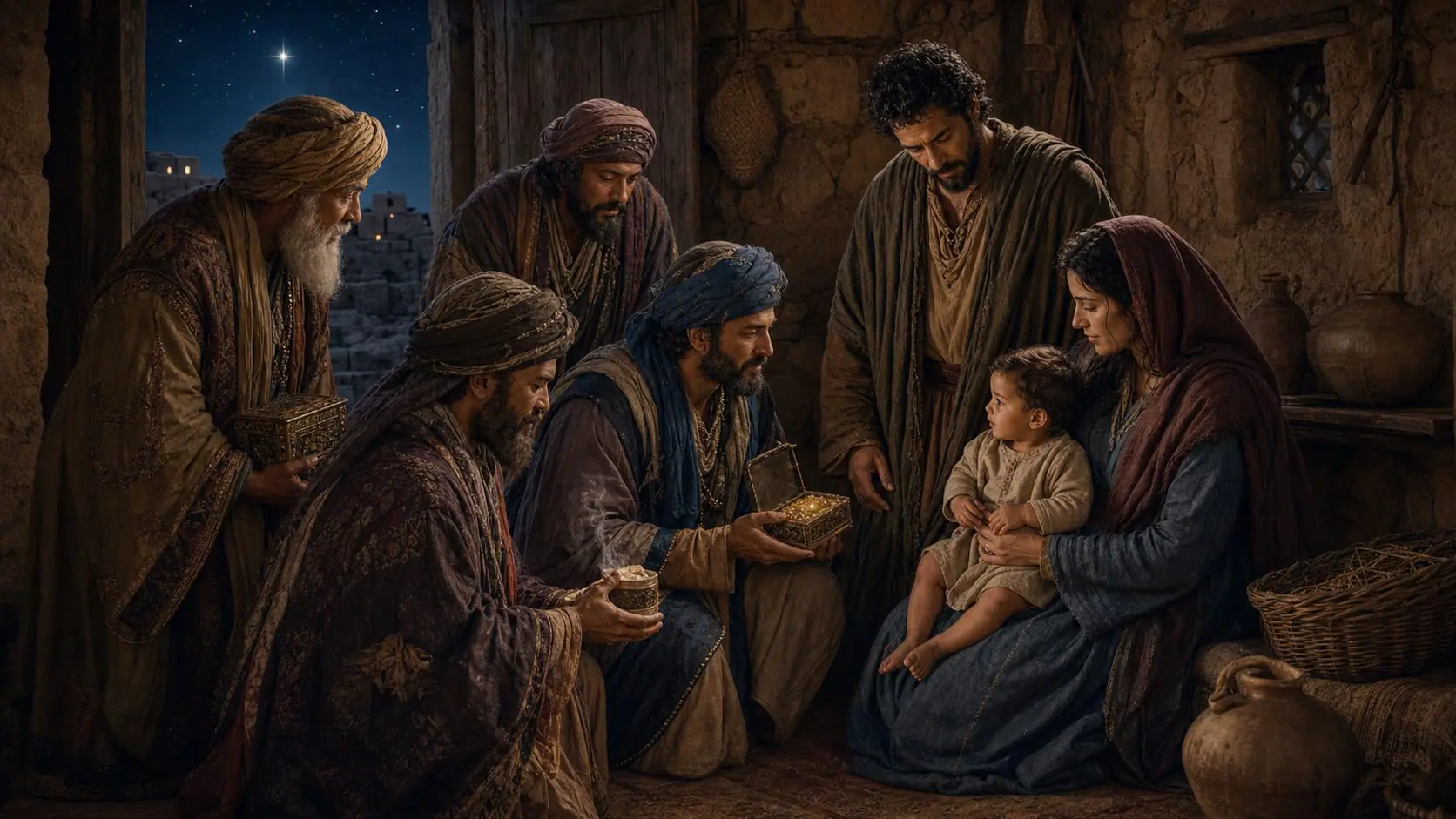
The magi enter a house and see the child with Mary. Matthew gives neither Jesus’ exact age at this visit nor the interval since the shepherds’ visit. It does not place the magi at the manger with the shepherds, call them kings, or give their number. Three kinds of gifts do not establish three visitors.
The magi worship Jesus and give gifts
The star filled the magi with joy and led them to the child. They fell down, worshiped him, and opened their treasures. Warned in a dream not to return to Herod, they went home by another route. Matthew 2:1–12
Matthew does not explain what kind of astronomical event the Star of Bethlehem was. Comets, planetary conjunctions, supernovae, and a unique divine sign have all been proposed, but none is identified by the passage itself.
When they saw the star, they rejoiced with exceedingly great joy. They came into the house and saw the young child with Mary, his mother, and they fell down and worshiped him. Opening their treasures, they offered to him gifts: gold, frankincense, and myrrh.
Joseph takes the child to Egypt
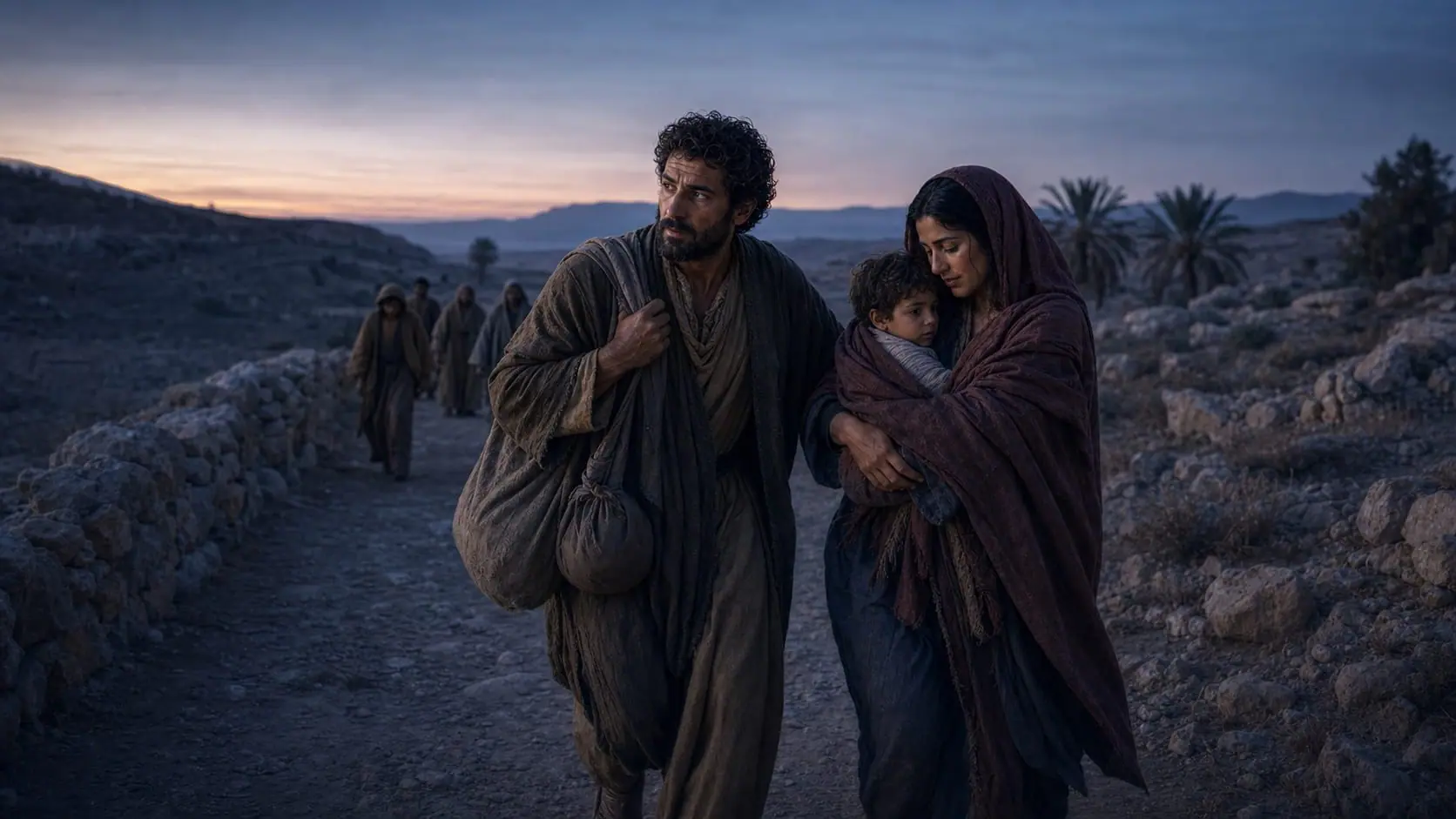
After the magi left, an angel warned Joseph in a dream that Herod would seek the child’s life. Joseph rose during the night and took Jesus and Mary to Egypt. Herod ordered the killing of boys aged two and under in and around Bethlehem, using the time he had learned from the magi. That age limit does not establish that Jesus was exactly two.
After Herod’s death, an angel told Joseph to return to Israel. Joseph feared going to Judea because Archelaus ruled there. Warned again in a dream, he went to Galilee and settled in Nazareth. Matthew 2:13–23
Two Gospel accounts
The Birth of Jesus in Matthew and Luke
Matthew 1–2
Matthew begins with Jesus’ genealogy, tells the story mainly through Joseph’s dreams, connects events to prophetic texts, and follows the magi, Herod’s hostility, the flight to Egypt, and the family’s settlement in Nazareth.
Luke 1–2
Luke begins with the intertwined announcements and births of John the Baptist and Jesus. It gives Mary a central voice and includes the registration, Bethlehem journey, feeding trough, shepherds, Jesus’ presentation, Simeon, and Anna.
Both accounts describe Mary’s virginal conception, Jesus’ birth in Bethlehem, and his upbringing in Nazareth. Their travel narratives differ in detail: Luke 2:39 moves from the temple visit to the family’s return to Nazareth, without narrating the magi or Egypt. Matthew describes Egypt and the move to Nazareth, without narrating the temple visit. Neither supplies a timetable that places every episode of the other account.
Ready to test the details? Play Christmas Bible Trivia for questions on Matthew and Luke, or continue through Jesus’ ministry in Jesus Trivia.