%20scale(.87)'%3e%3cg%20transform='rotate(-3%2032%2034)'%3e%3cpath%20d='M10.5%2019.5c7.65-2.35%2014.8-.45%2021.5%205.7%206.7-6.15%2013.85-8.05%2021.5-5.7v27.2c-7.65-2.15-14.8-.45-21.5%205.1-6.7-5.55-13.85-7.25-21.5-5.1V19.5Z'%20fill='%23fff'%20stroke='%23171528'%20stroke-width='4.5'%20stroke-linejoin='round'/%3e%3cpath%20d='M32%2025.2v26.6'%20stroke='%23171528'%20stroke-width='4'%20stroke-linecap='round'/%3e%3cpath%20d='M17.5%2034.5h9M22%2030v9'%20stroke='%23171528'%20stroke-width='3.75'%20stroke-linecap='round'/%3e%3ccircle%20cx='41.5'%20cy='32.5'%20r='2.5'%20fill='%23171528'/%3e%3ccircle%20cx='46.5'%20cy='38'%20r='2.5'%20fill='%23171528'/%3e%3c/g%3e%3c/g%3e%3c/svg%3e)
The quick answer
What happened at the Wedding at Cana?
Jesus, his mother, and his disciples attended a wedding in Cana of Galilee. When the wine ran out, Jesus’ mother told him about the problem and instructed the servants to do whatever he said. Jesus directed them to fill six large stone purification jars with water.
The servants filled the jars to the brim and carried a sample to the ruler of the feast. The water had become wine, and the ruler praised its quality without knowing where it came from. John calls this the beginning of Jesus’ signs: it revealed his glory, and his disciples believed in him.
The complete account
Jesus Turns Water into Wine: The Bible Story
Jesus and his disciples attend a wedding in Cana
John begins the story on “the third day” at a wedding in Cana of Galilee. Jesus’ mother was there, and Jesus and his disciples were also invited. John does not name the bride or bridegroom or explain their relationship to Jesus’ family. John 2:1–2
The wine runs out
During the celebration, the wine ran out. Jesus’ mother told him about the shortage. He addressed her as “Woman” and said his hour had not yet come. “Woman” can sound rude in modern English, but the NET translation note explains that this was a polite form of address, though unusual for a son speaking to his mother. Jesus uses it again when arranging care for her at the cross (John 19:26–27).
John does not say that Mary demanded a miracle or knew precisely what Jesus would do. She simply turned to the servants and told them to follow whatever instructions he gave. John 2:3–5
When the wine ran out, Jesus’ mother said to him, “They have no wine.” Jesus said to her, “Woman, what does that have to do with you and me? My hour has not yet come.”
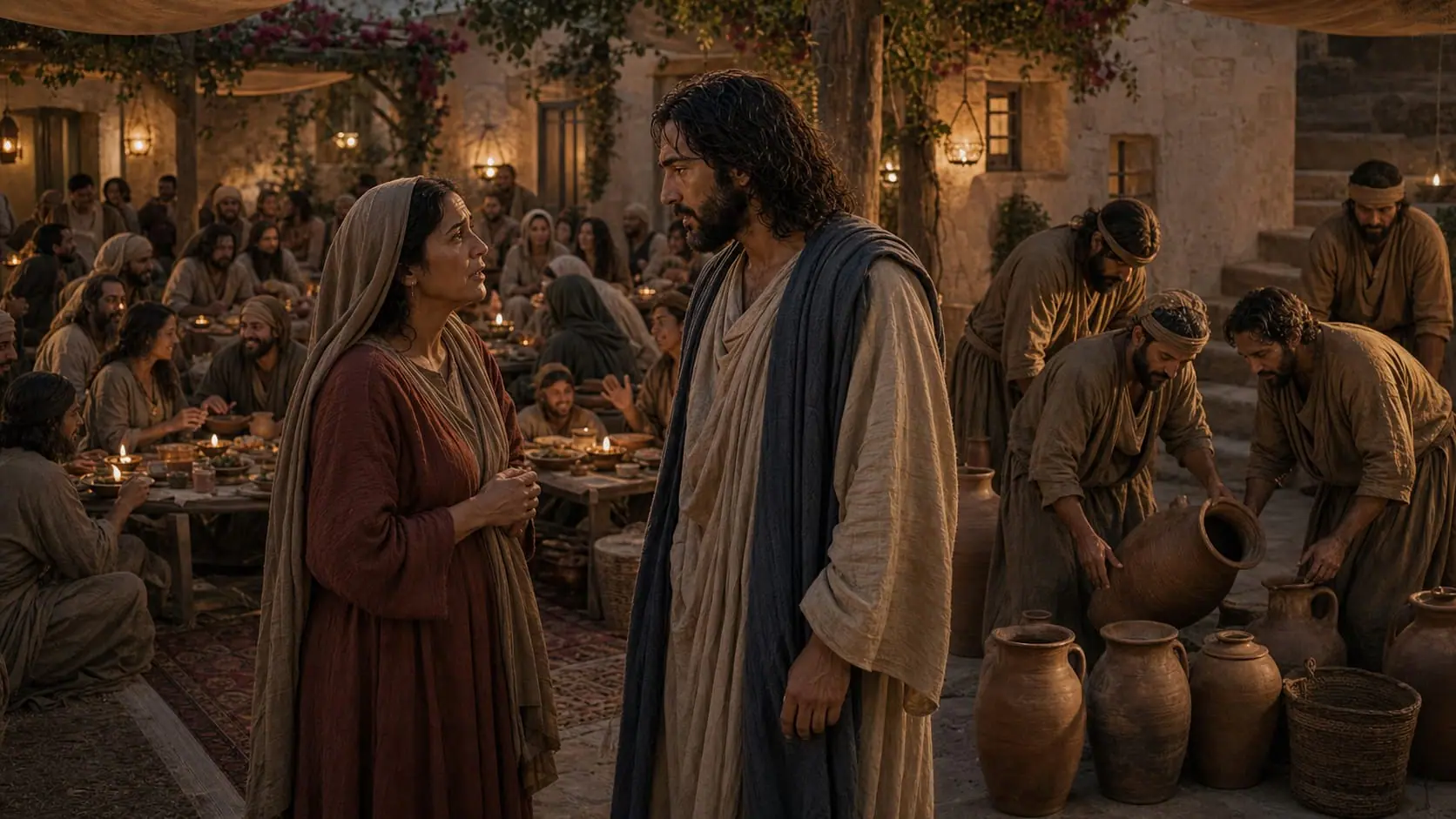
His mother said to the servants, “Whatever he says to you, do it.”
The servants fill six stone jars to the brim
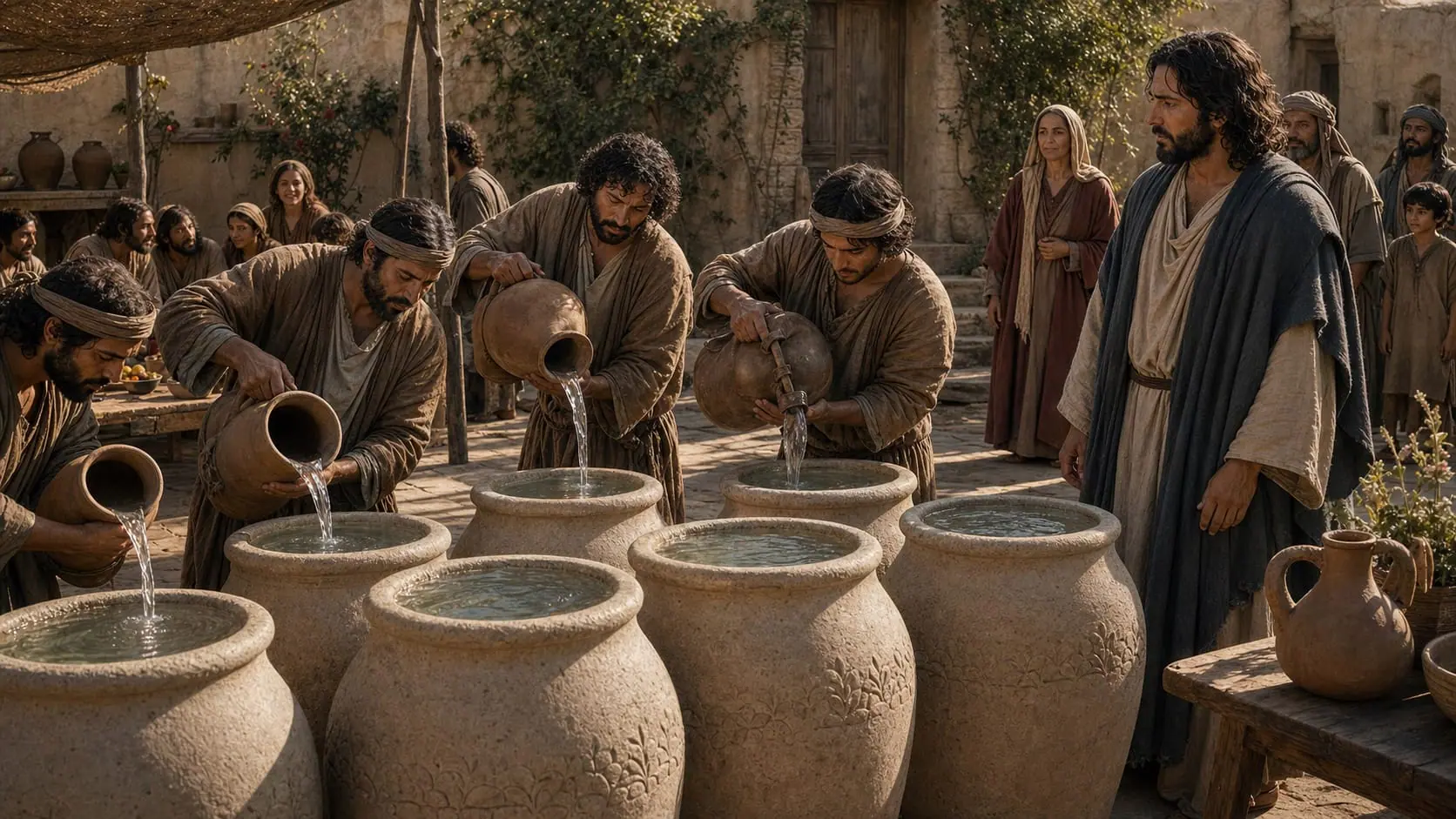
Nearby stood six large stone water pots used in connection with Jewish purification. John estimates that each held two or three metretes—about 20 to 30 U.S. gallons, or 75 to 115 liters. These were substantial vessels, not handheld pitchers.
Jesus told the servants to fill them with water, and they filled them to the brim. He then instructed them to draw some out and take it to the ruler of the feast—the person overseeing the meal. They did as he asked. John does not record an explanation to the servants of what would happen. John 2:6–8
Jesus said to them, “Fill the water pots with water.” So they filled them up to the brim. He said to them, “Now draw some out, and take it to the ruler of the feast.” So they took it.
The ruler of the feast tastes the good wine
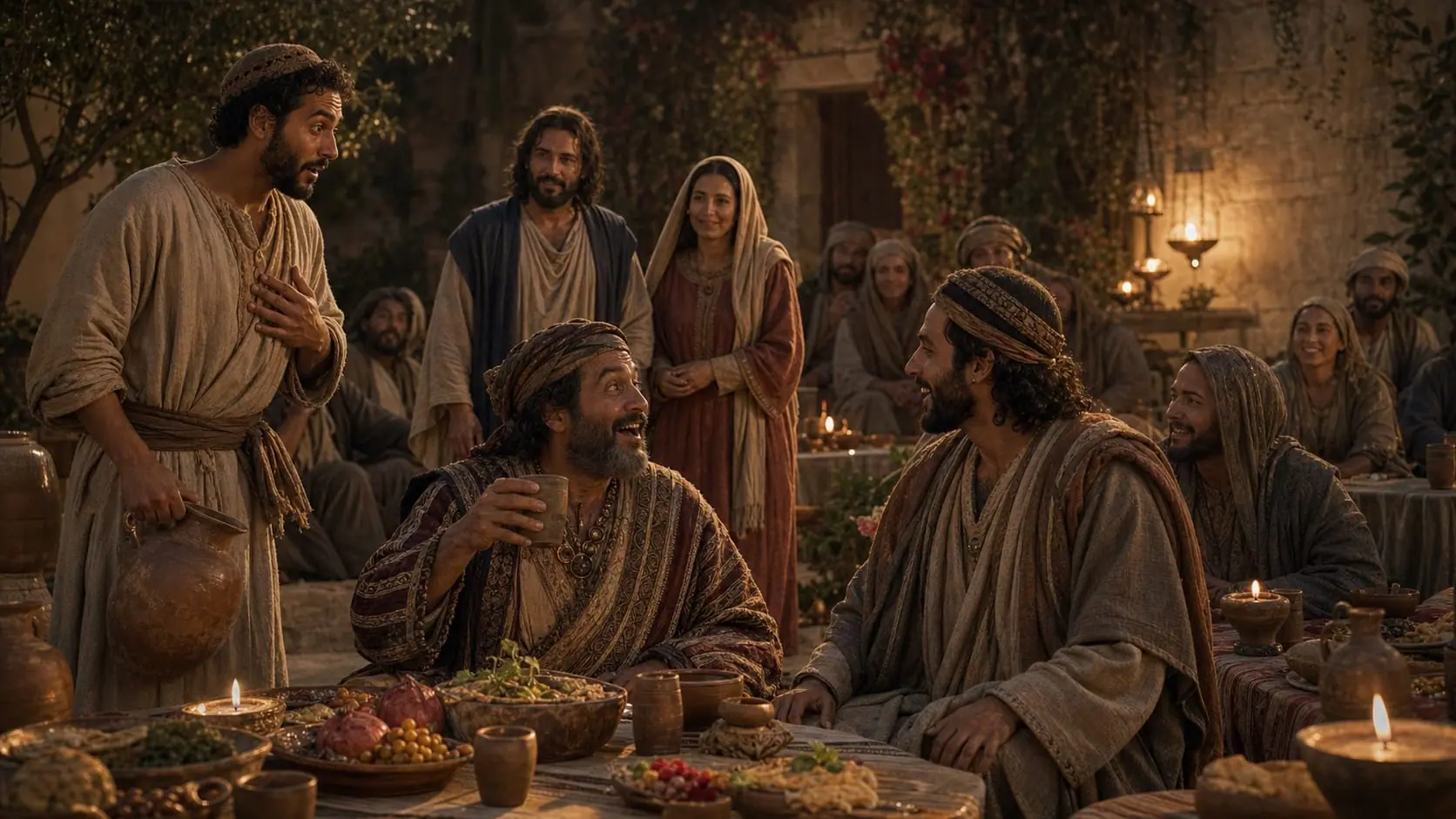
The ruler of the feast tasted what the servants brought. The water had become wine. He did not know where it came from, although the servants who had drawn the water knew. He called the bridegroom and observed that this celebration had kept the good wine until then.
The ruler spoke about the usual order of serving wine: good wine first, poorer wine after guests had drunk freely. This time, he told the bridegroom, the good wine had been kept until now. John tells us what he tasted, but not the exact moment when the water became wine. John 2:9–10
The sign reveals Jesus’ glory
John closes the scene by interpreting it. This was the beginning of Jesus’ signs in Cana of Galilee. Through it he revealed his glory, and his disciples believed in him. The point is therefore larger than rescuing a celebration from embarrassment: the action discloses something about Jesus.
Afterward Jesus went down to Capernaum with his mother, brothers, and disciples and remained there for a few days. The narrative then moves to Jerusalem and the temple. John 2:11–13
This beginning of his signs Jesus did in Cana of Galilee, and revealed his glory; and his disciples believed in him.
The first sign in John’s Gospel
What Was Jesus’ First Miracle?
Jesus’ first miracle was turning water into wine at Cana. John 2:11 calls this the beginning of his signs, not merely the first miracle John happened to include. The wedding marks the beginning of the signs through which Jesus reveals his glory.
Near the end of the Gospel, John explains why he recorded these signs: so that readers may believe Jesus is the Christ, the Son of God, and have life in his name (John 20:30–31). For the wider account of his ministry, read about Jesus’ life, teachings, death, and resurrection.
The purpose John states
Why Did Jesus Turn Water into Wine?
John 2:11 supplies the clearest answer: the sign revealed Jesus’ glory, and his disciples believed in him. At the human level, it also met a real shortage at a wedding celebration. Jesus’ response protects the household from the immediate consequences of having no wine.
Christians have also connected the abundance, wedding setting, purification jars, and superior wine with messianic joy and the arrival of something new. Those readings can illuminate John’s themes, but they should supplement rather than replace the purpose the Gospel states directly.
Capacity and purpose
How Much Water Did Jesus Turn into Wine?
John describes six stone pots, each holding about 20 to 30 U.S. gallons or 75 to 115 liters, using the WEB note’s approximate conversion. Their combined capacity was approximately 120 to 180 gallons—roughly 450 to 690 liters. The servants filled the jars to the brim.
That calculation describes the capacity implied by John’s measurements. The text does not measure the finished wine, report how much the guests consumed, or say that every remaining drop was served. The jars’ original purpose is also important: they were associated with purification, not normal wine storage.
What the passage does and does not say
Was the Wine at Cana Alcoholic?
The natural reading is ordinary fermented wine. The ruler’s comment in John 2:10 compares it with the wine served before and after guests have drunk freely. He is describing a serving custom, not saying that everyone at Cana was drunk. John gives no alcohol percentage or explanation of how the change occurred.
The account does not explicitly say whether Jesus drank any of this wine, and it does not command readers to drink. Ephesians 5:18 warns against drunkenness; Romans 14:21 urges consideration for another person’s conscience. Those passages also matter when Christians consider drinking or abstaining.
Test your recall of this sign alongside other events and teachings in Jesus Trivia, or browse facts about Jesus.