%20scale(.87)'%3e%3cg%20transform='rotate(-3%2032%2034)'%3e%3cpath%20d='M10.5%2019.5c7.65-2.35%2014.8-.45%2021.5%205.7%206.7-6.15%2013.85-8.05%2021.5-5.7v27.2c-7.65-2.15-14.8-.45-21.5%205.1-6.7-5.55-13.85-7.25-21.5-5.1V19.5Z'%20fill='%23fff'%20stroke='%23171528'%20stroke-width='4.5'%20stroke-linejoin='round'/%3e%3cpath%20d='M32%2025.2v26.6'%20stroke='%23171528'%20stroke-width='4'%20stroke-linecap='round'/%3e%3cpath%20d='M17.5%2034.5h9M22%2030v9'%20stroke='%23171528'%20stroke-width='3.75'%20stroke-linecap='round'/%3e%3ccircle%20cx='41.5'%20cy='32.5'%20r='2.5'%20fill='%23171528'/%3e%3ccircle%20cx='46.5'%20cy='38'%20r='2.5'%20fill='%23171528'/%3e%3c/g%3e%3c/g%3e%3c/svg%3e)
The quick answer
What is the story of Job in the Bible?
Job is a prosperous man from Uz whom the narrator calls blameless and upright. Satan challenges whether Job fears God only because God protects him. God first permits an attack on what Job has, but not on Job himself. After Job loses his livestock, many servants, and all ten children, a second permission allows Satan to afflict his body but spare his life.
Job mourns, protests, and wishes he had never been born, but he refuses his friends’ repeated claim that hidden wickedness must explain his suffering. Eliphaz, Bildad, and Zophar defend a simple moral order in which the righteous prosper and the wicked suffer. Job knows that explanation does not fit his case and asks God for a hearing.
After the debates and Elihu’s speeches, God answers Job from a whirlwind. He questions Job about creation and challenges Job’s attempt to condemn God in order to justify himself. Job admits that he spoke without understanding. God then rebukes the three friends, accepts Job’s prayer for them, and restores his prosperity. The ending gives Job renewed family life without explaining each earlier loss to him.
The full story
Job’s story from prosperity to the whirlwind
Job is introduced as upright in the land of Uz
Job lives in Uz with seven sons and three daughters, large herds, servants, and a reputation as the greatest man in the East. The narrator’s first moral judgment is unambiguous: Job is blameless and upright, fears God, and turns away from evil.
His sons invite their sisters to family feasts. Afterward, Job regularly offers burnt offerings for them, concerned that they may have sinned and renounced God in their hearts. This is Job’s concern, not the narrator’s verdict that his children have committed a particular sin.
Job 1:1–5
There was a man in the land of Uz, whose name was Job. That man was blameless and upright, and one who feared God, and turned away from evil.
The accuser challenges Job’s motives and disaster arrives
The World English Bible calls the challenger Satan. The Hebrew uses a term meaning adversary with the definite article, often rendered “the accuser” or “the adversary”; the NET note on Job 1:6 explains this wording. His challenge concerns Job’s motives: take away the protection and possessions, he claims, and Job will renounce God.
Four messengers arrive in succession. Sabean and Chaldean raiders have taken livestock and killed servants; fire has consumed sheep and servants; a great wind has collapsed the house where Job’s children were gathered. The messengers escape to report the disasters. Job tears his robe, shaves his head, falls to the ground, and worships.
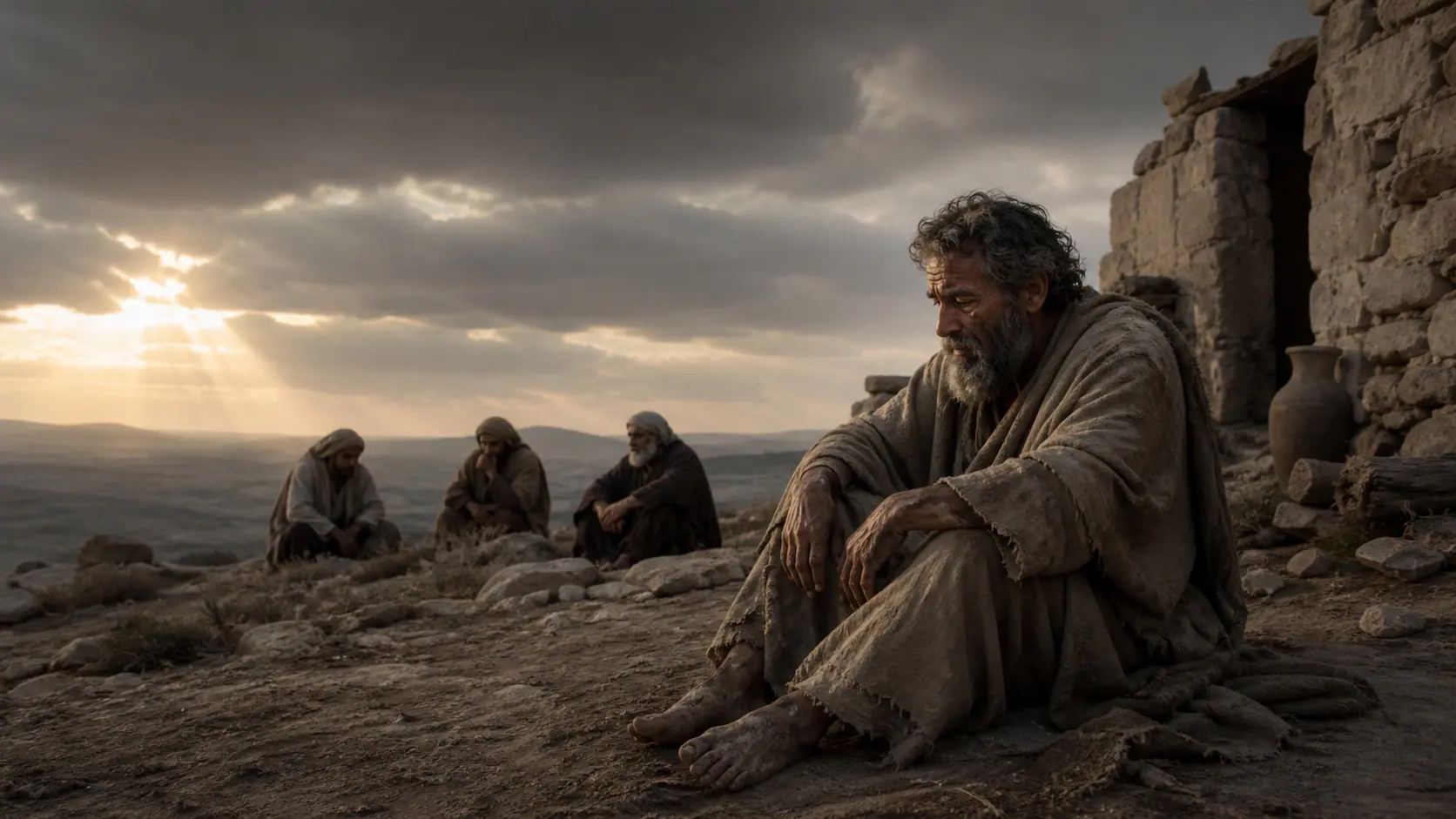
In the second heavenly scene, God says Job still holds to his integrity despite being ruined without cause. Satan receives permission to attack his body, but not kill him, and strikes him with painful sores. Job sits among ashes and scrapes himself with a broken piece of pottery. His wife tells him to renounce God and die. He rejects her advice, asking whether they should receive good from God but not adversity. Job 2:10 says he did not sin with his lips in this response.
Job 1:6–2:10
Then Job arose, and tore his robe, and shaved his head, and fell down on the ground, and worshiped. He said, “Naked I came out of my mother’s womb, and naked will I return there. Yahweh gave, and Yahweh has taken away. Blessed be Yahweh’s name.” In all this, Job didn’t sin, nor charge God with wrongdoing.
Three friends begin with seven days of silence
Eliphaz the Temanite, Bildad the Shuhite, and Zophar the Naamathite come to comfort Job. From a distance they barely recognize him. They weep, tear their robes, scatter dust, and sit with him for seven days and nights without speaking because his pain is very great.
Job breaks the silence by cursing the day of his birth, not God. He asks why he was born and why life continues when he longs for rest in death. These are the words of a person in deep anguish, not an instruction to harm oneself.
Job 2:11–3:26
Job and his friends argue about suffering and justice
The three friends repeatedly connect suffering with wrongdoing. Bildad applies that reasoning to Job’s dead children in Job 8:4. Eliphaz eventually accuses Job of withholding food and water and mistreating widows and orphans in Job 22:6–9. These are their accusations, not facts established by the narrator.
Job calls them miserable comforters. He points to wicked people who live securely, asks for a witness who will defend him, and longs to present his case to God. In Job 29–31, he recalls helping the vulnerable, describes his present humiliation, and insists that the friends’ charges do not fit his life. His anger includes accusations against God that God later challenges; the closing approval of Job is not an endorsement of every statement in the debates.
The poem in Job 28 asks where wisdom can be found. Mining can uncover hidden metal, but human skill cannot purchase ultimate wisdom. God alone knows its way, and reverence joined to turning from evil is wisdom for human beings.
Job 4–31
Elihu speaks, then God answers from the whirlwind
A younger speaker, Elihu, enters after the three friends stop answering. He is angry with Job for justifying himself and with the friends for condemning Job without finding an answer. His speeches emphasize divine greatness and propose that suffering may instruct as well as punish, but the book does not include him in the final rebuke or commendation.
God then answers Job from a whirlwind. He asks about the earth’s foundations, the sea, dawn, weather, stars, and wild animals. Job responds by putting his hand over his mouth. God speaks again, asking whether Job would condemn God to justify himself and whether Job can humble the proud and save himself. The descriptions of Behemoth and Leviathan follow this challenge.
The speeches show God’s power and care for a world Job cannot govern, including rain on uninhabited land and food for wild creatures. They also correct Job’s claims about God’s justice. God does not disclose the opening heavenly scenes to Job or tell him why each particular loss occurred.
Job 32–41
Moreover Yahweh answered Job, “Shall he who argues contend with the Almighty? He who argues with God, let him answer it.” Then Job answered Yahweh, “Behold, I am of small account. What will I answer you? I lay my hand on my mouth. I have spoken once, and I will not answer; Yes, twice, but I will proceed no further.”
Job responds, the friends are rebuked, and life is restored
Job acknowledges God’s power and admits that he spoke of things he did not understand. In the WEB, Job 42:6 says he abhors himself and repents in dust and ashes. The NET translation note explains that the Hebrew does not state the object of the first verb: Job may be rejecting himself or what he said. This response follows God’s correction; it is not a confession to the secret crimes alleged by his friends.
God tells Eliphaz that he and his two friends have not spoken rightly as Job has. They must offer sacrifices, and Job prays for them. This closing judgment confirms that confident accusations against a sufferer were not faithful explanations.
God restores Job’s prosperity when he prays for his friends. His relatives and former acquaintances come to eat with him, comfort him, and bring gifts. The livestock totals are doubled. He also has seven sons and three daughters; the daughters—Jemimah, Keziah, and Keren Happuch—receive an inheritance with their brothers. Job lives another 140 years and sees four generations of descendants before his death. The ending records renewed life, not the return to life of the children who died.
Job 42:1–17
Then Job answered Yahweh: “I know that you can do all things, and that no purpose of yours can be restrained. You asked, ‘Who is this who hides counsel without knowledge?’ therefore I have uttered that which I didn’t understand, things too wonderful for me, which I didn’t know. You said, ‘Listen, now, and I will speak; I will question you, and you will answer me.’ I had heard of you by the hearing of the ear, but now my eye sees you. Therefore I abhor myself, and repent in dust and ashes.”
The question the friends get wrong
Was Job suffering because he sinned?
The book does not allow that conclusion. The narrator calls Job blameless and upright, God repeats that assessment, and the heavenly scene presents the losses as a test of the accuser’s claim rather than punishment for a hidden crime. Job is not described as sinless in an absolute sense, but the specific catastrophe is not explained by the wrongdoing his friends imagine.
At the end, God rebukes Eliphaz, Bildad, and Zophar. Their mistake is not believing that actions have consequences; biblical wisdom often teaches that they do. Their mistake is turning a general pattern into certainty about one sufferer and speaking for God without knowledge.
History, poetry, and wisdom
Was Job a real person, a parable, or both history and literary art?
Job is presented as a man from Uz. Ezekiel 14:14, 20 names him as an example of righteousness, and James 5:11 recalls his endurance. The Book of Job places long poetic speeches within a prose account of his suffering and restoration. Readers differ over how this literary form relates to historical events; poetry by itself does not settle that question.
The Hebrew form translated in the WEB and KJV does not name the author or date Job’s life. A Greek ending, available in LXX2012, adds biographical traditions identifying him with Jobab and giving ancestry. Those details should not be presented as though they appear in every version of Job.
More than passive patience
What does “the patience of Job” mean?
The KJV uses “patience” in James 5:11; the WEB uses “perseverance.” James recalls Job’s endurance and points readers to the Lord’s compassion and mercy. Job’s own story includes tears, questions, protest, and eventually accepting correction—not an uninterrupted calm mood.
The book gives grief room to speak while challenging both the friends’ accusations and Job’s limited understanding. It does not promise that every person who endures suffering will receive twice their former wealth.
Reading familiar verses in context
What does “I know that my Redeemer lives” mean?
In Job 19:23–27, Job longs for his words to be preserved and expresses hope that a living redeemer will vindicate him. The WEB renders the following verse as seeing God in his flesh after his skin is destroyed. Christians often read this hope in light of Christ and resurrection, but the speech itself does not name Jesus. The NET notes discuss the difficult wording and differing readings of these verses.