See how 20 original scenarios become four preference scores and one of 16 biblical character patterns—including the interpretive limits of every match.
A story-based reflection tool, not a biblical personality diagnosis
BibleGamesHub created this quiz to help readers notice ordinary preferences and then return to Scripture with better questions. The result organizes self-reported choices; it does not reveal a calling, measure faith, or prove that an ancient biblical person had a modern personality type.
Purpose and boundaries
The quiz is intended for low-stakes personal reflection, group conversation, and deeper reading of a biblical story. Questions use familiar Christian-life settings—prayer, Bible study, church service, conflict, hospitality, planning, and change—without treating one response as more faithful than another.
Designed to support
Noticing recurring preferences
Starting a thoughtful conversation
Reading a character’s whole biblical story
Choosing a small reflection or growth step
Not designed to support
Clinical, vocational, or spiritual diagnosis
Claims about calling, destiny, or maturity
Proof of an ancient person’s personality type
Screening, counseling, or ministry placement decisions
The four preference pairs
Each pair describes two potentially useful tendencies. The quiz reports the stronger side found in this set of answers; it does not treat either side as morally or spiritually superior.
01
Energy and attention
Where you tend to process, recharge, and direct attention.
Extraversion (E) ↔ Introversion (I)02
Information
Whether you first notice concrete details or wider patterns and possibilities.
Sensing (S) ↔ Intuition (N)03
Decisions
Whether you first emphasize consistency and reasons or people and values.
Thinking (T) ↔ Feeling (F)04
Approach
Whether you usually prefer settled structure or room to adapt.
Judging (J) ↔ Perceiving (P)
How the 20 scenarios are written and reviewed
Five scenarios contribute to each preference pair. Every item offers four responses. Each response adds one point to one letter only; two options favor each side of that question's preference pair. Different wording does not necessarily mean different scoring.
1
Start with an observable choice
Questions describe a concrete situation rather than asking users to select a flattering trait.
2
Use balanced Christian settings
Prayer and ministry contexts are included without rewarding visibility, biblical knowledge, or religious language.
3
Separate preference from virtue
Courage, love, holiness, faithfulness, and maturity are not personality scores.
4
Review clarity and repeated signals
Items are checked for ambiguity, overlap, shame, and whether one option reveals the intended result too easily.
Scoring, step by step
How answers become a four-letter result
1. Count choicesEach option adds one point to one of E, I, S, N, T, F, J, or P. Five questions contribute to each pair.
2. Compare each pairThe two letter totals in each dimension are converted into percentages and the stronger letter is selected.
3. Read the marginFive answered questions cannot tie: a 3–2 split is 60%–40%, not strong proof of a lasting preference. The E/S/T/J tie fallback applies only if a restored score is exactly 50%, not to a normally completed round.
4. Form the type codeThe four selected letters create one of 16 possible codes, such as INTJ, ENFP, or ISFJ.
5. Select the mapped profileEach code has one primary biblical character profile. This pairing is an editorial interpretation, not a historical diagnosis.
6. Offer nearby examplesFour other codes differ by one letter. The result displays the first two in the fixed profile order. Those two are not more likely matches than the other two, and the ranking does not use the size of your preference margins.
How a personality pattern is connected with a Bible character
Mapping begins with narrated actions, decisions, relationships, and repeated responses in Scripture. Editors then compare those textual patterns with the broad preference code. The result profile includes strengths and pressure points because biblical people are complex and should never be reduced to a flattering archetype.
01
Text before type
Exact Scripture chapters and narrated behavior come before modern personality language.
02
Whole-story context
Grace, failure, growth, relationships, and consequences remain part of the match.
03
Resemblance, not identity
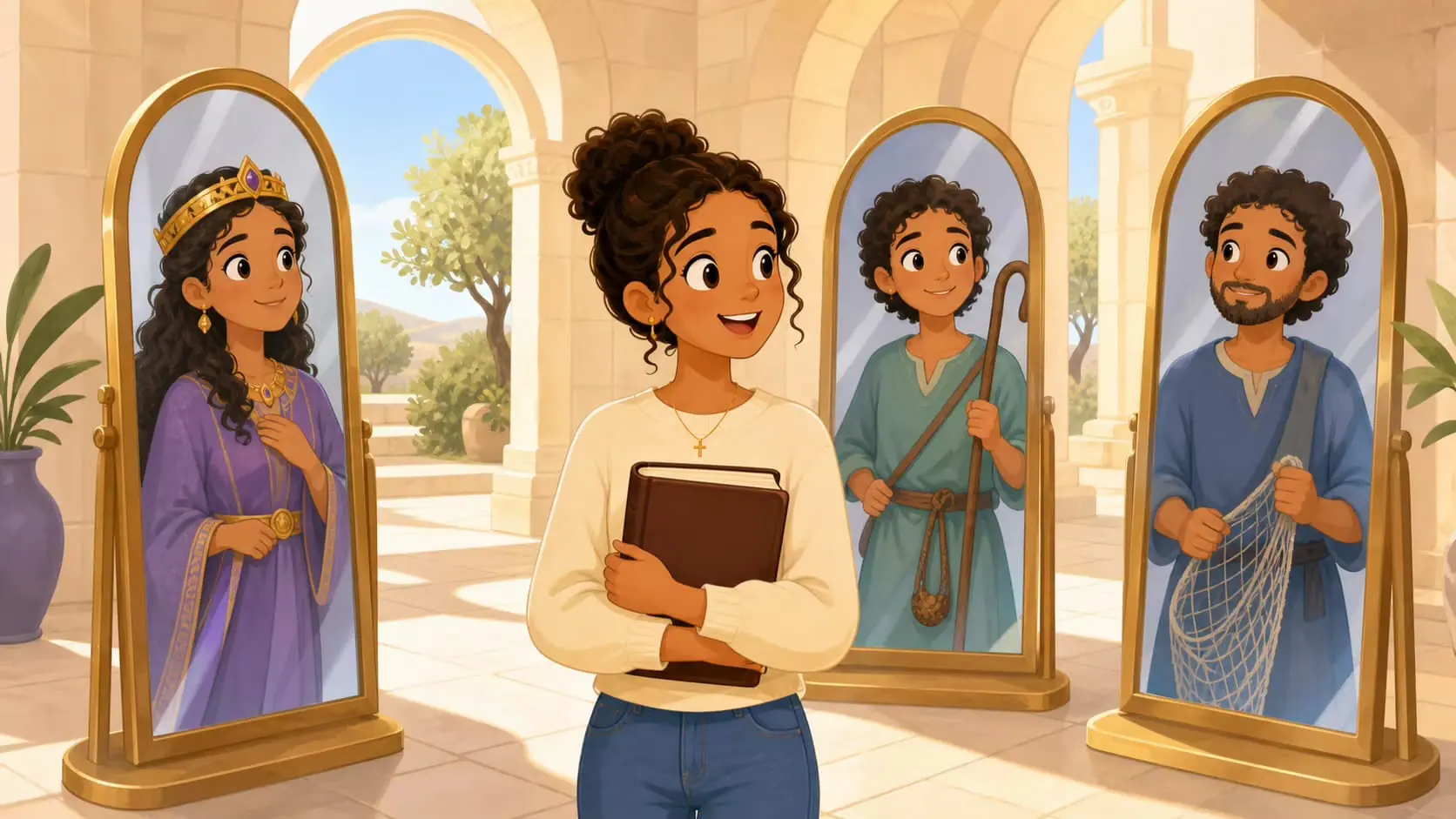
The result says your answers resemble a pattern; it never says you are that person.
04
No spiritual ranking
No character, temperament, or letter code represents greater value or faithfulness.
What a result can and cannot say
A result can offer language for your present self-reported preferences, point out a possible strength or pressure pattern, and suggest passages for reflection. It cannot establish a permanent identity, explain every context, predict behavior, or replace Scripture, prayer, community, pastoral care, or qualified professional support.
Version and editorial responsibility
BibleGamesHub maintains this quiz. Version 1.0.1 clarifies the story-based comparisons, uses complete World English Bible quotations with speaker and context notes, explains the fixed editorial chart, and corrects sharing and scoring descriptions. One question's wording was made less morally loaded. The point weights and 16 code-to-character mappings are unchanged. This is not an independently validated assessment.
Published byBibleGamesHub
Current version1.0.1
Last updatedSeptember 13, 2026
First publishedAugust 24, 2026
20 original scenarios · 4 preference pairs · 16 story patterns
Use the method, then return to the story.
Take the quiz, review your exact preference scores, and read the Scripture chapters connected with your result.
'%20fill-opacity='0.4'/%3e%3cdefs%3e%3cradialGradient%20id='paint0_radial_0_4'%20cx='0'%20cy='0'%20r='1'%20gradientTransform='matrix(6.50003%20-430.975%20892.955%2011.8475%20814.5%20695)'%20gradientUnits='userSpaceOnUse'%3e%3cstop%20offset='0.278846'%20stop-color='%23300E7D'/%3e%3cstop%20offset='1'%20stop-color='%2391229B'/%3e%3c/radialGradient%3e%3c/defs%3e%3c/svg%3e)
%20scale(.87)'%3e%3cg%20transform='rotate(-3%2032%2034)'%3e%3cpath%20d='M10.5%2019.5c7.65-2.35%2014.8-.45%2021.5%205.7%206.7-6.15%2013.85-8.05%2021.5-5.7v27.2c-7.65-2.15-14.8-.45-21.5%205.1-6.7-5.55-13.85-7.25-21.5-5.1V19.5Z'%20fill='%23fff'%20stroke='%23171528'%20stroke-width='4.5'%20stroke-linejoin='round'/%3e%3cpath%20d='M32%2025.2v26.6'%20stroke='%23171528'%20stroke-width='4'%20stroke-linecap='round'/%3e%3cpath%20d='M17.5%2034.5h9M22%2030v9'%20stroke='%23171528'%20stroke-width='3.75'%20stroke-linecap='round'/%3e%3ccircle%20cx='41.5'%20cy='32.5'%20r='2.5'%20fill='%23171528'/%3e%3ccircle%20cx='46.5'%20cy='38'%20r='2.5'%20fill='%23171528'/%3e%3c/g%3e%3c/g%3e%3c/svg%3e)
'%3e%3cpath%20id='Vector'%20d='M16.125%2021V14.4326L21.8125%2017.7163L27.5%2021L21.8125%2024.2837L16.125%2027.5674V21Z'%20fill='white'%20stroke='white'%20stroke-width='2'%20stroke-linejoin='round'/%3e%3c/g%3e%3c/g%3e%3c/svg%3e)