'%20fill-opacity='0.4'/%3e%3cdefs%3e%3cradialGradient%20id='paint0_radial_0_4'%20cx='0'%20cy='0'%20r='1'%20gradientTransform='matrix(6.50003%20-430.975%20892.955%2011.8475%20814.5%20695)'%20gradientUnits='userSpaceOnUse'%3e%3cstop%20offset='0.278846'%20stop-color='%23300E7D'/%3e%3cstop%20offset='1'%20stop-color='%2391229B'/%3e%3c/radialGradient%3e%3c/defs%3e%3c/svg%3e)
%20scale(.87)'%3e%3cg%20transform='rotate(-3%2032%2034)'%3e%3cpath%20d='M10.5%2019.5c7.65-2.35%2014.8-.45%2021.5%205.7%206.7-6.15%2013.85-8.05%2021.5-5.7v27.2c-7.65-2.15-14.8-.45-21.5%205.1-6.7-5.55-13.85-7.25-21.5-5.1V19.5Z'%20fill='%23fff'%20stroke='%23171528'%20stroke-width='4.5'%20stroke-linejoin='round'/%3e%3cpath%20d='M32%2025.2v26.6'%20stroke='%23171528'%20stroke-width='4'%20stroke-linecap='round'/%3e%3cpath%20d='M17.5%2034.5h9M22%2030v9'%20stroke='%23171528'%20stroke-width='3.75'%20stroke-linecap='round'/%3e%3ccircle%20cx='41.5'%20cy='32.5'%20r='2.5'%20fill='%23171528'/%3e%3ccircle%20cx='46.5'%20cy='38'%20r='2.5'%20fill='%23171528'/%3e%3c/g%3e%3c/g%3e%3c/svg%3e)
'%3e%3cpath%20id='Vector'%20d='M16.125%2021V14.4326L21.8125%2017.7163L27.5%2021L21.8125%2024.2837L16.125%2027.5674V21Z'%20fill='white'%20stroke='white'%20stroke-width='2'%20stroke-linejoin='round'/%3e%3c/g%3e%3c/g%3e%3c/svg%3e)
Biblical Guide to Ephesians 6
What is the Armor of God?
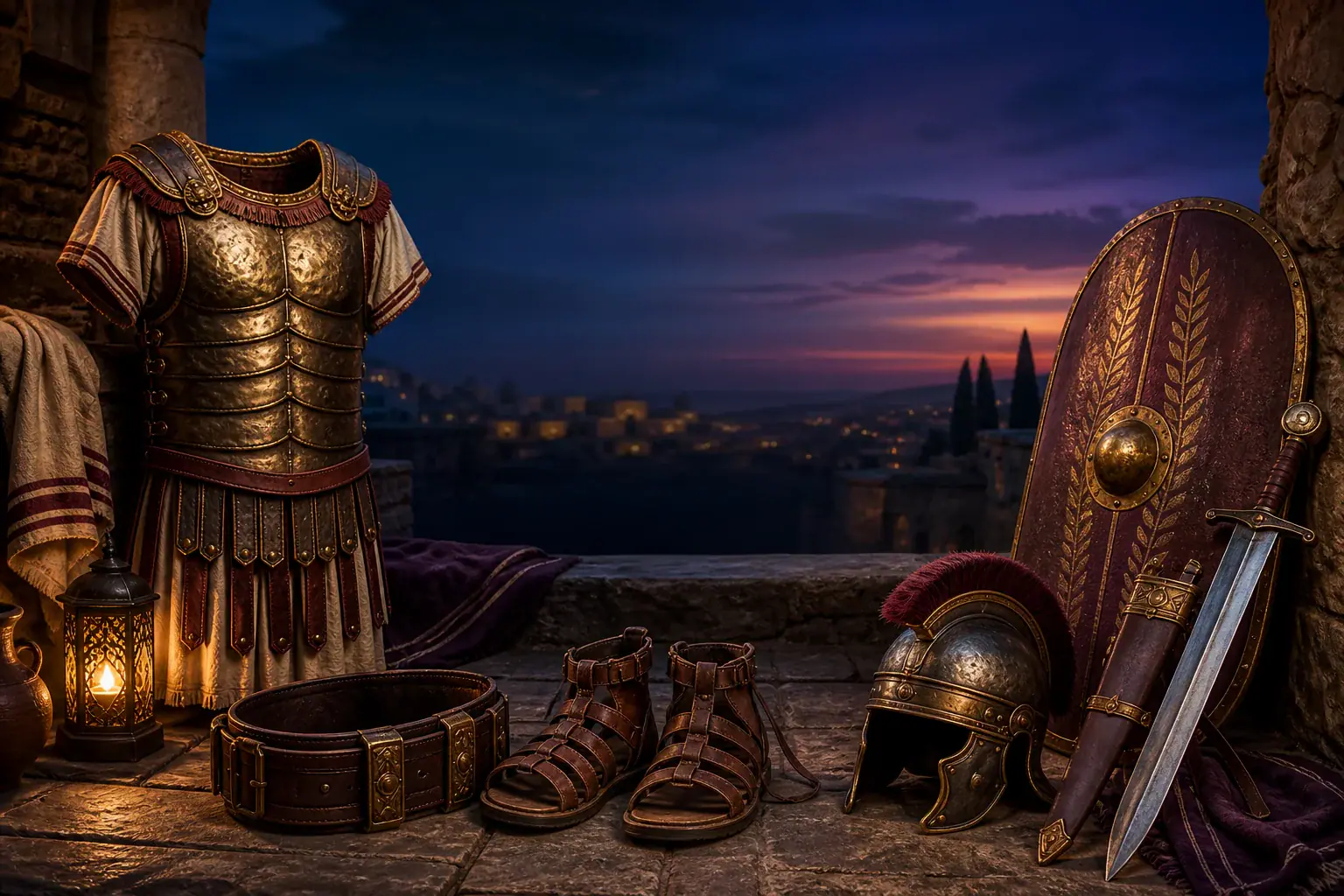
The Armor of God is the image Paul uses in Ephesians 6:10–18 to teach believers how to stand firm in spiritual struggle. He does not tell Christians to rely on personality, willpower, or literal weapons. He begins, “Be strong in the Lord and in the strength of his might,” then names truth, righteousness, readiness from the gospel of peace, faith, salvation, and the word of God.
The six pieces are easiest to remember separately, but the passage calls for the whole armor. Each part describes life grounded in God’s work: knowing what is true, living rightly, walking in gospel peace, trusting God, holding salvation’s hope, and receiving Scripture faithfully. Verse 18 carries the picture into persevering prayer.
QUICK ANSWER
Armor of God pieces at a glance
Paul names six pieces in Ephesians 6:14–17, then continues the instruction with prayer in verse 18.
| Piece | Verse | Meaning | Daily response |
|---|---|---|---|
| Belt of Truth | Ephesians 6:14 | Stand ready by holding to what is true. | Check claims against Scripture, speak honestly, and refuse deception even when it is convenient. |
| Breastplate of Righteousness | Ephesians 6:14 | Guard the heart with what is right before God. | Choose justice, mercy, integrity, and obedience rather than merely knowing the right answer. |
| Shoes of the Gospel of Peace | Ephesians 6:15 | Be ready to walk in and share the gospel of peace. | Respond gently, pursue peace where possible, and be prepared to explain the hope of the gospel. |
| Shield of Faith | Ephesians 6:16 | Trust God and stand firm when doubt arrives. | Bring fear to God, remember his promises, and keep obeying even before the outcome is visible. |
| Helmet of Salvation | Ephesians 6:17 | Let the hope of salvation shape the way you think. | Remember that salvation is God’s gift, reject condemning lies, and set the mind on what is true and hopeful. |
| Sword of the Spirit | Ephesians 6:17 | Know, understand, and rightly use God’s word. | Read Scripture in context, remember it, and respond with it as Jesus did without twisting its meaning. |
The context: “Be strong in the Lord”
Paul writes Ephesians 6 after chapters about God’s grace, a new life in Christ, unity, and relationships shaped by that new life. The armor is not a technique for earning salvation. Ephesians has already said salvation is by grace through faith, not works (Ephesians 2:8–10).
Paul describes a spiritual struggle rather than a fight against human opponents. That distinction matters: people are not the enemy to attack. The response he gives is to stand, to take up what God supplies, to use God’s word, and to pray with alert perseverance.
Reading the images and applying them
Paul names each piece but does not explain every detail of the metaphor. The examples below are applications, not additional promises in Ephesians 6. For instance, readers connect the breastplate with God-given righteousness, righteous conduct, or both. Ephesians 2:8–10 speaks of salvation by grace and a life of good works; Ephesians 4:24 describes the new life in righteousness. The image should not be used to claim that good behavior earns salvation or that believers are protected from every hardship.
1. Belt of Truth
Ephesians 6:14What it means: Truth steadies the whole life of a believer, beginning with God’s word and extending to honest speech and action.
A belt gathered a soldier’s clothing and prepared the body for movement. Paul’s image makes truth foundational to readiness. This includes receiving God’s word as true and refusing dishonest speech.
Practice: Check claims against Scripture, speak honestly, and refuse deception even when it is convenient.
Read alongside: John 17:17 · John 8:31–32 · Psalm 119:160 · Colossians 3:9
2. Breastplate of Righteousness
Ephesians 6:14What it means: Righteousness describes being made right through Christ and living in ways that reflect God’s good character.
A breastplate guarded the body’s vital area. The image joins the righteousness received through Christ with conduct that reflects God’s justice, mercy, and integrity. Obedience grows from grace; it does not purchase grace.
Practice: Choose justice, mercy, integrity, and obedience rather than merely knowing the right answer.
Read alongside: Philippians 1:11 · James 1:22 · Micah 6:8 · Romans 6:13
3. Shoes of the Gospel of Peace
Ephesians 6:15What it means: The good news of peace with God gives stable footing and readiness to carry that message to others.
Stable footwear made a person ready to move and stand. The gospel announces peace with God through Jesus Christ and prepares believers to carry that good news with gentleness.
Practice: Respond gently, pursue peace where possible, and be prepared to explain the hope of the gospel.
Read alongside: Romans 5:1 · Romans 10:15 · Isaiah 52:7 · 1 Peter 3:15
4. Shield of Faith
Ephesians 6:16What it means: Faith actively trusts God’s character and promises when fear, accusation, or uncertainty presses in.
A shield met incoming attacks. Faith is active reliance on God’s trustworthy character and promises when fear, accusation, doubt, or uncertain outcomes press in. It is trust, not a demand that God grant a chosen result.
Practice: Bring fear to God, remember his promises, and keep obeying even before the outcome is visible.
Read alongside: Hebrews 11:1 · Hebrews 11:6 · Psalm 56:3 · 2 Corinthians 5:7
5. Helmet of Salvation
Ephesians 6:17What it means: The hope and assurance of God’s saving work guard the mind from condemnation and despair.
A helmet protected the head. Paul also calls salvation’s hope a helmet in 1 Thessalonians 5:8. God’s saving work gives the mind an anchor against despair and condemnation without making sin or growth unimportant.
Practice: Remember that salvation is God’s gift, reject condemning lies, and set the mind on what is true and hopeful.
Read alongside: 1 Thessalonians 5:8 · Ephesians 2:8–9 · Romans 8:1 · 1 Peter 1:13
6. Sword of the Spirit
Ephesians 6:17What it means: The Spirit uses God’s word to expose falsehood, guide obedience, and equip believers for faithful action.
Paul names this piece directly: the sword of the Spirit is the word of God. Scripture exposes falsehood, guides obedience, and equips God’s people. It must be understood in context and used in dependence on the Spirit—not twisted to wound people.
Practice: Read Scripture in context, remember it, and respond with it as Jesus did without twisting its meaning.
Read alongside: Hebrews 4:12 · Matthew 4:4 · Psalm 119:11 · 2 Timothy 3:16–17
Prayer and the whole Armor of God
After naming the sword of the Spirit, Paul continues: pray at all times in the Spirit, stay alert, and persevere for all the saints (Ephesians 6:18). Prayer is not labeled as a seventh physical piece, yet it is inseparable from the way the passage works. Believers do not equip themselves through self-confidence; they depend on God.
Prayer also keeps the armor from becoming a private self-improvement list. Paul asks for prayer so he can speak the gospel boldly. Truth, peace, faith, salvation, and Scripture lead outward into faithful witness and care for the wider church.
To check how the six pieces relate to everyday choices, try a round of the Armor of God Game. Its questions connect the symbols with their meanings and practical situations, then explain each answer with a Scripture reference. Use any missed question as a reason to reread the passage—not as a measure of your faith.
How to put on the Armor of God each day
“Putting on” the armor is not a magic phrase or imaginary dressing ritual. It is a useful daily reminder to live from the realities Paul names.
- 1
Begin with God’s strength
Pray in dependence rather than treating the list as a display of self-discipline.
- 2
Read Scripture in context
Let truth and God’s word correct assumptions and direct the next faithful step.
- 3
Name the pressure honestly
Is the immediate struggle deception, wrongdoing, conflict, fear, condemnation, or confusion?
- 4
Respond with the whole picture
Trust God, choose what is right, pursue gospel peace, remember salvation, and continue in prayer.
Armor of God questions and answers
What is the Armor of God?
The Armor of God is Paul’s spiritual picture in Ephesians 6:10–18. It describes standing firm in God’s strength through truth, righteousness, gospel readiness, faith, salvation, God’s word, and prayer.
What are the six pieces of the Armor of God?
They are the Belt of Truth, Breastplate of Righteousness, Shoes of the Gospel of Peace, Shield of Faith, Helmet of Salvation, and Sword of the Spirit, which Paul identifies as the word of God.
Are there six or seven pieces of the Armor of God?
Ephesians 6:14–17 names six pieces of armor. Verse 18 then tells believers to pray at all times. Some teaching lists call prayer a seventh part, but Paul does not match prayer with a seventh physical object; prayer accompanies the whole armor.
Why does Paul say to put on the whole armor?
The pieces form one connected picture of readiness and dependence on God. Paul does not present one favorite virtue as a substitute for the others.
Is prayer one of the pieces of armor?
Paul does not assign prayer a separate object, but Ephesians 6:18 continues the instruction with prayer at all times. Prayer belongs to the way the whole armor is taken up.
Does the Sword of the Spirit teach violence?
No. Paul identifies the sword as God’s word and describes a spiritual struggle. The New Testament calls believers to truthful, gracious witness rather than violence against people.
Is it Armor or Armour of God?
Both spellings refer to the same Ephesians passage. Armor is standard American English; armour is standard British English.
Can you match every piece with its meaning?
Use the guide in a free game with 72 Scripture-based challenges across three difficulty levels.
Play the Armor of God Game