%20scale(.87)'%3e%3cg%20transform='rotate(-3%2032%2034)'%3e%3cpath%20d='M10.5%2019.5c7.65-2.35%2014.8-.45%2021.5%205.7%206.7-6.15%2013.85-8.05%2021.5-5.7v27.2c-7.65-2.15-14.8-.45-21.5%205.1-6.7-5.55-13.85-7.25-21.5-5.1V19.5Z'%20fill='%23fff'%20stroke='%23171528'%20stroke-width='4.5'%20stroke-linejoin='round'/%3e%3cpath%20d='M32%2025.2v26.6'%20stroke='%23171528'%20stroke-width='4'%20stroke-linecap='round'/%3e%3cpath%20d='M17.5%2034.5h9M22%2030v9'%20stroke='%23171528'%20stroke-width='3.75'%20stroke-linecap='round'/%3e%3ccircle%20cx='41.5'%20cy='32.5'%20r='2.5'%20fill='%23171528'/%3e%3ccircle%20cx='46.5'%20cy='38'%20r='2.5'%20fill='%23171528'/%3e%3c/g%3e%3c/g%3e%3c/svg%3e)
The quick answer
Who was Paul in the Bible?
Paul, also called Saul, was a Jewish Pharisee from Tarsus and a Roman citizen by birth. After persecuting the church, he encountered the risen Jesus near Damascus. The Lord told Ananias that Saul would carry his name before the nations, kings, and the children of Israel (Acts 9:15). Paul traveled with coworkers such as Barnabas and Silas, taught in synagogues and homes, helped establish churches, and wrote to believers facing questions about faith and life together. Acts ends with him preaching in Rome as a prisoner, not with his death.
Saul of Tarsus: Jewish upbringing and Roman citizenship
Paul tells the Jerusalem crowd that he was born in Tarsus in Cilicia, brought up in Jerusalem, and educated under Gamaliel. He describes himself as a Pharisee and a member of the tribe of Benjamin. His Jewish identity and Roman citizenship were not alternatives: he was both Jewish and a Roman citizen by birth.
Acts mentions Paul’s sister and the nephew who later warned him about an ambush, but gives neither of their names. In 1 Corinthians 7:7–8, Paul speaks as an unmarried man. That passage does not tell us whether he had ever been married.
Acts 22:3, 25–29; 23:6, 16–22; Philippians 3:5; 1 Corinthians 7:7–8
From persecuting the church to preaching Jesus
Saul guarded the witnesses’ garments at Stephen’s stoning, approved of his death, and dragged believers from their homes. He was approaching Damascus to make further arrests when Jesus confronted him. After three days without sight, Saul received Ananias, regained his sight, and was baptized. He began proclaiming in the synagogues that Jesus is the Son of God.
Paul supplies more of the early chronology in Galatians 1. He went to Arabia, returned to Damascus, and went to Jerusalem after three years, staying with Peter for fifteen days and also seeing James, the Lord’s brother. He does not say he spent all three years in Arabia. Acts describes Barnabas helping the frightened Jerusalem disciples receive him.
Acts 7:58–8:3; 9:1–30; Galatians 1:15–24 · Read the Damascus-road encounter and compare the three accounts in Acts →
Paul’s missionary journeys: Antioch, Asia Minor, and Greece
The first missionary journey is the usual name for Acts 13–14. The Holy Spirit called Barnabas and Saul, and the Antioch church prayed and sent them out. They traveled through Cyprus and cities including Pisidian Antioch, Iconium, Lystra, and Derbe. They then revisited communities, appointed elders, and returned to Antioch to report what God had done.
On the second journey, Paul traveled with Silas after separating from Barnabas over John Mark. Timothy joined them. A vision at Troas led them toward Macedonia. In Philippi, Lydia welcomed them; later Paul and Silas were imprisoned. An earthquake opened the prison, but the prisoners did not flee. Paul also preached in Thessalonica, Berea, Athens, and Corinth, where he worked as a tentmaker with Priscilla and Aquila.
The third journey begins in Acts 18:23 with visits to Galatia and Phrygia. Paul spent an extended period teaching in Ephesus, traveled through Macedonia and Greece, and returned toward Jerusalem. At Miletus, he said farewell to the Ephesian elders. These three numbered journeys are a common way to outline Acts, not a claim that Paul traveled only three times. His voyage to Rome came later, in custody.
Coworkers, disagreements, and Gentile believers
Paul did not work alone. Barnabas brought him from Tarsus to teach at Antioch. Priscilla and Aquila worked and traveled with him. Timothy became a trusted coworker, and Romans 16 names many women and men who served the churches, including Phoebe, Prisca, and Aquila.
Some believers argued that Gentiles had to be circumcised to be saved. Acts 15 describes the apostles and elders meeting in Jerusalem, with Peter, Barnabas, Paul, and James contributing to the discussion. The decision did not require Gentile believers to be circumcised. It also gave instructions about food associated with idols, blood, strangled animals, and sexual immorality.
Agreement did not remove every conflict. Paul and Barnabas parted over whether to take Mark, and Paul later opposed Peter at Antioch for withdrawing from meals with Gentile believers. Neither incident is a reason to erase those men’s work together. In 2 Timothy 4:11, Paul asks for Mark because he is useful to him in ministry.
Acts 11:25–26; 15:1–29, 36–41; 18:1–5, 18–19; Romans 16:1–16; Galatians 2:11–14; 2 Timothy 4:11
Which New Testament letters bear Paul’s name?
Thirteen letters identify Paul as their sender: Romans, 1 and 2 Corinthians, Galatians, Ephesians, Philippians, Colossians, 1 and 2 Thessalonians, 1 and 2 Timothy, Titus, and Philemon. Christians traditionally attribute these letters to Paul; scholars debate the authorship of some of them. Hebrews does not name its author, so its earlier association with Paul should not be presented as something the letter itself states.
These letters address particular people and problems. Romans discusses sin, faith, and God’s righteousness. First Corinthians deals with divisions, worship, spiritual gifts, and resurrection. Philemon asks its recipient to welcome Onesimus as a beloved brother. Their order in the New Testament is not a timeline of when Paul wrote them.
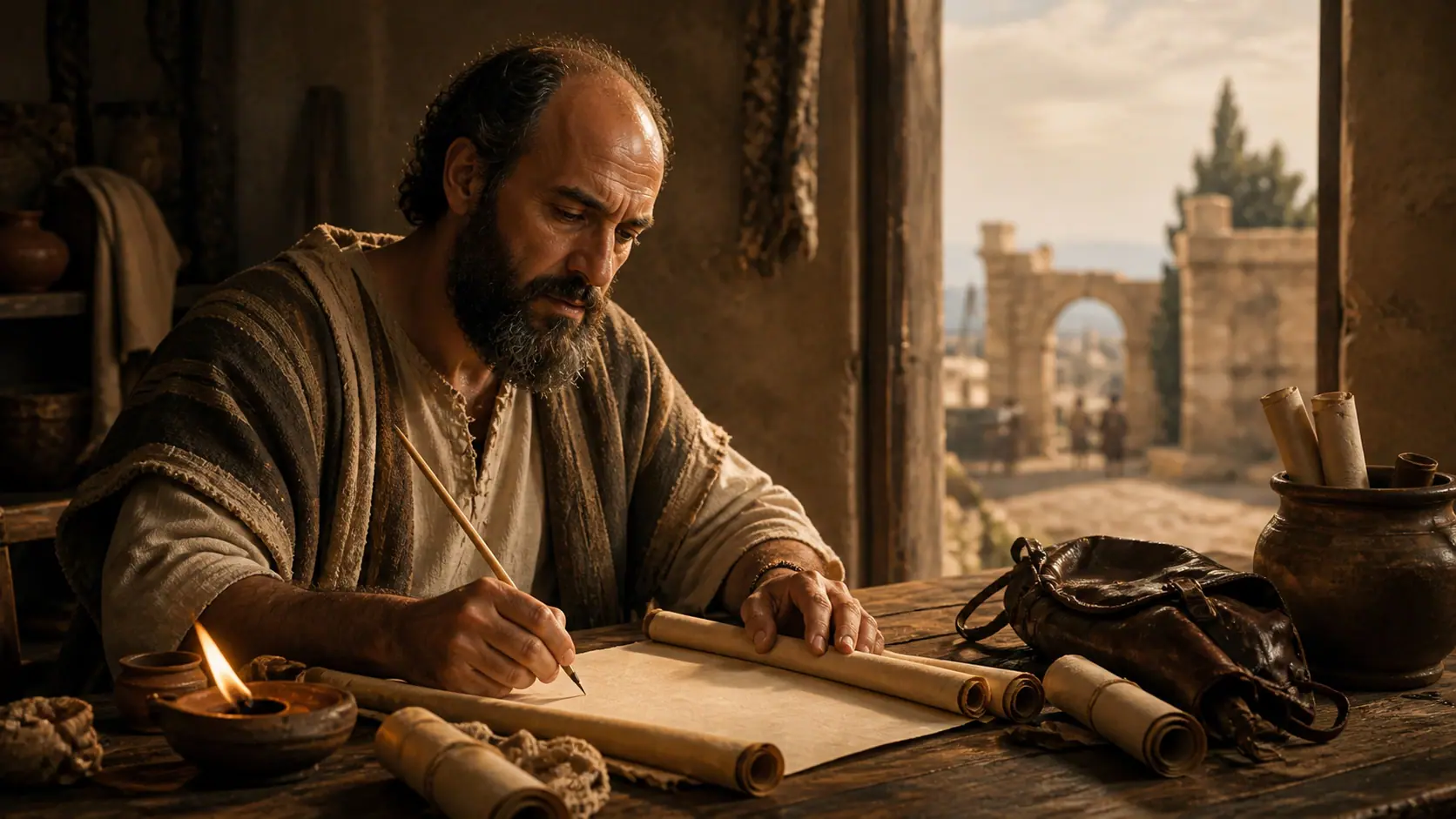
Writing a letter also involved other people. Several openings name coworkers alongside Paul, and Romans 16:22 includes a greeting from Tertius, who wrote the letter. The illustration above imagines Paul writing; it is not a historical portrait or evidence that he personally penned every letter.
Romans 1:1; 3:21–28; 16:22; 1 Corinthians 1:1; 12:12–27; 15:12–23; Philemon 1–2, 8–21 · Read a Bible publisher’s introduction to the letters and authorship questions →
Arrest in Jerusalem and the voyage to Rome
A crowd attacked Paul in Jerusalem after accusers alleged that he had brought a Gentile into the temple. Acts says they had seen Trophimus with him in the city and assumed Paul had taken him inside. Roman soldiers intervened and took Paul into custody. His nephew later uncovered an ambush plot, and Paul was transferred to Caesarea.
Felix left Paul in custody for two years. Under Festus, Paul appealed to Caesar. He also explained his case before King Agrippa. On the voyage to Italy, a storm wrecked the ship, but all 276 people reached land safely. They were on Malta, where they stayed three months before continuing the journey.
In Rome, Paul was allowed to live with a soldier guarding him. Acts closes with two years in his own rented dwelling, welcoming visitors and teaching about Jesus unhindered. It does not give the outcome of his appeal. Romans 15 records his hope of traveling to Spain, not proof that he reached it.
Acts 21:27–36; 23:12–35; 24:27; 25:1–12; 26; 27:37–28:31; Romans 15:22–29
How did Paul die? Scripture and later testimony
The New Testament does not narrate Paul’s execution. In 2 Timothy 4:6–8, he speaks of his approaching departure and looks toward the Lord’s reward, but the passage does not describe a method of execution or supply a date.
Writing later, Eusebius reports that Paul was beheaded in Rome during Nero’s reign (Church History 2.25.5). This is a source for the Christian tradition about Paul’s martyrdom, distinct from the account in Acts, which leaves him alive. An exact execution date should not be presented as a biblical fact.
Acts 28:30–31; 2 Timothy 4:6–8; Eusebius, Church History 2.25.5 · Read Eusebius’s report in Church History, Book 2, chapter 25 →
Two names, not a narrated renaming
What do the names Saul and Paul mean?
Saul is the Hebrew name Sha’ul, understood as “asked for.” Paul comes from the Latin Paulus, meaning “small” or “little.” Acts 13:9 identifies Saul as also called Paul; it does not describe a name change at conversion. The meaning of Paul’s name does not establish his height or explain why he used it.
The life arc in Scripture
Paul’s life in brief
Acts 7:58–8:3; 9:1–19
Saul persecutes the church and encounters Jesus
Galatians 1:15–24; Acts 9:26–30
Arabia, Damascus, and an early visit to Jerusalem
Acts 11:25–26; 13:1–14:28
Antioch sends Paul and Barnabas
Acts 15:1–21; 15:36–18:22
The Jerusalem decision and wider mission
Acts 18:23–21:17
Teaching, conflict, and a return to Jerusalem
Acts 21:27–28:31
Arrest, trials, shipwreck, and witness in Rome
Family and companions
Paul’s family and relationships
Paul’s recorded network is unusually broad: mentors, coworkers, hosts, church leaders, opponents, and entire congregations. Scripture mentions a sister and nephew but gives no complete family tree and does not name a wife.
Barnabas
Barnabas introduces Saul to the Jerusalem apostles, recruits him for Antioch, and travels with him before they later separate over John Mark.
Priscilla and Aquila
Paul stays and works with this married couple in Corinth. They travel with him to Ephesus and later help teach Apollos more accurately (Acts 18:1–3, 18–26).
Timothy
Paul calls Timothy his true child in the faith and sends him to strengthen and represent his ministry among churches.
Paul’s sister and nephew
Paul’s unnamed nephew hears of an ambush and warns Paul and the Roman commander in Jerusalem.
What the text says—and does not say
Common questions about Paul
Saul was also called Paul
Acts introduces the Roman name without describing a divine renaming. The name Paul then becomes the narrator’s normal usage.
Acts 13:9Paul was a Pharisee, Roman citizen, and tentmaker
He identifies himself as a Pharisee and a Roman citizen by birth. Acts also records him working with Priscilla and Aquila as a tentmaker.
Acts 18:3; 22:3, 25–29; 23:6The Bible does not name Paul’s wife or children
Paul writes as an unmarried person in 1 Corinthians 7, but Scripture does not settle whether he had never married, was widowed, or had another earlier circumstance.
1 Corinthians 7:7–8Paul’s execution is not narrated in the Bible
Eusebius reports Paul’s beheading in Rome under Nero. That testimony is later than the New Testament; Acts ends with Paul still alive.
Acts 28:16–31; Eusebius, Church History 2.25.5Follow the biblical accounts
Explore Paul’s connected stories and guides
Paul’s Conversion
Follow Saul on the road to Damascus through blindness, Ananias, baptism, and a new commission.
Read more →Ephesians 6 guideArmor of God: Six Pieces and Their Meaning
Read Paul’s picture of truth, righteousness, peace, faith, salvation, God’s word, and prayer in its biblical context.
Read more →