%20scale(.87)'%3e%3cg%20transform='rotate(-3%2032%2034)'%3e%3cpath%20d='M10.5%2019.5c7.65-2.35%2014.8-.45%2021.5%205.7%206.7-6.15%2013.85-8.05%2021.5-5.7v27.2c-7.65-2.15-14.8-.45-21.5%205.1-6.7-5.55-13.85-7.25-21.5-5.1V19.5Z'%20fill='%23fff'%20stroke='%23171528'%20stroke-width='4.5'%20stroke-linejoin='round'/%3e%3cpath%20d='M32%2025.2v26.6'%20stroke='%23171528'%20stroke-width='4'%20stroke-linecap='round'/%3e%3cpath%20d='M17.5%2034.5h9M22%2030v9'%20stroke='%23171528'%20stroke-width='3.75'%20stroke-linecap='round'/%3e%3ccircle%20cx='41.5'%20cy='32.5'%20r='2.5'%20fill='%23171528'/%3e%3ccircle%20cx='46.5'%20cy='38'%20r='2.5'%20fill='%23171528'/%3e%3c/g%3e%3c/g%3e%3c/svg%3e)
The quick answer
Who was Esau in the Bible?
Esau was Isaac and Rebekah’s older twin son, Jacob’s brother, a skillful hunter, and the ancestor associated with Edom. Genesis remembers him for trading his birthright, losing Isaac’s intended blessing, and later receiving Jacob peacefully. His wider biography also includes three wives in the Genesis 36 summary, five named sons, great possessions, settlement in Seir, and a large line of descendants. The Bible does not state his age or cause of death.
Why he matters
Why is Esau important in the Bible?
Jacob’s older twin
His relationship with Jacob frames questions of firstborn status, family favoritism, conflict, and reconciliation.
The ancestor called Edom
Genesis 36 moves from one man’s household to the chiefs and early rulers connected with Edom.
A figure later writers revisit
Malachi, Romans, and Hebrews refer to Esau when discussing Edom, divine purpose, and the value of the birthright.
Two names and two word associations
What do Esau and Edom mean?
Esau is commonly connected with being hairy or rough because Genesis describes him at birth as covered like a hairy garment. The exact etymology is not fully certain. Edom is more directly linked with “red”: Genesis 25:30 connects the name with Esau’s request for Jacob’s red food. The text describes Esau as red, but it does not specifically say he was red-headed.
A biography beyond one famous meal
Esau’s life from older twin to father of Edom
Esau’s life moves from his parents’ household to a family of his own in Seir. Genesis records both his anger toward Jacob and their later reunion.
Genesis 25:21–26
Esau is born first to Isaac and Rebekah
Genesis 25:27–34
He becomes a hunter and sells his birthright
Genesis 26:34–35
Esau marries and forms his own household
Genesis 27:30–28:9
He loses the intended blessing and threatens Jacob
Genesis 32:3; 33:1–17; 35:29
He welcomes Jacob and later helps bury Isaac
No biblical lifespan is given
How did Esau die?
The Bible does not record Esau’s cause of death, age at death, or burial. Genesis says he was forty when he married Judith and Basemath, and its final extended account traces his family in Seir. Claims about the exact manner or year of his death come from later tradition, not the biblical text.
Appearance and behavior before labels
What did Esau look like, and what was his character like?
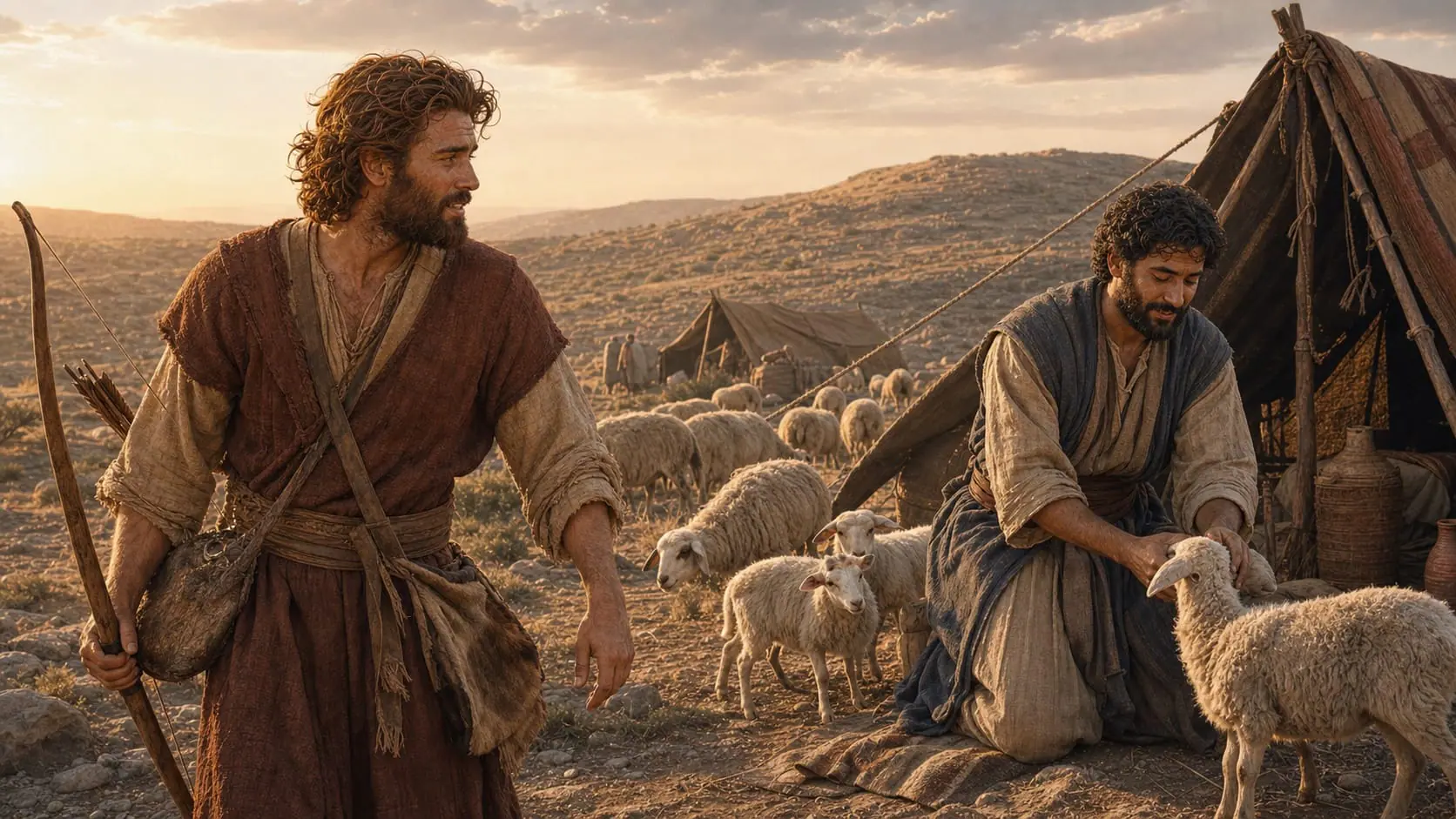
Esau is described as red and hairy at birth, and his hairy skin matters again when Jacob impersonates him. Genesis later records both his threat to kill Jacob and his peaceful embrace of him. Hebrews 12:16 calls him profane, using the sale of his birthright as a warning.
Active and capable in the field
Esau develops the demanding skill of hunting and becomes closely associated with life outdoors.
This describes his vocation; it does not establish a complete modern personality type.Driven by an immediate appetite
He exchanges a long-term firstborn privilege for an immediate meal, and Genesis says he despised the birthright.
This exchange happens before the separate episode in which Jacob deceives Isaac to obtain the blessing.Deeply hurt and dangerously angry
Esau weeps over the lost blessing and then plans to kill Jacob after Isaac’s death.
His anger is real in Genesis 27, but it is not the final scene between the brothers.Peaceful and generous at the reunion
He runs to meet Jacob, embraces him, weeps with him, and initially says he already has enough.
Genesis shows reconciliation; it does not use the explicit word forgiveness in this scene.Esau’s family tree
Parents, wives, sons, and descendants
Genesis 36 names five sons and also mentions daughters without naming them. The genealogical chapter then follows grandchildren and clan leaders connected with Edom.
Eliphaz
Esau’s firstborn; his line includes Teman and Amalek.
Reuel
Father of Nahath, Zerah, Shammah, and Mizzah.
Jeush & Jalam
Two of three sons born to Oholibamah in Canaan.
Korah
The fifth named son in the Genesis 36 household list.
A real naming difficulty in Genesis
Who were Esau’s wives?
Genesis 36 names three wives: Adah, Oholibamah, and Basemath. The earlier accounts use different names and parentage in places. Genesis does not explain how all the names correspond, so alternate-name explanations remain interpretations rather than an explicit statement in the text.
Judith and Basemath
At forty, Esau marries Judith daughter of Beeri and Basemath daughter of Elon, both Hittites.
Genesis 26:34–35Mahalath
Esau later marries Mahalath, daughter of Ishmael and sister of Nebaioth.
Genesis 28:6–9Adah, Oholibamah, and Basemath
Adah is Elon’s daughter, Oholibamah is Anah’s daughter, and Basemath is Ishmael’s daughter. Notice that Basemath has a different father here from the Basemath in Genesis 26.
Genesis 36:1–5Alternate names or additional wives?
The biblical text does not tell readers exactly how the earlier names correspond to the Genesis 36 list.
Harmonizations require interpretationFrom one household to a people
Esau’s descendants and the nation of Edom
Genesis 36 gathers Esau’s family records and explains why he and Jacob could not remain together: the land could not support both households’ livestock. This is not a new move that must come after Isaac’s death just because it appears in the next chapter. Genesis 32:3 and 33:16 already locate Esau in Seir before that death is reported.
Five named sons
Eliphaz, Reuel, Jeush, Jalam, and Korah anchor the first generation in Genesis 36.
Genesis 36:4–5The hill country of Seir
Esau moves away from Jacob because their possessions are too great for the land to support both households.
Genesis 36:6–8Esau is Edom
The chapter repeatedly identifies Esau with Edom and traces chiefs descended from his family.
Genesis 36:1, 8–19Rulers before Israel’s monarchy
Genesis concludes with kings and chiefs who ruled in the land associated with Edom.
Genesis 36:31–43A question that needs its full context
Why does the Bible say, “Jacob I loved, but Esau I hated”?
In Malachi 1:2–4, God answers Israel’s question about his love by contrasting Jacob with Esau and describing judgment on Edom. Esau’s mountains and inheritance refer to the land of his descendants. The passage concerns the histories of two peoples as well as their ancestors.
Romans 9:10–16 brings together the word to Rebekah before the twins’ birth and the later quotation from Malachi. Paul emphasizes God’s purpose, calling, and mercy rather than human works. Christian traditions differ over the full scope of election in this chapter; the quotation should not be used as a shortcut for declaring one brother’s every action good and the other’s every action bad.
Esau also represents Edom
Malachi names Edom and describes its ruined land and God’s judgment against its rebuilding.
Malachi 1:2–4Purpose and calling
Romans recalls the twins before birth while discussing the freedom of God’s purpose rather than human achievement.
Romans 9:10–16Choice, mercy, and judgment
Read both passages in full: Malachi speaks of judgment on Edom, while Romans uses the quotation in Paul’s argument about God’s choice and mercy.
Malachi 1:1–5; Romans 9:6–18Follow the people and passages
Esau’s loss, anger, and reunion with Jacob
Esau’s life intersects with Jacob’s at the birthright, their father’s blessing, and their meeting years later. The Jacob and Esau story follows those encounters, including Esau’s embrace of the brother he had once threatened.
Isaac in the Bible
Explore Isaac’s name, wife, sons, wells, faith, exact ages, death, and burial.
Meet Isaac →Mother’s profileRebekah in the Bible
Read Rebekah’s family, character, faith, age questions, burial, and influence.
Meet Rebekah →Genesis 25–33Jacob and Esau Story
Follow the complete birthright, blessing, separation, fear, and reunion narrative.
Read the full story →Twin’s profileJacob in the Bible
Explore Jacob’s names, wives, twelve sons, age, burial, and legacy as Israel.
Meet Jacob →