%20scale(.87)'%3e%3cg%20transform='rotate(-3%2032%2034)'%3e%3cpath%20d='M10.5%2019.5c7.65-2.35%2014.8-.45%2021.5%205.7%206.7-6.15%2013.85-8.05%2021.5-5.7v27.2c-7.65-2.15-14.8-.45-21.5%205.1-6.7-5.55-13.85-7.25-21.5-5.1V19.5Z'%20fill='%23fff'%20stroke='%23171528'%20stroke-width='4.5'%20stroke-linejoin='round'/%3e%3cpath%20d='M32%2025.2v26.6'%20stroke='%23171528'%20stroke-width='4'%20stroke-linecap='round'/%3e%3cpath%20d='M17.5%2034.5h9M22%2030v9'%20stroke='%23171528'%20stroke-width='3.75'%20stroke-linecap='round'/%3e%3ccircle%20cx='41.5'%20cy='32.5'%20r='2.5'%20fill='%23171528'/%3e%3ccircle%20cx='46.5'%20cy='38'%20r='2.5'%20fill='%23171528'/%3e%3c/g%3e%3c/g%3e%3c/svg%3e)
The quick answer
Who was Jonah in the Bible?
Jonah son of Amittai was an Israelite prophet from Gath Hepher (2 Kings 14:25). He is known for fleeing God’s command to preach in Nineveh and being swallowed by a great fish. But the Book of Jonah does not end with his rescue: after he delivers God’s warning, he becomes angry that Nineveh is spared. God’s final question challenges the prophet’s concern for a plant beside his resistance to mercy for a city.
What did Jonah prophesy about Israel?
Second Kings 14:25 identifies Jonah as the son of Amittai, from Gath Hepher. Israel’s King Jeroboam II restored territory from the entrance of Hamath to the sea of the Arabah, in accordance with God’s word through Jonah. The passage describes the fulfillment during Jeroboam’s reign; it does not date Jonah’s original announcement or place his journey to Nineveh before or after it.
The king is not praised for righteousness: verse 24 says he continued in sin. God saw Israel’s bitter suffering and delivered the people despite that failure. Read beside Jonah 4, this offers a striking contrast: the prophet associated with mercy for Israel becomes angry when Nineveh receives mercy.
Did Jonah change after he was rescued?
Jonah prays from the fish’s belly, thanking God for hearing him in distress and promising sacrifice. The prayer describes deliverance, but it does not explicitly contain an apology for refusing the mission. Chapter 3 shows a change in his actions: when the command comes again, he goes to Nineveh.
His response to the city’s rescue is different. He becomes angry and asks to die, explaining that he fled because he knew God could show mercy. Outside the city, he welcomes shade from a plant but is furious when it withers. God asks why Jonah cares for the plant but objects to compassion for a city full of people and animals.
The book records no answer to God’s final question. It does not tell us that Jonah finally agreed, returned home, or changed his attitude for good. Readers have to face the question without an invented happy ending.
Jonah 2:1–10; 3:1–3; 4:1–11 · Follow the storm, rescue, and unresolved ending in Jonah’s story →
A prophet named for a dove
What does the name Jonah mean?
Jonah is the Hebrew name Yonah, also the word for “dove.” The book does not say who chose the name or why. The Brown–Driver–Briggs lexicon connects his father’s name, Amittai, with “true.” Neither name is an explanation of the prophet’s behavior: the story shows him both obeying and resisting God.
The life arc in Scripture
Jonah’s life in brief
2 Kings 14:23–27
A prophecy fulfilled under Jeroboam II
Jonah 1:1–16
He flees toward Tarshish instead of Nineveh
Jonah 1:17–2:10
Jonah prays from inside a great fish
Jonah 3:1–10
He preaches and Nineveh responds
Jonah 4:1–11
Jonah argues about mercy outside the city
Family and companions
Jonah’s family and relationships
Jonah’s book gives few family details. His father and hometown are named, while most relationships are encounters with sailors, Ninevites, and God’s persistent call.
Amittai
Named in both 2 Kings and the opening line of Jonah.
The sailors
They move from fear of the storm to prayer, sacrifice, and vows to Yahweh.
The people of Nineveh
They believe the warning, turn from violence, and seek mercy.
Yahweh
God calls, pursues, rescues, recommissions, questions, and teaches Jonah.
What the text says—and does not say
Common questions about Jonah
Why do readers say “fish” or “whale”?
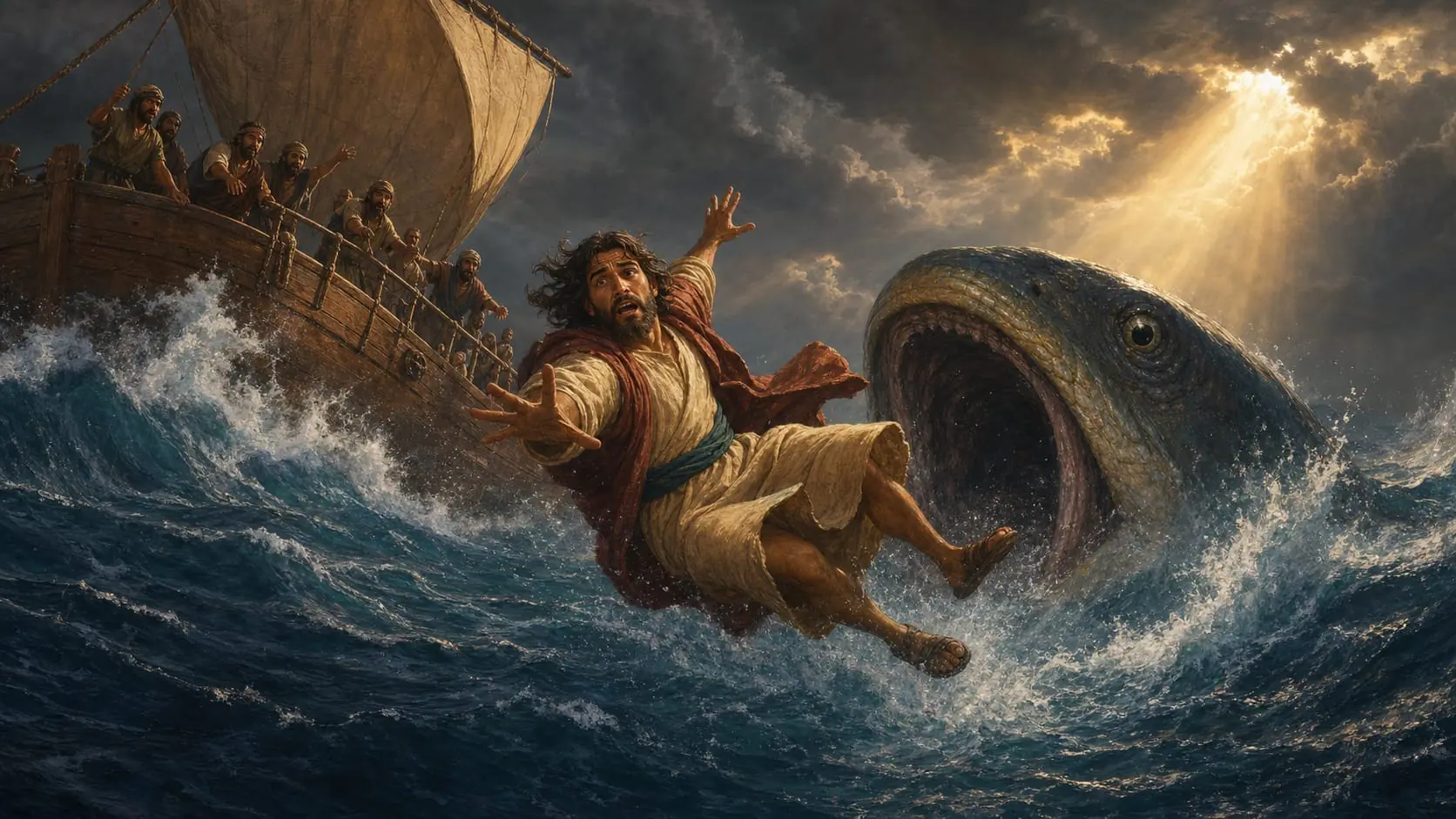
Jonah 1:17 says “huge fish” in the WEB and “great fish” in the KJV. The KJV uses “whale” in Matthew 12:40. Neither identifies a modern species. The cover combines the storm and the fish in one imagined scene; Jonah 1:15 says the sea stopped raging after he was thrown overboard.
Jonah 1:15–17; Matthew 12:40Jonah was a prophet from Gath Hepher
Second Kings identifies Jonah son of Amittai and his hometown while recounting Jeroboam II’s restoration of Israel’s borders.
2 Kings 14:25Jonah’s mother, wife, and children are not named
Only his father Amittai appears in the biblical family identification.
2 Kings 14:25; Jonah 1:1The book does not tell us how Jonah died
Jonah ends with God’s question, not a death or burial account. No age at death or burial place is supplied by the biblical passages about him.
Jonah 4:11Follow the biblical accounts