%20scale(.87)'%3e%3cg%20transform='rotate(-3%2032%2034)'%3e%3cpath%20d='M10.5%2019.5c7.65-2.35%2014.8-.45%2021.5%205.7%206.7-6.15%2013.85-8.05%2021.5-5.7v27.2c-7.65-2.15-14.8-.45-21.5%205.1-6.7-5.55-13.85-7.25-21.5-5.1V19.5Z'%20fill='%23fff'%20stroke='%23171528'%20stroke-width='4.5'%20stroke-linejoin='round'/%3e%3cpath%20d='M32%2025.2v26.6'%20stroke='%23171528'%20stroke-width='4'%20stroke-linecap='round'/%3e%3cpath%20d='M17.5%2034.5h9M22%2030v9'%20stroke='%23171528'%20stroke-width='3.75'%20stroke-linecap='round'/%3e%3ccircle%20cx='41.5'%20cy='32.5'%20r='2.5'%20fill='%23171528'/%3e%3ccircle%20cx='46.5'%20cy='38'%20r='2.5'%20fill='%23171528'/%3e%3c/g%3e%3c/g%3e%3c/svg%3e)
The quick answer
What happened in the Jonah and the whale story?
God told Jonah to preach against Nineveh, but Jonah boarded a ship headed toward Tarshish. God sent a violent storm. After the sailors learned Jonah was fleeing from Yahweh, Jonah told them to throw him into the sea. The storm stopped, and a huge fish swallowed him.
Jonah spent three days and three nights in the fish and prayed from its belly. At God’s command, the fish vomited him onto dry land. Jonah obeyed the second call and warned Nineveh. The city turned from evil, so God spared it. Jonah became angry, and God used a plant, a worm, and an east wind to confront his resistance to mercy.
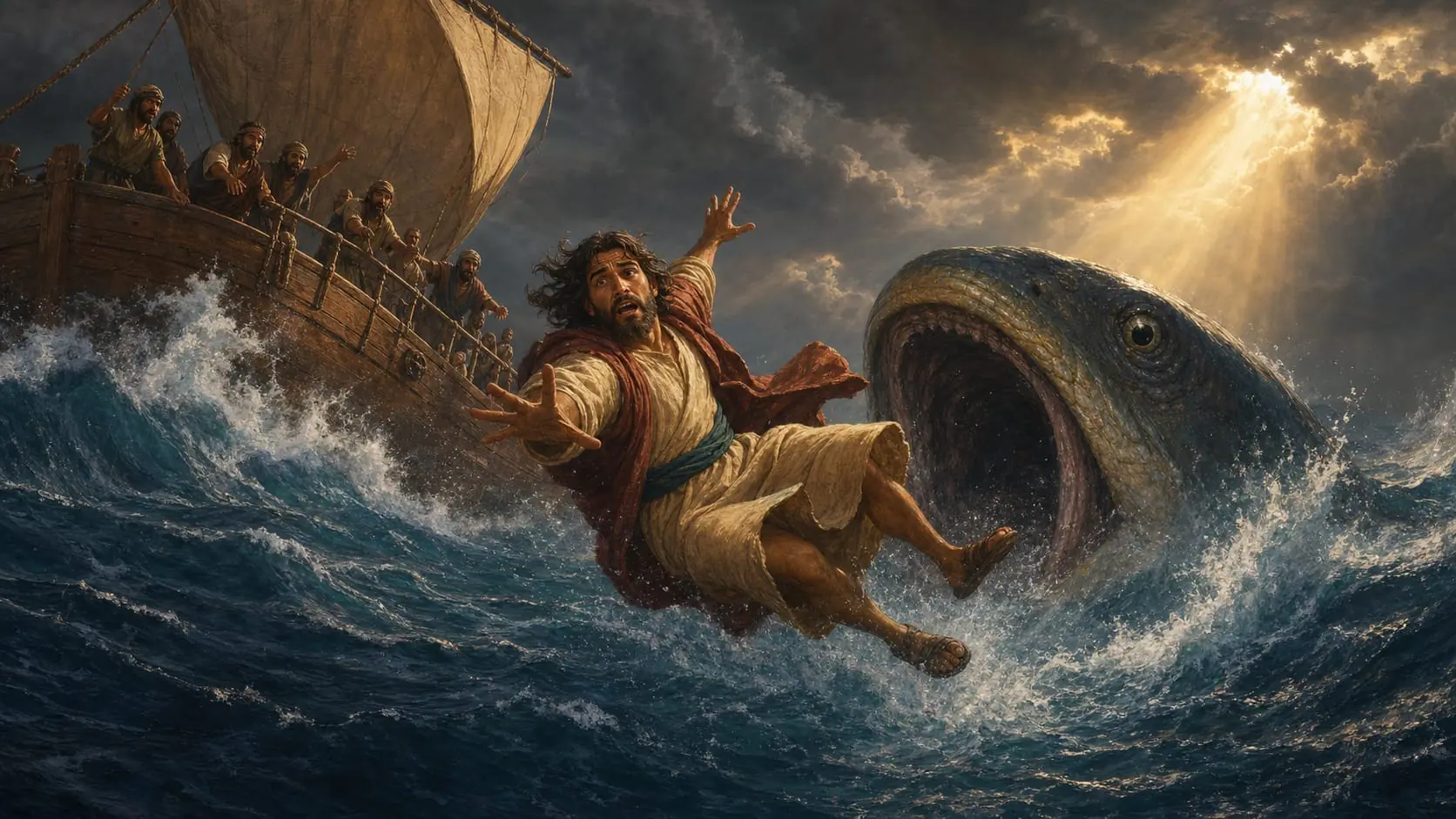
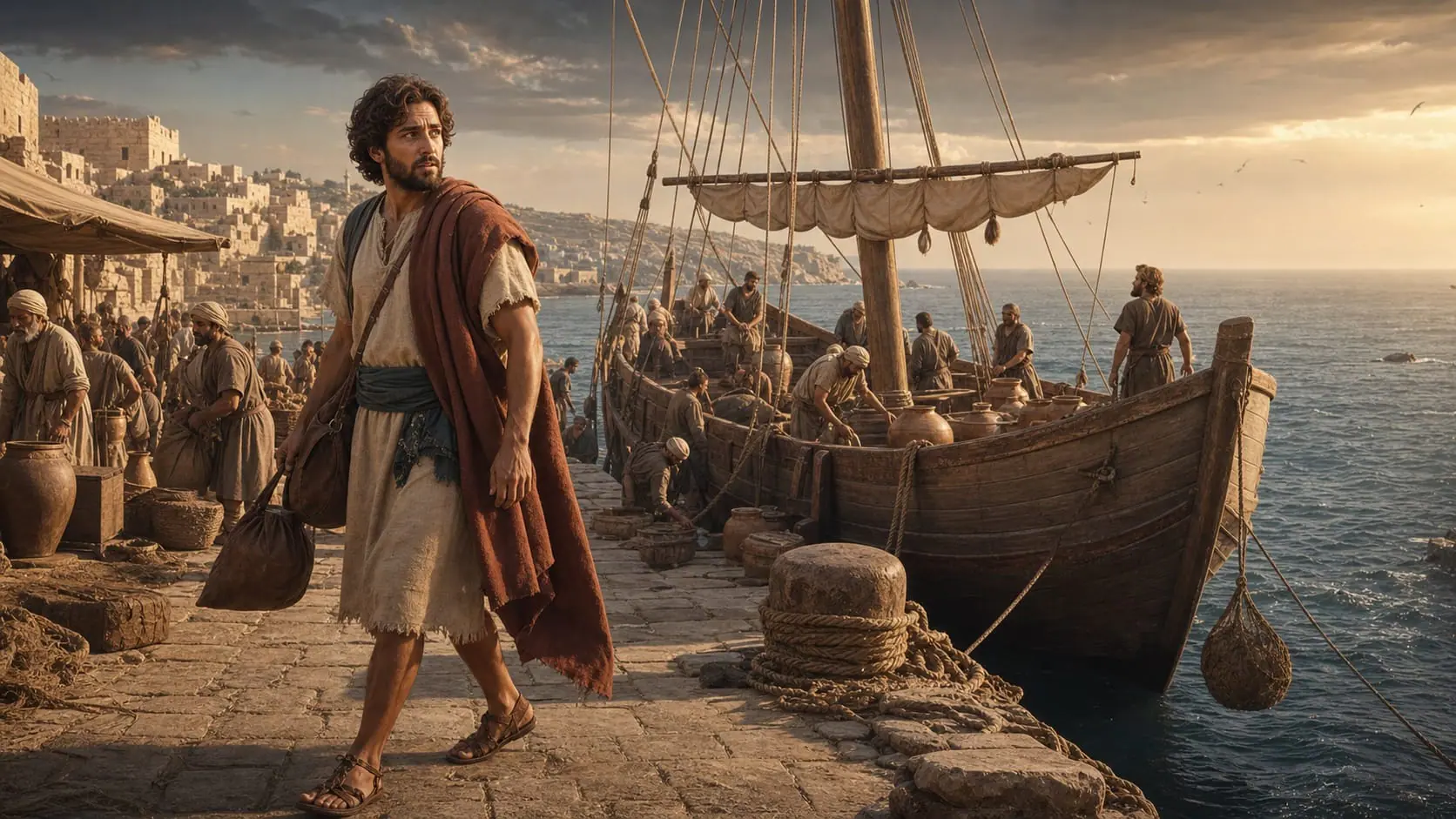
The illustrations imagine Jonah’s appearance, the ship, and the city. The cover combines the storm, Jonah’s fall, and the fish in one scene; Jonah 1:15 says the sea stopped raging after the sailors threw him overboard.
The full story
The Story of Jonah, the Great Fish, and Nineveh
God sends Jonah to Nineveh
Yahweh’s word came to Jonah son of Amittai: he was to go to the great city of Nineveh and preach against its wickedness. Nineveh was an Assyrian city far to Israel’s northeast.
Instead of going to Nineveh, Jonah traveled down to Joppa, found a ship going to Tarshish, paid the fare, and went aboard to flee from Yahweh’s presence. The book names his intended destination but does not map his sailing route. Jonah 1:1–3
A great storm threatens the ship
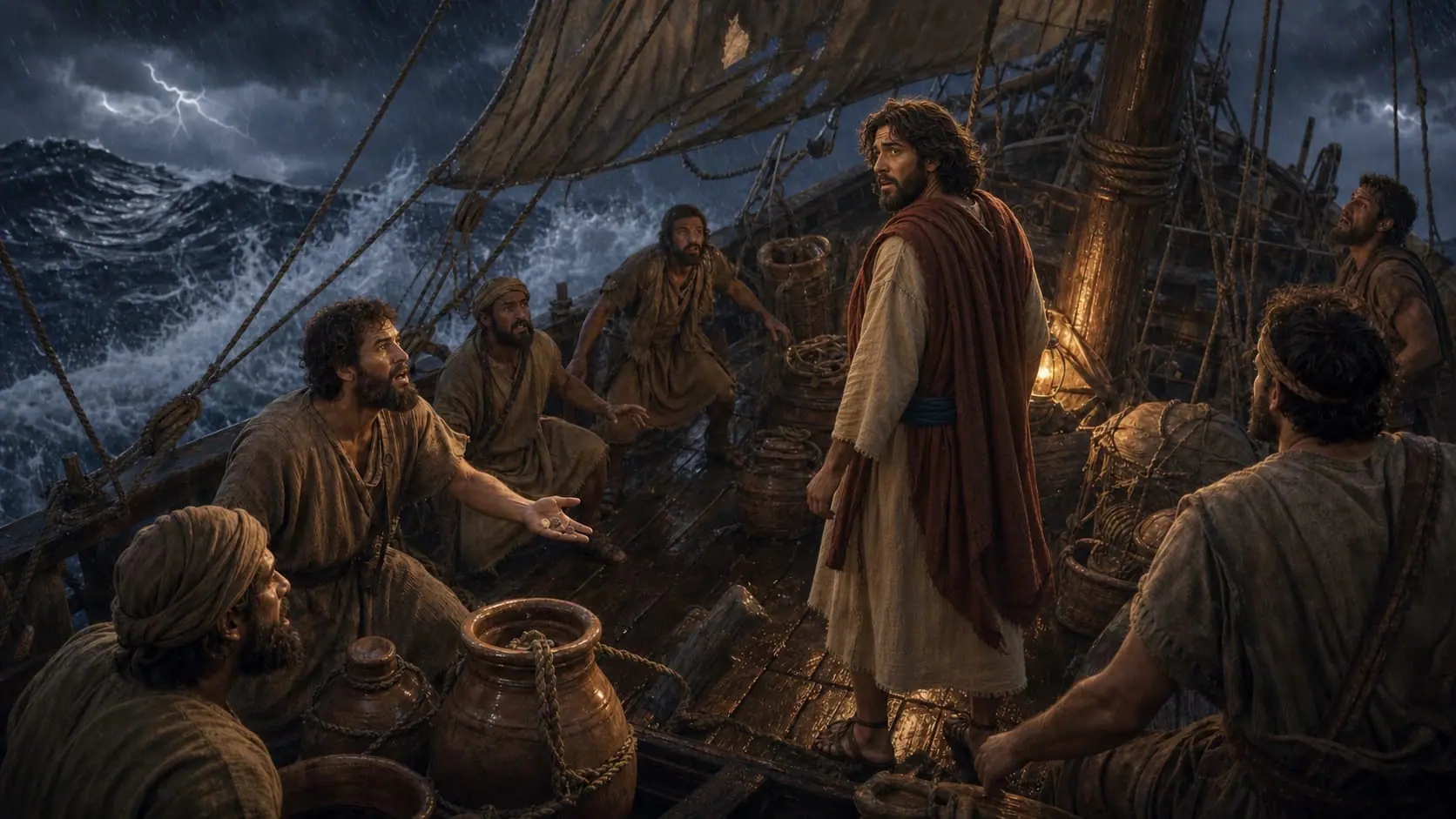
Yahweh sent a great wind, and the ship was in danger of breaking apart. The sailors cried to their gods and threw cargo overboard. Jonah, however, was asleep in the innermost part of the ship until the captain woke him and told him to pray.
The sailors cast lots to discover who was responsible, and the lot fell on Jonah. He identified himself as a Hebrew who feared Yahweh, the God of heaven who made the sea and dry land, and admitted that he was fleeing. Jonah 1:4–10
Jonah is thrown into the sea
Jonah told the sailors to throw him into the sea so it would become calm. They first rowed hard toward land, showing that they did not rush to harm him. When their effort failed, they prayed to Yahweh and cast Jonah overboard.
The sea immediately ceased its raging. The sailors feared Yahweh, offered a sacrifice, and made vows. Jonah’s disobedience had brought danger, but the pagan sailors now responded to Israel’s God with reverence. Jonah 1:11–16
Yahweh prepared a huge fish to swallow up Jonah, and Jonah was in the belly of the fish three days and three nights.
Three days and three nights in the great fish
God appointed a huge fish to swallow Jonah. The fish is not presented only as punishment: it also saves him from drowning. Jonah remained inside it for three days and three nights.
The text does not say at what point during that time Jonah began praying. In Matthew 12:40, Jesus compares Jonah’s time in the fish with the Son of Man’s time in the heart of the earth. In verse 41, he also points to Nineveh’s repentance and says someone greater than Jonah is here. Jonah 1:17–2:1; Matthew 12:38–41
Jonah prays from the fish’s belly
Jonah’s prayer in chapter 2 looks back on his descent into the sea. He describes waves passing over him, weeds around his head, and the earth seeming to bar him in. Yet he remembers Yahweh and looks again toward the holy temple.
The prayer ends with thanksgiving, promised sacrifice, and the confession, “Salvation belongs to Yahweh.” God then spoke to the fish, and it vomited Jonah onto dry land. The text does not name that landing place. Jonah 2:1–10
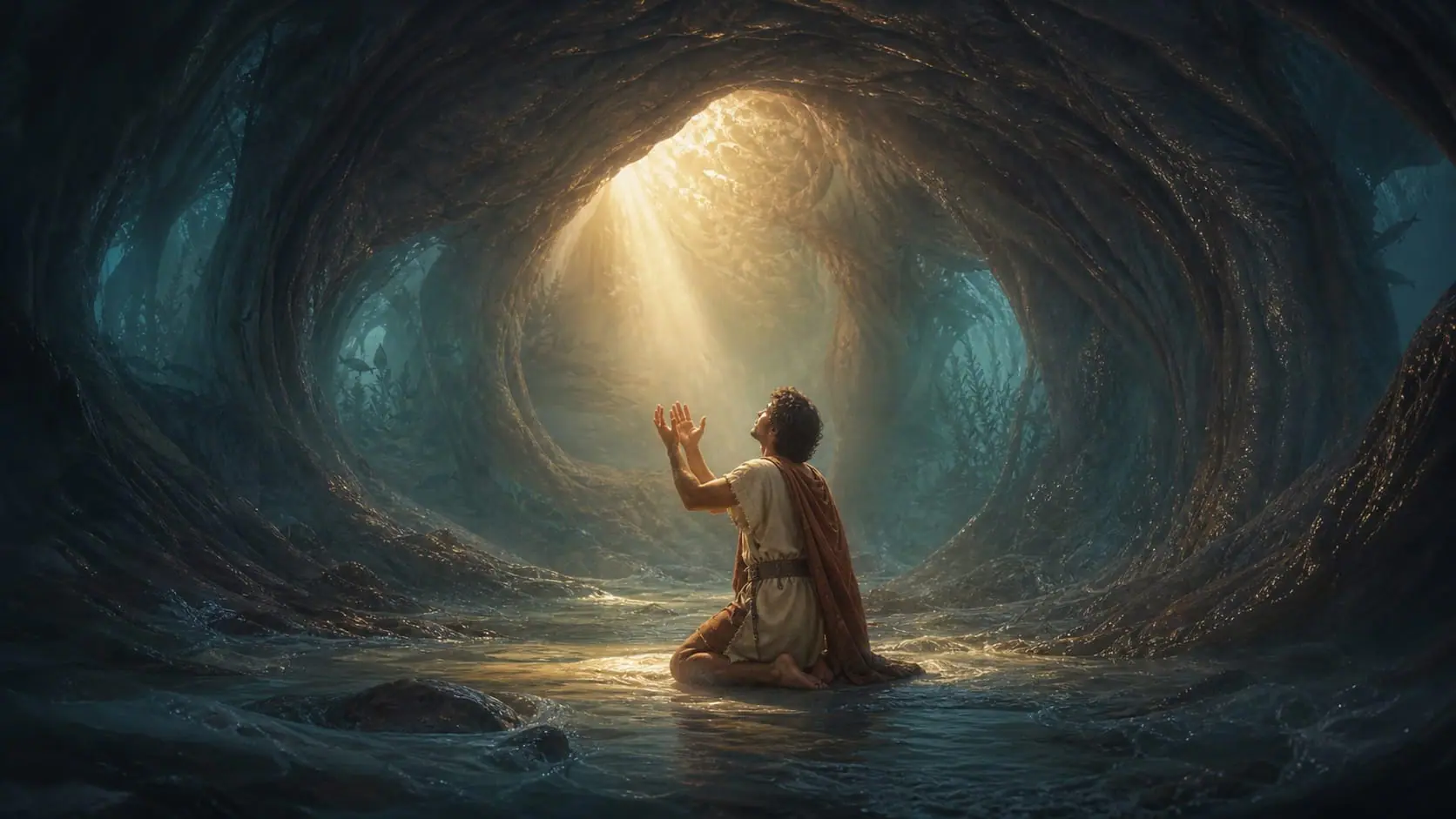
But I will sacrifice to you with the voice of thanksgiving. I will pay that which I have vowed. Salvation belongs to Yahweh.”
Jonah preaches in Nineveh
Yahweh’s word came to Jonah a second time. This time Jonah went to Nineveh and announced, “In forty days, Nineveh will be overthrown!”
The people believed God, proclaimed a fast, and put on sackcloth. When the news reached the king, he left his throne, removed his robe, covered himself with sackcloth, and sat in ashes. He and his nobles ordered people and animals to go without food or water and wear sackcloth. The decree called for urgent prayer and for people to turn from evil and violence. The king hoped for mercy; he did not claim to know that it was guaranteed. Jonah 3:1–9
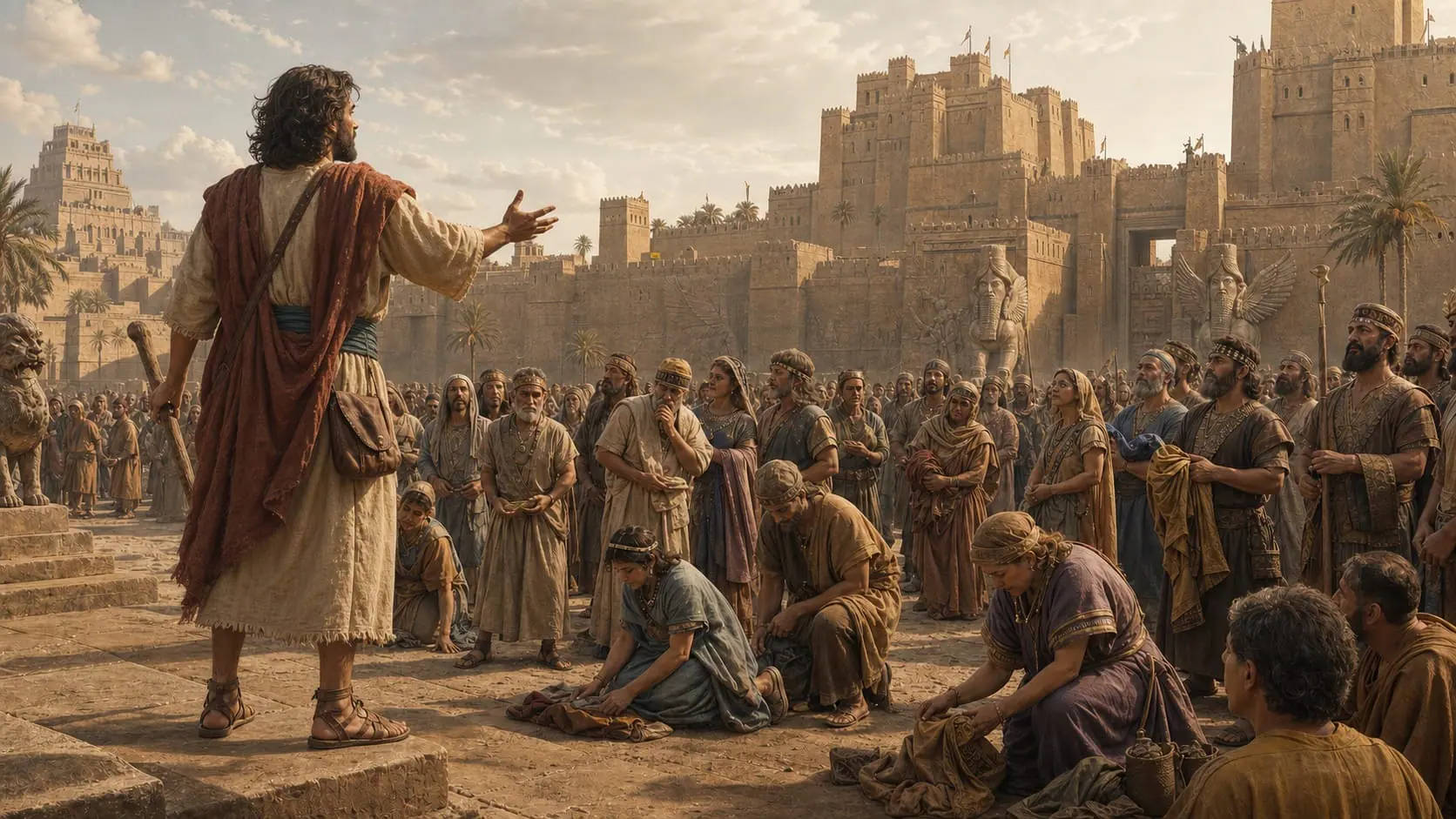
God saw their works, that they turned from their evil way. God relented of the disaster which he said he would do to them, and he didn’t do it.
God spares Nineveh—and Jonah becomes angry
When God saw that Nineveh turned from its evil way, he did not bring the announced disaster. Jonah was not pleased. He finally explained why he had fled: he knew God was gracious, merciful, slow to anger, abundant in loving kindness, and willing to relent.
Jonah asked God to take his life, saying he would rather die than live. God asked whether it was right for him to be angry. Jonah went east of the city, built a shelter, and waited to see what would happen. Jonah 3:10–4:5
The plant, the worm, and God’s final question
God provided a plant to shade Jonah, and Jonah was delighted. At dawn the next day, God sent a worm that made the plant wither. Then an east wind and the sun left Jonah faint, and he again wished for death. The WEB calls the plant a “vine”; the KJV calls it a “gourd.” The ESV’s note suggests a castor-oil plant, but marks the identification as probable.
God contrasted Jonah’s concern for a plant he had not grown with God’s concern for Nineveh—more than 120,000 people who could not discern their right hand from their left, as well as many animals. The book ends with God’s question still open for Jonah and the reader. Jonah 4:6–11
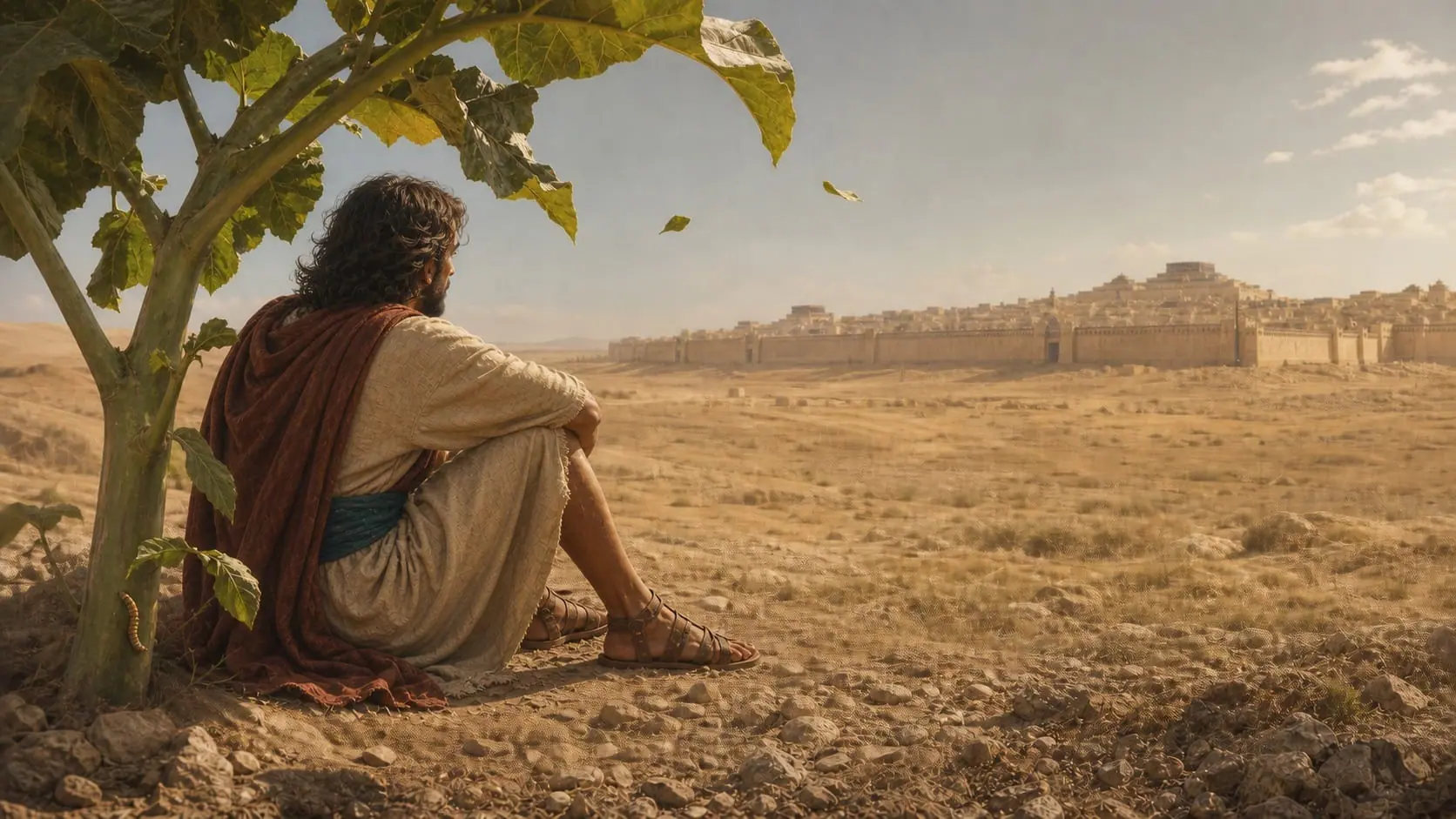
Yahweh said, “You have been concerned for the vine, for which you have not labored, neither made it grow; which came up in a night and perished in a night. Shouldn’t I be concerned for Nineveh, that great city, in which are more than one hundred twenty thousand persons who can’t discern between their right hand and their left hand, and also many animals?”
What the Bible actually says
Was Jonah Swallowed by a Whale or a Big Fish?
Jonah 1:17 says “huge fish” in the WEB and “great fish” in the KJV. However, “whale” is also biblical translation wording: the KJV’s Matthew 12:40 uses it when Jesus speaks about Jonah.
The Greek word in Matthew is kētos, which Thayer’s lexicon describes with terms for a large sea creature, whale, or huge fish. Neither passage identifies a modern species. The cover’s whale-like animal is an illustration, not proof of which creature swallowed Jonah.
Jonah also appears in 2 Kings 14:25, where his prophecy concerns Israel’s borders. Meet Jonah, the prophet from Gath Hepher, and explore how that account relates to the messenger sent to Nineveh. To recall other biblical people as well as prophets, try the Bible Characters Quiz; its rounds are not limited to Jonah.