%20scale(.87)'%3e%3cg%20transform='rotate(-3%2032%2034)'%3e%3cpath%20d='M10.5%2019.5c7.65-2.35%2014.8-.45%2021.5%205.7%206.7-6.15%2013.85-8.05%2021.5-5.7v27.2c-7.65-2.15-14.8-.45-21.5%205.1-6.7-5.55-13.85-7.25-21.5-5.1V19.5Z'%20fill='%23fff'%20stroke='%23171528'%20stroke-width='4.5'%20stroke-linejoin='round'/%3e%3cpath%20d='M32%2025.2v26.6'%20stroke='%23171528'%20stroke-width='4'%20stroke-linecap='round'/%3e%3cpath%20d='M17.5%2034.5h9M22%2030v9'%20stroke='%23171528'%20stroke-width='3.75'%20stroke-linecap='round'/%3e%3ccircle%20cx='41.5'%20cy='32.5'%20r='2.5'%20fill='%23171528'/%3e%3ccircle%20cx='46.5'%20cy='38'%20r='2.5'%20fill='%23171528'/%3e%3c/g%3e%3c/g%3e%3c/svg%3e)
The quick answer
Who was Joshua in the Bible?
Joshua was the son of Nun, from the tribe of Ephraim, and Moses’ assistant and successor. He led Israel’s fight against Amalek and, with Caleb, urged the people to trust God after scouting Canaan. After Moses died, Joshua led Israel across the Jordan and in the battles described in the Book of Joshua. He helped distribute the land, renewed the covenant at Shechem, and died at 110.
Serving Moses before leading Israel
Joshua first appears by name at Rephidim, where Moses sends him to fight Amalek. While Joshua leads the fighters, Aaron and Hur support Moses’ raised hands. Later Joshua accompanies Moses up Sinai and is with him when they hear the noise from the golden-calf celebration. Exodus 33:11 says Joshua remained at the tent of meeting when Moses returned to the camp; it does not describe a formal guard duty.
He also had to accept correction. When Eldad and Medad prophesied in the camp, Joshua asked Moses to stop them. Moses answered that he wished all God’s people had the Spirit. After scouting Canaan, Joshua and Caleb stood against the people’s demand to return to Egypt. God later chose Joshua to succeed Moses, who commissioned him before Eleazar the priest and the congregation.
Exodus 17:8–16; 24:13; 32:17–18; 33:11; Numbers 11:26–30; 14:6–10; 27:18–23 · Read about Moses and the transfer of leadership →
Across the Jordan: victories and failures
Joshua sent two spies to Jericho, where Rahab hid them and secured an oath for her household’s safety. These were not the twelve spies Moses had sent earlier. Israel then crossed the Jordan on dry ground while the priests stood in the river with the ark. At Gilgal they kept Passover, and the manna stopped after they ate the land’s produce.
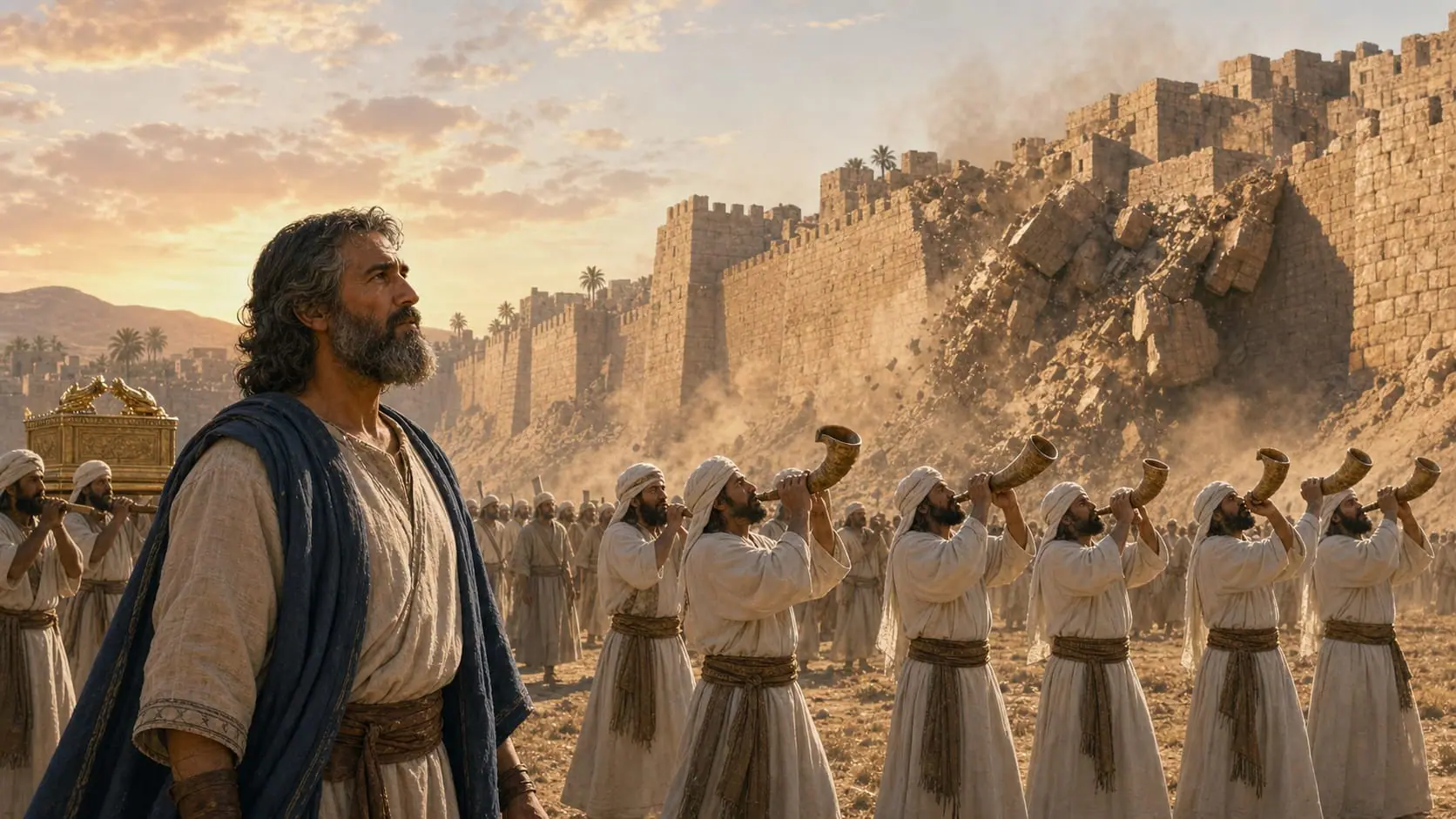
Before Jericho fell, Joshua met a man with a drawn sword who identified himself as commander of Yahweh’s army. Joshua bowed down and removed his sandals on holy ground. The passage does not give the commander a personal name. The following chapter describes six days of marching once around Jericho, then seven circuits on the seventh day before the walls fell and Rahab’s household was brought out.
The account also records the killing of Jericho’s men and women, young and old. Deuteronomy 9:4–6 presents the taking of Canaan as judgment and fulfillment of God’s promise, not a reward for Israel’s superior righteousness. These commands concerning ancient Israel are not a general permission to attack people of other beliefs; Jesus tells his followers to love their enemies in Matthew 5:43–48.
Victory did not make Joshua’s leadership trouble-free. Israel was defeated at Ai after Achan took forbidden goods from Jericho. Later Joshua made peace with the Gibeonites, whose worn supplies disguised their nearby origins; Israel’s leaders had not sought God’s counsel. They nevertheless honored their oath to let the Gibeonites live, and Joshua came to their aid when neighboring kings attacked.
Joshua 2–7; 9:3–27; 10:1–15; Deuteronomy 9:4–6; Matthew 5:43–48 · Read the Jericho account and Rahab’s rescue →
The land, the covenant, and Joshua’s last appeal
Joshua shared the distribution of inheritances with Eleazar and the tribal leaders. The book records towns for the Levites, cities of refuge for people who killed unintentionally, and the eastern tribes’ return home after helping their fellow Israelites. Joshua himself received Timnath-serah in Ephraim.
Joshua 21:43–45 celebrates God’s gift of the land and rest from enemies. Yet Joshua 13:1 says much land remained to be possessed, and 23:4–13 speaks of remaining nations and Israel’s continuing obligations. The book’s statements about fulfilled promises should not be turned into a claim that every community had already been driven out.
At Shechem, Joshua recalled what God had done from Abraham’s time onward. He told the people to put away other gods and serve Yahweh. Their promise to obey was followed by a warning about God’s holiness and the consequences of abandoning him. Joshua recorded the covenant words and set up a large stone as a witness; his appeal concerned worship and obedience, not simply choosing a personal ambition.
A renamed leader
What does the name Joshua mean?
Joshua comes from the Hebrew Yehoshua, commonly understood as “Yahweh is salvation” or “the LORD saves.” Numbers 13:8, 16 gives his earlier name, Hoshea, meaning “salvation,” and says Moses called him Joshua. Exodus already uses the name Joshua, so the note in Numbers should not be treated as a scene that precisely dates the change. In Greek, Joshua’s name is Iēsous, also the name rendered Jesus. This explains why the KJV says “Jesus” in Hebrews 4:8 while the WEB says “Joshua”: that verse refers to Moses’ successor, not Jesus of Nazareth.
Joshua: Hebrew name and lexical sources
The life arc in Scripture
Joshua’s life in brief
Exodus 17:8–16; 24:12–18; 33:7–11
Warrior and assistant beside Moses
Numbers 13–14
Joshua and Caleb bring a minority report
Numbers 27:12–23; Deuteronomy 31
He is publicly commissioned as Moses’ successor
Joshua 1–6
Jordan crossing and the fall of Jericho
Joshua 7–24
Campaigns, land allotments, and a final covenant
Family and companions
Joshua’s family and relationships
Joshua’s father was Nun, and Numbers 13:8 identifies his tribe as Ephraim. Joshua speaks of his household in Joshua 24:15, but the biblical accounts do not name his mother, wife, or children. This silence does not establish that he was unmarried or childless.
Nun
Joshua is repeatedly called son of Nun, though the Bible provides no extended story about Nun.
Moses
Joshua serves Moses for years and is publicly commissioned to continue leadership after his death.
Caleb
Joshua and Caleb oppose the fearful majority and later enter the land with the new generation.
Eleazar
Numbers 27:21 directs Joshua to seek God’s judgment through Eleazar and the Urim. They later distribute land with the tribal leaders (Joshua 14:1).
What the text says—and does not say
Common questions about Joshua
Moses changed Hoshea’s name to Joshua
Numbers names Hoshea son of Nun among the spies and then notes the new name Joshua.
Numbers 13:8, 16Joshua belonged to Ephraim
The spy list identifies him as the representative from the tribe of Ephraim.
Numbers 13:8Joshua’s household is not named
Joshua commits himself and his household to serving Yahweh, but the passage does not give their names or explain his marital status.
Joshua 24:15Joshua died at 110; no cause of death is given
Joshua 24:29–30 places his burial at Timnath-serah in Ephraim, north of Mount Gaash. Judges 2:8–9 repeats the age and location but uses the name Timnath-heres. Neither account says how he died.
Joshua 24:29–30; Judges 2:8–9The illustration is not an archaeological reconstruction
The opening image imagines Joshua, horn-blowing priests, and a falling wall. Their faces, clothing, and the city’s precise appearance are artistic choices, not details supplied by Joshua 6.
Joshua 6Follow the biblical accounts