%20scale(.87)'%3e%3cg%20transform='rotate(-3%2032%2034)'%3e%3cpath%20d='M10.5%2019.5c7.65-2.35%2014.8-.45%2021.5%205.7%206.7-6.15%2013.85-8.05%2021.5-5.7v27.2c-7.65-2.15-14.8-.45-21.5%205.1-6.7-5.55-13.85-7.25-21.5-5.1V19.5Z'%20fill='%23fff'%20stroke='%23171528'%20stroke-width='4.5'%20stroke-linejoin='round'/%3e%3cpath%20d='M32%2025.2v26.6'%20stroke='%23171528'%20stroke-width='4'%20stroke-linecap='round'/%3e%3cpath%20d='M17.5%2034.5h9M22%2030v9'%20stroke='%23171528'%20stroke-width='3.75'%20stroke-linecap='round'/%3e%3ccircle%20cx='41.5'%20cy='32.5'%20r='2.5'%20fill='%23171528'/%3e%3ccircle%20cx='46.5'%20cy='38'%20r='2.5'%20fill='%23171528'/%3e%3c/g%3e%3c/g%3e%3c/svg%3e)
The quick answer
What happened in the Battle of Jericho?
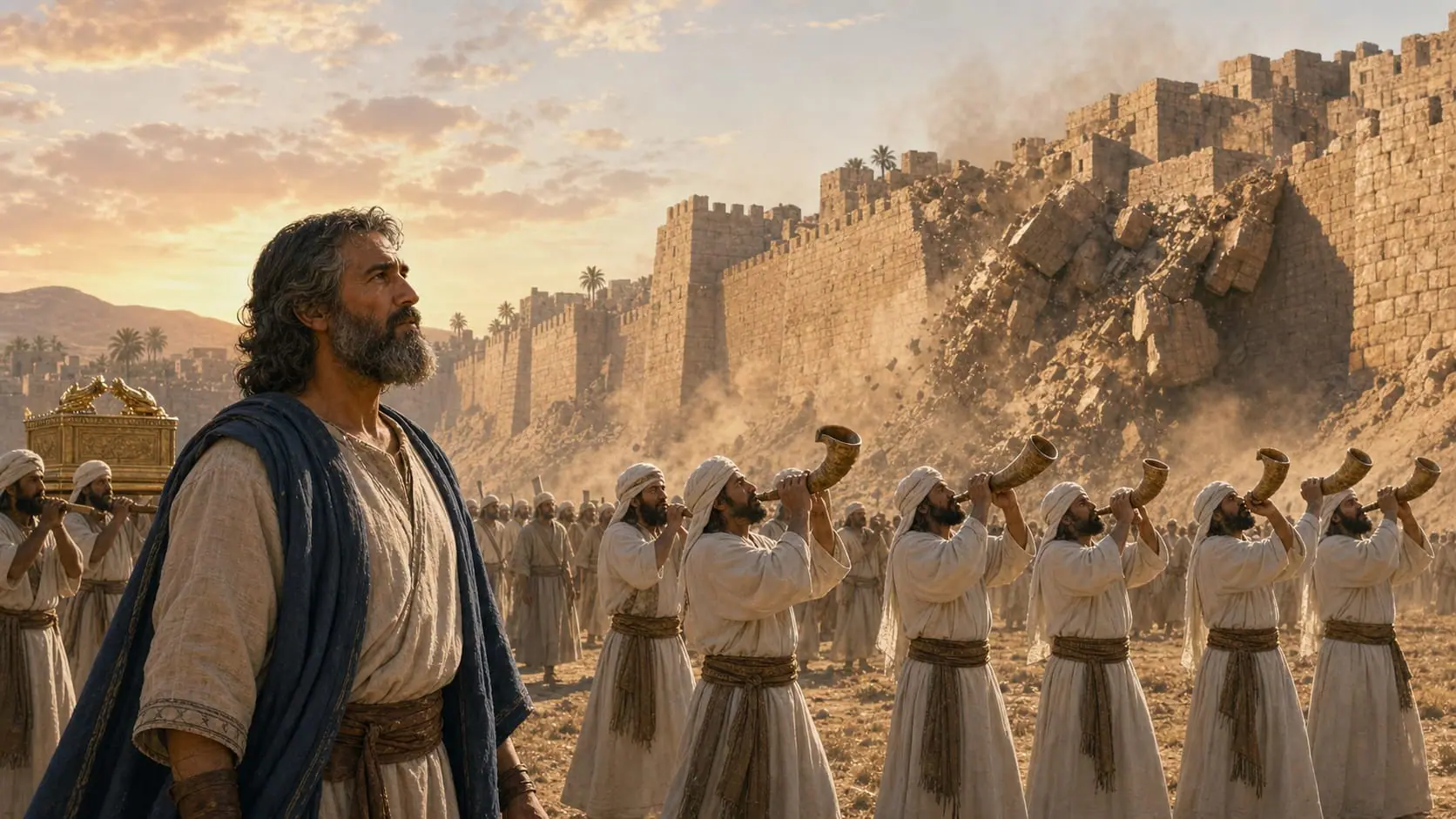
After Israel crossed the Jordan under Joshua, Moses’ successor, Jericho stood closed behind its walls. God instructed Israel’s fighting men to march around the city once a day for six days, with priests sounding rams’ horns and carrying the Ark. On the seventh day they circled it seven times. At Joshua’s command, the people shouted while the horns sounded, and the wall fell.
The story begins before the march. Rahab hid two Israelite spies and tied a scarlet cord in her window as the agreed sign. When Jericho fell, the spies kept their promise and rescued Rahab and the family gathered in her house. Joshua 6 therefore places judgment on the city beside mercy toward Rahab.
The story
Joshua 2–6: Rahab, the Jordan, and Jericho
Rahab hides Joshua’s two spies
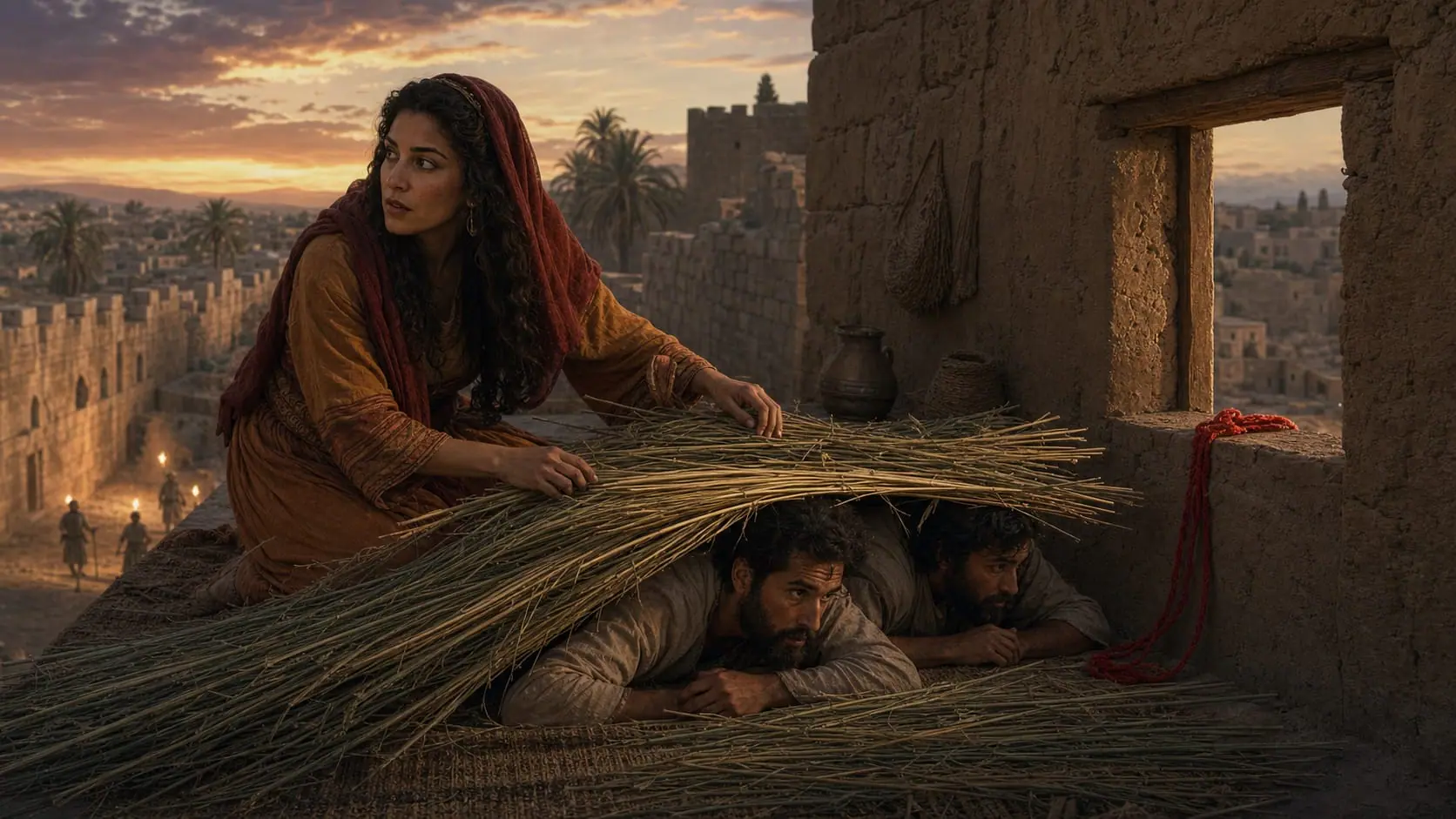
From Israel’s camp at Shittim, Joshua secretly sent two men to examine the land and Jericho. They entered the house of Rahab, whom the text identifies as a prostitute. When Jericho’s king demanded that she bring the men out, she said they had already left and urged his men to pursue them. In fact, she had hidden them beneath stalks of flax on her roof. The pursuers headed toward the Jordan crossings.
Rahab told the spies that Jericho had heard what Israel’s God had done and that fear had fallen on the people. She confessed that Yahweh is God in heaven and on earth, then asked the men to spare her parents, siblings, and their households. Joshua 2:1–14
As soon as we had heard it, our hearts melted, and there wasn’t any more spirit in any man, because of you: for Yahweh your God, he is God in heaven above, and on earth beneath.
The scarlet cord becomes the sign of their promise
Because Rahab’s house was built into the city wall, she lowered the spies by a rope through her window. They told her to tie a scarlet line in that same window and gather her whole family inside. Anyone who left the house would not be covered by their promise. She also had to keep their mission secret. The account does not specify the color of the rope used for their escape.
The spies hid in the mountains for three days until the pursuers returned, then crossed back to Joshua. They reported that Yahweh had delivered the land and that the inhabitants were afraid. Joshua 2:15–24
Israel crosses the Jordan on dry ground
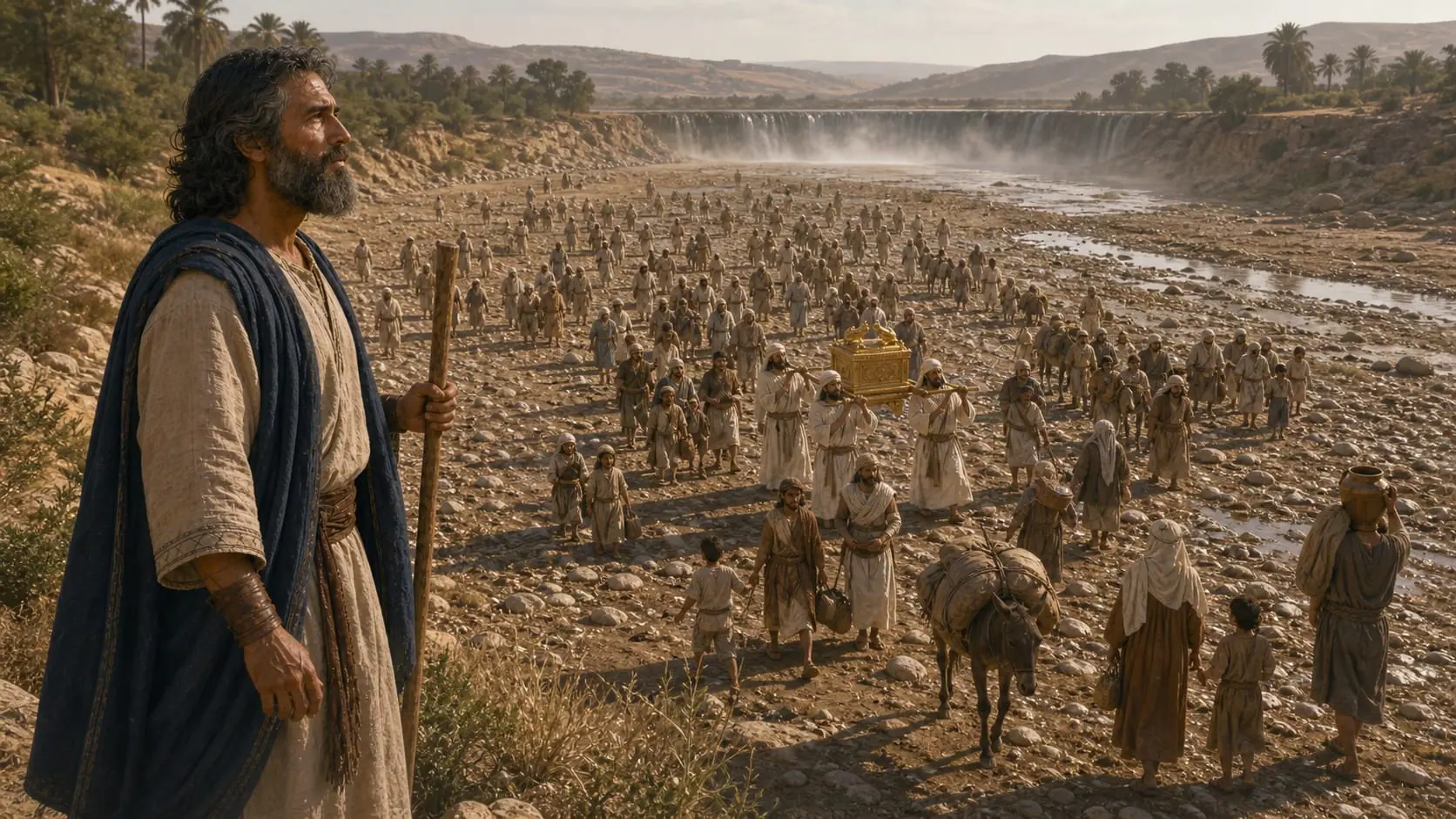
When the priests carrying the Ark stepped into the flooded Jordan, the water flowing from upstream stopped. The priests remained in the middle of the riverbed while the entire nation crossed on dry ground.
Twelve representatives, one from each tribe, took stones from the riverbed. Joshua set them up at Gilgal so future generations could learn how Israel had crossed. When the priests stepped out, the Jordan returned to its flooded course. The crossing confirmed Joshua’s leadership in the people’s eyes. Joshua 3:1–17; 4:1–24
The priests who bore the ark of Yahweh’s covenant stood firm on dry ground in the middle of the Jordan; and all Israel crossed over on dry ground, until all the nation had passed completely over the Jordan.
Israel keeps Passover at Gilgal
Before the march around Jericho, God told Joshua to circumcise the males who had been born during the wilderness journey and had not been circumcised. They stayed in camp until they healed. Israel then celebrated Passover on the plains of Jericho and ate the produce of Canaan. After they began eating from the land, the manna ceased. Joshua 5:2–12
Joshua meets the commander of Yahweh’s army
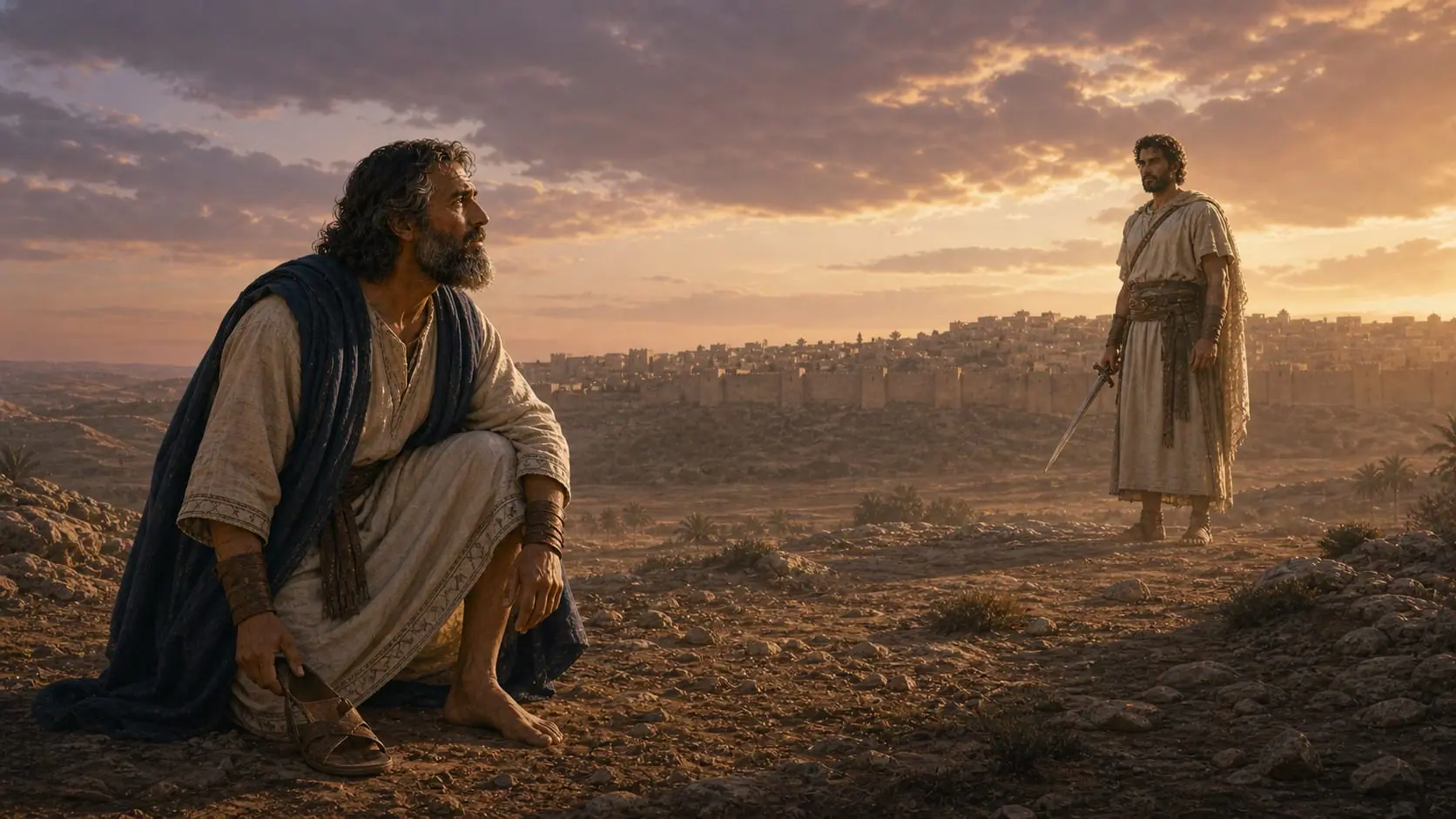
Near Jericho, Joshua saw a man standing before him with a drawn sword. Joshua asked whether he came for Israel or for its enemies. The answer was “No”; the figure identified himself as commander of Yahweh’s army.
Joshua fell facedown and asked what message his lord had for him. He was told to remove his sandals because the place was holy. The figure is called the commander of Yahweh’s army, but is not given a personal name. Identifying him specifically as an angel or as the preincarnate Christ is an interpretation, not an identification stated in these verses. Joshua 5:13–15
He said, “No; but I have come now as commander of Yahweh’s army.” Joshua fell on his face to the earth, and worshiped, and asked him, “What does my lord say to his servant?”
For six days, horns sound while the people keep quiet
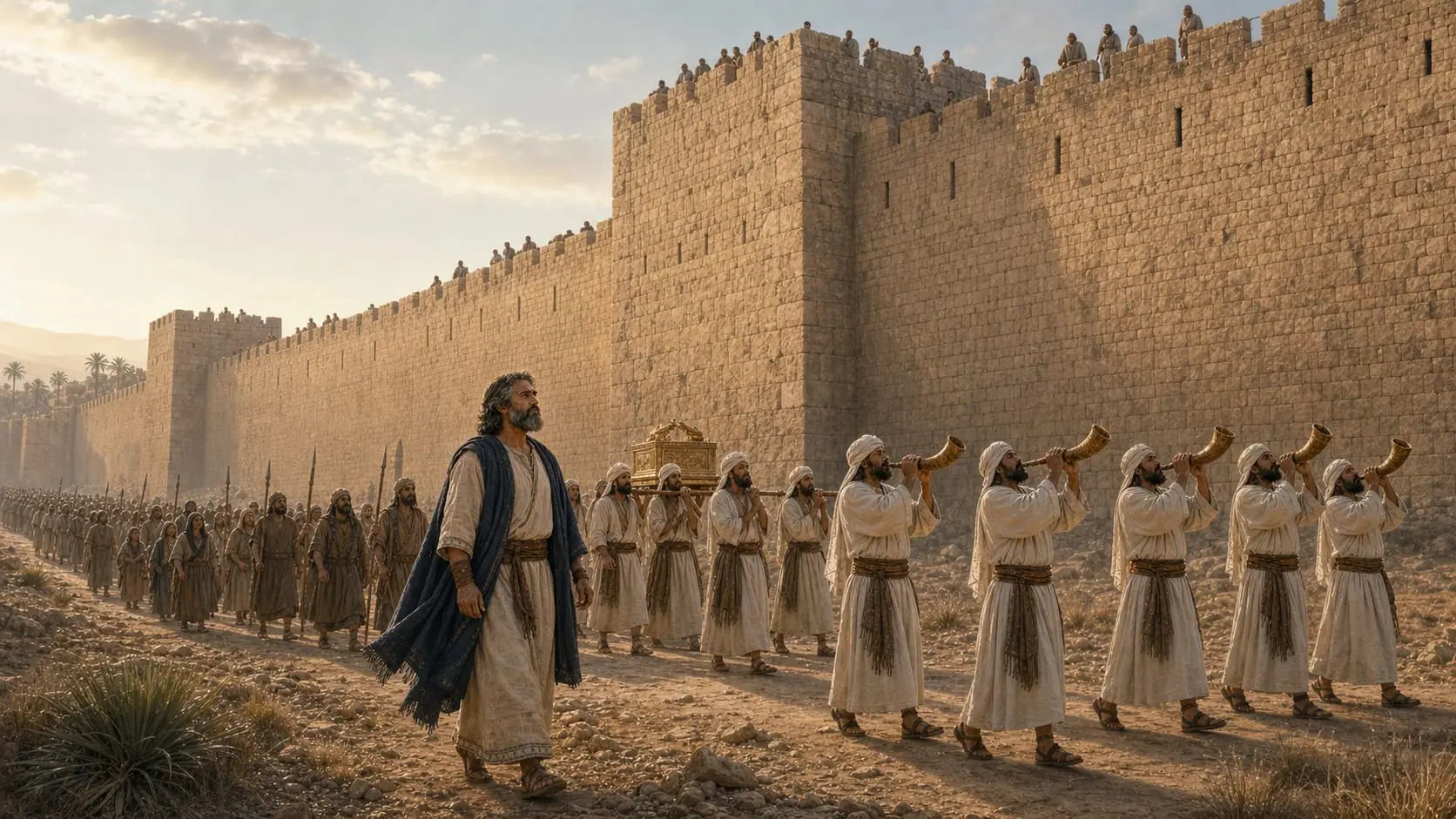
Jericho was tightly shut. Joshua was instructed to arrange armed men, seven priests with seven rams’ horns, the Ark, and a rear guard. The people were not to shout or speak until Joshua gave the command.
On each of the first six days, the procession went around the city once and returned to camp. The priests kept sounding their horns as they marched. The instruction to remain quiet applied to the people’s voices, not to the instruments. Joshua 6:1–14
On the seventh day, the walls fall
The people rose early and circled Jericho seven times. God’s instructions called for a long horn blast followed by a shout. On the seventh circuit, as the priests sounded the horns, Joshua told the people to shout because Yahweh had given them the city. He also declared that Rahab and everyone with her in the house were to live.
When the people shouted, the wall fell down and the Israelite force entered. The account says they killed men and women, young and old, and the livestock. Rahab’s household was brought out before the city was burned. Silver, gold, and vessels of bronze and iron went into Yahweh’s treasury; the Israelites were forbidden to take the devoted goods for themselves. Joshua 6:5, 15–25
So the people shouted and the priests blew the trumpets. When the people heard the sound of the trumpet, the people shouted with a great shout, and the wall fell down flat, so that the people went up into the city, every man straight in front of him, and they took the city.
Rahab and her family are brought to safety
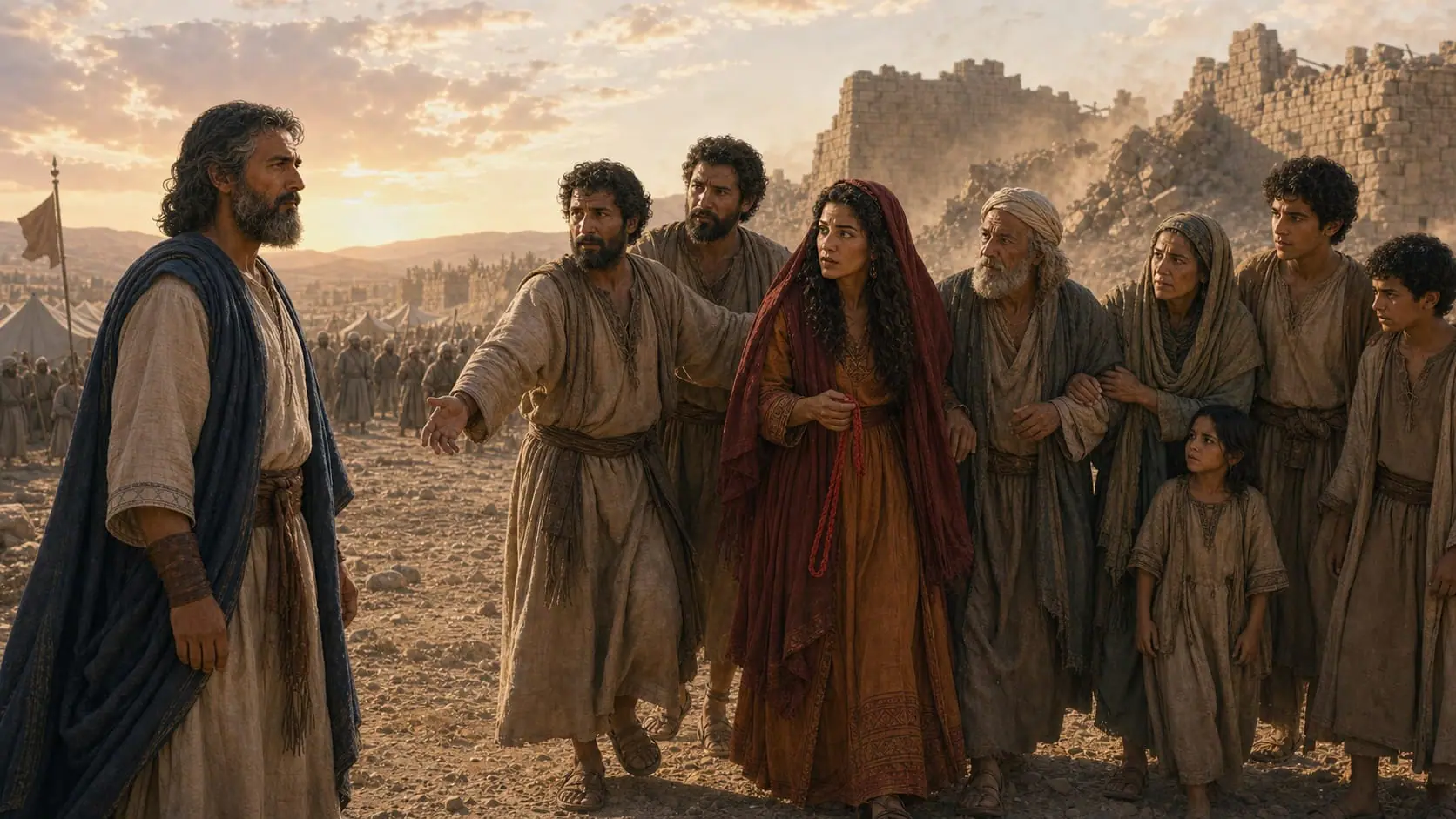
The two spies entered Rahab’s house and brought out Rahab, her parents, her brothers, and all who belonged to her. They first placed them outside Israel’s camp. Joshua 6:25 then says Rahab lived among Israel because she had hidden the messengers.
Hebrews 11:31 remembers Rahab’s faith, and James 2:25 points to her actions in receiving the messengers and helping them escape. Matthew’s genealogy names her as Boaz’s mother, placing her in the family line leading to David and Jesus. Boaz later appears in the story of Ruth and Boaz. Joshua 6:22–25; Hebrews 11:31; James 2:25; Matthew 1:5–6
Joshua’s warning about rebuilding Jericho
Joshua pronounced a curse on the person who rebuilt the city: laying its foundation would cost his firstborn, and setting up its gates would cost his youngest son. Later, 1 Kings 16:34 connects Hiel’s rebuilding of Jericho and the loss of his sons Abiram and Segub with that warning. It does not describe how the sons died. Joshua 6:26–27; 1 Kings 16:34
The chapter at a glance
Joshua 6 Summary
Jericho begins shut behind its defenses. God gives Joshua a seven-day procession involving armed guards, seven priests with rams’ horns, and the Ark. Israel circles once on each of six days, then seven times on the seventh day—a total of thirteen circuits.
At the final circuit, the horns sound, the people shout, and the wall falls. Israel destroys the city and its inhabitants, while the spies rescue Rahab’s household. The specified metals go to Yahweh’s treasury. Taking the devoted goods for private use was forbidden; Joshua 7 describes Achan breaking this command and the consequences for Israel.
What the text claims
How Did the Walls of Jericho Fall?
Joshua 6 does not offer an engineering or acoustic mechanism. Its explanation is that God had given Jericho into Israel’s hand. The march, sounding horns, people’s silence until the command, and final shout follow God’s instructions; the chapter does not say that sound waves physically shattered the walls.
Hebrews 11:30 later attributes the fall of the walls to faith, after Israel had marched around them for seven days. That is different from treating the march as a technique readers can repeat to guarantee success in their own struggles.
Site and evidence
Jericho Archaeology and the Bible Story
UNESCO identifies Tell es-Sultan, northwest of modern Jericho, as an exceptionally ancient settlement with occupation deposits reaching back to about 10,500 BC, twenty-nine occupation phases, early walls and a tower, and later Bronze Age urban remains and ramparts.
Dating a destruction layer is a separate question from identifying who caused it. In a 1995 radiocarbon study, Hendrik Bruins and Johannes van der Plicht dated the end of Middle Bronze Age Jericho to the late seventeenth or sixteenth century BC. Connecting such evidence with Joshua 6 requires further arguments about chronology and the biblical account. The remains alone do not establish that connection or prove the account’s claim of divine intervention.
To review names and events beyond this story, try the Bible Characters Quiz or Old Testament Bible Trivia. These games cover other passages too; they are not dedicated Jericho quizzes. The five questions below stay within Joshua 2–6.