Bible Timeline: 30 People, Events & Books in Order
Explore an interactive Bible timeline from Creation to the early church, open Scripture references, and test the sequence in a free online game.
See the story. Test the order.
A Bible chronology guide you can explore—not just a static chart.
30 timeline entries
7 Bible eras
Scripture-linked details
Easy, Medium, and Hard
Interactive Bible chronology
Follow the Bible’s major events from Genesis through Acts
This free Bible timeline combines a chronological reference guide with an interactive learning tool. Filter the Old Testament, New Testament, life of Jesus, people, events, and books, then open any point for its passage and story connection.
The timeline follows the broad narrative sequence. Calendar dates are historical estimates; entries without a secure year use periods such as the patriarchs or the wilderness journey.
Explore the Bible in chronological order
Follow the broad story from Creation to the early church. Choose a view, then open an event to read its setting and Scripture reference.
Dates are approximate where Scripture and external chronology do not supply an exact year. Book entries are positioned by story setting, not composition date.
How to use the interactive Bible timeline
Start with the full storyline, then narrow the chronology when you want to study one Testament or one kind of entry.
1
Choose a Bible timeline view
Explore the Whole Bible, Old Testament, New Testament, or the life of Jesus.
2
Filter people, events, and books
Separate major events from key people and book placements without leaving the page.
3
Open the Scripture connection
Select a point to see its period, Bible reference, summary, and place in the larger story.
4
Play the chronological order game
Arrange a fresh set of event cards and review the correct sequence after every round.
Seven eras connect the Old and New Testament timelines
This guide groups the entries into seven broad eras: beginnings, the patriarchs, the Exodus, Israel’s kingdoms, exile and return, the life of Jesus, and the early church. These are reading groups used on this page, not seven periods named by Scripture.
30 major Bible events, people, and books in chronological order
This at-a-glance overview mirrors the interactive timeline. Dates are approximate where noted, and book entries are positioned by the period their story covers rather than by a disputed composition date.
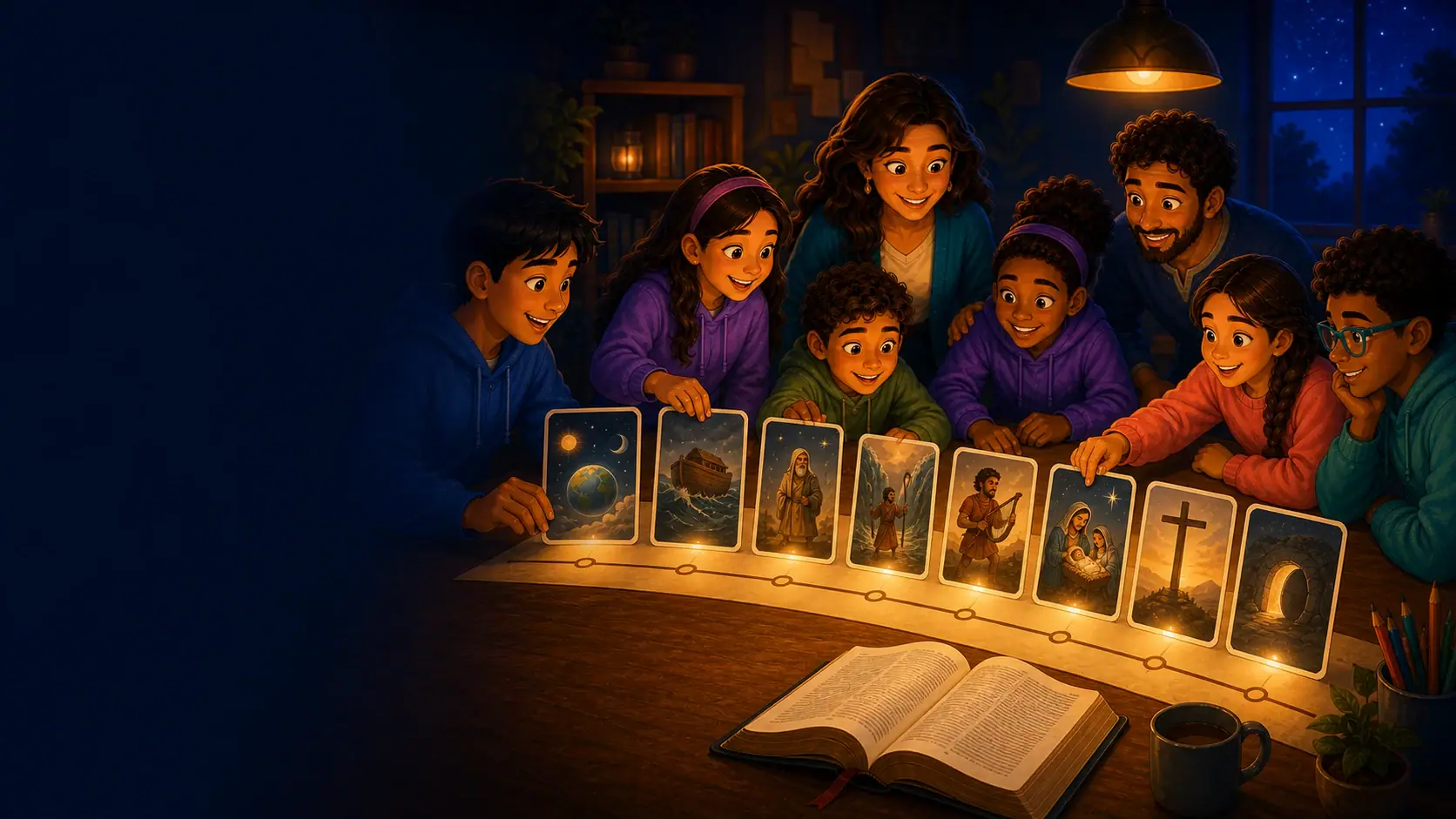
Choose a theme and difficulty, arrange the cards, and check the sequence. Easy uses five cards, Medium uses eight, and Hard uses ten. All three draw from the same theme.
Example: the correct order5 cards
1The ExodusExodus 12–14Exodus
2David becomes king2 Samuel 5Kingdoms
3Jerusalem falls2 Kings 25Exile
4Birth of JesusLuke 2Jesus
5Paul meets JesusActs 9Early Church
Life of Jesus timeline: from Bethlehem to the Ascension
The New Testament portion begins with Jesus’ birth around 6–4 BC and follows his baptism, early signs, Galilean ministry, final week, crucifixion, resurrection, and ascension. The dedicated Life of Jesus filter removes unrelated entries so the Gospel sequence can be studied on its own.
Because the Gospels sometimes arrange material by theme as well as chronology, this timeline focuses on sequences explicitly connected in the biblical accounts—for example, Jesus walking on water after feeding the five thousand.
A Bible timeline from Creation to the early church—without false precision
The Old Testament timeline follows Creation, Noah, Abraham’s family, the Exodus, Sinai, Israel in the land, the kings and prophets, exile, and return. The New Testament timeline continues through Jesus and the growth of the church in Acts.
Labels such as “patriarchal period,” “after the Exodus,” and “about AD 30 or 33” communicate the level of certainty more honestly than inventing exact dates. Every entry includes a Scripture reference so readers can check the sequence in context.
Revelation timeline: from the seven churches to new creation
The final book of the Bible presents a carefully ordered series of messages and visions: seven churches, a sealed scroll, seals, trumpets, symbolic conflict, bowls, Babylon’s fall, final judgment, and the New Jerusalem.
The dedicated guide follows Revelation 1–22 in textual order while clearly noting that Christian traditions interpret how those visions relate to history and future events in different ways.
A Bible timeline places people, events, kingdoms, and story periods in broad chronological order. It helps readers see how narratives from different books connect without replacing the literary purpose of each book.
Are all Bible dates exact?
No. Some events can be connected with well-attested historical dates, while others are known only in relation to surrounding events. This timeline labels uncertain periods broadly and avoids presenting debated dates as if Scripture supplied them directly.
What timeline does the game use?
The game follows the broad narrative sequence found in the Protestant Bible, from Genesis through the Gospels and Acts. It tests story order rather than asking players to memorize disputed calendar years.
Can children and church groups play?
Yes. Easy mode uses five cards, Medium eight, and Hard ten, drawn from the same selected theme. Difficulty changes the sequence length, not which events are considered child-friendly. Families, Sunday school classes, homeschool groups, and youth groups can discuss each card before moving it.
Why are Bible books not placed by writing date?
Dates of composition are debated for many books. When the Books filter is selected, a book is positioned by the period its story covers, and the page clearly labels that choice.
Free · No account · Scripture linked
Can you put the Bible story in order?
Explore all 30 entries, then play five rounds and follow every answer back to Scripture.
'%20fill-opacity='0.4'/%3e%3cdefs%3e%3cradialGradient%20id='paint0_radial_0_4'%20cx='0'%20cy='0'%20r='1'%20gradientTransform='matrix(6.50003%20-430.975%20892.955%2011.8475%20814.5%20695)'%20gradientUnits='userSpaceOnUse'%3e%3cstop%20offset='0.278846'%20stop-color='%23300E7D'/%3e%3cstop%20offset='1'%20stop-color='%2391229B'/%3e%3c/radialGradient%3e%3c/defs%3e%3c/svg%3e)
%20scale(.87)'%3e%3cg%20transform='rotate(-3%2032%2034)'%3e%3cpath%20d='M10.5%2019.5c7.65-2.35%2014.8-.45%2021.5%205.7%206.7-6.15%2013.85-8.05%2021.5-5.7v27.2c-7.65-2.15-14.8-.45-21.5%205.1-6.7-5.55-13.85-7.25-21.5-5.1V19.5Z'%20fill='%23fff'%20stroke='%23171528'%20stroke-width='4.5'%20stroke-linejoin='round'/%3e%3cpath%20d='M32%2025.2v26.6'%20stroke='%23171528'%20stroke-width='4'%20stroke-linecap='round'/%3e%3cpath%20d='M17.5%2034.5h9M22%2030v9'%20stroke='%23171528'%20stroke-width='3.75'%20stroke-linecap='round'/%3e%3ccircle%20cx='41.5'%20cy='32.5'%20r='2.5'%20fill='%23171528'/%3e%3ccircle%20cx='46.5'%20cy='38'%20r='2.5'%20fill='%23171528'/%3e%3c/g%3e%3c/g%3e%3c/svg%3e)