%20scale(.87)'%3e%3cg%20transform='rotate(-3%2032%2034)'%3e%3cpath%20d='M10.5%2019.5c7.65-2.35%2014.8-.45%2021.5%205.7%206.7-6.15%2013.85-8.05%2021.5-5.7v27.2c-7.65-2.15-14.8-.45-21.5%205.1-6.7-5.55-13.85-7.25-21.5-5.1V19.5Z'%20fill='%23fff'%20stroke='%23171528'%20stroke-width='4.5'%20stroke-linejoin='round'/%3e%3cpath%20d='M32%2025.2v26.6'%20stroke='%23171528'%20stroke-width='4'%20stroke-linecap='round'/%3e%3cpath%20d='M17.5%2034.5h9M22%2030v9'%20stroke='%23171528'%20stroke-width='3.75'%20stroke-linecap='round'/%3e%3ccircle%20cx='41.5'%20cy='32.5'%20r='2.5'%20fill='%23171528'/%3e%3ccircle%20cx='46.5'%20cy='38'%20r='2.5'%20fill='%23171528'/%3e%3c/g%3e%3c/g%3e%3c/svg%3e)
The quick answer
What happened at the baptism of Jesus?
Jesus traveled from Galilee to the Jordan, where John was calling people to repentance and baptizing them. Matthew records John’s reluctance, but Jesus answered that the baptism should proceed “to fulfill all righteousness.” John then baptized him.
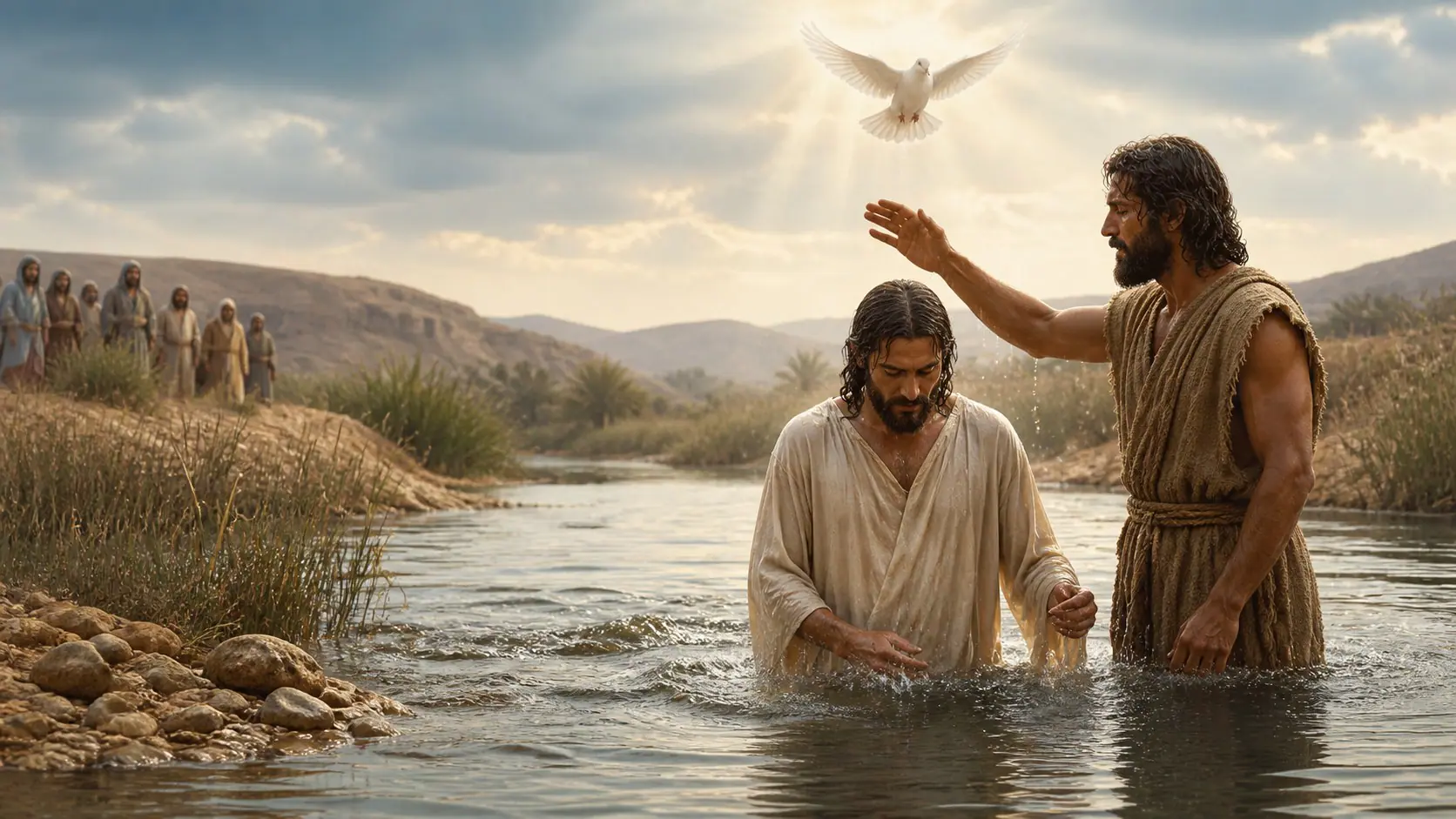
Matthew and Mark describe Jesus coming up from the water and seeing the Spirit descend like a dove. Luke mentions that Jesus is praying when heaven opens. All three record a heavenly voice identifying Jesus as the beloved Son. John’s Gospel does not directly narrate the baptism: it records the Baptist’s testimony that he saw the Spirit descend and remain on Jesus.
The full story
The baptism of Jesus across the four Gospels
John prepares the way at the Jordan
People come to John confessing their sins and seeking baptism. He warns that descent from Abraham is no substitute for repentance. When people ask what to do, Luke records his instructions to share food and clothing, collect taxes honestly, and avoid extortion and false accusations.
John says someone greater is coming, who will baptize with the Holy Spirit. In John 1, he denies being the Messiah, Elijah, or the Prophet, and identifies himself with Isaiah’s voice preparing the Lord’s way. The connection between John and Elijah is explained elsewhere through John’s prophetic role.
Matthew 3:1–12; Mark 1:1–8; Luke 3:1–20; John 1:19–28
Matthew: Jesus comes from Galilee and John objects
Matthew alone records this conversation. Jesus comes to be baptized, but John tries to stop him, saying that he needs baptism from Jesus instead. Jesus tells him to allow it because this is the fitting way for them to fulfill all righteousness. John agrees.
Unlike the earlier description of the crowds, this passage does not describe Jesus confessing sins. The question of why he receives baptism is addressed below; the conversation itself gives Jesus’ answer without a longer explanation.
Matthew 3:13–15
Then Jesus came from Galilee to the Jordan to John, to be baptized by him. But John would have hindered him, saying, “I need to be baptized by you, and you come to me?” But Jesus, answering, said to him, “Allow it now, for this is the fitting way for us to fulfill all righteousness.” Then he allowed him.
Matthew and Mark: the Spirit and the heavenly voice
Matthew says Jesus comes up from the water, the heavens open to him, and he sees God’s Spirit descending like a dove. The voice speaks about Jesus: “This is my beloved Son.” In Mark, the voice addresses him: “You are my beloved Son.” Both passages express God’s pleasure in him, but they are not word-for-word identical.
Read the language about the Son alongside Psalm 2:7, and the Spirit and God’s delight alongside Isaiah 42:1. Christians often see connections with these passages; neither baptism account explicitly introduces the heavenly voice as a quotation of those two texts.
Matthew 3:16–17; Mark 1:9–11
Jesus, when he was baptized, went up directly from the water: and behold, the heavens were opened to him. He saw the Spirit of God descending as a dove, and coming on him. Behold, a voice out of the heavens said, “This is my beloved Son, with whom I am well pleased.”
Luke: Jesus is praying when heaven opens
Luke describes Jesus as having been baptized and praying when heaven opens. He says the Holy Spirit descends in bodily form like a dove. As in Mark, the voice addresses Jesus directly. The passage does not say that the Spirit is simply an ordinary bird.
Luke has already mentioned John’s imprisonment in verses 19–20, before turning to Jesus’ baptism. This is his narrative arrangement, not a statement that John baptized Jesus from prison. Mark 1:9 explicitly names John as the one who baptized Jesus in the Jordan.
Luke 3:21–22
Now when all the people were baptized, Jesus also had been baptized and was praying. The sky was opened, and the Holy Spirit descended in a bodily form like a dove on him; and a voice came out of the sky, saying “You are my beloved Son. In you I am well pleased.”
John’s Gospel: the Baptist recalls what he saw
John the Baptist calls Jesus the Lamb of God and testifies that he saw the Spirit descend and remain on him. He explains that the one who sent him to baptize had given him that sign. This Gospel records his witness rather than narrating the act of baptism or quoting a heavenly voice.
John’s words about not knowing or recognizing Jesus explain the importance of the sign. They do not supply an account of whether the two had met as children. The next day, two of John’s disciples follow Jesus after hearing his testimony. Andrew is named; the other disciple is not named in this passage.
John 1:29–42
John testified, saying, “I have seen the Spirit descending like a dove out of heaven, and it remained on him. I didn’t recognize him, but he who sent me to baptize in water said to me, ‘On whomever you will see the Spirit descending and remaining on him is he who baptizes in the Holy Spirit.’ I have seen and have testified that this is the Son of God.”
What happens after the baptism?
Matthew, Mark, and Luke describe the Spirit leading or driving Jesus into the wilderness, where he is tempted. Mark says this happens immediately. Luke places Jesus’ genealogy between the baptism and the wilderness account, so the next lines on the page differ among the Gospels.
Matthew and Mark introduce Jesus’ Galilean preaching after John’s arrest. John 3:22–24 also records an earlier period when John is still baptizing and Jesus is with his disciples in Judea. John’s ministry does not end the moment he baptizes Jesus.
Matthew 4:1–12; Mark 1:12–14; Luke 3:23–4:14; John 3:22–24
Why Jesus receives baptism
Why was Jesus baptized if he was without sin?
Hebrews 4:15 describes Jesus as without sin. Matthew 3:15 gives Jesus’ own reason for proceeding: to fulfill all righteousness. The account does not describe him repenting of personal wrongdoing.
A common Christian reading is that Jesus obeys the Father’s will and identifies with the people he has come to save. That is an interpretation of the event’s significance, not an extra sentence spoken by Jesus in Matthew. The baptism accounts themselves record his baptism, the Spirit’s descent, and the heavenly declaration.
Reading the accounts separately
Do all four Gospels record Jesus’ baptism?
Matthew 3:13–17, Mark 1:9–11, and Luke 3:21–22 directly narrate the baptism. Matthew includes John’s objection; Mark names Nazareth as Jesus’ starting place; Luke mentions prayer. John 1:29–34 instead records the Baptist’s testimony about the Spirit’s descent and Jesus’ identity.
Matthew and Mark describe Jesus seeing the Spirit, and John records the Baptist as a witness. These passages do not establish that every onlooker saw and heard every detail. The illustration’s clothing, hand positions, crowd, and beam of light are artistic choices, not additional facts from the text. John’s belt is described as leather in Matthew 3:4 and Mark 1:6.