%20scale(.87)'%3e%3cg%20transform='rotate(-3%2032%2034)'%3e%3cpath%20d='M10.5%2019.5c7.65-2.35%2014.8-.45%2021.5%205.7%206.7-6.15%2013.85-8.05%2021.5-5.7v27.2c-7.65-2.15-14.8-.45-21.5%205.1-6.7-5.55-13.85-7.25-21.5-5.1V19.5Z'%20fill='%23fff'%20stroke='%23171528'%20stroke-width='4.5'%20stroke-linejoin='round'/%3e%3cpath%20d='M32%2025.2v26.6'%20stroke='%23171528'%20stroke-width='4'%20stroke-linecap='round'/%3e%3cpath%20d='M17.5%2034.5h9M22%2030v9'%20stroke='%23171528'%20stroke-width='3.75'%20stroke-linecap='round'/%3e%3ccircle%20cx='41.5'%20cy='32.5'%20r='2.5'%20fill='%23171528'/%3e%3ccircle%20cx='46.5'%20cy='38'%20r='2.5'%20fill='%23171528'/%3e%3c/g%3e%3c/g%3e%3c/svg%3e)
The quick answer
Who was John the Baptist in the Bible?
John the Baptist was the son of Zechariah, a priest, and Elizabeth, a descendant of Aaron. He preached repentance and baptized in the Jordan, preparing people for Jesus. He denied being the Messiah and testified that Jesus was the Lamb of God. After John condemned Herod Antipas’s marriage to Herodias, Herod imprisoned him and eventually ordered his execution. Matthew, Mark, Luke, and John describe his ministry; Luke alone gives the account of his birth.
An unexpected birth and a disputed name
Zechariah and Elizabeth are elderly and have no child when Gabriel appears to Zechariah during his temple service. The angel promises a son who will prepare people for the Lord. Zechariah questions how this can happen and is unable to speak until the promise is fulfilled. When the baby is named, Elizabeth says he is to be called John. Zechariah asks for a writing tablet, confirms the name, and regains his speech.
Before John’s birth, Mary visits Elizabeth. Luke says the baby leaps at Mary’s greeting and Elizabeth is filled with the Holy Spirit. Gabriel had already promised that John would be filled with the Spirit from his mother’s womb. Luke later says John grows and lives in the wilderness until he appears publicly to Israel; it does not describe his childhood education or say he grew up alongside Jesus.
What did John tell people to change?
When the crowds ask what repentance requires, John gives practical answers: share clothing and food with those who lack them. Tax collectors must take no more than the appointed amount. Soldiers must not extort money or make false accusations, and must be content with their wages. He does not tell these questioners that descent from Abraham makes changed conduct unnecessary.
John also makes a distinction between himself and the one coming after him. He baptizes with water, but the greater one will baptize with the Holy Spirit. In John’s Gospel, he identifies Jesus as the Lamb of God and describes seeing the Spirit descend and remain on him. Two disciples then follow Jesus; Andrew is named, but the other disciple is not named in that passage.
John does not stop baptizing as soon as Jesus gains followers. John 3:22–24 places their ministries alongside one another before John’s imprisonment. When his disciples report that people are going to Jesus, he compares his joy to that of the bridegroom’s friend. John 4:2 clarifies that Jesus’ disciples, not Jesus himself, performed the baptisms associated with Jesus’ ministry.
Luke 3:7–17; John 1:29–42; 3:22–30; 4:1–2 · Read why John hesitates when Jesus asks for baptism →
Why was John imprisoned and killed?
John tells Herod that taking his brother’s wife, Herodias, is unlawful. Herod has him arrested. From prison, John sends disciples to ask whether Jesus is the coming one or whether they should expect someone else. Jesus tells them to report the healings and good news they hear and see. After the messengers leave, Jesus praises John as more than a prophet. The passage records the question and response without explaining every reason John asked it.
Mark says Herodias wants John dead, while Herod fears him as a righteous and holy man and protects him. At Herod’s birthday banquet, Herodias’s daughter dances. Herod promises her a gift; prompted by her mother, she asks for John’s head. Herod is grieved but orders the execution because of his oaths and guests. A guard beheads John in prison, and John’s disciples take his body and bury it.
Matthew emphasizes that Herod himself had wanted to kill John but feared the crowd, which regarded John as a prophet. It also says John’s disciples tell Jesus after the burial. These are the writers’ different emphases, not one identical account of Herod’s motives. Neither passage supplies John’s exact age at death.
Was John the Baptist Elijah?
John answers no when asked whether he is Elijah (John 1:21). Yet Gabriel says John will go in Elijah’s spirit and power, and Jesus identifies John with the expected Elijah in Matthew 11:14. These passages distinguish the two men while connecting John’s prophetic role with Elijah’s. They do not describe reincarnation.
John applies Isaiah’s voice-in-the-wilderness passage to himself. His task is to prepare the Lord’s way, not to claim that he is the Messiah. The title Baptist, also translated Baptizer, describes his ministry of baptizing; it is not a surname or a reference to a modern denomination.
Isaiah 40:3; Luke 1:17; Matthew 11:14; John 1:19–23 · Compare Elijah’s story with the passages about John →
A name given before birth
What does the name John mean?
John comes through Greek Iōannēs from the Hebrew Yohanan, a form of Yehohanan, meaning “the LORD has been gracious.” Gabriel tells Zechariah to give the child this name. At the naming, Elizabeth insists on John; when those present object that none of their relatives has that name, Zechariah confirms it in writing (Luke 1:13, 59–63).
The life arc in Scripture
John the Baptist’s life in brief
Luke 1:5–25, 39–45, 57–80
An announced birth to Zechariah and Elizabeth
Matthew 3:1–12; Mark 1:2–8; Luke 3:1–20
A wilderness ministry of repentance and baptism
Matthew 3:13–17; Mark 1:9–11; Luke 3:21–22
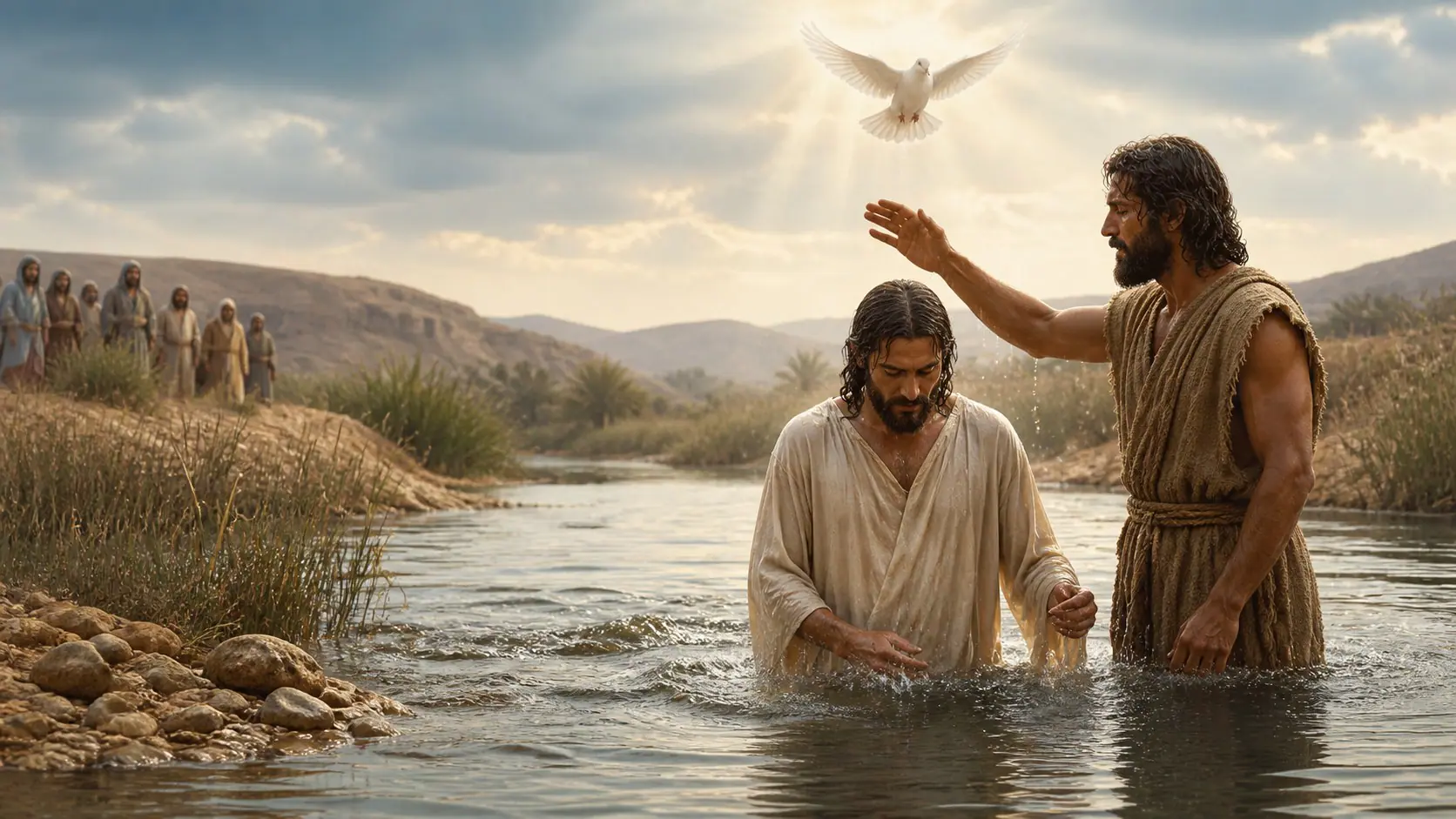
John baptizes Jesus in the Jordan
John 1:19–42; 3:22–30
John bears witness as Jesus gains followers
Matthew 11:2–19; 14:1–12; Mark 6:14–29
Questions from prison and death under Herod Antipas
Family and companions
John the Baptist’s family and relationships
John’s parents belong to a priestly family. His mother is related to Mary, but Luke does not say exactly how. The Herod who imprisons him is the ruler of Galilee, known as Herod Antipas.
Zechariah
A priest of the division of Abijah who receives Gabriel’s announcement in the temple and later prophesies over his son.
Elizabeth
A descendant of Aaron who conceives in old age and welcomes Mary during pregnancy.
Jesus
Luke calls Elizabeth a relative of Mary. John prepares Jesus’ way, baptizes him, and bears witness to him.
Herod Antipas
The Galilean tetrarch imprisons John after John condemns his marriage to Herodias.
What the text says—and does not say
Common questions about John the Baptist
John’s parents were Zechariah and Elizabeth
Luke identifies Zechariah as a priest and Elizabeth as a descendant of Aaron; both are described as righteous and elderly.
Luke 1:5–7, 13The exact family relationship is not given
The WEB calls Elizabeth Mary’s relative; the KJV uses cousin. This verse does not establish that their sons John and Jesus were first cousins. The spellings Zechariah and Zacharias also refer to the same father of John, not two different people.
Luke 1:5, 36The Bible does not say John belonged to the Qumran community
John lived in the wilderness and practiced baptism, but no Gospel names the Essenes or Qumran as his community.
Matthew 3; Mark 1; Luke 3; John 1John ate locusts and wild honey
Matthew and Mark describe his camel-hair clothing, leather belt, and wilderness diet.
Matthew 3:4; Mark 1:6The picture is not a record of the ceremony
The clothing, hand positions, crowd, and beam of light are artistic choices. The image shows a rope-like belt, whereas Matthew and Mark describe John’s belt as leather.
Matthew 3:4, 13–17; Mark 1:6, 9–11Follow the biblical accounts
Read John the Baptist’s connected stories
The Baptism of Jesus
Read the three baptism accounts alongside John’s testimony about the Spirit.
Read more →The larger Gospel lifeJesus in the Bible
Follow the birth, teachings, signs, disciples, crucifixion, and resurrection.
Read more →The Elijah connectionElijah in the Bible
Meet the earlier prophet whose ministry helps explain the language used about John.
Read more →