%20scale(.87)'%3e%3cg%20transform='rotate(-3%2032%2034)'%3e%3cpath%20d='M10.5%2019.5c7.65-2.35%2014.8-.45%2021.5%205.7%206.7-6.15%2013.85-8.05%2021.5-5.7v27.2c-7.65-2.15-14.8-.45-21.5%205.1-6.7-5.55-13.85-7.25-21.5-5.1V19.5Z'%20fill='%23fff'%20stroke='%23171528'%20stroke-width='4.5'%20stroke-linejoin='round'/%3e%3cpath%20d='M32%2025.2v26.6'%20stroke='%23171528'%20stroke-width='4'%20stroke-linecap='round'/%3e%3cpath%20d='M17.5%2034.5h9M22%2030v9'%20stroke='%23171528'%20stroke-width='3.75'%20stroke-linecap='round'/%3e%3ccircle%20cx='41.5'%20cy='32.5'%20r='2.5'%20fill='%23171528'/%3e%3ccircle%20cx='46.5'%20cy='38'%20r='2.5'%20fill='%23171528'/%3e%3c/g%3e%3c/g%3e%3c/svg%3e)
The quick answer
What happened when Jesus fed the 5,000?
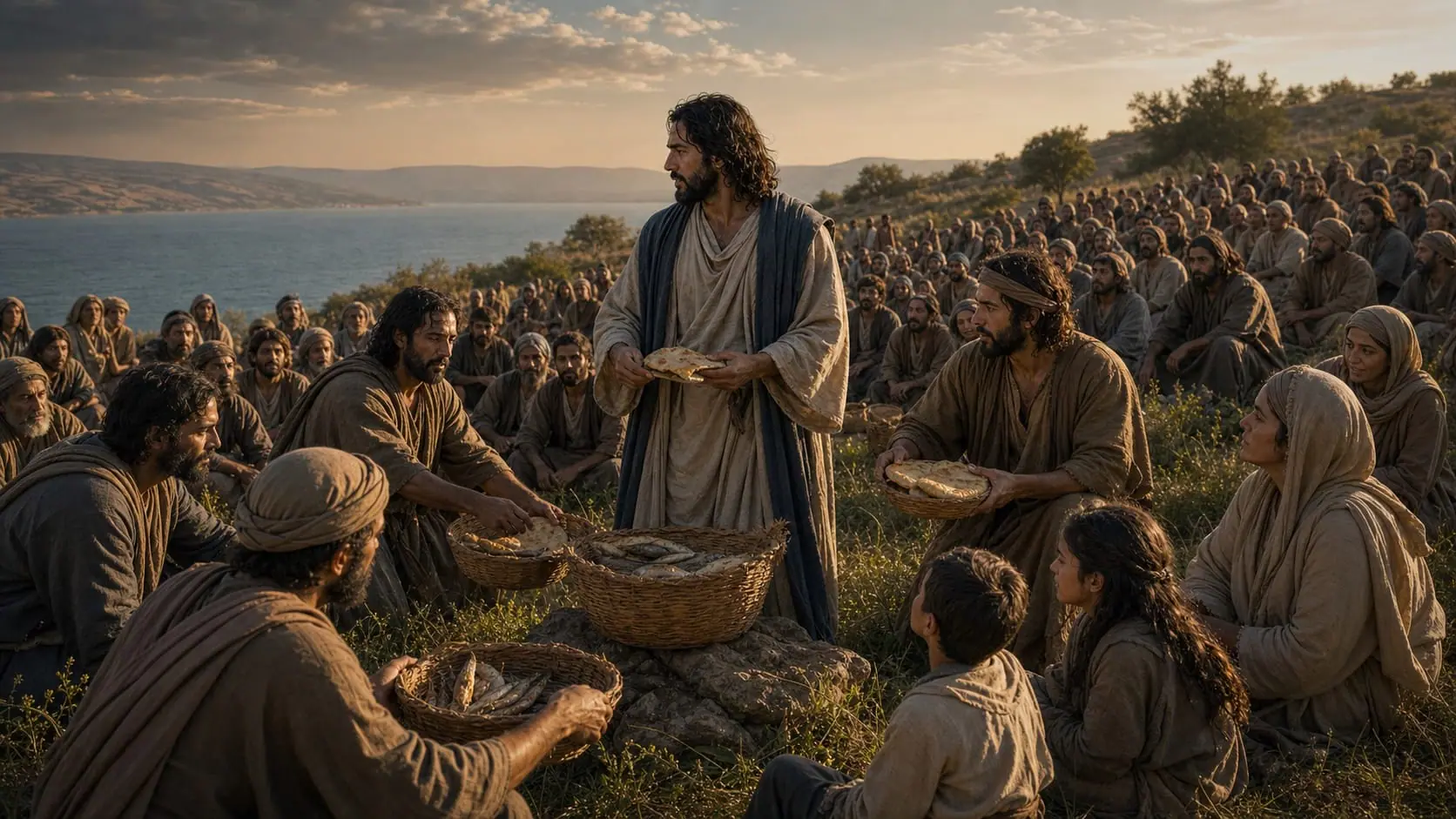
A large crowd followed Jesus to a remote place. He welcomed them, taught about God’s Kingdom, healed those who needed help, and had compassion on them. As the day ended, the disciples wanted to send the people away to find food, but Jesus told them, “You give them something to eat.”
The disciples had five loaves and two fish. Jesus had the people sit down, gave thanks, broke the loaves, and gave the food through his disciples. Everyone ate and was filled. Afterward, the disciples collected twelve baskets of broken pieces.
The small meal at the center of the sign
Five Loaves and Two Fish
Matthew, Mark, and Luke report five loaves and two fish. John adds two details: the loaves were made from barley, and a boy had the food. John does not give the boy’s name or exact age.
John names Andrew as the disciple who mentions the boy’s food. Philip says even two hundred denarii would not buy enough bread for everyone to receive a little. They can see the need, but not how to meet it.
The full story
The Feeding of the 5,000 Bible Story
The crowd follows Jesus to a deserted place
Matthew says Jesus withdrew after hearing about John the Baptizer’s death. Mark places the event after the apostles returned from their mission and Jesus invited them to rest. Luke connects the setting with Bethsaida, while John places it across the Sea of Galilee near Passover.
The crowd recognized where Jesus was going and followed on foot. Their arrival interrupted the planned withdrawal, but Jesus did not treat them as an inconvenience. Matthew 14:13–14; Mark 6:30–34; Luke 9:10–11; John 6:1–4
Jesus welcomes, teaches, and heals
Mark says Jesus saw the people as sheep without a shepherd and began teaching them many things. Matthew emphasizes his compassion and healing. Luke says he welcomed the crowd, spoke about God’s Kingdom, and cured those who needed healing.
Before the question of food comes up, Jesus is already caring for the people. He teaches and heals them, then responds to their hunger as the day grows late. Matthew 14:14–15; Mark 6:34–35; Luke 9:11–12
Jesus came out, saw a great multitude, and he had compassion on them because they were like sheep without a shepherd; and he began to teach them many things.
“You give them something to eat”
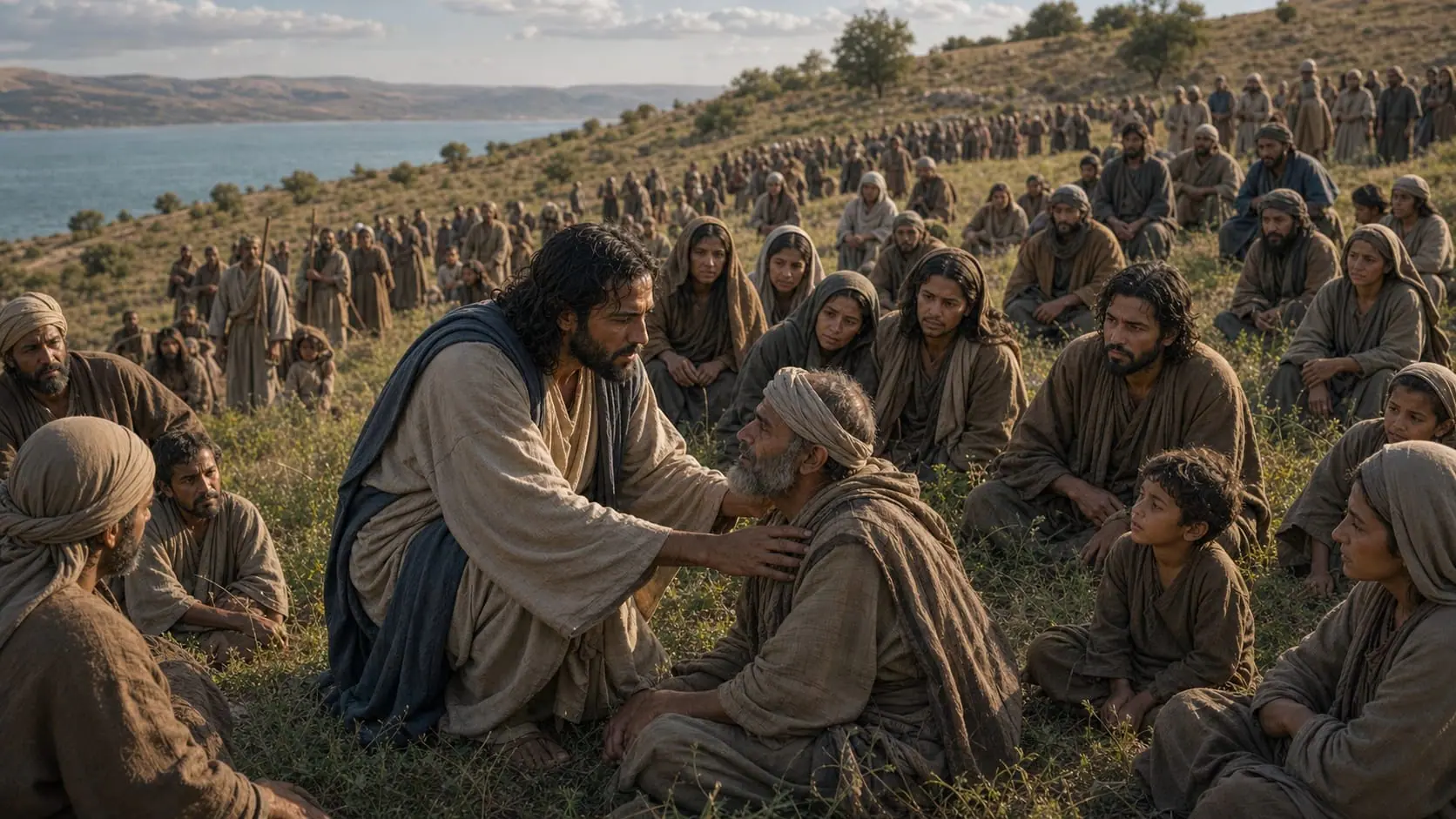
Late in the day, the disciples urged Jesus to send the crowd into nearby villages to buy food. Jesus answered that the people did not need to leave and told the disciples to feed them.
In Mark’s account, the disciples ask whether they should buy two hundred denarii worth of bread. For a sense of that amount, the vineyard workers in Jesus’ parable agree to one denarius for a day’s work (Matthew 20:2). Two hundred denarii was a substantial sum, yet Philip says it would not buy enough for even a little each. Matthew 14:15–16; Mark 6:35–38; Luke 9:12–13; John 6:7
But he answered them, “You give them something to eat.” They asked him, “Shall we go and buy two hundred denarii worth of bread and give them something to eat?”
Jesus tests Philip, and Andrew mentions the boy’s food
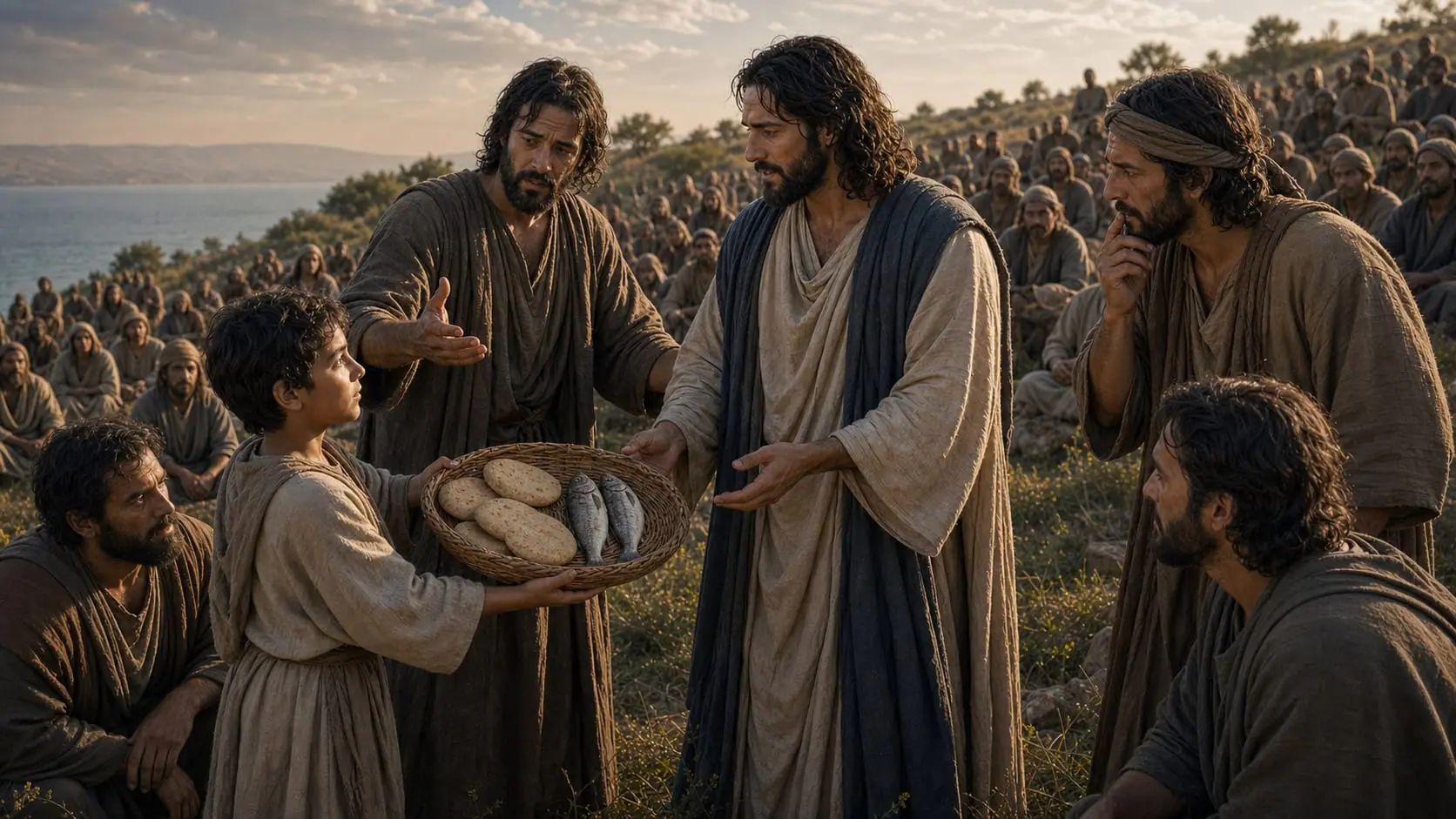
John says Jesus asked Philip where bread could be purchased, testing him while already knowing what he would do. Philip calculated the cost. Andrew then spoke up about a boy who had five barley loaves and two fish, while immediately recognizing how small that food was among so many people.
John does not describe the boy volunteering his food or Andrew leading him to Jesus. Those are familiar details in retellings and illustrations, but what John records is Andrew telling Jesus what the boy has. John 6:5–9
One of his disciples, Andrew, Simon Peter’s brother, said to him, “There is a boy here who has five barley loaves and two fish, but what are these among so many?”
The people sit down in groups on the grass
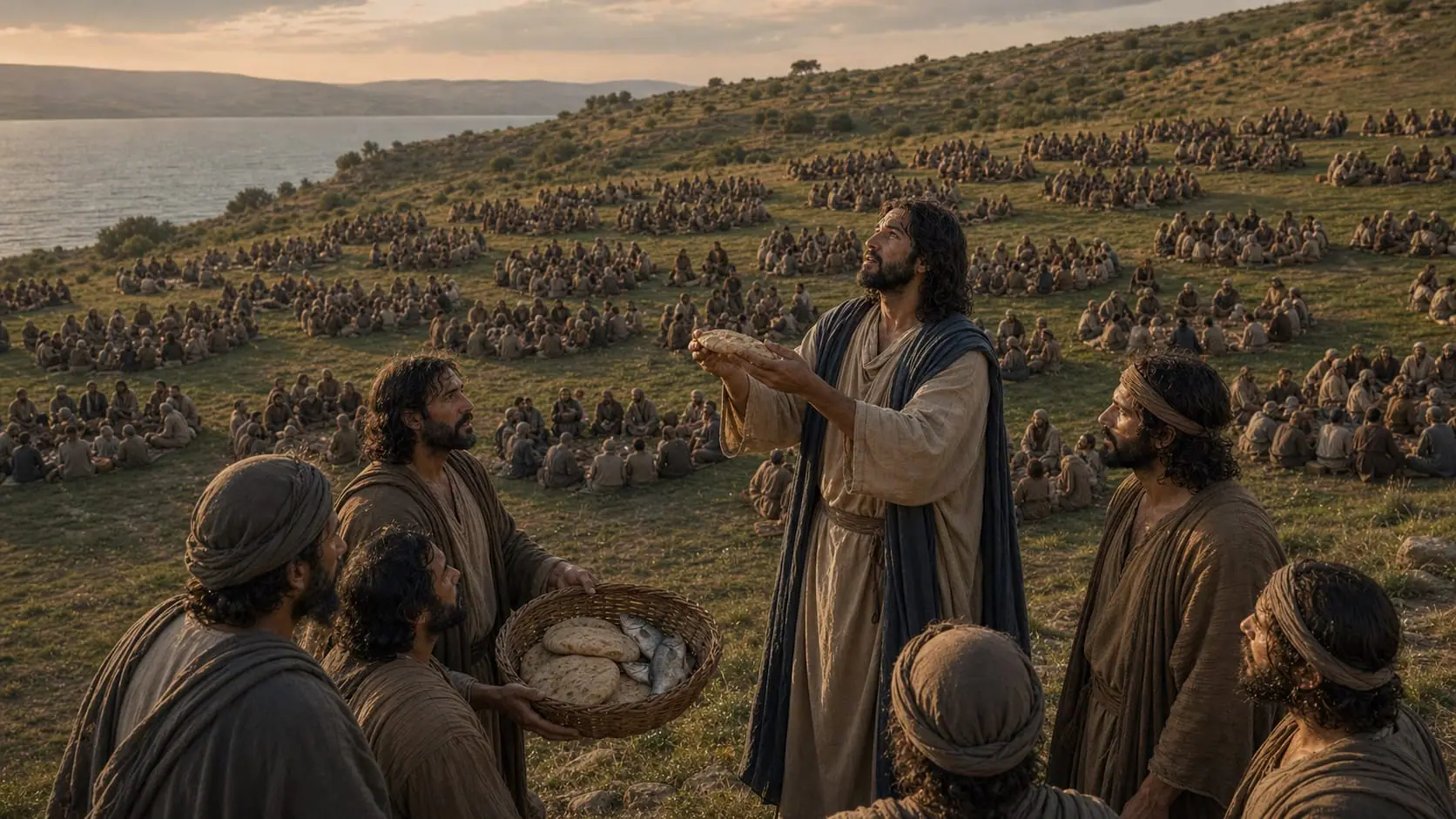
Jesus instructed the disciples to have the people sit down. Mark describes green grass and orderly groups by hundreds and fifties; Luke also mentions groups of about fifty. The arrangement made a vast gathering manageable for distribution.
John notes there was much grass in that place and that Passover was near. These details give the scene a particular season and setting rather than a vague desert landscape. Mark 6:39–40; Luke 9:14–15; John 6:4, 10
Jesus gives thanks and the disciples distribute
Jesus took the five loaves and two fish, looked up toward heaven, blessed or gave thanks, broke the loaves, and gave the food to the disciples. The disciples then set it before the people.
The Gospels do not describe the mechanics of multiplication or a visible burst of food. They simply move from the small meal in Jesus’ hands to repeated distribution until the multitude has as much as it needs. Matthew 14:18–19; Mark 6:41; Luke 9:16; John 6:11
He took the five loaves and the two fish, and looking up to the sky, he blessed them, broke them, and gave them to the disciples to set before the multitude.
Everyone eats and is filled
The result is stated plainly in every account: the people ate and were satisfied. John says they received as much as they desired. This was not a symbolic taste or a small ration divided into tiny crumbs.
The disciples participated throughout the distribution. The food came from Jesus’ action, yet it passed through their hands to the seated crowd. Matthew 14:19–20; Mark 6:41–42; Luke 9:16–17; John 6:11–12
More than the familiar number suggests
How Many People Did Jesus Feed?
Matthew says those who ate were about five thousand men, “in addition to women and children.” Luke and John also say about five thousand men; Mark gives five thousand men without the word “about.”
“Feeding the 5,000” is the familiar name, not an exact count of everyone present. Matthew includes women and children outside the men’s count, but does not give their number. Estimates such as 15,000 or 20,000 people are not totals stated in the Gospels.
Nothing is lost
How Many Baskets Were Left Over?
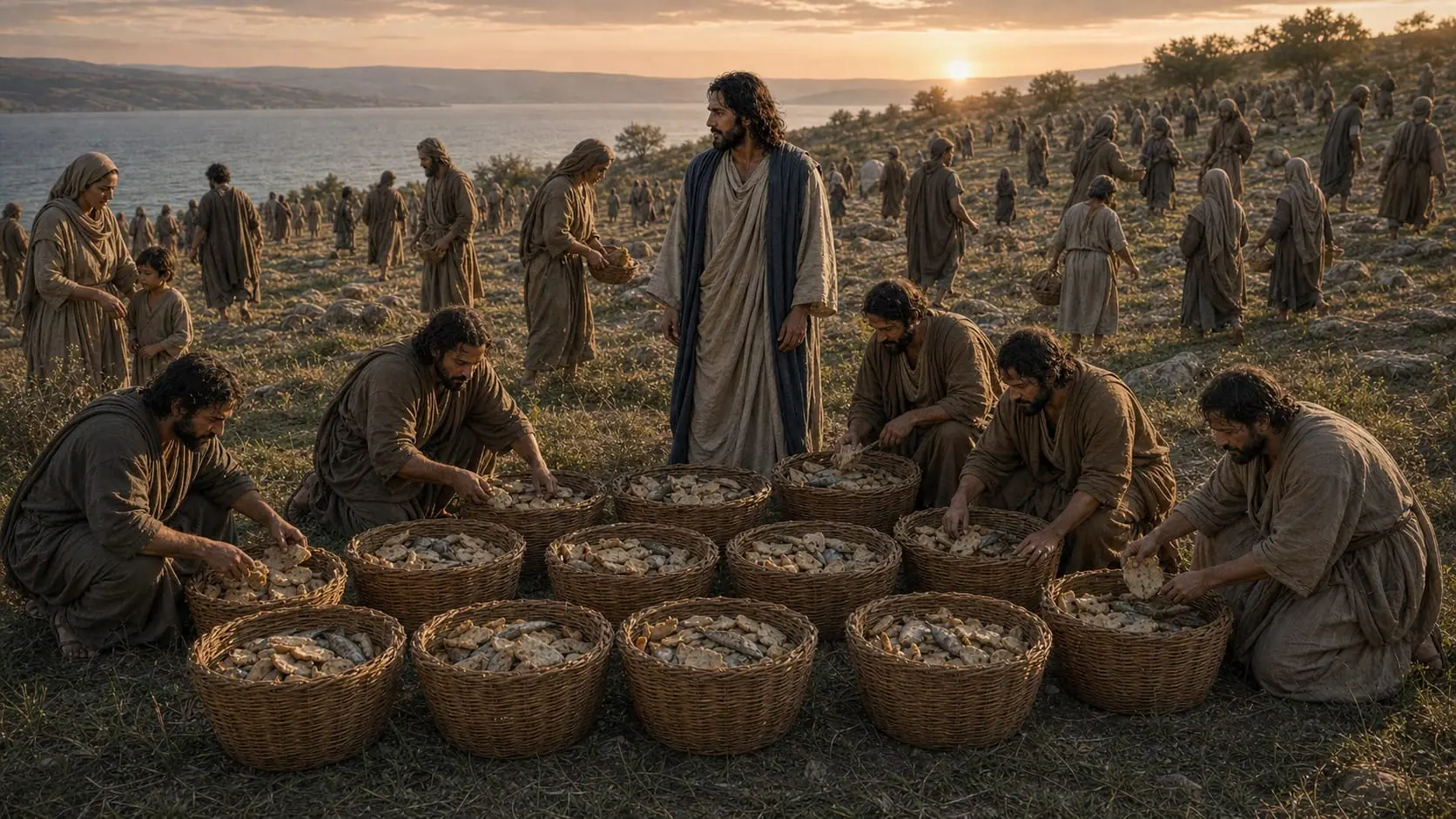
All four Gospels say twelve baskets of broken pieces were gathered. John records Jesus telling the disciples to collect what remained “that nothing be lost.” The leftovers show that everyone’s hunger was satisfied without treating abundance as waste.
Christian interpreters often connect twelve baskets with Israel’s twelve tribes or the twelve disciples. The four feeding accounts do not explain such a connection. What they do say is that everyone ate and there was still food left over.
They ate and were all filled. They gathered up twelve baskets of broken pieces that were left over.
The crowd wants to make Jesus king
John says the people recognized the event as a sign and called Jesus the prophet who was to come into the world. When Jesus perceived they were about to take him by force and make him king, he withdrew again to the mountain alone.
Matthew and Mark say Jesus immediately sent the disciples across the lake while he dismissed the crowd and went to pray. Matthew, Mark, and John then describe Jesus walking on water during that crossing. Luke does not include the night crossing in his account. Matthew 14:22–33; Mark 6:45–52; John 6:14–21
One sign, four narrative perspectives
The Feeding of the 5,000 in All Four Gospels
Matthew 14:13–21
Matthew connects Jesus’ withdrawal with news of John’s death, highlights healing, and explicitly says the five thousand men did not include women and children.
Mark 6:30–44
Mark begins with the apostles’ return and need for rest, describes the crowd as sheep without a shepherd, and vividly pictures groups seated on green grass by hundreds and fifties.
Luke 9:10–17
Luke connects the location with Bethsaida and emphasizes Jesus welcoming the crowd, teaching about God’s Kingdom, healing, and arranging groups of about fifty.
John 6:1–15
John mentions Passover, Philip’s test, Andrew, the unnamed boy, barley loaves, the command that nothing be lost, and the crowd’s attempt to make Jesus king.
Later in John 6, people find Jesus in Capernaum. He challenges them to seek the food that lasts for eternal life and calls himself the bread of life (John 6:26–35). The meal leads into a larger question: will they believe in the one who fed them?
This is the only miracle from Jesus’ public ministry before the crucifixion that appears in all four Gospels. Their shared outline is strong, while their distinctive details should remain attached to the Gospel that supplies them.
Not the same as feeding the 4,000
Matthew 15:32–39 and Mark 8:1–10 tell a separate feeding. That account begins with seven loaves and a few small fish and ends with seven baskets left over. Matthew counts four thousand men, besides women and children. Jesus later refers to both meals and their different numbers (Matthew 16:9–10; Mark 8:19–20).
Try questions about Jesus’ miracles and teachings in Jesus Trivia. For Acts, selected New Testament letters, and Revelation, continue to New Testament Bible Trivia.