%20scale(.87)'%3e%3cg%20transform='rotate(-3%2032%2034)'%3e%3cpath%20d='M10.5%2019.5c7.65-2.35%2014.8-.45%2021.5%205.7%206.7-6.15%2013.85-8.05%2021.5-5.7v27.2c-7.65-2.15-14.8-.45-21.5%205.1-6.7-5.55-13.85-7.25-21.5-5.1V19.5Z'%20fill='%23fff'%20stroke='%23171528'%20stroke-width='4.5'%20stroke-linejoin='round'/%3e%3cpath%20d='M32%2025.2v26.6'%20stroke='%23171528'%20stroke-width='4'%20stroke-linecap='round'/%3e%3cpath%20d='M17.5%2034.5h9M22%2030v9'%20stroke='%23171528'%20stroke-width='3.75'%20stroke-linecap='round'/%3e%3ccircle%20cx='41.5'%20cy='32.5'%20r='2.5'%20fill='%23171528'/%3e%3ccircle%20cx='46.5'%20cy='38'%20r='2.5'%20fill='%23171528'/%3e%3c/g%3e%3c/g%3e%3c/svg%3e)
The quick answer
What happened when Jesus walked on water?
The crossing follows Jesus feeding about five thousand men, besides women and children. Matthew and Mark describe him sending the disciples ahead and going up a mountain alone to pray. A contrary wind makes them struggle at the oars. During the fourth watch of the night, Jesus comes toward them walking on the sea. They think they see a ghost, but Jesus tells them, “It is I! Don’t be afraid.”
Matthew adds that Peter steps out of the boat and walks toward Jesus. He becomes afraid, begins to sink, and cries, “Lord, save me!” Jesus immediately catches him. After they enter the boat, the wind ceases. Matthew records the disciples worshiping Jesus as the Son of God; Mark emphasizes their amazement and lack of understanding.
The place behind the story
Where Did Jesus Walk on Water?
Jesus walked on the Sea of Galilee, a freshwater lake in northern Israel that John also calls the Sea of Tiberias. John says the disciples were traveling toward Capernaum. Mark says Jesus sent them ahead toward Bethsaida, and Matthew and Mark say they completed the crossing at Gennesaret.
These place names have produced several proposed routes, but the Gospels do not supply the miracle’s exact coordinates. John does say that the disciples had rowed twenty-five or thirty stadia—about three to four miles—when Jesus approached.
The full story
Jesus and Peter Walk on Water
Jesus sends the disciples ahead
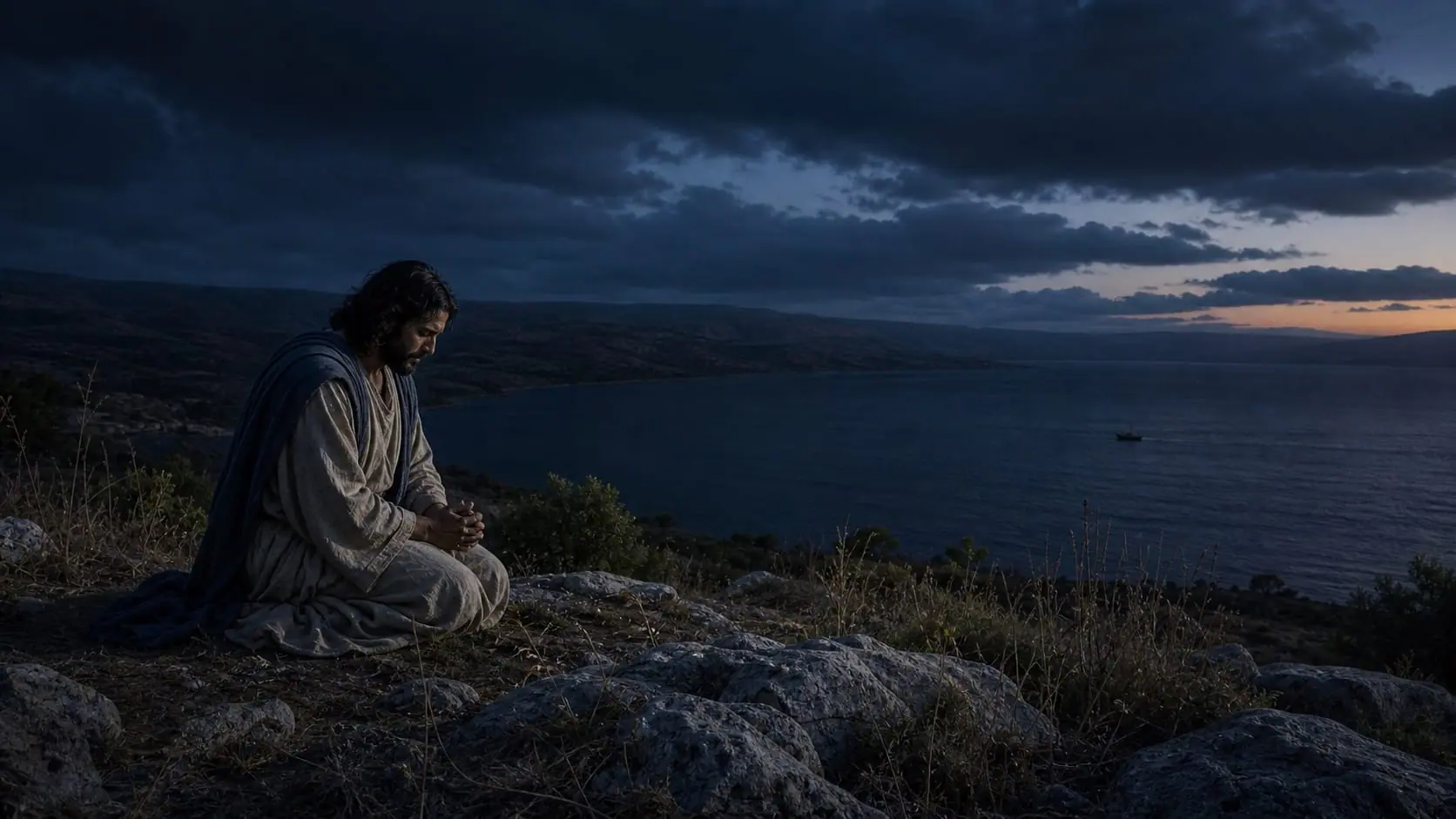
The story begins immediately after Jesus fed a crowd with five loaves and two fish. Matthew and Mark say Jesus made the disciples get into the boat while he dismissed the multitude. John adds that the people were about to take Jesus by force and make him king, so he withdrew to the mountain.
Matthew and Mark describe Jesus praying alone on the mountain. John describes his withdrawal from the crowd but does not mention prayer here. The disciples began their crossing without him as evening settled over the lake. Matthew 14:13–23; Mark 6:30–46; John 6:1–17
After he had sent the multitudes away, he went up into the mountain by himself to pray. When evening had come, he was there alone.
The disciples struggle against a contrary wind
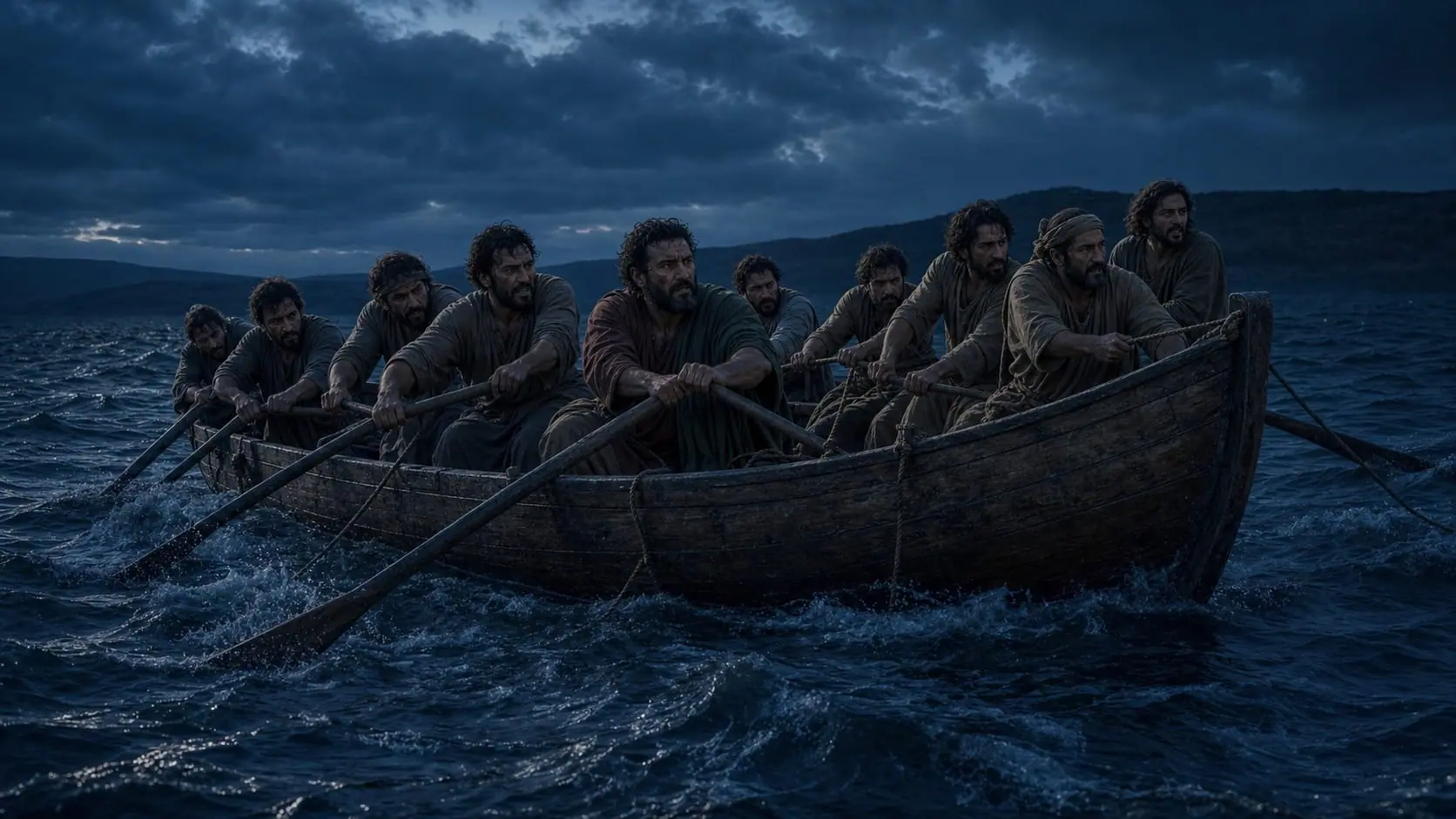
Darkness came, and a strong wind tossed the sea. Matthew describes the boat as distressed by the waves. Mark says Jesus could see the disciples struggling at the oars. John says they had traveled about twenty-five or thirty stadia before Jesus came near.
The wind was against them, not helping them toward shore. Mark describes their difficult rowing while Jesus was still alone on land. Matthew 14:24; Mark 6:47–48; John 6:16–19
Jesus comes walking on the sea
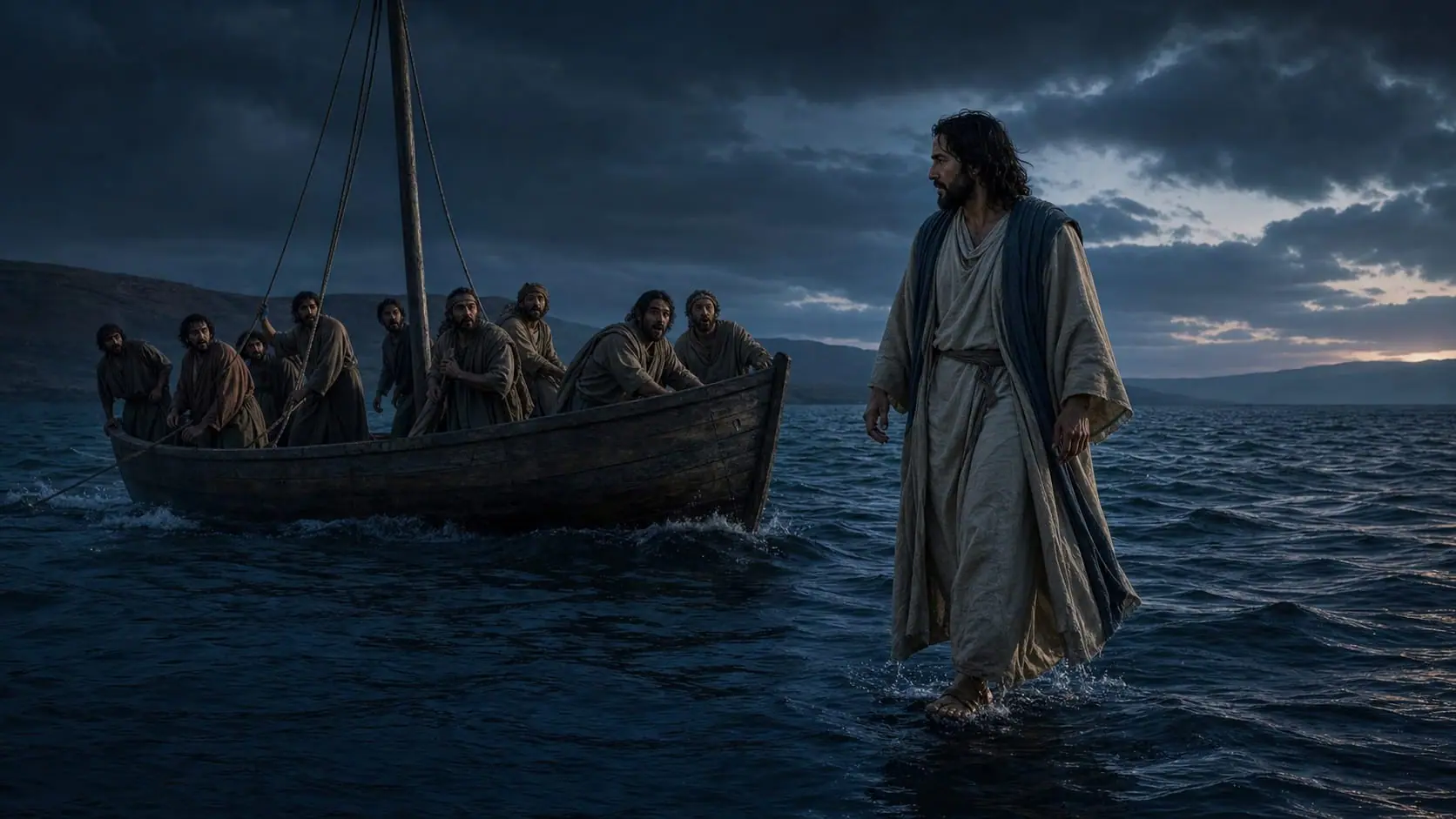
During the fourth watch—approximately 3:00 a.m. until sunrise—Jesus approached the boat by walking on the sea. Matthew and Mark say the disciples thought he was a ghost and cried out in fear.
Jesus immediately answered their fear: “Cheer up! It is I! Don’t be afraid.” The WEB notes that “It is I” can also be rendered “I AM.” In a scene where Jesus walks upon the sea, many readers hear an echo of Old Testament language about God’s authority over the waters, including Job 9:8. Matthew 14:25–27; Mark 6:48–50; John 6:19–20
But immediately Jesus spoke to them, saying, “Cheer up! It is I! Don’t be afraid.”
A detail found only in Matthew
Peter Walks on Water
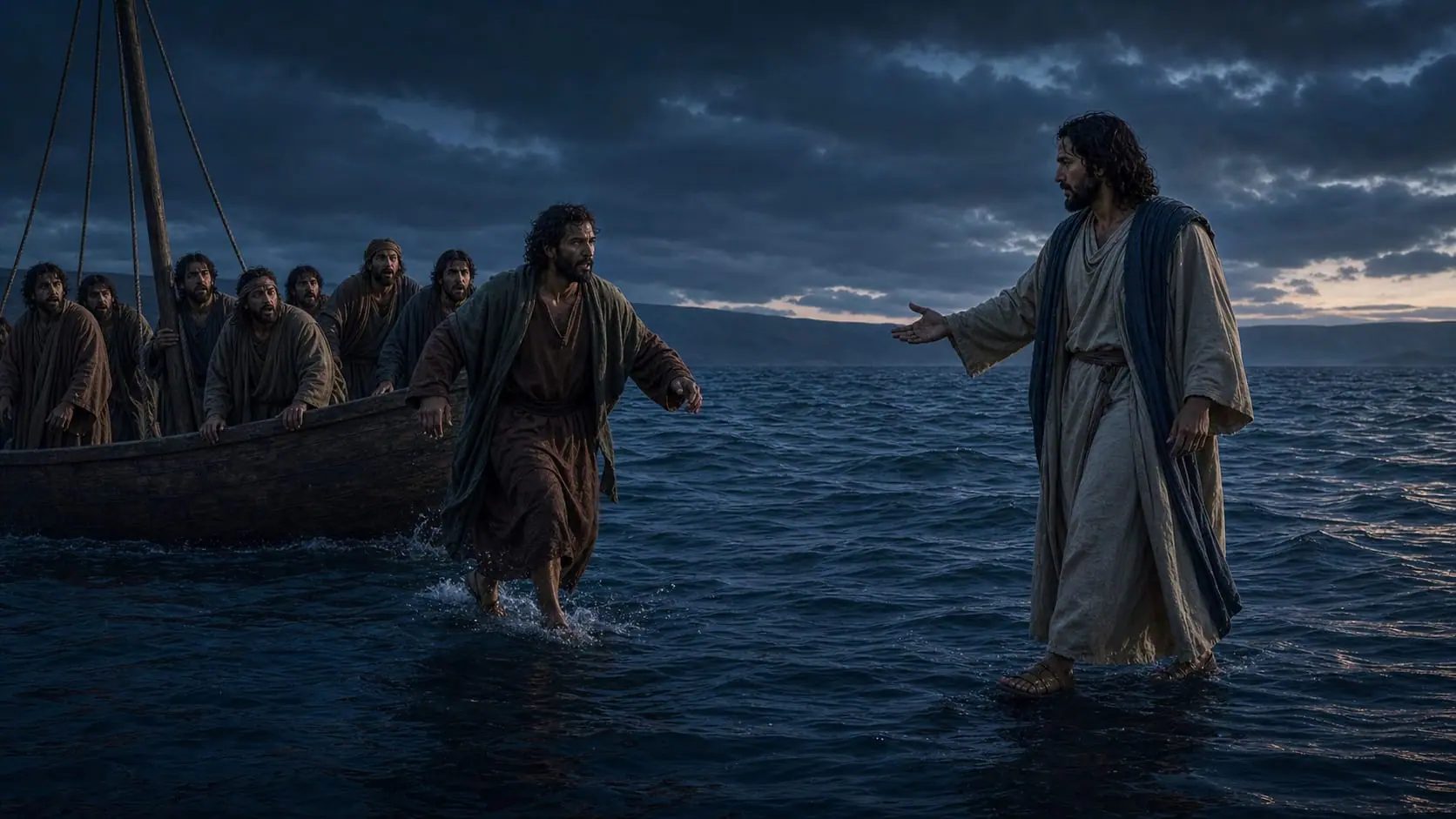
Peter answered, “Lord, if it is you, command me to come to you on the waters.” Jesus said, “Come!” Peter stepped out of the boat and truly walked on the water toward Jesus. Matthew does not present the act of leaving the boat as simple recklessness: Peter asks for Jesus’ command and moves after receiving it.
Mark and John do not tell this part of the event. That does not mean they deny it; each Gospel selects different details for its own account.
Peter becomes afraid and begins to sink
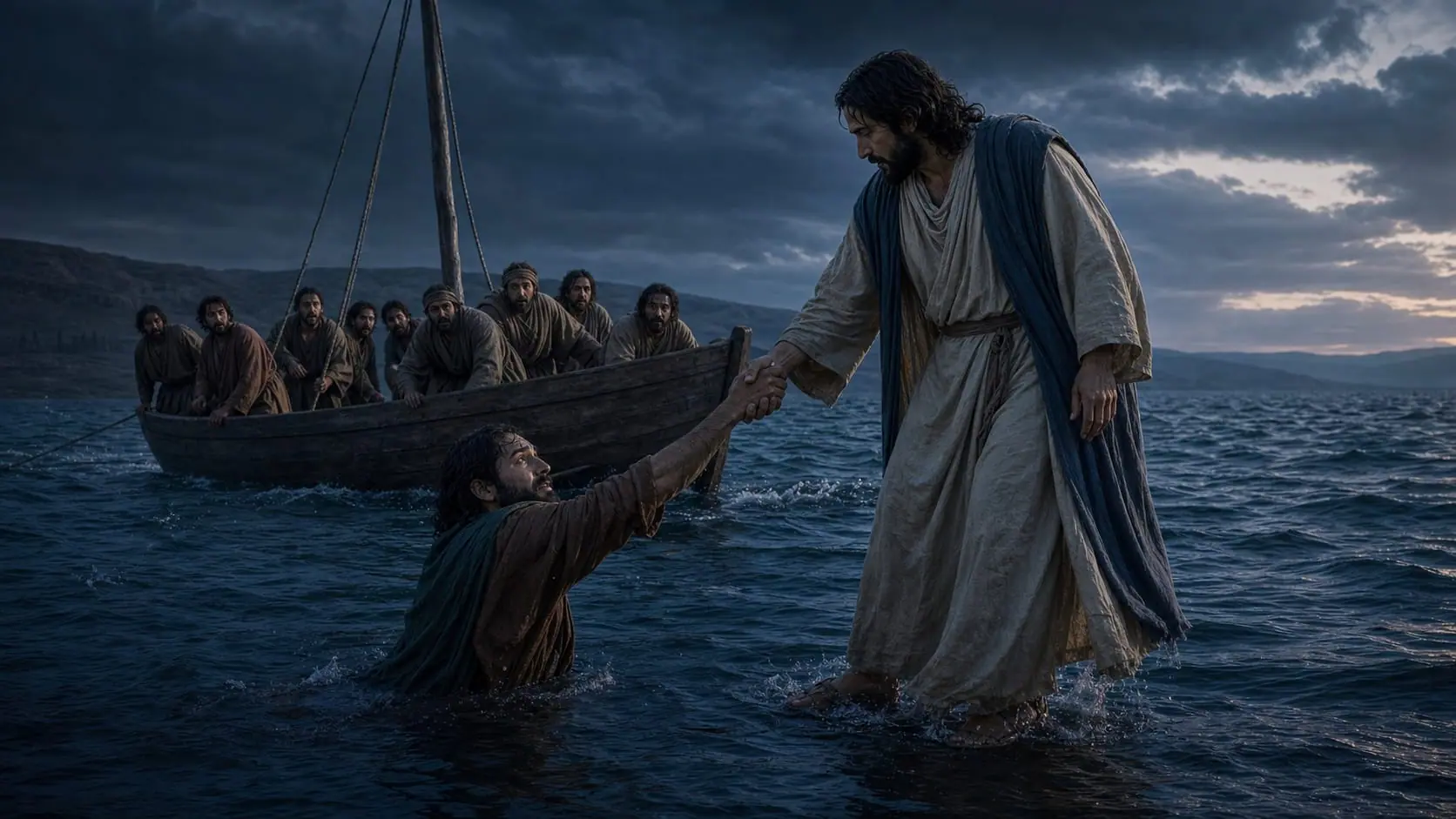
When Peter saw the strong wind, he became afraid. He began to sink and cried, “Lord, save me!” Jesus did not wait for Peter to recover or deliver a long explanation first. He immediately stretched out his hand and took hold of him.
Jesus caught Peter before calling him a person of “little faith” and asking why he had doubted. Matthew then says they entered the boat; it does not describe how they traveled back to it. Matthew 14:30–31
But when he saw that the wind was strong, he was afraid, and beginning to sink, he cried out, saying, “Lord, save me!” Immediately Jesus stretched out his hand, took hold of him, and said to him, “You of little faith, why did you doubt?”
The wind ceases and the disciples respond
When Jesus and Peter entered the boat, the wind ceased. Matthew says those in the boat worshiped Jesus and declared, “You are truly the Son of God!” Mark emphasizes their overwhelming amazement and adds that they had not understood the meaning of the loaves because their hearts were hardened.
John gives a compact ending: in the WEB, the disciples “were willing” to receive Jesus into the boat, and the boat was immediately at the land toward which they were traveling. He does not retell Peter’s rescue or the wind ceasing. Matthew 14:32–33; Mark 6:51–52; John 6:21
When they got up into the boat, the wind ceased. Those who were in the boat came and worshiped him, saying, “You are truly the Son of God!”
Meaning inside the narrative
Why Did Jesus Walk on Water?
The Gospels do not give one sentence beginning, “Jesus did this because.” The narrative itself supplies several connected answers: Jesus comes to disciples in distress, reveals authority over the sea, replaces their fear with his presence, and deepens the question of who he is after the feeding of the crowd.
Mark explicitly links the disciples’ amazement to their failure to understand the loaves. Matthew moves toward worship and the confession that Jesus is God’s Son. John places the sign inside a chapter that continues with Jesus’ teaching about the bread of life. The event is therefore more than a lesson about personal confidence.
Read each witness carefully
Jesus Walks on Water in Matthew, Mark, and John
Matthew 14:22–33
Matthew gives the longest account. It includes the disciples’ fear, Peter walking and sinking, Jesus’ immediate rescue, the wind ceasing, and the disciples worshiping Jesus as the Son of God.
Mark 6:45–52
Mark says Jesus saw the disciples distressed in rowing and “would have passed by them.” It ends by connecting their amazement to their failure to understand the loaves and their hardened hearts. Peter’s steps on the water are not part of Mark’s account.
John 6:16–21
John records the darkness, the distance rowed, the great wind, Jesus’ words, and the boat’s immediate arrival. He does not mention the disciples thinking they saw a ghost or Peter leaving the boat.
For Peter’s request and rescue, read Matthew. For the link between the crossing and the disciples’ response to the loaves, read Mark. John gives the rowing distance and the immediate arrival at land.
Not the same event as Jesus calming the storm
Jesus walking on water should not be confused with the earlier story in Matthew 8:23–27, Mark 4:35–41, and Luke 8:22–25. In that event, Jesus is already inside the boat and asleep before rebuking the storm. Here, the disciples cross without him, and Jesus later approaches on the water.
This is not the last time Peter struggles after promising to follow Jesus. Read about his later denials and Jesus’ renewed commission, or explore Bible passages about faith. To revisit other events in Jesus’ ministry after this story, try Jesus Trivia.