%20scale(.87)'%3e%3cg%20transform='rotate(-3%2032%2034)'%3e%3cpath%20d='M10.5%2019.5c7.65-2.35%2014.8-.45%2021.5%205.7%206.7-6.15%2013.85-8.05%2021.5-5.7v27.2c-7.65-2.15-14.8-.45-21.5%205.1-6.7-5.55-13.85-7.25-21.5-5.1V19.5Z'%20fill='%23fff'%20stroke='%23171528'%20stroke-width='4.5'%20stroke-linejoin='round'/%3e%3cpath%20d='M32%2025.2v26.6'%20stroke='%23171528'%20stroke-width='4'%20stroke-linecap='round'/%3e%3cpath%20d='M17.5%2034.5h9M22%2030v9'%20stroke='%23171528'%20stroke-width='3.75'%20stroke-linecap='round'/%3e%3ccircle%20cx='41.5'%20cy='32.5'%20r='2.5'%20fill='%23171528'/%3e%3ccircle%20cx='46.5'%20cy='38'%20r='2.5'%20fill='%23171528'/%3e%3c/g%3e%3c/g%3e%3c/svg%3e)
The quick answer
Who was Peter in the Bible?
Peter, also known as Simon and Cephas, was a Galilean fisherman and one of Jesus’ twelve apostles. Andrew was his brother, and the New Testament gives evidence that he was married. Matthew records Peter walking on water, confessing Jesus as the Messiah, and later denying him. After the resurrection, Jesus commissions him to care for his flock. In Acts, Peter preaches at Pentecost, heals in Jesus’ name, faces imprisonment, and brings the gospel to Cornelius’s household.
A fisherman from Bethsaida, with a home in Capernaum
John 1:44 calls Bethsaida the town of Andrew and Peter. Mark places the house of Simon and Andrew in the Capernaum setting, where Jesus heals Simon’s mother-in-law. These passages tell us about Peter’s family and home; they do not give his birth date or a full family tree.
In John’s account, Andrew brings Simon to Jesus after following John the Baptist. Jesus tells Simon he will be called Cephas, translated Peter. Matthew describes the brothers leaving their nets when Jesus calls them. Luke tells of Jesus teaching from Simon’s boat, a great catch after an unsuccessful night, and Simon falling at Jesus’ knees. Jesus tells him not to be afraid: he will now catch people alive.
John 1:35–44; Matthew 4:18–22; Mark 1:21, 29–31; Luke 5:1–11
Peter confesses Jesus as Messiah—and needs correction
At Caesarea Philippi, Peter identifies Jesus as the Christ, the Son of the living God. Jesus says this has been revealed by the Father and speaks of Peter, the rock, the building of his church, and the keys of the kingdom. The WEB uses assembly where many English translations use church. Christian traditions differ over how this passage relates Peter, his confession, and later church leadership; the words in Matthew 16:17–19 should be read before drawing those conclusions.
The same chapter records a sharp correction. When Jesus predicts his suffering, death, and resurrection, Peter takes him aside and objects. Jesus rebukes him for setting his mind on human rather than divine concerns. At the transfiguration, Peter is present with James and John; when he proposes three shelters, the voice from the cloud directs them to listen to Jesus.
Matthew 16:13–23; 17:1–9 · Read another moment when Peter trusts Jesus and becomes afraid →
Three denials and a renewed commission
Peter promises that he is ready for prison and death. Jesus predicts that he will deny knowing him three times, but also says he has prayed for Peter and tells him to strengthen his brothers when he turns back. After the arrest, Peter follows at a distance and denies knowing Jesus when challenged in the courtyard. Luke records Jesus turning to look at him; Peter remembers the warning and weeps.
Mark records two rooster crows, with the second after the third denial. Luke records a crow after the third denial. Both preserve Peter’s tears. The danger he faces helps explain his fear, although neither account gives a full explanation of his motives.
After the resurrection, John records Peter entering the empty tomb, then meeting Jesus beside the Sea of Tiberias. Following breakfast, Jesus asks him three times about his love and tells him to feed and tend his flock. Christians commonly read this as Peter’s restoration after the three denials. Peter is grieved by the third question, yet Jesus again calls him to follow.
Luke 22:31–34, 54–62; Mark 14:66–72; John 20:1–10; 21:1–19 · Follow the empty-tomb accounts and resurrection appearances →
Preaching, healing, and imprisonment in Acts
At Pentecost, Peter stands with the eleven and explains the outpouring of the Holy Spirit. He proclaims Jesus’ death and resurrection and calls his hearers to repent and be baptized. Acts says about three thousand people are added that day. When he and John later meet a man unable to walk at the temple gate, Peter tells him to rise in Jesus’ name. He explicitly denies that their own power or godliness caused the healing.
Acts also records Peter telling Aeneas that Jesus Christ heals him, and praying before Tabitha is raised from death. In Joppa, a vision of animals challenges his understanding of what is unclean. When he enters Cornelius’s home in Caesarea, he explains that God has shown him not to call any person unholy or unclean. The Holy Spirit falls on the hearers while he speaks; Peter then commands that they be baptized. He later explains these events to believers in Jerusalem.
Acts 12 places Peter in prison after Herod has killed James, John’s brother. While the church prays, an angel leads Peter out. At the house of Mary, John Mark’s mother, Rhoda recognizes his voice but is so joyful that she leaves him outside while she tells the others. Peter keeps knocking until they open the gate. His rescue does not erase James’s death or promise that every faithful prisoner will be released.
Acts 2:1–41; 3:1–16; 4:1–22; 9:32–43; 10:1–48; 11:1–18; 12:1–19
Peter and Paul: fellowship and confrontation
Galatians 2 names James, Cephas, and John as recognized pillars who extend fellowship to Paul and Barnabas. It also records Paul confronting Peter at Antioch. Peter had eaten with Gentile believers but withdrew when certain people arrived from James, fearing those of the circumcision. Paul calls the conduct hypocrisy, and says even Barnabas was carried along with it.
At the Jerusalem meeting in Acts 15, Peter argues that God gave Gentile believers the Holy Spirit and cleansed their hearts by faith. He speaks of salvation through the grace of Jesus and opposes placing an unbearable yoke on them. His words at that meeting and his conduct at Antioch show why Peter’s leadership cannot be told only as a series of successes.
Galatians 2:1–14; Acts 15:6–11 · Read about Paul’s mission and his work with other apostles →
Peter’s letters and what is known about his death
First and Second Peter identify their sender as Peter or Simon Peter. First Peter encourages believers facing suffering and calls them to holy conduct, humility, and care for one another. Second Peter recalls the transfiguration, warns about false teachers, and addresses the promised return of Christ. These are letters of instruction, not a continuous biography of Peter’s later travels.
John 21:18–19 says Jesus’ words about Peter stretching out his hands indicate the kind of death by which he would glorify God. The New Testament does not narrate the execution. Eusebius’s Church History 3.1, citing Origen, reports that Peter was crucified head-down in Rome at his own request. That is a later Christian report, not a detail recorded in Acts or John. It does not make Peter’s exact age or a precise execution date a biblical fact.
1 Peter 1:1–9, 13–16; 4:12–19; 5:1–14; 2 Peter 1:1–18; 2:1–3; 3:1–18; John 21:18–19 · Read Eusebius, Church History 3.1, as a source for the later tradition →
Simon, Cephas, and Peter
Why was Simon called Peter?
Simon was his personal name. Jesus gave him the Aramaic name Cephas, rendered in Greek as Petros and in English as Peter; both are connected with “rock” or “stone.” The New Testament uses Simon, Simon Peter, Cephas, and Peter for the same apostle. Matthew 16 links the name with Jesus’ saying about the rock and the building of his church, a passage interpreted in several Christian traditions.
The life arc in Scripture
Peter’s life in brief
John 1:35–42; Luke 5:1–11
Andrew introduces Simon; Jesus calls him to follow
Matthew 14:22–33; 16:13–23
Peter steps onto the water and confesses Jesus
Luke 22:31–34, 54–62
Peter denies knowing Jesus three times
John 21:1–19
The risen Jesus restores and commissions Peter
Acts 2:14–41; 10:1–48
Peter preaches at Pentecost and enters a Gentile home
Family and companions
Peter’s family and relationships
Andrew is Peter’s brother; James and John are his fishing partners in Luke 5. His father’s name differs among Gospel passages and textual traditions. His mother-in-law and Paul’s reference to a believing wife provide evidence of his marriage, but his wife’s name is not given.
Andrew
A fellow fisherman and disciple who brings Simon to Jesus.
Jonah / John in different texts
Matthew 16:17 calls him Simon Bar Jonah. In John 1:42, the WEB has Jonah, the KJV spells it Jona, and the NABRE has John. None identifies his father as the prophet Jonah.
Unnamed wife
Jesus heals Peter’s mother-in-law. In 1 Corinthians 9:5, Paul specifically names Cephas when discussing the right to travel with a believing wife.
Jesus
Jesus calls, corrects, restores, and commissions Peter throughout the Gospels.
What the text says—and does not say
Common questions about Peter
Peter had a wife
Jesus heals his mother-in-law, and Paul asks about the right to travel with a believing wife as Cephas does.
Mark 1:29–31; 1 Corinthians 9:5His children are not listed
The New Testament does not provide a list of Peter’s children. First Peter 5:13 calls Mark his son, language commonly understood as a spiritual relationship; it is not enough to establish biological parentage.
1 Peter 5:13; Acts 12:12The execution account is outside the New Testament
John anticipates Peter’s death but does not narrate it. Eusebius, citing Origen in Church History 3.1, reports crucifixion head-down in Rome. Keep that report distinct from the Gospel’s words.
John 21:18–19Peter’s exact age is unknown
No birth year or age at death is given. Claims with precise numbers depend on reconstruction rather than explicit text.
Gospels–ActsThe picture does not establish appearances or headcounts
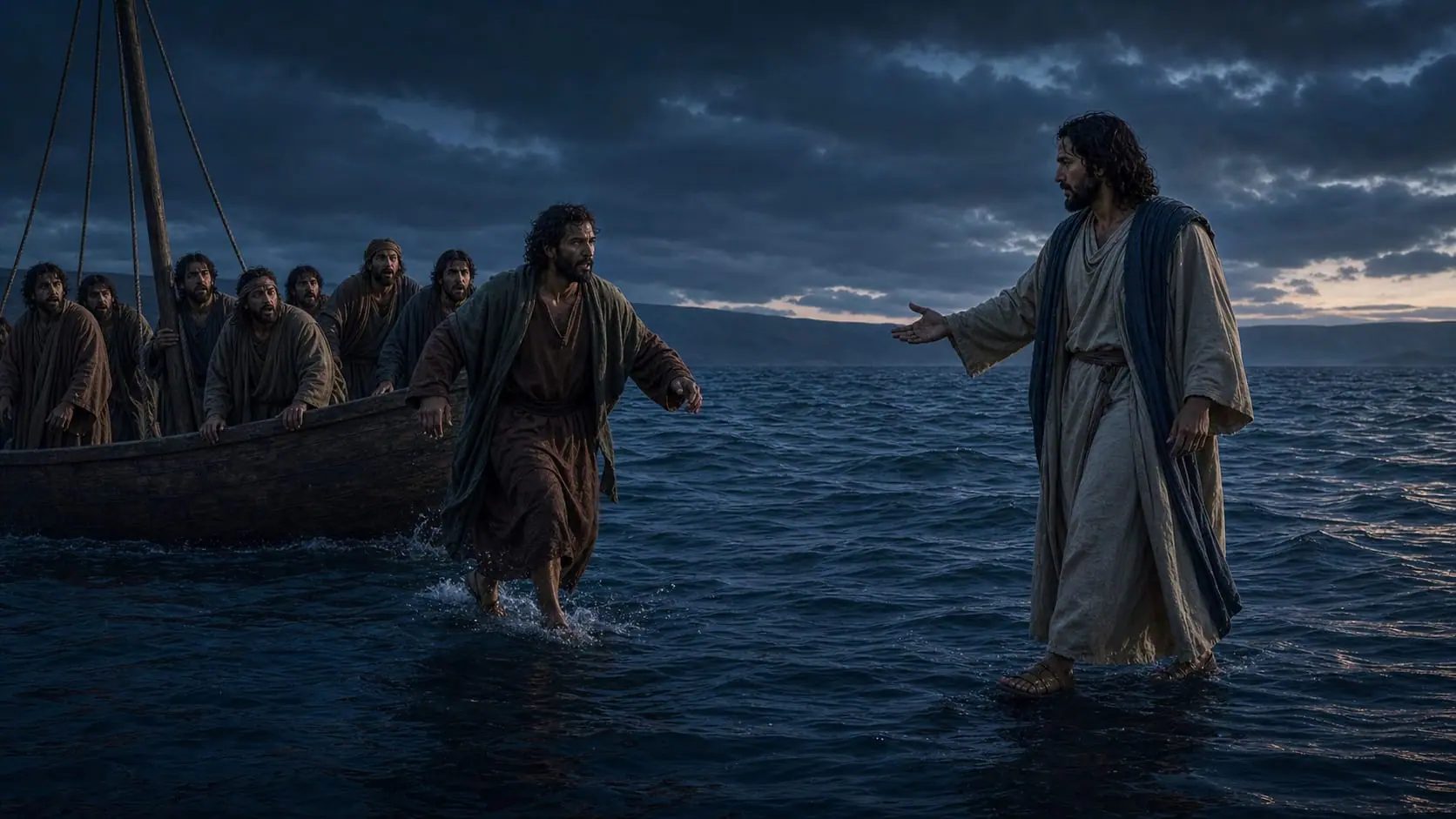
Matthew says Peter walked toward Jesus after leaving the boat. The clothing, faces, lighting, boat design, and number of visible passengers in the illustration are artistic choices.
Matthew 14:22–33Follow the biblical accounts
Read Peter’s connected stories
Jesus Walks on Water
Read how Peter leaves the boat, begins to sink, calls for rescue, and returns with Jesus.
Read more →Final meal contextThe Last Supper
Read about the meal Peter and John prepare in Luke and Jesus’ warning about Peter’s denial.
Read more →Passion narrativeCrucifixion of Jesus
Follow the arrest, trial, and crucifixion accounts that surround Peter’s denial.
Read more →Resurrection contextResurrection of Jesus
See Peter run to the tomb within the larger resurrection narrative.
Read more →