%20scale(.87)'%3e%3cg%20transform='rotate(-3%2032%2034)'%3e%3cpath%20d='M10.5%2019.5c7.65-2.35%2014.8-.45%2021.5%205.7%206.7-6.15%2013.85-8.05%2021.5-5.7v27.2c-7.65-2.15-14.8-.45-21.5%205.1-6.7-5.55-13.85-7.25-21.5-5.1V19.5Z'%20fill='%23fff'%20stroke='%23171528'%20stroke-width='4.5'%20stroke-linejoin='round'/%3e%3cpath%20d='M32%2025.2v26.6'%20stroke='%23171528'%20stroke-width='4'%20stroke-linecap='round'/%3e%3cpath%20d='M17.5%2034.5h9M22%2030v9'%20stroke='%23171528'%20stroke-width='3.75'%20stroke-linecap='round'/%3e%3ccircle%20cx='41.5'%20cy='32.5'%20r='2.5'%20fill='%23171528'/%3e%3ccircle%20cx='46.5'%20cy='38'%20r='2.5'%20fill='%23171528'/%3e%3c/g%3e%3c/g%3e%3c/svg%3e)
The quick answer
What happened in Paul’s conversion story?
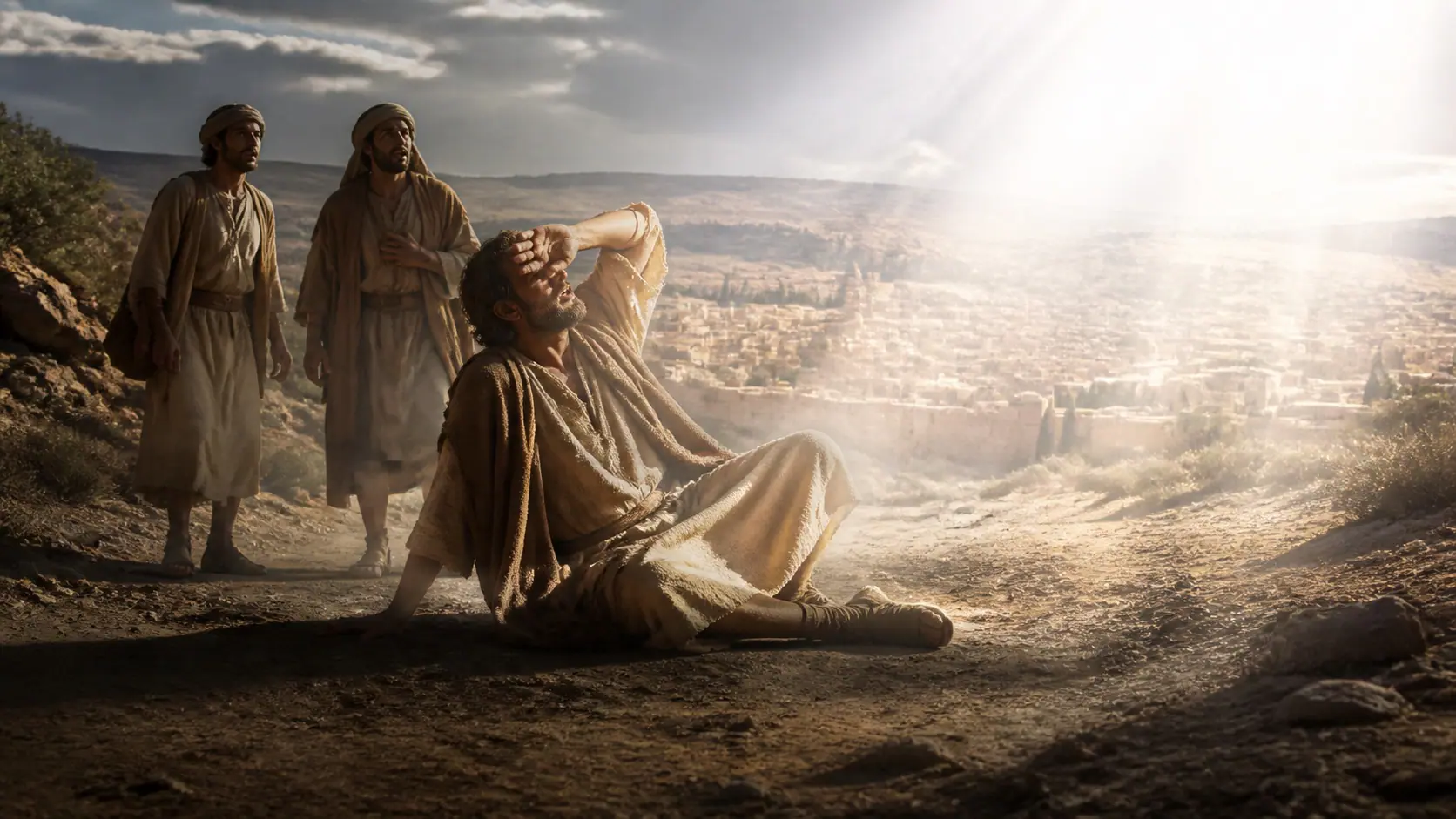
Saul was traveling to Damascus with authority to arrest followers of Jesus when a light from heaven flashed around him. He fell to the ground and heard Jesus ask why Saul was persecuting him. Saul entered Damascus blind and neither ate nor drank for three days.
Jesus sent a disciple named Ananias so that Saul could receive his sight and be filled with the Holy Spirit. Saul was baptized, ate, and stayed with the Damascus disciples. He began proclaiming that Jesus is the Son of God—the message of the people he had come to arrest.
The full story
Acts 9: Saul’s Encounter, Baptism, and New Mission
Saul threatens the disciples and heads for Damascus
At Stephen’s stoning, the witnesses left their garments with Saul. He approved of Stephen’s death and then attacked the church, entering homes and dragging away both men and women to prison. He asked the high priest for letters to the Damascus synagogues so that he could bring followers of the Way back to Jerusalem as prisoners.
Years later, Paul told Agrippa that he had thought he ought to oppose the name of Jesus. His own account acknowledges the imprisonment and violence he had inflicted on believers.
Acts 7:58–8:3; 9:1–2; 26:9–11
A light from heaven stops Saul on the road
As Saul approached Damascus, a light from heaven suddenly shone around him. He fell to the ground and heard a voice: “Saul, Saul, why do you persecute me?” When Saul asked who was speaking, the answer identified the risen Jesus with the people Saul was attacking.
Jesus told Saul to enter the city, where he would be told what to do. Acts 9:7 describes the men with him standing speechless, hearing the sound but seeing no one. That is the World English Bible wording used in the quotations on this page; the comparison below explains how Acts 22 and 26 describe the encounter.
Acts 9:3–7
He fell on the earth, and heard a voice saying to him, “Saul, Saul, why do you persecute me?” He said, “Who are you, Lord?” The Lord said, “I am Jesus, whom you are persecuting. But rise up and enter into the city, then you will be told what you must do.”
Saul enters Damascus blind for three days
When Saul opened his eyes, he could not see. His companions led him by the hand into Damascus. For three days he remained without sight and did not eat or drink.
When the Lord spoke to Ananias, he said Saul was praying at a house on Straight Street. Saul had seen a vision of Ananias coming and laying hands on him so that he could receive his sight.
Acts 9:8–12
Ananias obeys despite Saul’s reputation
The Lord called a Damascus disciple named Ananias and told him to visit Saul on Straight Street. Ananias answered honestly: he had heard how much harm Saul had done and knew why Saul came to Damascus.
The Lord told Ananias that Saul would carry Jesus’ name before the nations, kings, and the children of Israel, and would suffer for that name. Ananias went to the house, laid hands on Saul, and addressed him as “Brother Saul.”
Acts 9:10–17
But the Lord said to him, “Go your way, for he is my chosen vessel to bear my name before the nations and kings, and the children of Israel. For I will show him how many things he must suffer for my name’s sake.”
Saul regains his sight and is baptized
Ananias said that the Lord Jesus, who had appeared to Saul on the road, had sent him so that Saul could receive his sight and be filled with the Holy Spirit. Something like scales fell from Saul’s eyes. He got up, was baptized, ate, and regained strength. He stayed with the disciples in Damascus.
Acts 9:17–19; 22:12–16
Ananias departed and entered into the house. Laying his hands on him, he said, “Brother Saul, the Lord, who appeared to you on the road by which you came, has sent me that you may receive your sight and be filled with the Holy Spirit.” Immediately something like scales fell from his eyes, and he received his sight. He arose and was baptized. He took food and was strengthened. Saul stayed several days with the disciples who were at Damascus.
The former persecutor begins proclaiming Jesus
Saul began proclaiming Jesus in the synagogues, astonishing people who knew why he had come. Acts says that after many days, opponents plotted to kill him and watched the city gates. His disciples lowered him in a basket through the wall at night. Paul also recalls an escape through a window in the wall while the governor under King Aretas was guarding Damascus.
When Saul reached Jerusalem, the disciples were afraid of him. Barnabas brought him to the apostles and described Saul’s encounter and preaching. Saul spoke boldly there, but another threat to his life led believers to take him to Caesarea and send him to Tarsus. This was not an immediate trip to Jerusalem after his baptism: Galatians 1 describes Arabia, a return to Damascus, and a Jerusalem visit after three years.
Acts 9:19–30; 2 Corinthians 11:32–33; Galatians 1:15–24
Compare the accounts
Paul’s Conversion in Acts 9, 22, and 26
Acts 9 narrates Saul’s encounter and the Lord’s instructions to Ananias. Acts 22 records Paul speaking to a crowd in Jerusalem. Its commission to go far away to the Gentiles comes during a later vision in the Jerusalem temple, not on the Damascus road. In Acts 26, Paul speaks before Agrippa and Festus and recounts Jesus giving him an extended commission during the road encounter.
The descriptions of the companions differ. In the World English Bible, Acts 9:7 says they heard the sound but saw no one; Acts 22:9 says they saw the light but did not understand the voice. The King James Version instead renders Acts 22:9 as not hearing the voice. Distinguishing hearing a sound from understanding speech is a common explanation, reflected in the WEB translation, not identical wording in every English Bible. Compare Acts 22:9 in the WEB with the KJV.
Acts 9 describes the men standing speechless; Acts 26:14 says they all fell to the ground. The accounts do not specify when each companion stood up. They should not be rewritten to supply a sequence that neither passage gives.
Common claims checked
Did Saul Fall from a Horse, and When Did He Become Paul?
No biblical account mentions a horse. Acts says Saul fell to the ground, so the horse belongs to later artistic tradition rather than the text.
Acts does not describe Jesus changing Saul’s name. Acts 13:9 identifies Saul as also called Paul, and the narrator then normally uses Paul. The illustration on this page is an artist’s imagined scene: the faces, exact poses, city view, and choice of two companions are not details supplied by Acts.
After Damascus
Did Paul go straight to Jerusalem?
No. In Galatians 1:15–18, Paul says he went to Arabia and returned to Damascus, then visited Jerusalem after three years. He stayed with Peter for fifteen days and also saw James, the Lord’s brother. Acts 9 tells the story more briefly without mentioning Arabia.
Paul does not say that all three years were spent in Arabia or describe a three-year course of private instruction there. Read his own account in Galatians 1 alongside Acts 9 when following the early timeline.
An unfamiliar expression
What does “kick against the goads” mean?
In Acts 26:14, Jesus uses the image of an animal kicking against a pointed stick used to guide it. The saying describes Saul’s resistance to Jesus. The KJV uses the older word “pricks” for the goads; it is not a different object.
The KJV also includes this saying in Acts 9:5. The WEB places it in Acts 26:14 and notes the additional wording in its Acts 9 footnotes. Read Acts 26:14 and the WEB notes to Acts 9 before comparing quotations from different translations.