%20scale(.87)'%3e%3cg%20transform='rotate(-3%2032%2034)'%3e%3cpath%20d='M10.5%2019.5c7.65-2.35%2014.8-.45%2021.5%205.7%206.7-6.15%2013.85-8.05%2021.5-5.7v27.2c-7.65-2.15-14.8-.45-21.5%205.1-6.7-5.55-13.85-7.25-21.5-5.1V19.5Z'%20fill='%23fff'%20stroke='%23171528'%20stroke-width='4.5'%20stroke-linejoin='round'/%3e%3cpath%20d='M32%2025.2v26.6'%20stroke='%23171528'%20stroke-width='4'%20stroke-linecap='round'/%3e%3cpath%20d='M17.5%2034.5h9M22%2030v9'%20stroke='%23171528'%20stroke-width='3.75'%20stroke-linecap='round'/%3e%3ccircle%20cx='41.5'%20cy='32.5'%20r='2.5'%20fill='%23171528'/%3e%3ccircle%20cx='46.5'%20cy='38'%20r='2.5'%20fill='%23171528'/%3e%3c/g%3e%3c/g%3e%3c/svg%3e)
The quick answer
What happened to Shadrach, Meshach, and Abednego?
King Nebuchadnezzar erected a huge golden image and commanded officials from across his empire to bow when the music played. Shadrach, Meshach, and Abednego—Judean exiles appointed over affairs in Babylon—refused. Accusers reported them, and the furious king offered one more opportunity to worship the image.
The three answered that their God could deliver them, but even if he did not, they would not serve the king’s gods or worship the image. Bound and thrown into the overheated furnace, they were seen walking free in the flames with a fourth figure. Nebuchadnezzar called them out. The assembled officials found no burns, singed hair, damaged clothes, or even the smell of fire.
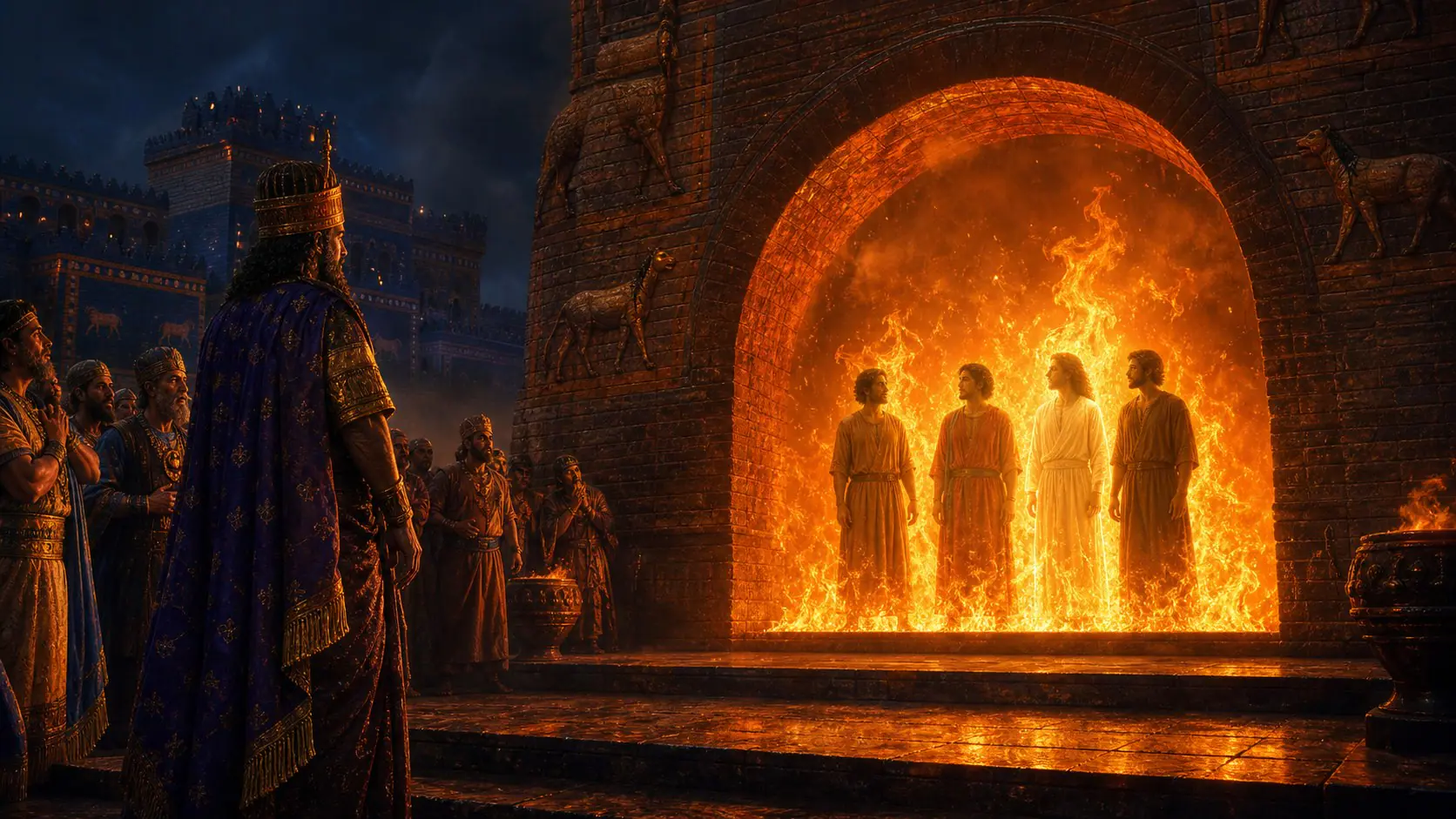
This retelling follows the World English Bible’s Daniel 3:1–30. The illustration imagines the furnace’s architecture and the figures’ appearance; the fourth figure’s white robe is an artistic choice, not a detail given in that passage.
The full story
The fiery furnace story from Daniel 3
Officials gather before a golden image
The king sets up a golden image on the plain of Dura in the province of Babylon. It measures sixty cubits high and six cubits wide. The chapter does not say that it is a statue of Nebuchadnezzar himself. Officials assemble for its dedication, and a herald announces the command to peoples of every nation and language.
At the sound of the instruments, they must fall down and worship the image. Anyone who refuses faces the furnace. Verse 7 describes the assembled peoples bowing; the following scene singles out three men who have refused.
Daniel 3:1–7
The three Judeans are accused of refusing worship
Certain Chaldeans denounce Shadrach, Meshach, and Abednego. Their accusation reminds the king that he appointed the three over Babylonian affairs, then frames their refusal as disregard for the king himself.
Nebuchadnezzar summons them in rage but offers another chance. He repeats the musical signal and threatens the furnace, ending with a challenge: what god will be able to rescue them from his hand?
Daniel 3:8–15
They refuse even if rescue does not come
The three say that their God is able to deliver them. In the WEB, verse 17 also expresses confidence that he will deliver them from the king’s hand. Verse 18 follows with a condition: even if not, they will not serve the king’s gods or worship the image.
Their refusal does not depend on being told in advance how this confrontation will end. They do not ask the king for another chance to reconsider.
Daniel 3:16–18
If it happens, our God whom we serve is able to deliver us from the burning fiery furnace; and he will deliver us out of your hand, O king. But if not, let it be known to you, O king, that we will not serve your gods or worship the golden image which you have set up.”
The furnace is overheated and a fourth figure appears
Nebuchadnezzar orders the furnace heated seven times more than usual. Strong soldiers bind the men in their clothing and throw them in; the flames kill the soldiers who carry them up.
The king then rises in astonishment. He expected three bound men, yet sees four unbound figures walking in the fire without harm. His description of the fourth figure is translated in different ways, including “like a son of the gods” and “like a son of God.” The Aramaic wording reports the pagan king’s perception; later interpretations should not erase that narrative setting.
Daniel 3:19–25
They leave unharmed and the king issues another decree
Nebuchadnezzar approaches the furnace and calls the men servants of the Most High God. Officials gather and inspect them: the fire has no power over their bodies, their hair is not singed, their clothes are unchanged, and there is no smell of fire.
The king praises their God for sending his angel to rescue them. Then he threatens anyone who speaks against their God with being cut to pieces and having their house made a refuse heap. This violent decree is Nebuchadnezzar’s command, not an instruction from God to imitate. He also promotes the three men in the province of Babylon.
Daniel 3:26–30
Names in exile
What were their Hebrew names?
Daniel 1:6–7 gives the names one by one: Hananiah becomes Shadrach, Mishael becomes Meshach, and Azariah becomes Abednego. The chief official assigns these new names during their preparation for court service.
They are introduced as young Judean exiles. Although often called the “three Hebrew boys,” their ages at the furnace are not given. Daniel 2:49 says they were appointed over the affairs of the province of Babylon at Daniel’s request.
The fourth figure
Who was the fourth man in the fire?
In Daniel 3:25, the WEB has Nebuchadnezzar say the fourth figure looks like “a son of the gods.” The KJV reads “the Son of God.” In verse 28, both translations report the king saying that God sent his angel.
Christians who identify the figure as Christ understand this as an appearance before Jesus’ birth. Other readers understand an angel. The chapter does not name the figure as Jesus. The illustration’s white-robed figure should not settle that question for the reader.
Reading another edition
Why does my Bible include a prayer and song?
Catholic and Orthodox Bibles include the Greek additions to Daniel as Scripture. In the NABRE’s Daniel 3, verses 24–90 include Azariah’s prayer, the angel’s protection, and the three men’s song of praise. The king sees four men in verse 92, corresponding to verse 25 in the WEB and KJV.
Those additions do not appear within Daniel 3 in the WEB edition used here. For more about the different arrangements, see the Book of Daniel guide.