%20scale(.87)'%3e%3cg%20transform='rotate(-3%2032%2034)'%3e%3cpath%20d='M10.5%2019.5c7.65-2.35%2014.8-.45%2021.5%205.7%206.7-6.15%2013.85-8.05%2021.5-5.7v27.2c-7.65-2.15-14.8-.45-21.5%205.1-6.7-5.55-13.85-7.25-21.5-5.1V19.5Z'%20fill='%23fff'%20stroke='%23171528'%20stroke-width='4.5'%20stroke-linejoin='round'/%3e%3cpath%20d='M32%2025.2v26.6'%20stroke='%23171528'%20stroke-width='4'%20stroke-linecap='round'/%3e%3cpath%20d='M17.5%2034.5h9M22%2030v9'%20stroke='%23171528'%20stroke-width='3.75'%20stroke-linecap='round'/%3e%3ccircle%20cx='41.5'%20cy='32.5'%20r='2.5'%20fill='%23171528'/%3e%3ccircle%20cx='46.5'%20cy='38'%20r='2.5'%20fill='%23171528'/%3e%3c/g%3e%3c/g%3e%3c/svg%3e)
The quick answer
Who was Daniel in the Bible?
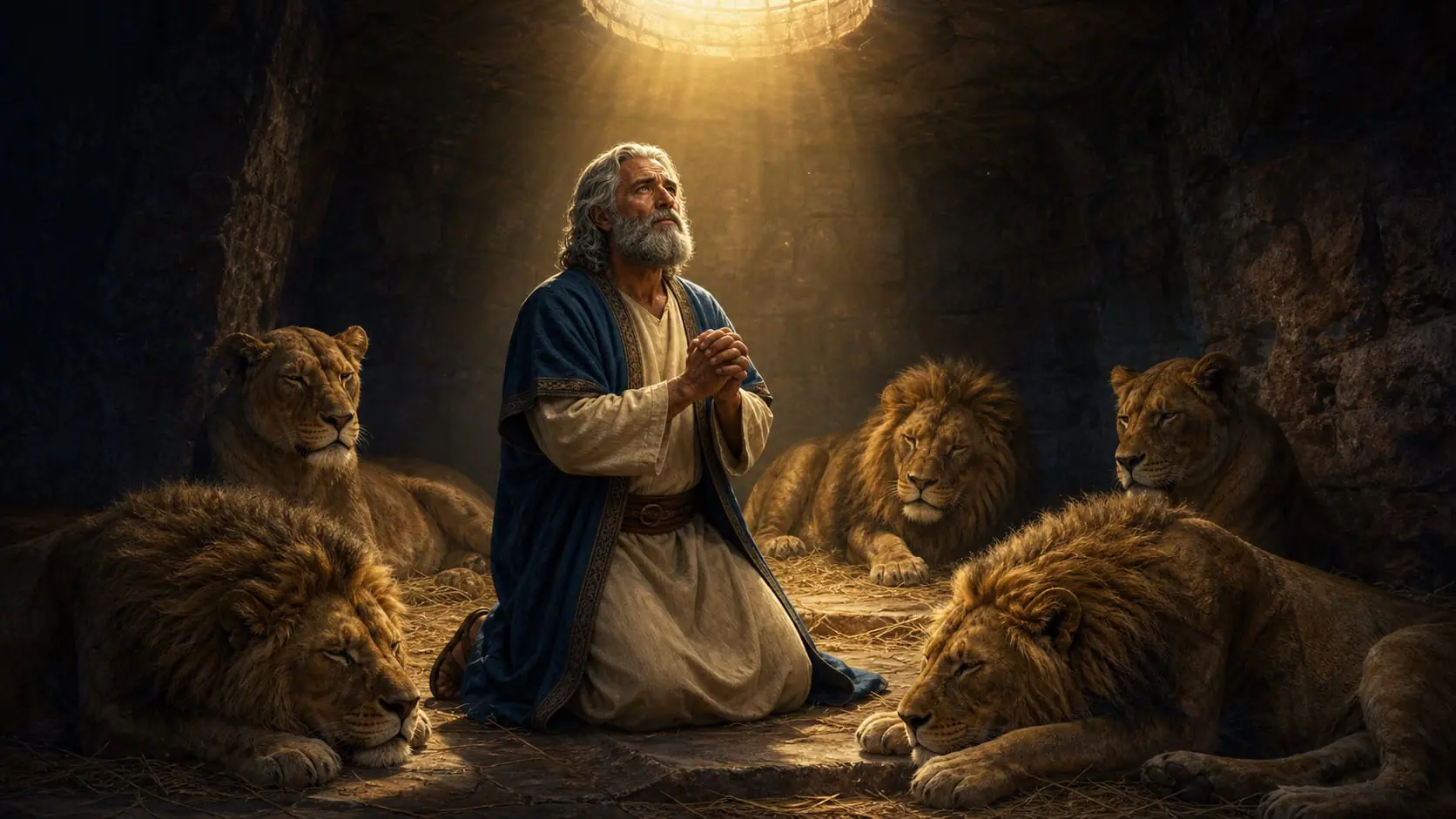
Daniel was a young Judean taken to Babylon and trained for royal service. Given the Babylonian name Belteshazzar, he served across changing empires while maintaining allegiance to God. Daniel interpreted Nebuchadnezzar’s dreams, explained the writing on Belshazzar’s wall, prayed despite a royal prohibition, survived the lions’ den, and received visions concerning kingdoms, judgment, suffering, and restoration.
What changed when Daniel was taken to Babylon?
Daniel enters the story as a young man from Judah, taken into a court that gives him a new name, teaches him its language and literature, and assigns him the king’s food and wine. He asks not to defile himself with that food, then proposes a ten-day test of vegetables and water to the steward. The steward continues the alternative diet after seeing the result. The chapter does not spell out exactly what made the royal food defiling.
This ten-day test is not the three weeks of mourning in Daniel 10, when Daniel avoids pleasant food, meat, and wine. Neither passage gives the detailed food rules of every modern “Daniel Fast.” Daniel’s companions share the early food test and join him in seeking God’s mercy over the king’s dream. Chapter 3 later follows those three friends into the furnace; it does not say where Daniel is during that event.
Daniel 1:3–20; 2:17–18; 3:12–30; 10:2–3 · Read the account of Daniel’s three friends in the furnace →
Daniel asks for understanding—and does not receive every answer
Daniel tells Nebuchadnezzar that God has revealed the dream, not that he is wiser than everyone else. When Daniel receives visions himself, he asks for their meaning. Gabriel explains the ram and goat in chapter 8, yet Daniel remains troubled and is ill for days. By chapter 12 he still says that he does not understand what he has heard. Receiving a vision does not make him all-knowing.
His prayer in chapter 9 also goes beyond asking for personal protection. Reading Jeremiah’s prophecy about Jerusalem, he confesses his own sin and his people’s sin, and asks for mercy for the city and sanctuary. His innocence of the charges in chapter 6 is not a claim that he has never sinned.
The visions are not all later than the lions’ den. Chapters 7 and 8 are dated to Belshazzar’s reign, before that king’s death in chapter 5. Chapter 9 is dated to Darius’s first year and chapter 10 to Cyrus’s third year. Daniel 1:21 mentions Cyrus’s first year, but it does not give Daniel’s death date.
Daniel 1:21; 2:27–30; 5:30–31; 6:22; 7:1; 8:1, 15–27; 9:1–20; 10:1; 12:8–13 · Explore the book’s structure, languages, and visions →
A Hebrew confession carried into exile
What does the name Daniel mean?
Daniel means “God is my judge,” as the Brown–Driver–Briggs lexicon explains. The chief official gives him the Babylonian name Belteshazzar (Daniel 1:7), which Nebuchadnezzar associates with his god (4:8). Belteshazzar is Daniel, not King Belshazzar, the ruler he addresses in chapter 5. Ezekiel 14:14, 20 and 28:3 mention a wise, righteous figure whose name is rendered Daniel or Danel. Some readers identify him with Daniel the exile; others see an earlier figure known from Ugaritic literature. His identity is disputed.
Brown–Driver–Briggs: Daniel, entry 1840
Yale Bible Study: the Danel identification and Daniel’s name
The life arc in Scripture
Daniel’s life in brief
Daniel 1:1–21
A Judean youth is trained in Babylon
Daniel 2:1–49
He reveals and interprets Nebuchadnezzar’s dream
Daniel 4:1–37
He warns Nebuchadnezzar and urges mercy
Daniel 7:1; 8:1, 15–27
Visions come during Belshazzar’s reign
Daniel 5:1–31
Daniel interprets the writing at Belshazzar’s feast
Daniel 6:1–28
Prayer leads to the lions’ den—and deliverance
Daniel 9:1–3; 10:1; 12:8–13
Prayer and revelation under Darius and Cyrus
Family and companions
Daniel’s family and relationships
Daniel 1–12 names his three Judean companions and the rulers he serves, but not his parents, wife, or children. A different Greek form of the Bel and the Dragon story names a Daniel as the son of Abal; it is not a family history supplied by these twelve chapters.
Hananiah · Shadrach
One of the companions who prays with Daniel and later faces the fiery furnace.
Mishael · Meshach
A Judean companion renamed and trained for service in Babylon.
Azariah · Abednego
The third companion who shares Daniel’s early food test and prayer.
Nebuchadnezzar, Belshazzar, Darius, and Cyrus
Daniel interprets revelations for the two Babylonian kings. Chapter 6 places him in office under Darius the Mede and says he prospered under Darius and Cyrus the Persian.
What the text says—and does not say
Common questions about Daniel
Daniel and Belteshazzar are the same person
The Babylonian name was assigned by the chief official and is used alongside Daniel’s Hebrew name.
Daniel 1:6–7; 4:8–9Daniel had three named Judean companions
Hananiah, Mishael, and Azariah also receive the court names Shadrach, Meshach, and Abednego. Daniel is not one of the three men thrown into the furnace.
Daniel 1:6–7; 3:20–23These chapters give no names for Daniel’s parents or wife
They identify him as a young man from Judah, but do not describe his marriage or children. In an Old Greek version of Bel and the Dragon, a Daniel is called a priest and son of Abal. The USCCB note on Daniel 14:1–3 preserves that variant, which differs from the text printed in the NABRE.
Daniel 1:3–7; USCCB note on Daniel 14:1–3Daniel’s exact age and death are unknown
He appears to have lived from youth into advanced age, but Scripture gives no birth year, age at the den, cause of death, or burial place.
Daniel 1:4; 6:1–28; 10:1Follow the biblical accounts
Read Daniel’s connected stories
Daniel in the Lions’ Den Story
Read the decree, Daniel’s prayer, the sealed den, Darius’s night, and the morning rescue.
Read more →Daniel 3Shadrach, Meshach and Abednego
Read how Daniel’s three friends refuse the golden image and survive the fiery furnace.
Read more →Book-level overviewBook of Daniel Summary
See the twelve-chapter structure, court stories, visions, themes, and reading plan.
Read more →