%20scale(.87)'%3e%3cg%20transform='rotate(-3%2032%2034)'%3e%3cpath%20d='M10.5%2019.5c7.65-2.35%2014.8-.45%2021.5%205.7%206.7-6.15%2013.85-8.05%2021.5-5.7v27.2c-7.65-2.15-14.8-.45-21.5%205.1-6.7-5.55-13.85-7.25-21.5-5.1V19.5Z'%20fill='%23fff'%20stroke='%23171528'%20stroke-width='4.5'%20stroke-linejoin='round'/%3e%3cpath%20d='M32%2025.2v26.6'%20stroke='%23171528'%20stroke-width='4'%20stroke-linecap='round'/%3e%3cpath%20d='M17.5%2034.5h9M22%2030v9'%20stroke='%23171528'%20stroke-width='3.75'%20stroke-linecap='round'/%3e%3ccircle%20cx='41.5'%20cy='32.5'%20r='2.5'%20fill='%23171528'/%3e%3ccircle%20cx='46.5'%20cy='38'%20r='2.5'%20fill='%23171528'/%3e%3c/g%3e%3c/g%3e%3c/svg%3e)
The quick answer
Who was Benjamin in the Bible?
Benjamin was Jacob’s twelfth and youngest son, Rachel’s second son, and Joseph’s only full brother. As Rachel was dying after a difficult labor, she named him Ben-oni; Jacob called him Benjamin. Years later, Joseph demanded that the older brothers bring Benjamin to Egypt. There, Judah offered his own freedom to protect him, and Joseph revealed his identity. Benjamin eventually settled in Egypt with Jacob’s household and became the ancestor of the tribe of Benjamin.
Why he matters
Why is Benjamin important in the Bible?
He completes Jacob’s twelve sons
Benjamin is Rachel’s last child and the youngest of the twelve sons associated with Israel’s tribes.
He reveals whether the brothers have changed
Joseph’s final test asks whether the older brothers will abandon another favored son or protect him.
His line continues across Scripture
Benjamin’s tribe later includes Ehud, King Saul, Mordecai, and the apostle Paul.
A name changed at birth
What does the name Benjamin mean?
Rachel first calls her son Ben-oni, commonly translated “son of my sorrow,” “son of my trouble,” or “son of my affliction.” Jacob instead calls him Binyamin. The Hebrew parts ben and yamin mean “son” and “right hand” or “south,” producing the common meanings “son of the right hand” and “son of the south.” Genesis records the change but does not explain precisely which nuance Jacob intended.
Read Genesis 35:18 and the Hebrew entries for Ben-oni, Benjamin, and yamin. The name’s meaning does not establish that Benjamin was right-handed or give a reason for Jacob’s choice.
On the road from Bethel
How was Benjamin born?
Benjamin was born during a difficult labor while Jacob’s household traveled from Bethel toward Ephrath, identified with Bethlehem. Rachel heard from the midwife that she had another son, named him as her life was ending, and was buried on the road. The passage gives a location and sequence but does not give Benjamin’s date or Jacob’s exact age.
On the way to Ephrath
The family has left Bethel but has not yet reached Ephrath when Rachel’s labor begins.
Genesis 35:16Ben-oni
Rachel names the child while dying; the name holds the sorrow surrounding his birth.
Genesis 35:18Benjamin
Jacob gives a different name without a recorded speech explaining his reason.
Genesis 35:18No date is given
Genesis 35 does not state Jacob’s age at this birth or describe the baby’s appearance.
Genesis 35:16–20Five turning points
Benjamin’s life from Canaan to Egypt
Benjamin is born in Canaan, stays behind on the first grain-buying journey, and travels to Egypt when the family’s food runs out again. The silver-cup incident comes before Joseph reveals who he is.
Genesis 35:16–20
Born during Rachel’s final journey
Genesis 37; 42:1–4
The youngest son remains with Jacob
Genesis 43:1–34
Travels to Egypt under Judah’s pledge
Genesis 44–45
The silver cup and the reunion
Genesis 46:5–27; 49:27
Moves to Egypt and leaves a tribal line
Benjamin’s family tree
Parents, brother, and wider household
Benjamin belongs to Abraham’s family through Isaac and Jacob. He is Jacob’s youngest son, with Joseph as his full brother and ten older half-brothers.
Isaac & Rebekah
Jacob’s parents connect Benjamin with Abraham and Sarah’s family line.
Joseph
Joseph is Rachel’s firstborn and the only brother who shares both of Benjamin’s parents.
Ten older sons
Leah, Bilhah, and Zilpah are the mothers of Jacob’s ten other sons.
Dinah
Genesis names Leah’s daughter Dinah within Jacob’s household.
The silver cup and Judah’s plea
What happened between Benjamin and Joseph?
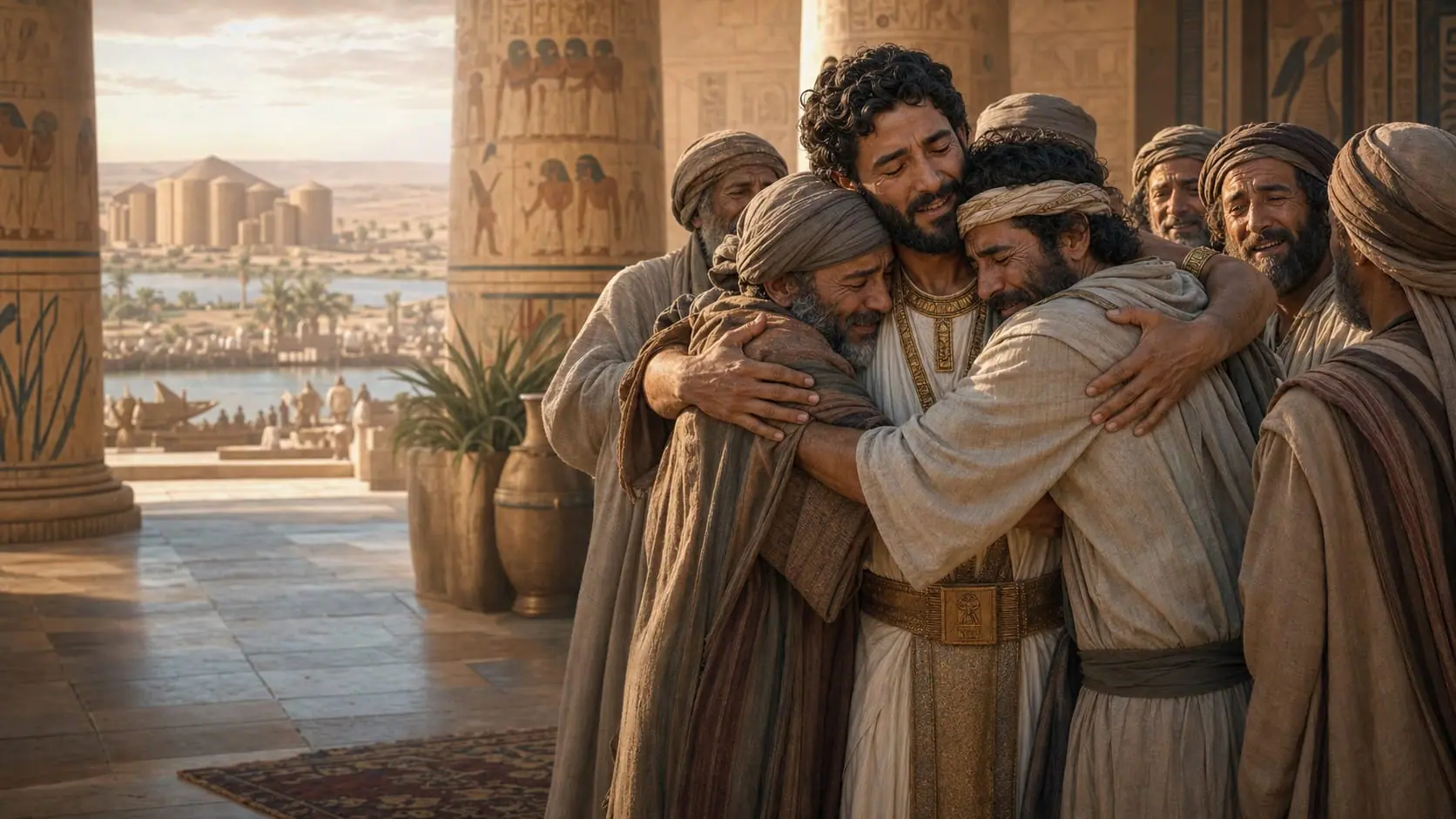
Joseph gives Benjamin a portion five times larger than the others’ at their meal. Before they leave, he orders his steward to hide his silver cup in Benjamin’s sack. Benjamin has not stolen it. When the cup is found, Joseph says Benjamin must remain as a slave while the others may leave. Judah offers to take his place, fearing what losing Benjamin would do to Jacob. Joseph then reveals his identity and embraces Benjamin; both brothers weep. Read the meal, the planted cup, and the reunion.
Benjamin stays home first
Jacob fears that harm will happen to Rachel’s remaining son if he travels with the others.
Genesis 42:4The full brothers meet again
Joseph sees Benjamin, blesses him, and withdraws to weep before returning to the meal.
Genesis 43:29–31The steward plants the cup
Joseph orders this before the brothers leave. Its discovery in Benjamin’s sack is not evidence that Benjamin stole it.
Genesis 44:1–17Judah offers himself
Judah’s plea and offer to remain instead of Benjamin show a different response to a favored younger brother.
Genesis 44:18–34Ten names in Genesis, several later arrangements
Who were Benjamin’s sons?
Genesis 46:21 lists Bela, Becher, Ashbel, Gera, Naaman, Ehi, Rosh, Muppim, Huppim, and Ard. Numbers and Chronicles arrange the family differently. For example, Numbers 26:40 calls Ard and Naaman sons of Bela, placing them one generation below Benjamin. The lists therefore cannot all be read as identical lists of ten immediate sons.
Ten names at the move to Egypt
Bela, Becher, Ashbel, Gera, Naaman, Ehi, Rosh, Muppim, Huppim, and Ard appear in the household list.
Genesis 46:21Clans and descendants
The WEB names Bela, Ashbel, Ahiram, Shephupham, and Hupham as clan ancestors. Ard and Naaman are called sons of Bela.
Numbers 26:38–40Three sons introduce another genealogy
Bela, Becher, and Jediael begin a line organized around warriors and family heads.
1 Chronicles 7:6–12Five names open a longer tribal record
Bela, Ashbel, Aharah, Nohah, and Rapha introduce the genealogy that later reaches Saul’s house.
1 Chronicles 8:1–40No personal lifespan is recorded
How old was Benjamin, and how did he die?
No exact age or cause of death is given for Benjamin. Exodus 1:6 reports that Joseph and all his brothers died, without an individual account of Benjamin’s death. Acts 7:15–16 speaks collectively of the ancestors’ deaths and burial at Shechem, but does not name Benjamin separately. His wife is not named either.
What the reunion tells us
What were Benjamin’s characteristics?
Genesis describes Jacob’s fear for Benjamin and Joseph’s affection for him. Benjamin weeps on Joseph’s neck at their reunion (Genesis 45:14), but no individual speech explains his thoughts about the accusation or his brothers. The account gives us that emotional moment, not a detailed personality type.
Youngest and protected
Jacob identifies Benjamin as the youngest and fears losing him after Rachel and Joseph.
Genesis 42:4, 38; 44:20Deeply loved by Joseph
Joseph is moved when he sees Benjamin and later weeps on his neck.
Genesis 43:29–30; 45:14Benjamin’s private response
Genesis does not record what Benjamin says about the cup, Joseph’s identity, or the older brothers’ earlier betrayal.
Do not invent a reactionTimid or fierce?
Neither description follows from being Jacob’s youngest son. The later wolf image is poetry, not an account of Benjamin’s behavior.
Genesis 49:27Poetry directed toward a future line
What blessings did Benjamin receive?
Jacob blesses Benjamin with his brothers before dying in Egypt. Generations later, Moses blesses the tribe bearing Benjamin’s name. These two speeches use different images: a wolf in Genesis and the Lord’s protection in Deuteronomy.
A ravenous wolf
Benjamin devours prey in the morning and divides spoil in the evening—a compact image of force and success.
Genesis 49:27Beloved and secure
The tribe is described as the Lord’s beloved, living under his protection. The NIV makes the final image explicit: the one the Lord loves rests between his shoulders.
Deuteronomy 33:12, NIVNot a personality diagnosis
The wolf image should not be used to claim that the individual Benjamin was violent or predatory.
Poetry and biography stay distinctReaders connect the images with descendants
Ehud, Saul, and Paul are sometimes linked back to the blessings, but individual correspondences are interpretive.
Label the connectionFollow the people and passages
Why Benjamin matters in the journey to Egypt
Jacob fears losing Rachel’s remaining son, while Judah promises to bring Benjamin home. The Joseph story follows the journey, the silver cup, and the appeal in which Judah offers his own freedom.
Joseph Bible Story
Read the journeys to Egypt, Benjamin’s arrival, the silver cup, Judah’s plea, and the brothers’ reunion.
Read Joseph’s story →Brother’s profileJoseph in the Bible
Explore Joseph’s meaning, family, ages, Egyptian authority, death, bones, and legacy.
Meet Joseph →Mother’s profileRachel in the Bible
Meet Benjamin’s mother and read about her life, children, fatal labor, burial, and legacy.
Meet Rachel →Father’s profileJacob in the Bible
Explore Israel’s names, wives, twelve sons, daughter, age, death, and burial.
Meet Jacob →