%20scale(.87)'%3e%3cg%20transform='rotate(-3%2032%2034)'%3e%3cpath%20d='M10.5%2019.5c7.65-2.35%2014.8-.45%2021.5%205.7%206.7-6.15%2013.85-8.05%2021.5-5.7v27.2c-7.65-2.15-14.8-.45-21.5%205.1-6.7-5.55-13.85-7.25-21.5-5.1V19.5Z'%20fill='%23fff'%20stroke='%23171528'%20stroke-width='4.5'%20stroke-linejoin='round'/%3e%3cpath%20d='M32%2025.2v26.6'%20stroke='%23171528'%20stroke-width='4'%20stroke-linecap='round'/%3e%3cpath%20d='M17.5%2034.5h9M22%2030v9'%20stroke='%23171528'%20stroke-width='3.75'%20stroke-linecap='round'/%3e%3ccircle%20cx='41.5'%20cy='32.5'%20r='2.5'%20fill='%23171528'/%3e%3ccircle%20cx='46.5'%20cy='38'%20r='2.5'%20fill='%23171528'/%3e%3c/g%3e%3c/g%3e%3c/svg%3e)
The quick answer
Who was Rachel in the Bible?
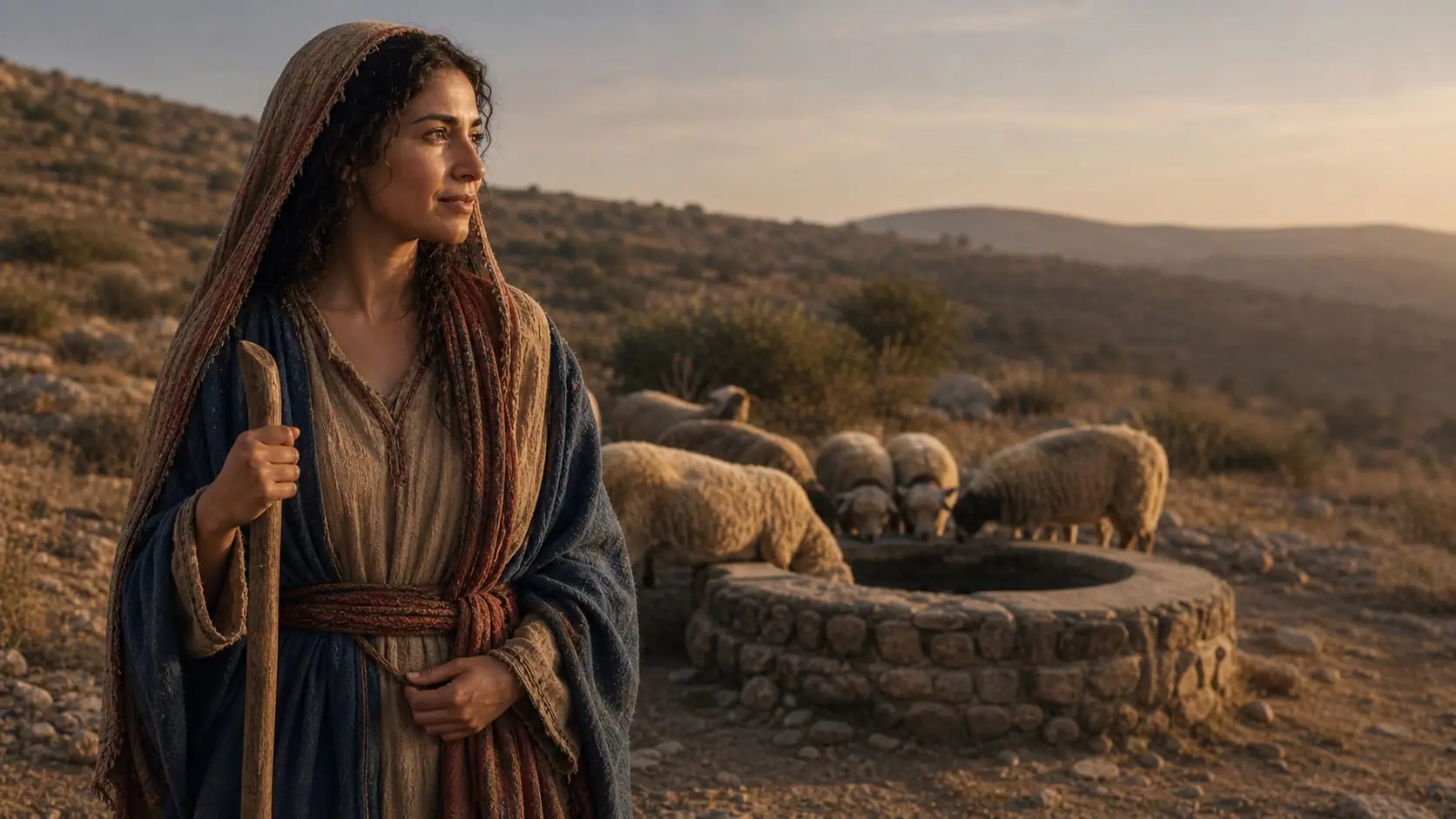
Rachel was Laban’s younger daughter, Leah’s sister, Jacob’s beloved wife, and the mother of Joseph and Benjamin. Genesis introduces her as a shepherdess at a well near Haran. Her life includes Jacob’s long service for her, a painful rivalry with Leah, years of childlessness, the birth of Joseph, the taking of Laban’s household gods, and her death while giving birth to Benjamin. Later Scripture remembers Rachel as both a matriarch and a poetic mother mourning for Israel’s children.
Why she matters
Why is Rachel important in the Bible?
A matriarch of Israel
Ruth 4:11 names Rachel with Leah as the women who built the house of Israel.
Mother of Joseph and Benjamin
Her sons and Joseph’s sons become central to Israel’s tribal history and later settlement.
A symbol of maternal grief
Jeremiah portrays Rachel weeping for exiled descendants, an image Matthew later applies near Bethlehem.
A pastoral name
What does the name Rachel mean?
The Hebrew name Rachel means “ewe,” an adult female sheep (Hebrew lexicon, H7354). Rachel first appears caring for Laban’s sheep, but Genesis does not say why her parents chose the name or give it a prophetic meaning.
Five turning points
Rachel’s life from shepherdess to matriarch
Rachel meets Jacob at work, marries him after Laban’s deception, and leaves her father’s home with a growing family. Her final journey is from Bethel toward Ephrath.
Genesis 29:1–14
Introduced as a shepherdess at the well
Genesis 29:15–30
Marries Jacob after Leah’s bridal week
Genesis 30:1–24
Longs for children and gives birth to Joseph
Genesis 31:1–35
Leaves Laban and takes the household gods
Genesis 35:16–20
Dies while giving birth to Benjamin
Actions before one-word labels
What were Rachel’s characteristics?
Being Jacob’s favored wife does not spare Rachel from grief or rivalry. Genesis records her longing for children alongside choices that affect Leah, Bilhah, and the rest of the family.
A shepherdess at work
Rachel arrives at the well with Laban’s sheep. Jacob waters the flock and tells her that he is Rebekah’s son.
She runs to tell her father that his nephew has arrived.Beautiful and deeply loved
Genesis describes Rachel as beautiful in form and appearance, and Jacob’s seven years of service seem short because of his love for her.
Being favored also becomes part of a painful family imbalance.Envious of her sister
Rachel demands that Jacob give her children. He responds angrily that he is not in God’s place. She then gives Bilhah to him as a wife.
Rachel names Bilhah’s sons Dan and Naphtali, speaking of judgment and rivalry with Leah.Conceals the household gods
Rachel takes Laban’s household gods and hides them in a camel’s saddle when he searches the camp.
She remains seated, telling Laban she is having her period. He does not find the objects.Rachel’s family tree
Father, sister, husband, and sons
Rachel belongs to Abraham’s extended family through Laban and Rebekah. She becomes Jacob’s wife and gives birth to two of his twelve sons.
Rebekah
Laban’s sister and Jacob’s mother connects Rachel to Abraham’s wider family.
Leah
Rachel’s older sister becomes Jacob’s first wife and the mother of six sons and Dinah.
Jacob
Jacob loves Rachel, works for Laban to marry her, and later buries her on the road to Ephrath.
Joseph & Benjamin
Joseph is born before the family leaves Laban. Benjamin is born later in Canaan, on the journey from Bethel toward Ephrath.
Rachel’s sons and Bilhah’s sons
How many children did Rachel have?
Rachel gave birth to Joseph and Benjamin. Before Joseph’s birth, she gave her servant Bilhah to Jacob as a wife, hoping to obtain children through her. Bilhah gave birth to Dan and Naphtali, and Rachel named them. Genesis identifies Bilhah as their mother, not Rachel. Genesis 30:3–8, 22–24; 35:16–26
Joseph
After God remembers Rachel, she gives birth and names him Joseph with a hope that another son will be added.
Genesis 30:22–24Benjamin
Rachel names him Ben-oni during her fatal labor; Jacob gives him the name Benjamin.
Genesis 35:16–20Dan & Naphtali
Bilhah bears both boys to Jacob. Rachel names them in speeches about God hearing her and her rivalry with Leah.
Genesis 30:3–8No daughter is named
Genesis names Joseph and Benjamin as Rachel’s sons but does not name a daughter of hers.
Genesis 35:24A famous question with no stated motive
Why did Rachel steal her father’s idols?
Genesis says Rachel took Laban’s teraphim, or household gods, but does not explain her motive. Jacob does not know she has taken them. When Laban searches the tents, Rachel sits on the camel’s saddle where she has hidden the objects and says she cannot stand because she is having her period. Laban leaves without finding them. Genesis 31:19, 30–35
Rachel takes the teraphim
The act occurs while Laban is away shearing his sheep and Jacob’s household leaves secretly.
Genesis 31:19–21She hides them successfully
Rachel places the objects in a camel’s saddle and remains seated when Laban searches.
Genesis 31:33–35Why she took them
The chapter does not say whether Rachel wanted the objects for worship, inheritance, protection, or another reason.
Genesis 31:19, 30–35The household puts away foreign gods
Before going to Bethel, Jacob tells everyone to put away their foreign gods. The passage does not identify any of them specifically as Rachel’s teraphim.
Genesis 35:2–4Her age is not recorded
How did Rachel die?
Rachel died during a difficult labor while giving birth to Benjamin. The midwife tells her she has another son; as her life is leaving, Rachel names him Ben-oni, and Jacob calls him Benjamin. Genesis gives neither Rachel’s age nor a more specific medical cause. Genesis 35:16–20
The grave described in Genesis
Where was Rachel buried?
Genesis places Rachel’s burial on the way to Ephrath, identified in the passage with Bethlehem, where Jacob sets up a pillar. She is not buried in Machpelah with Leah. First Samuel 10:2 places Rachel’s tomb on Benjamin’s border at Zelzah, while Jeremiah’s poem places her weeping at Ramah. The grave reference and the poetic setting are not interchangeable geographical descriptions.
Road to Ephrath
Jacob buries Rachel on the journey and marks the grave with a pillar.
Genesis 35:19–20; 48:7A separate grave
Jacob later names Leah among those buried in Machpelah; Rachel’s roadside burial remains distinct.
Genesis 49:29–32Benjamin’s border at Zelzah
Samuel tells Saul he will meet two men by Rachel’s tomb. This location needs to be considered alongside Genesis’s reference to Bethlehem.
1 Samuel 10:2Rachel’s Tomb near Bethlehem
The present monument is traditionally associated with Rachel. The biblical passages alone do not establish that it marks the original grave.
Tradition is distinct from the Genesis accountFollow the people and passages
Rachel’s sons and the family’s future
Rachel’s two sons lead into very different experiences: Joseph grows up in Canaan and is sold into Egypt, while Benjamin is born on the journey where Rachel dies. Their reunion is part of Joseph’s story.
Jacob in the Bible
Explore Jacob’s names, wives, twelve sons, age, burial, and legacy as Israel.
Meet Jacob →Aunt’s profileRebekah in the Bible
Read the life of Laban’s sister and Jacob’s mother.
Meet Rebekah →Family profileIsaac in the Bible
Meet Rachel’s uncle by marriage and father-in-law, who sent Jacob to Laban’s family.
Meet Isaac →Son’s storyJoseph Bible Story
Follow Rachel’s firstborn from Canaan to slavery, prison, authority, and family rescue.
Read Joseph’s story →