%20scale(.87)'%3e%3cg%20transform='rotate(-3%2032%2034)'%3e%3cpath%20d='M10.5%2019.5c7.65-2.35%2014.8-.45%2021.5%205.7%206.7-6.15%2013.85-8.05%2021.5-5.7v27.2c-7.65-2.15-14.8-.45-21.5%205.1-6.7-5.55-13.85-7.25-21.5-5.1V19.5Z'%20fill='%23fff'%20stroke='%23171528'%20stroke-width='4.5'%20stroke-linejoin='round'/%3e%3cpath%20d='M32%2025.2v26.6'%20stroke='%23171528'%20stroke-width='4'%20stroke-linecap='round'/%3e%3cpath%20d='M17.5%2034.5h9M22%2030v9'%20stroke='%23171528'%20stroke-width='3.75'%20stroke-linecap='round'/%3e%3ccircle%20cx='41.5'%20cy='32.5'%20r='2.5'%20fill='%23171528'/%3e%3ccircle%20cx='46.5'%20cy='38'%20r='2.5'%20fill='%23171528'/%3e%3c/g%3e%3c/g%3e%3c/svg%3e)
The quick answer
What happened in the Joseph Bible story?
Joseph was Jacob’s beloved son. His brothers hated him because of their father’s favoritism, Joseph’s special tunic, and dreams that pictured his family bowing before him. They sold him to traders, and he was taken to Egypt. There Joseph served Potiphar, was falsely accused by Potiphar’s wife, and was imprisoned.
Joseph credited God with interpreting dreams in prison and later explained Pharaoh’s dreams: seven years of plenty would be followed by seven years of famine. Pharaoh placed the thirty-year-old Joseph over Egypt. When famine brought his brothers there, they bowed before him without recognizing him. After Joseph tested their account and Judah offered to stay as a slave in Benjamin’s place, Joseph revealed his identity and arranged for Jacob’s family to move to Egypt.
The story ends with Joseph reassuring his brothers after Jacob’s death. He promises to provide for them and their children, while still calling their earlier intention evil. This retelling follows Genesis 37–50; the Joseph character page explains his family, name, ages, and burial in more detail. Illustrations imagine the people’s appearance, clothing, buildings, and props; they are not historical reconstructions.
The full story
From a Pit in Canaan to Power in Egypt
Who was Joseph in the Bible?
Joseph was the son of Jacob and Rachel. Genesis 37 introduces him at seventeen, tending the family’s flocks with his brothers in Canaan. Jacob—also called Israel—loved Joseph more than his other sons because Joseph was born in his old age.
Jacob made Joseph a special tunic. When the brothers saw their father’s unequal love, they hated Joseph and could not speak peacefully with him. The family’s favoritism did not create a harmless preference; it sharpened an already divided household. Genesis 30:22–24; 35:22–26; 37:1–4
Now Israel loved Joseph more than all his children, because he was the son of his old age, and he made him a tunic of many colors. His brothers saw that their father loved him more than all his brothers, and they hated him, and couldn’t speak peaceably to him.
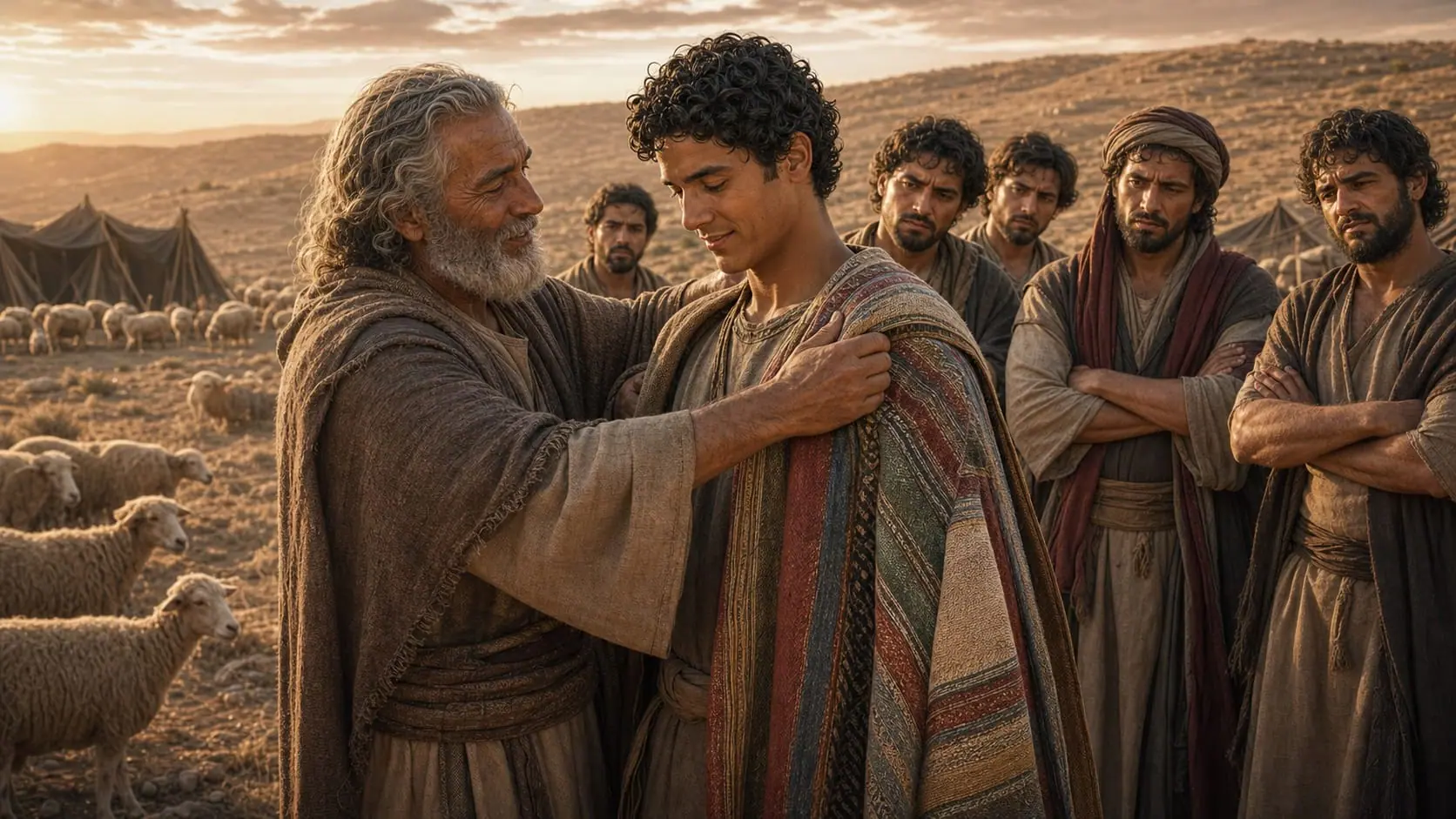
Was it a coat of many colors?
The WEB calls it a “tunic of many colors”; the NIV says “an ornate robe,” and the NRSV says “a long robe with sleeves.” These are alternative translations of the same Hebrew description. We can identify the gift as special without claiming to know its exact pattern or cut. Compare Genesis 37:3 across translations.
Joseph’s dreams deepen the brothers’ hatred
Joseph dreamed that his brothers’ sheaves of grain bowed to his sheaf. In another dream, the sun, moon, and eleven stars bowed to him. His brothers heard a claim to rule and hated him even more. Jacob rebuked Joseph, yet kept the matter in mind.
The dreams point forward to the family’s later arrival in Egypt, but Joseph could not yet see the years of suffering between promise and fulfillment. Genesis 37:5–11
Joseph is thrown into a pit and sold
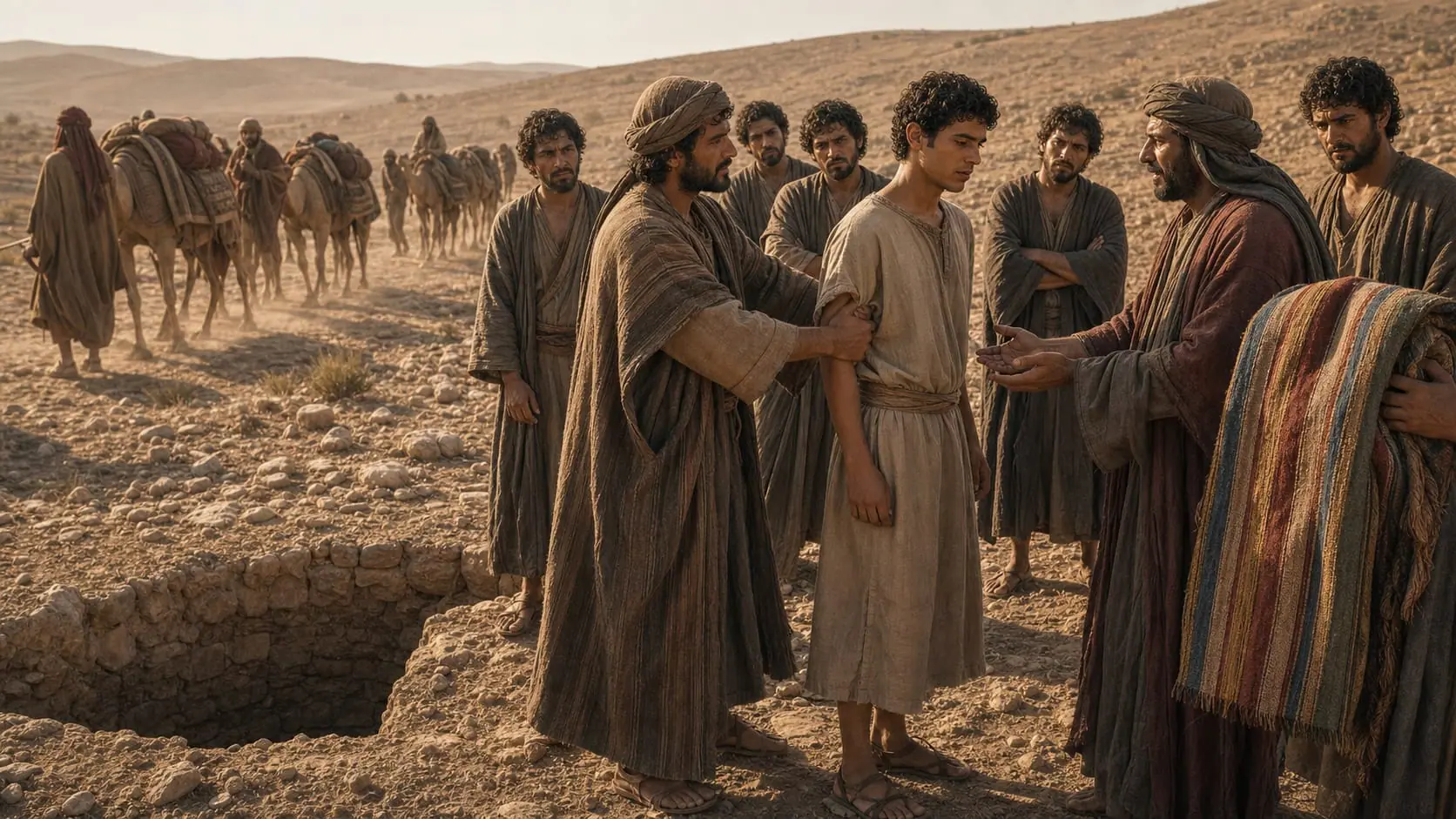
Jacob sent Joseph to check on his brothers near Shechem, and Joseph found them at Dothan. Seeing him from a distance, they plotted to kill “this dreamer.” Reuben persuaded them not to kill him but to put him in an empty pit, intending to return him to Jacob. Judah then proposed selling Joseph to the approaching Ishmaelites.
Genesis 37:28 describes Joseph being lifted from the pit and sold for twenty pieces of silver. It mentions both Midianite merchants and Ishmaelites. The WEB uses “they” for those who lift and sell him; the NIV explicitly says “his brothers.” The wording raises a question about the immediate agents, but Joseph later holds his brothers responsible for selling him (Genesis 45:4–5). Compare the translations.
When Reuben returned to the pit, Joseph was gone. The chapter does not explain Reuben’s absence. The brothers dipped Joseph’s tunic in a male goat’s blood and asked Jacob to identify it. Jacob concluded that a wild animal had killed his son. Joseph was taken to Egypt and sold to Potiphar, Pharaoh’s officer and captain of the guard. Genesis 37:12–36; 39:1
Midianites who were merchants passed by, and they drew and lifted up Joseph out of the pit, and sold Joseph to the Ishmaelites for twenty pieces of silver. The merchants brought Joseph into Egypt.
Joseph serves Potiphar and refuses his wife
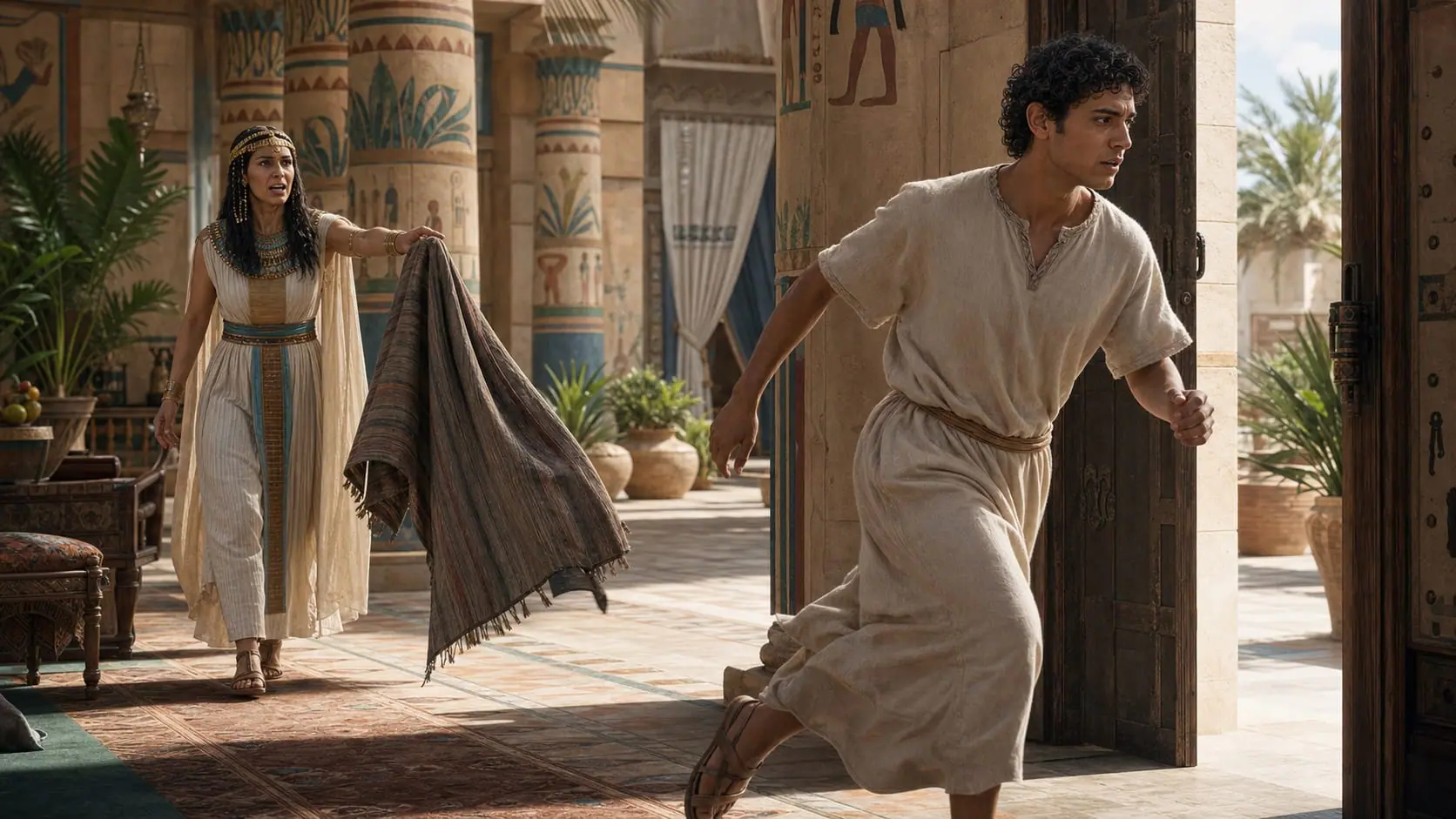
In Egypt, Joseph was enslaved in Potiphar’s household. Genesis repeatedly says Yahweh was with Joseph. Potiphar saw that his work prospered and entrusted the whole house to him.
Potiphar’s wife demanded that Joseph sleep with her, continuing day after day despite his refusal. Joseph said the act would betray his master and be a sin against God. One day she caught his garment, but he left it in her hand and fled. She used the garment to support a false accusation, and Potiphar placed Joseph in prison. Potiphar’s wife is unnamed in Genesis; the chapter also gives no later account of her fate. Genesis 39:1–23
No one is greater in this house than I am, and he has not kept back anything from me but you, because you are his wife. How then can I do this great wickedness, and sin against God?”
Joseph interprets dreams in prison
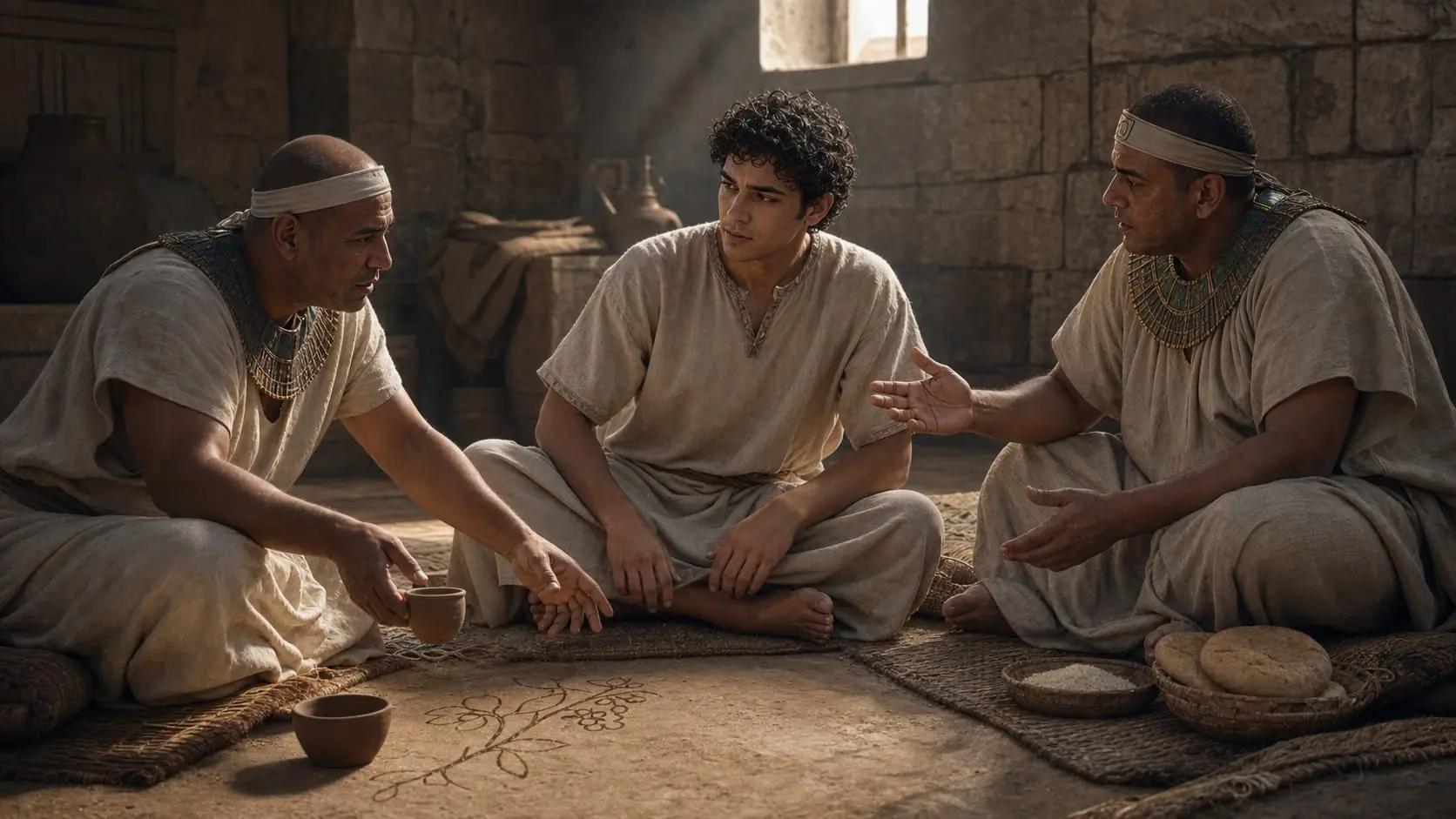
Even in prison, Yahweh was with Joseph. The keeper placed other prisoners under his care. Pharaoh’s chief cup bearer and chief baker later arrived, and both awoke troubled by dreams. Joseph did not claim a private magical power; he said interpretations belong to God.
Joseph explained that the cup bearer would be restored and the baker executed in three days. Both events happened as he said. Joseph asked the cup bearer to remember him, but the restored official forgot him. Two full years passed before another set of dreams opened the prison door. Genesis 39:21–23; 40:1–23; 41:1
They said to him, “We have dreamed a dream, and there is no one who can interpret it.” Joseph said to them, “Don’t interpretations belong to God? Please tell it to me.”
Joseph explains Pharaoh’s dreams
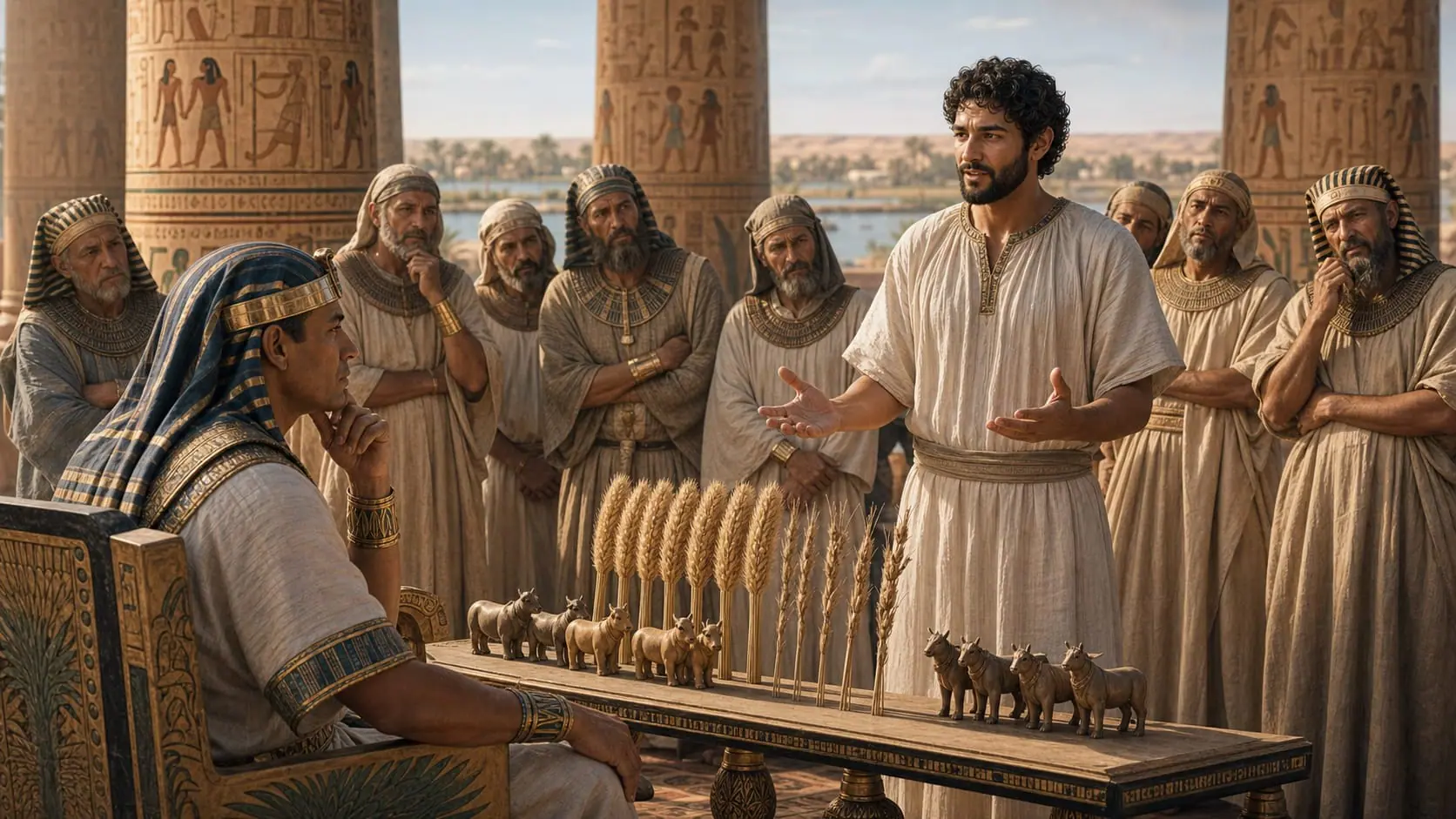
Pharaoh dreamed of seven healthy cattle swallowed by seven thin cattle, then of seven full heads of grain swallowed by seven thin and wind-scorched heads. None of Egypt’s magicians or wise men could interpret the dreams for him. The cup bearer finally remembered Joseph, who was hurried from prison, shaved, changed his clothes, and came before Pharaoh.
Joseph began, “It isn’t in me. God will give Pharaoh an answer of peace.” He explained that both dreams carried one message: seven years of abundance were coming, followed by seven years of famine. Their repetition meant the matter was established by God and would happen soon. Genesis 41:1–32
Joseph answered Pharaoh, saying, “It isn’t in me. God will give Pharaoh an answer of peace.”
Joseph is placed over Egypt’s food supply
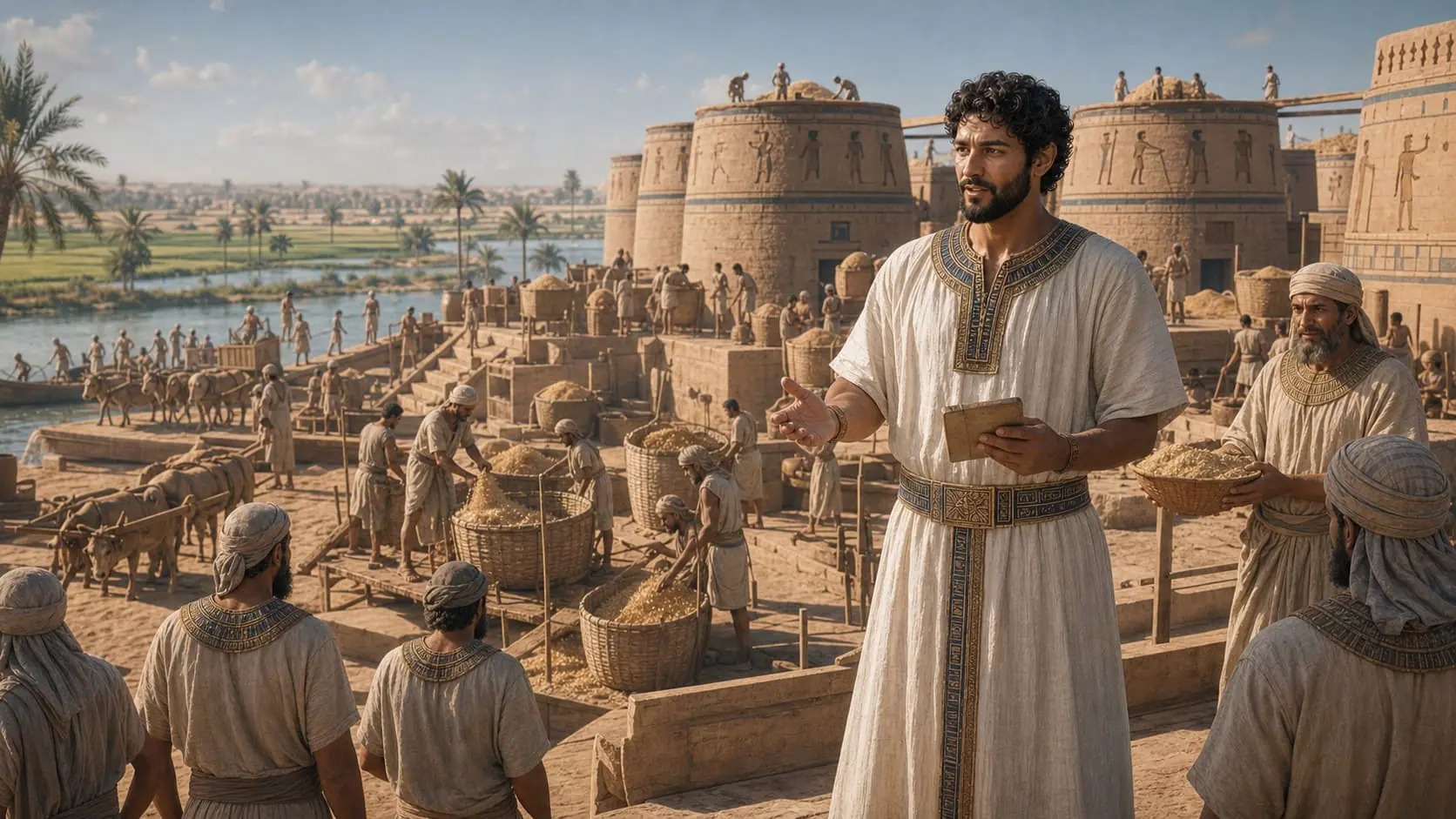
Joseph advised Pharaoh to appoint a discerning leader and collect one fifth of the produce during the abundant years. Pharaoh recognized God-given wisdom in Joseph and placed him over the land, second only to the throne. Joseph was thirty years old when he entered Pharaoh’s service.
During seven plentiful years, Joseph stored grain in the cities until it could no longer be counted. Then the famine began across the surrounding lands, but Egypt had food. People came to Joseph to buy grain. Genesis 41:33–57
Pharaoh said to Joseph, “Because God has shown you all of this, there is no one so discreet and wise as you. You shall be over my house. All my people will be ruled according to your word. Only in the throne I will be greater than you.” Pharaoh said to Joseph, “Behold, I have set you over all the land of Egypt.”
Joseph’s brothers bow before him
Famine reached Canaan, and Jacob sent ten sons to buy grain in Egypt while keeping Benjamin at home. The brothers bowed before Egypt’s governor without recognizing Joseph. Joseph recognized them and remembered his dreams.
Joseph accused them of spying and demanded that they bring their youngest brother to verify their account. After three days in custody, he kept Simeon and sent the others home with grain and their money secretly returned. Jacob was afraid to let Benjamin go. Only when the grain ran out, and Judah accepted responsibility for Benjamin’s return, did Jacob agree. Genesis 42:1–43:14
On the second visit, Joseph’s steward brought Simeon out to them. Joseph invited the brothers to eat in his house and gave Benjamin a portion five times larger than theirs. The next morning, he ordered his steward to hide his silver cup in Benjamin’s sack, then to pursue the brothers. Benjamin had not stolen the cup. When it was found, all the brothers returned to Joseph. Genesis 43:15–44:13
Joseph declared that Benjamin must stay as his slave while the others could leave. Judah offered to remain as a slave instead, explaining that their father could not bear losing Benjamin. The brother who once proposed selling Joseph was now offering himself for another brother. Genesis shows this change without explaining every motive behind Joseph’s tests. Genesis 44:14–34
Joseph reveals himself and forgives
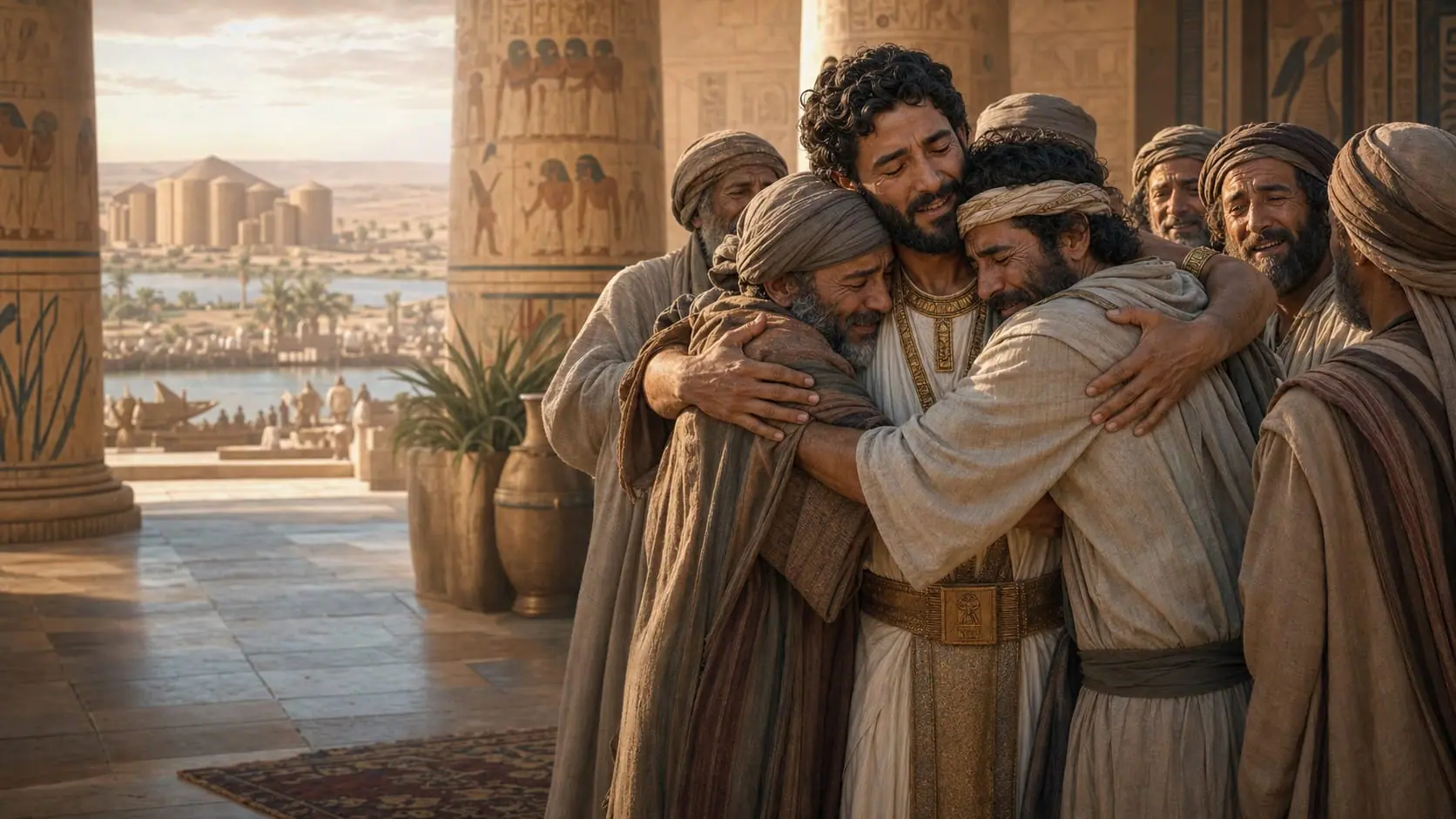
Joseph could no longer control his emotion. He sent his attendants out, wept loudly, and told the frightened brothers who he was. He acknowledged what they had done, yet understood his position in Egypt through God’s purpose to preserve life during the famine. Two years of famine had passed; five remained.
Joseph and Benjamin embraced and wept together. Joseph then kissed all his brothers and wept over them; afterward they talked with him. Pharaoh approved the plan to bring Jacob’s household to Egypt, with wagons and provisions for the journey. Genesis 45:1–28
Joseph said to his brothers, “Come near to me, please.” They came near. He said, “I am Joseph, your brother, whom you sold into Egypt. Now don’t be grieved, nor angry with yourselves, that you sold me here, for God sent me before you to preserve life.
Joseph and Jacob reunite in Egypt
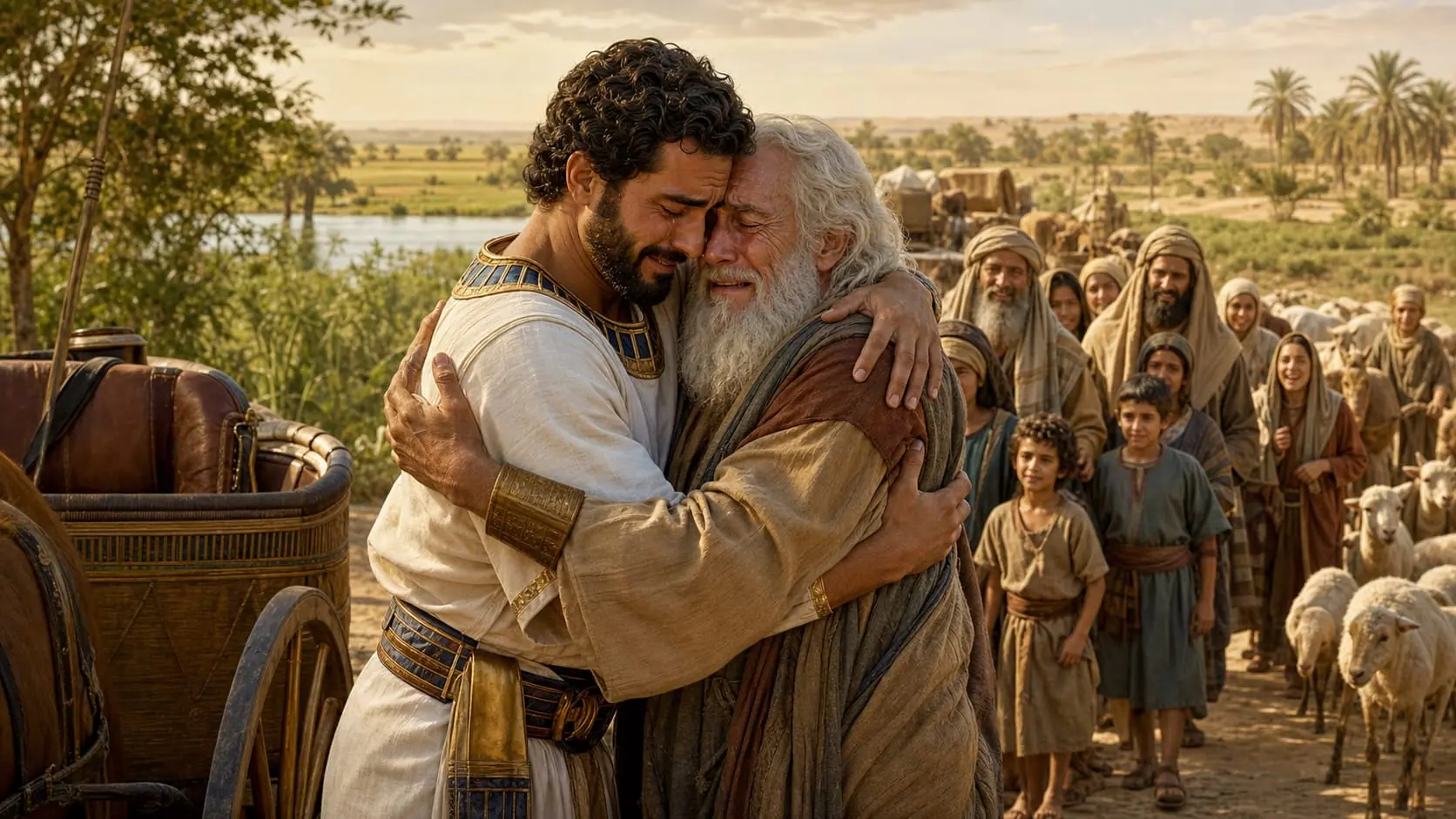
God reassured Jacob on the journey, and Jacob’s household entered Egypt. Joseph prepared his chariot and went to Goshen to meet his father. He appeared before Jacob, fell on his neck, and wept for a long time.
Pharaoh allowed the family to settle in the land of Goshen. Joseph continued to manage Egypt through the famine and provide food for his father’s household. Genesis 46:1–34; 47:1–12
The famine changes Egypt’s land ownership
As the famine continued, Egyptians used their money and then livestock to buy food. When these were exhausted, they offered their land and themselves in exchange for food and seed. Joseph acquired the land for Pharaoh, except the priests’ land, and required a fifth of future harvests for Pharaoh. The people said he had saved their lives and agreed to serve Pharaoh. Their survival came with a loss of land and independence; the account is not simply one of free grain distribution. Genesis 47:13–26
Jacob blesses Joseph’s sons and is buried in Canaan
Joseph’s wife Asenath had borne Manasseh and Ephraim before the famine. Near the end of Jacob’s life, Joseph brought them to his father. Jacob received them as his own sons and deliberately put the younger Ephraim ahead of Manasseh in the blessing, despite Joseph’s objection. Genesis 41:45, 50–52; 48:1–20
Jacob lived seventeen years in Egypt and died at 147. Joseph wept over him and had him embalmed. With Pharaoh’s permission, Joseph and his brothers took their father to Canaan and buried him in the cave of Machpelah, as Jacob had requested. They then returned to Egypt. Genesis 47:28–31; 49:29–50:14
“God meant it for good”
After Jacob died, the brothers feared Joseph might finally repay them. Joseph wept at their message and told them not to be afraid. He refused to put himself in God’s place, promised to provide for them and their children, and spoke kindly to them.
Joseph did not rename evil as good. He held the brothers’ intention and God’s preserving purpose together: “You meant evil against me, but God meant it for good.” Joseph died at 110 after making Israel’s sons swear to carry his bones when God brought them out of Egypt. Genesis 50:15–26
Joseph said to them, “Don’t be afraid, for am I in the place of God? As for you, you meant evil against me, but God meant it for good, to save many people alive, as is happening today.
Joseph’s bones are carried out of Egypt
Genesis ends with Joseph embalmed and placed in a coffin in Egypt. His burial in Canaan comes much later: Moses carries his bones at the Exodus, and Joshua 24:32 records their burial at Shechem. Joseph is not buried in Jacob’s tomb at Machpelah. Hebrews 11:22 remembers his instructions as an act of faith in Israel’s future departure. Genesis 50:24–26; Exodus 13:19; Joshua 24:32; Hebrews 11:22