%20scale(.87)'%3e%3cg%20transform='rotate(-3%2032%2034)'%3e%3cpath%20d='M10.5%2019.5c7.65-2.35%2014.8-.45%2021.5%205.7%206.7-6.15%2013.85-8.05%2021.5-5.7v27.2c-7.65-2.15-14.8-.45-21.5%205.1-6.7-5.55-13.85-7.25-21.5-5.1V19.5Z'%20fill='%23fff'%20stroke='%23171528'%20stroke-width='4.5'%20stroke-linejoin='round'/%3e%3cpath%20d='M32%2025.2v26.6'%20stroke='%23171528'%20stroke-width='4'%20stroke-linecap='round'/%3e%3cpath%20d='M17.5%2034.5h9M22%2030v9'%20stroke='%23171528'%20stroke-width='3.75'%20stroke-linecap='round'/%3e%3ccircle%20cx='41.5'%20cy='32.5'%20r='2.5'%20fill='%23171528'/%3e%3ccircle%20cx='46.5'%20cy='38'%20r='2.5'%20fill='%23171528'/%3e%3c/g%3e%3c/g%3e%3c/svg%3e)
The quick answer
Who was Esther in the Bible?
Esther, also called Hadassah, was a Jewish woman and the daughter of Abihail. Her cousin Mordecai raised her after her parents died. As queen to Ahasuerus in Persia, she faced a decision that threatened her own life: whether to identify herself with the Jewish people and speak to the king on their behalf.
Hadassah, daughter of Abihail and cousin of Mordecai
Esther 2:7 introduces Hadassah, also called Esther, as Mordecai’s cousin and an orphan whom he raises as his daughter. Verse 15 names her father Abihail, Mordecai’s uncle. Her mother is not named. Mordecai is therefore her cousin and guardian, not her biological father.
At Mordecai’s instruction, Esther initially conceals her Jewish identity. Becoming queen does not separate her from the people threatened by Haman’s decree. When she eventually speaks to the king, she identifies their danger as her own.
Esther 2:7, 10, 15; 7:3–4 · Read about Esther’s Persian setting and the book’s structure →
What power did Esther have—and what could she risk?
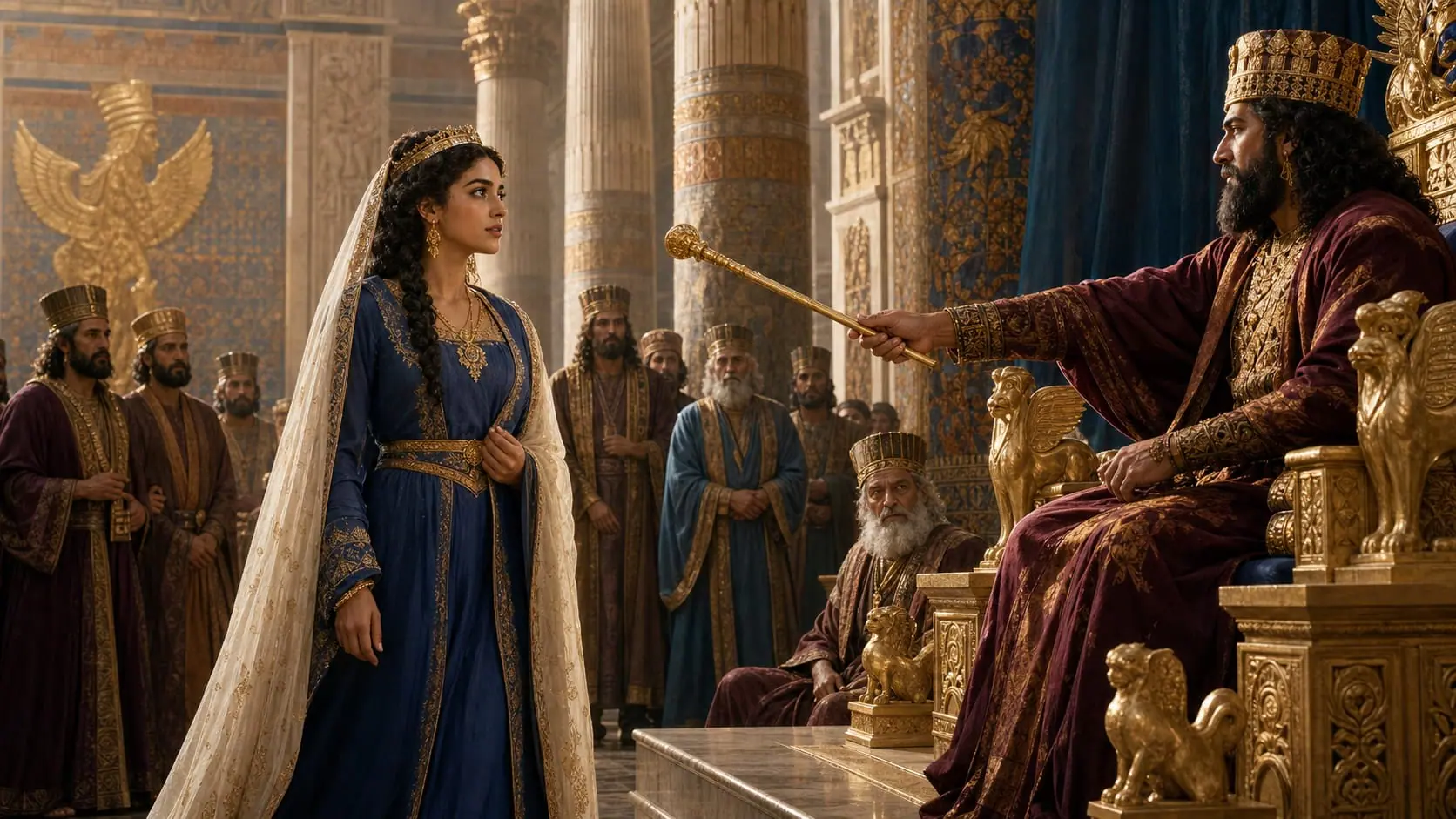
A crown does not give Esther unrestricted access to the king. She explains that entering uninvited can mean death and that she has not been summoned for thirty days. Esther asks the Jews in Susa to fast for three days, joining them with her attendants. The next chapter places her appearance before the king on the third day.
Mordecai asks whether she has reached her royal position for this moment. His words are a challenge to Esther, not a direct speech from God or a promise that taking a risk will always end safely.
After Haman is executed, Esther appeals again because his decree remains in force. The king authorizes a second decree allowing the Jews to gather and defend themselves; he does not revoke the first. Esther later requests a second day of action in Susa and the public hanging of Haman’s ten sons, who have already been killed. These difficult decisions are part of her story too, alongside her role in confirming Purim.
Esther 4:10–17; 5:1; 8:3–13; 9:6–15, 29–32 · Follow the two decrees, banquets, and reversal in Esther’s story →
One woman, two biblical names
What does the name Esther mean?
Esther 2:7 calls her Hadassah and Esther; it does not describe a ceremony in which one name replaces the other. Hadassah means “myrtle.” The Brown–Driver–Briggs lexicon connects Esther with Persian stâra, “star.” That is a proposed derivation of the name, not an explanation given in the biblical story.
The life arc in Scripture
Esther’s life in brief
Esther 2:7, 15–17
Hadassah is raised by Mordecai and becomes queen
Esther 4:10–17; 7:3–4
She chooses to identify herself with her threatened people
Esther 8:3–8; 9:29–32
She continues advocating and confirms Purim
Family and companions
Esther’s family and relationships
Esther 2:15 names her father Abihail, Mordecai’s uncle. Her mother is unnamed. After both parents die, Mordecai raises his cousin as his daughter. Her later court relationships put this family loyalty under pressure.
Abihail
Esther 2:15 identifies him as her father and Mordecai’s uncle. Esther 9:29 names him again as her father.
Mordecai
He raises Esther, uncovers a plot against the king, and urges her to act during the crisis.
King Ahasuerus
Usually identified with Xerxes I; the biblical narrative names him Ahasuerus.
Haman
His anger against Mordecai becomes a plan to destroy every Jew in the empire.
Queen Vashti
Her removal creates the court setting in which Esther is selected as queen.
What the text says—and does not say
Common questions about Esther
Esther’s Hebrew name was Hadassah
The book explicitly gives both names and identifies her as the daughter of Mordecai’s uncle.
Esther 2:7Abihail was Esther’s father
Esther 2:15 and 9:29 name her father Abihail. Her mother’s name and the circumstances of her parents’ deaths are not recorded.
Esther 2:7, 15; 9:29Esther’s children are not identified
The Book of Esther does not identify any children of hers. This does not establish that she was childless.
Esther 1–10Her age and death are unknown
Esther is described as a young woman, but Scripture gives no number for her age, reign length, death, or burial.
Esther 2:7; 10:1–3Follow the biblical accounts