%20scale(.87)'%3e%3cg%20transform='rotate(-3%2032%2034)'%3e%3cpath%20d='M10.5%2019.5c7.65-2.35%2014.8-.45%2021.5%205.7%206.7-6.15%2013.85-8.05%2021.5-5.7v27.2c-7.65-2.15-14.8-.45-21.5%205.1-6.7-5.55-13.85-7.25-21.5-5.1V19.5Z'%20fill='%23fff'%20stroke='%23171528'%20stroke-width='4.5'%20stroke-linejoin='round'/%3e%3cpath%20d='M32%2025.2v26.6'%20stroke='%23171528'%20stroke-width='4'%20stroke-linecap='round'/%3e%3cpath%20d='M17.5%2034.5h9M22%2030v9'%20stroke='%23171528'%20stroke-width='3.75'%20stroke-linecap='round'/%3e%3ccircle%20cx='41.5'%20cy='32.5'%20r='2.5'%20fill='%23171528'/%3e%3ccircle%20cx='46.5'%20cy='38'%20r='2.5'%20fill='%23171528'/%3e%3c/g%3e%3c/g%3e%3c/svg%3e)
The quick answer
What is the Book of Esther about?
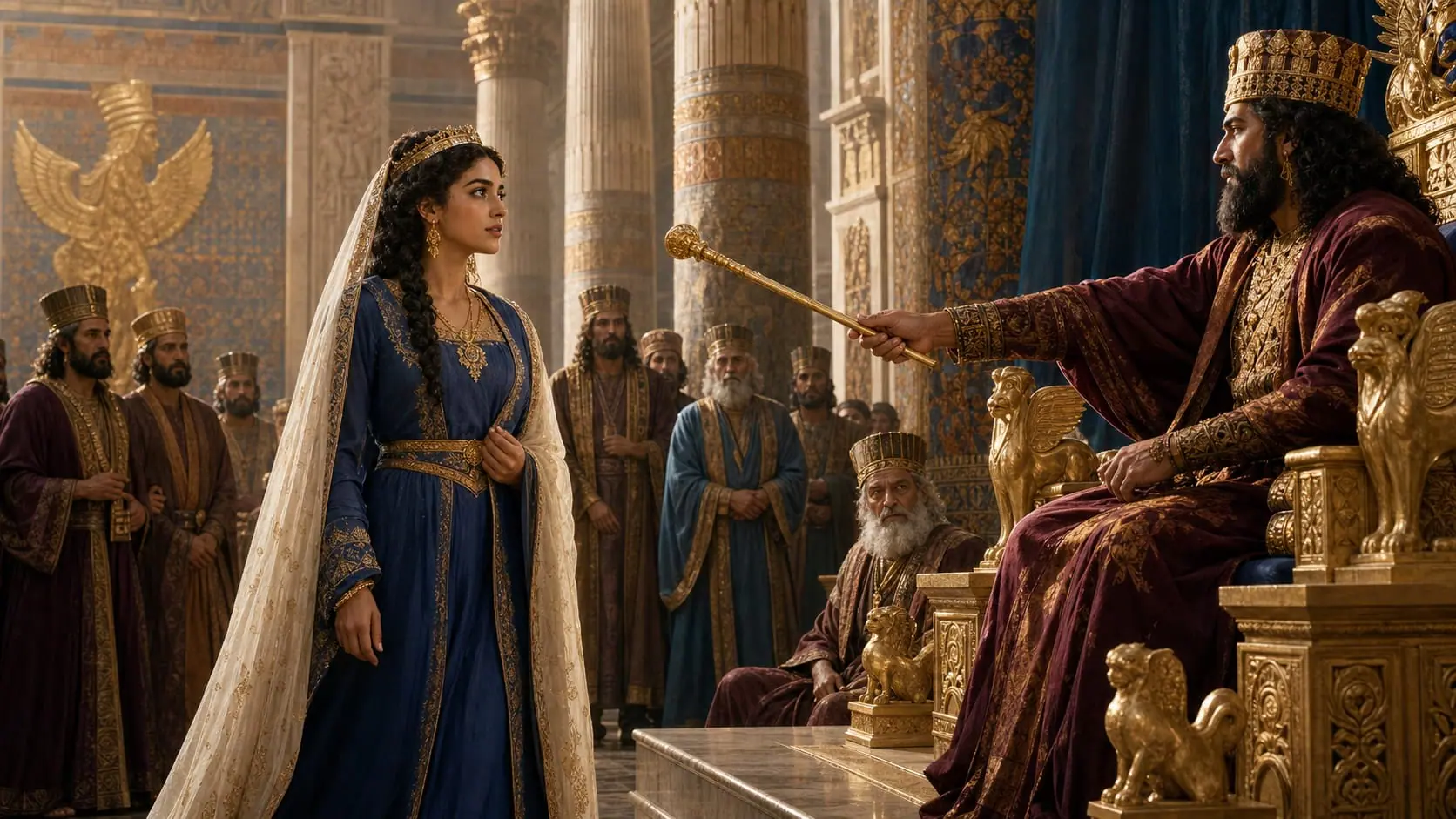
The Book of Esther tells how Esther, a Jewish orphan raised by Mordecai, becomes queen in the Persian Empire. When Haman persuades King Ahasuerus to authorize the destruction of the Jews, Mordecai urges Esther to use her position. Esther calls for a fast, approaches the king without being summoned, exposes Haman’s plan through two banquets, and helps secure a counter-decree that allows the Jewish people to defend themselves. The deliverance is remembered through Purim.
Literary and historical setting
How the Book of Esther fits into the Bible
Esther is set mainly in Susa, a royal center of the Persian Empire. The Hebrew text calls the king Ahasuerus, commonly identified with Xerxes I. It dates Esther’s arrival before the king to his seventh regnal year and Haman’s plot to his twelfth (Esther 2:16; 3:7). Those are dates within the story, not a stated date of composition; the book does not name its author.
This outline follows the ten-chapter Hebrew form, also found in Protestant Old Testaments. It never names God. Esther 4 describes fasting without recording a prayer; 9:31 refers to fasting and mourning or cries. Many readers understand the events as providence, but the Hebrew narrator does not explicitly explain them that way.
Catholic and Orthodox Bibles also include material preserved in Greek Esther. These passages name God and include prayers by Mordecai and Esther. The New American Bible labels the added sections A–F; the prayers appear in section C after 4:17. Other editions arrange or number them differently. These are part of Scripture in those traditions, not simply later commentary.
Summary by chapter
Book of Esther outline
Vashti is removed and Esther becomes queen
Vashti refuses the king’s summons and loses her position; the text does not say she is executed. Esther is taken into the royal women’s quarters, keeps her Jewish identity secret at Mordecai’s instruction, and becomes queen. Mordecai discovers an assassination plot and tells Esther, who reports it to the king in his name.
Haman’s decree and Esther’s decision
Mordecai refuses to bow to Haman. Haman obtains royal authority for the killing of all Jews on the thirteenth of Adar. Mordecai urges Esther to plead for her people. She asks the Jews in Susa to fast without food or drink for three days, as she and her attendants will do.
Two banquets and Haman’s execution
On the third day, Esther approaches the king and receives his favor. She invites him and Haman to two banquets. Between them, a sleepless night brings Mordecai’s unrewarded service to the king’s attention. At the second banquet, Esther exposes Haman; he is executed on the wooden structure he prepared for Mordecai.
A second decree, fighting, and Purim
The first decree cannot be revoked. A second authorizes Jewish communities to gather and defend themselves. Chapter 9 records the killing of their enemies and Esther’s request for another day of action in Susa. It repeatedly says they take no plunder. Mordecai and Esther confirm Purim, and the book closes with Mordecai’s service as second to the king.
Themes to look for
Main themes in the Book of Esther
Courage under threat
Esther names the danger of entering uninvited, calls for a shared fast, and goes to the king despite the possible cost to her own life.
Esther 4:11–16; 5:1–8Providence without direct naming
The Hebrew narrative repeatedly turns on timing and reversal without explicitly naming God; the Greek additions do name God.
Esther 2:21–23; 6:1–11; 9:1Identity in diaspora
Esther and Mordecai navigate life as Jews within a powerful foreign court.
Esther 2:5–10; 3:8; 7:3–4Reversal and remembrance
Haman’s plan returns upon him, mourning becomes celebration, and Purim preserves the memory.
Esther 7–9People in the book
Key characters in Esther
Esther
Hadassah, a Jewish orphan who becomes queen and risks her life for her people.
Mordecai
Esther’s cousin and guardian, who uncovers an assassination plot and refuses to bow to Haman.
Haman
The royal official who turns his anger at Mordecai into a plan to destroy the Jews.
Ahasuerus
The king who authorizes Haman’s decree, then permits Esther and Mordecai to issue a second one.
Meaning and application
Why does the Book of Esther matter?
The threat begins when Haman turns a grievance against one man into a plan to destroy a whole people. Esther must decide whether to identify herself with that people when even her position as queen offers no certain protection. Mordecai’s challenge in 4:14 addresses this crisis; it is not a promise that every reader who takes a risk will receive a happy ending.
Deliverance does not mean the story ends without bloodshed. Esther 8:11 permits lethal action against attackers and includes their women and children in the decree’s wording. Chapter 9 records 500 men killed in Susa, Haman’s ten sons killed, a further 300 men killed there on a second day requested by Esther, and 75,000 enemies killed in the provinces. Haman’s sons are already dead when she requests their public hanging. The account repeatedly says the Jews take no plunder (9:10, 15–16); it does not specifically report women and children among those killed.
Purim remembers survival after that threat, with feasting, food shared among neighbors, and gifts to the needy (9:20–22). The account of this imperial conflict is not a command for readers to attack people today. Its violence belongs in the reading alongside Esther’s advocacy, not outside it.
A short reading plan
How to read the Book of Esther
- Day 1
Read Esther 1–2
Track who has authority, who lacks it, and what identities are visible or hidden.
- Day 2
Read Esther 3–4
Follow the movement from one man’s pride to collective danger and Esther’s decision.
- Day 3
Read Esther 5–7
Notice the delays, banquets, sleepless night, and reversal of honor.
- Day 4
Read Esther 8–10
Read the counter-decree and Purim in the context of the first decree.
Check the sources
Scripture and further references
Esther 1–10: read the Hebrew-form narrative in the World English Bible
Esther 8–9: compare the decrees with the account of what happened
Greek Esther’s prayers: section C in the New American Bible
New American Bible introduction: the Greek additions and their arrangement
Direct answers
Book of Esther FAQ
What is the Book of Esther about?
It tells how Esther and Mordecai respond to Haman’s plan to destroy the Jews in Persia. Esther exposes him, and a second royal decree permits Jewish communities to defend themselves. Their deliverance is remembered at Purim.
Who wrote the Book of Esther?
The book does not name its author. Esther 9:20 says Mordecai recorded the events and sent letters, and 9:29 associates Esther and Mordecai with a further Purim letter. Those references do not explicitly identify the author of the whole book.
Why is God not mentioned in Esther?
The Hebrew form never names God and gives no reason for that choice. Readers often understand its timing and reversals as providence. Greek Esther, included in Catholic and Orthodox Bibles, names God and contains prayers by Mordecai and Esther.
How many chapters are in Esther?
The Hebrew form, also used in Protestant Old Testaments, has ten chapters. Catholic and Orthodox Bibles include additional Greek material. The New American Bible labels the added sections A–F; other editions arrange or number them differently.
What is Purim?
Esther 9 establishes Purim on the fourteenth and fifteenth of Adar to remember Jewish deliverance from Haman’s planned destruction. The observance includes feasting, sharing food, and gifts to the needy. The name comes from Pur, the lot Haman cast.
Did the king cancel Haman’s decree?
No. In Esther 8:8, a document written in the king’s name and sealed with his ring cannot be revoked. The response is a second decree authorizing the Jews to gather and defend their lives, not cancellation of the first decree.