%20scale(.87)'%3e%3cg%20transform='rotate(-3%2032%2034)'%3e%3cpath%20d='M10.5%2019.5c7.65-2.35%2014.8-.45%2021.5%205.7%206.7-6.15%2013.85-8.05%2021.5-5.7v27.2c-7.65-2.15-14.8-.45-21.5%205.1-6.7-5.55-13.85-7.25-21.5-5.1V19.5Z'%20fill='%23fff'%20stroke='%23171528'%20stroke-width='4.5'%20stroke-linejoin='round'/%3e%3cpath%20d='M32%2025.2v26.6'%20stroke='%23171528'%20stroke-width='4'%20stroke-linecap='round'/%3e%3cpath%20d='M17.5%2034.5h9M22%2030v9'%20stroke='%23171528'%20stroke-width='3.75'%20stroke-linecap='round'/%3e%3ccircle%20cx='41.5'%20cy='32.5'%20r='2.5'%20fill='%23171528'/%3e%3ccircle%20cx='46.5'%20cy='38'%20r='2.5'%20fill='%23171528'/%3e%3c/g%3e%3c/g%3e%3c/svg%3e)
The quick answer
Who was Elijah in the Bible?
Elijah was a prophet of Yahweh, the LORD, in the northern kingdom of Israel. Introduced as “the Tishbite” from Gilead, he confronted Ahab and later Ahab’s son Ahaziah. He announced a drought, stayed with a widow at Zarephath, prayed for her son’s life, challenged Baal’s prophets on Mount Carmel, and heard God at Horeb. Elisha became his successor. Second Kings 2 describes Elijah being taken up in a whirlwind; the Gospels later show him with Moses at Jesus’ transfiguration.
Why does Elijah stay with a widow at Zarephath?
After announcing the drought, Elijah hides by the brook Cherith, where ravens bring him bread and meat. When the brook dries up, God sends him to Zarephath in the territory of Sidon. The widow he meets has only a handful of flour and a little oil. She expects to prepare one last meal for herself and her son.
Elijah asks her to make him a small cake first and gives God’s promise that the flour and oil will last until rain returns. She does as he asks, and the household eats for many days. When her son later dies, Elijah carries him upstairs, cries to Yahweh, and stretches himself over the child three times. The text says Yahweh hears him and the boy revives. The widow’s grief is real; the passage does not say her son died because she lacked faith.
What happens after the victory on Mount Carmel?
Jezebel threatens to kill Elijah. He runs to Beersheba, leaves his servant there, and goes a day’s journey into the wilderness. Under a tree he asks God to take his life. An angel wakes him to eat and drink twice; strengthened by that food, he travels forty days and nights to Horeb. The WEB and KJV call the tree a juniper; the NIV calls it a broom bush.
At Horeb, Elijah says Israel has broken the covenant, killed the prophets, and left him alone. A strong wind, an earthquake, and a fire pass, but the passage says Yahweh is not in them. Afterward comes what the WEB and KJV call a “still small voice.” Elijah covers his face and goes to the cave entrance. This scene does not mean that God only ever speaks quietly.
God gives Elijah further work and tells him of seven thousand who have not bowed to Baal. Elijah then calls Elisha by placing his mantle on him while he plows. The commission also names Hazael and Jehu; later chapters show Elisha addressing Hazael and sending a prophetic messenger to anoint Jehu. Kings does not describe Elijah personally completing all three anointings.
1 Kings 19:1–21; 2 Kings 8:7–15; 9:1–10 · Read the Mount Carmel events that precede Elijah’s flight →
Elijah’s later confrontations with the kings
Naboth refuses to sell his inherited vineyard to Ahab. Jezebel arranges false accusations and his execution; Ahab then goes to claim the property. Elijah meets the king there and announces judgment on him and his house. When Ahab tears his clothes, fasts, and humbles himself, God tells Elijah that the disaster on Ahab’s house will come in his son’s days.
After Ahab’s death, his son Ahaziah sends messengers to ask Baal Zebub of Ekron whether he will recover from an injury. Elijah intercepts them with God’s message that the king will die. Fire consumes two captains and their fifty men each. The third captain pleads for their lives, and an angel tells Elijah to go with him to the king. These are separate events from the fire at Carmel. In Luke 9:51–56, Jesus rebukes disciples who want to destroy a Samaritan village with fire; Elijah’s account is not permission for readers to attack religious opponents.
Why is John the Baptist connected with Elijah?
Malachi 4:5–6 promises Elijah before the day of Yahweh and describes a turning of parents’ and children’s hearts. Luke 1:17 applies that language to John, who will go in Elijah’s spirit and power. Jesus also connects John with the expected Elijah in Matthew 11:14 and 17:10–13.
John 1:21 records John’s own answer that he is not Elijah. Read together, the passages distinguish the earlier prophet from John while presenting John’s ministry as fulfilling an Elijah-like role. They do not describe reincarnation. Elijah himself appears with Moses at Jesus’ transfiguration; Luke says they speak about the departure Jesus will accomplish at Jerusalem.
Malachi 4:5–6; Luke 1:17; 9:28–36; Matthew 11:14; 17:1–13; John 1:21 · Read about John the Baptist’s ministry and message →
Elijah, Eliyyahu, and Elias
What does the name Elijah mean?
Elijah is the English form of Eliyyahu, also shortened to Eliyyah. Brown–Driver–Briggs explains the name as “Yah(u) is God”; it is also commonly rendered “My God is Yahweh,” as the NABRE note on 1 Kings 18:8 explains. The name combines a word for God with a form of the divine name. Kings does not tell us who named the prophet. “Elias” in the KJV New Testament is another form of Elijah’s name, not a different prophet.
The life arc in Scripture
Elijah’s life in brief
1 Kings 17:1–16
Elijah announces drought and receives daily provision
1 Kings 17:17–24
The widow’s son is restored to life
1 Kings 18:17–46
Fire and rain at Mount Carmel
1 Kings 19:1–21
Flight, Horeb, and a renewed commission
1 Kings 21:1–29
Elijah confronts Ahab over Naboth’s vineyard
2 Kings 1:1–17
Ahaziah seeks an answer from Ekron
2 Kings 2:1–14
Elijah is taken up and Elisha continues the work
Family and companions
Elijah’s family and relationships
Scripture identifies Elijah mainly through his prophetic relationships rather than a recorded household. It names the rulers he confronts, the people he serves, and the successor he trains, but it does not name a wife or child.
Elisha
Elijah calls Elisha from his plowing, mentors him, and leaves him the mantle that marks the continuation of the prophetic work.
Ahab
Ahab blames Elijah for Israel’s trouble, while Elijah identifies the royal abandonment of the LORD’s commands as the deeper cause.
Jezebel
After Mount Carmel, Jezebel threatens Elijah’s life and prompts his flight into the wilderness.
Widow of Zarephath
With only a little flour and oil left, she prepares food for Elijah as he asks. The supplies last. When her son later dies, Elijah prays, and God restores his life.
What the text says—and does not say
Common questions about Elijah
Elijah is called the Tishbite from Gilead
The WEB calls him one of the settlers of Gilead; the KJV says inhabitants of Gilead. Tishbite is commonly understood as a connection with Tishbe, but this verse does not give his birthplace or childhood story.
1 Kings 17:1The Bible does not name Elijah’s wife, parents, or children
No biblical passage supplies a spouse, parent, child, age, or family tree for Elijah.
1 Kings 17–2 Kings 2Elijah went up in a whirlwind
Second Kings says a chariot and horses of fire separated Elijah and Elisha, then Elijah went up by a whirlwind. The popular phrase “rode a chariot to heaven” compresses those details.
2 Kings 2:11Scripture does not narrate Elijah’s death
Elisha sees Elijah taken from him, but the passage does not describe a death or burial. Elijah later appears at the transfiguration.
2 Kings 2:11–12; Matthew 17:1–3Chronicles attributes a letter to Elijah
A letter from Elijah warns Jehoram of Judah about idolatry and the murder of his brothers. Chronicles does not date when Elijah wrote it or explain its timing relative to the whirlwind account. It should not be turned into an invented scene of Elijah writing from heaven.
2 Chronicles 21:12–15The cover is an imagined scene
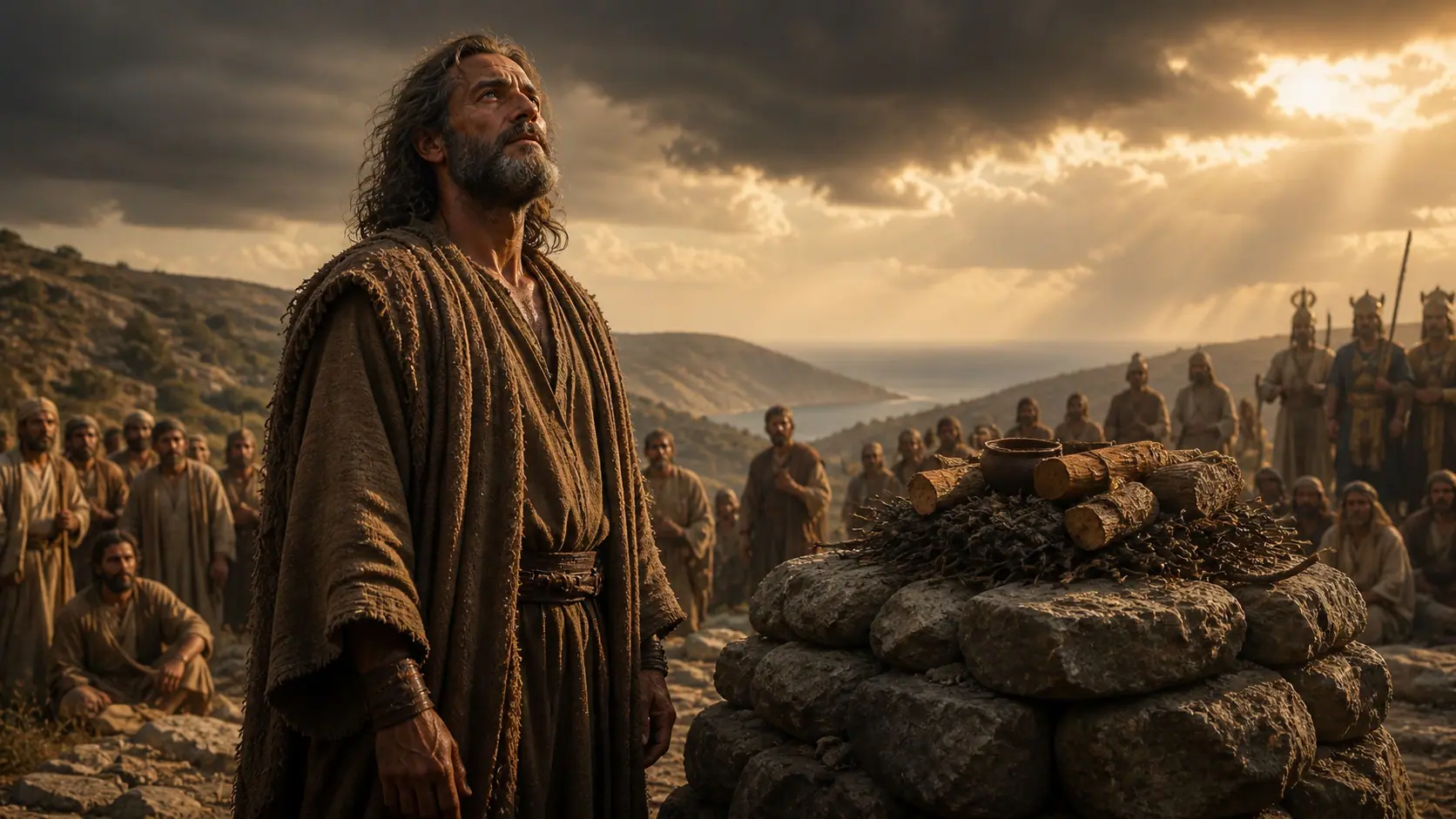
The picture suggests Mount Carmel but does not show the complete sacrifice, trench, or pouring of water. The bowl, clothes, faces, and sky are artistic details, not a visual record of the event.
1 Kings 18:30–39Follow the biblical accounts
Read Elijah’s connected stories
Elijah and the Prophets of Baal
Read the full Mount Carmel challenge, answer by fire, Israel’s response, and return of rain.
Read more →Final Elijah eventElijah and the Chariot of Fire
Follow the Jordan crossing, double portion, whirlwind, and transfer of Elijah’s mantle.
Read more →