%20scale(.87)'%3e%3cg%20transform='rotate(-3%2032%2034)'%3e%3cpath%20d='M10.5%2019.5c7.65-2.35%2014.8-.45%2021.5%205.7%206.7-6.15%2013.85-8.05%2021.5-5.7v27.2c-7.65-2.15-14.8-.45-21.5%205.1-6.7-5.55-13.85-7.25-21.5-5.1V19.5Z'%20fill='%23fff'%20stroke='%23171528'%20stroke-width='4.5'%20stroke-linejoin='round'/%3e%3cpath%20d='M32%2025.2v26.6'%20stroke='%23171528'%20stroke-width='4'%20stroke-linecap='round'/%3e%3cpath%20d='M17.5%2034.5h9M22%2030v9'%20stroke='%23171528'%20stroke-width='3.75'%20stroke-linecap='round'/%3e%3ccircle%20cx='41.5'%20cy='32.5'%20r='2.5'%20fill='%23171528'/%3e%3ccircle%20cx='46.5'%20cy='38'%20r='2.5'%20fill='%23171528'/%3e%3c/g%3e%3c/g%3e%3c/svg%3e)
The quick answer
Who was Mary Magdalene in the Bible?
Mary Magdalene was a follower of Jesus and one of the women who supported his traveling ministry from their own resources. Luke 8:2 identifies her as Mary, called Magdalene, from whom seven demons had gone out. All four Gospels name her in their empty-tomb accounts. John 20 tells how she first thinks Jesus’ body has been taken away, then recognizes the risen Jesus when he speaks her name and reports the encounter to his disciples.
Following and supporting Jesus in Galilee
Luke introduces Mary while Jesus is traveling through towns and villages, proclaiming God’s kingdom. The Twelve are with him, along with women who have been healed. Luke names Mary Magdalene, Joanna, Susanna, and many others, and says the women support the group from their possessions. Joanna is identified as the wife of Chuzas, Herod’s steward; Luke gives no comparable family information about Mary.
The seven demons are a detail of Mary’s deliverance, not a list of seven sins. Luke does not describe the exorcism or name the demons. Mark 16:9, in the passage often labeled the longer ending, explicitly says Jesus cast them out. Neither passage calls Mary a prostitute or gives a medical diagnosis. Luke also does not say how much money she had or where it came from.
Luke 8:1–3; Mark 16:9 · Read about Jesus’ ministry and the people who followed him →
At the cross and the burial
Matthew and Mark name Mary Magdalene among women watching the crucifixion from a distance. John names her near the cross with Jesus’ mother and other women. John also describes a disciple whom Jesus loved standing there, so Mary’s presence should not become a claim that every male disciple was absent.
Matthew places Mary Magdalene and the other Mary opposite the tomb after Joseph of Arimathea buries Jesus. Mark says Mary Magdalene and Mary the mother of Joses see where the body is laid. Luke describes women from Galilee observing the burial and preparing spices, but does not name Mary Magdalene until the empty-tomb report in chapter 24.
Matthew 27:55–61; Mark 15:40–47; Luke 23:49–24:10; John 19:25–27
From a missing body to meeting Jesus
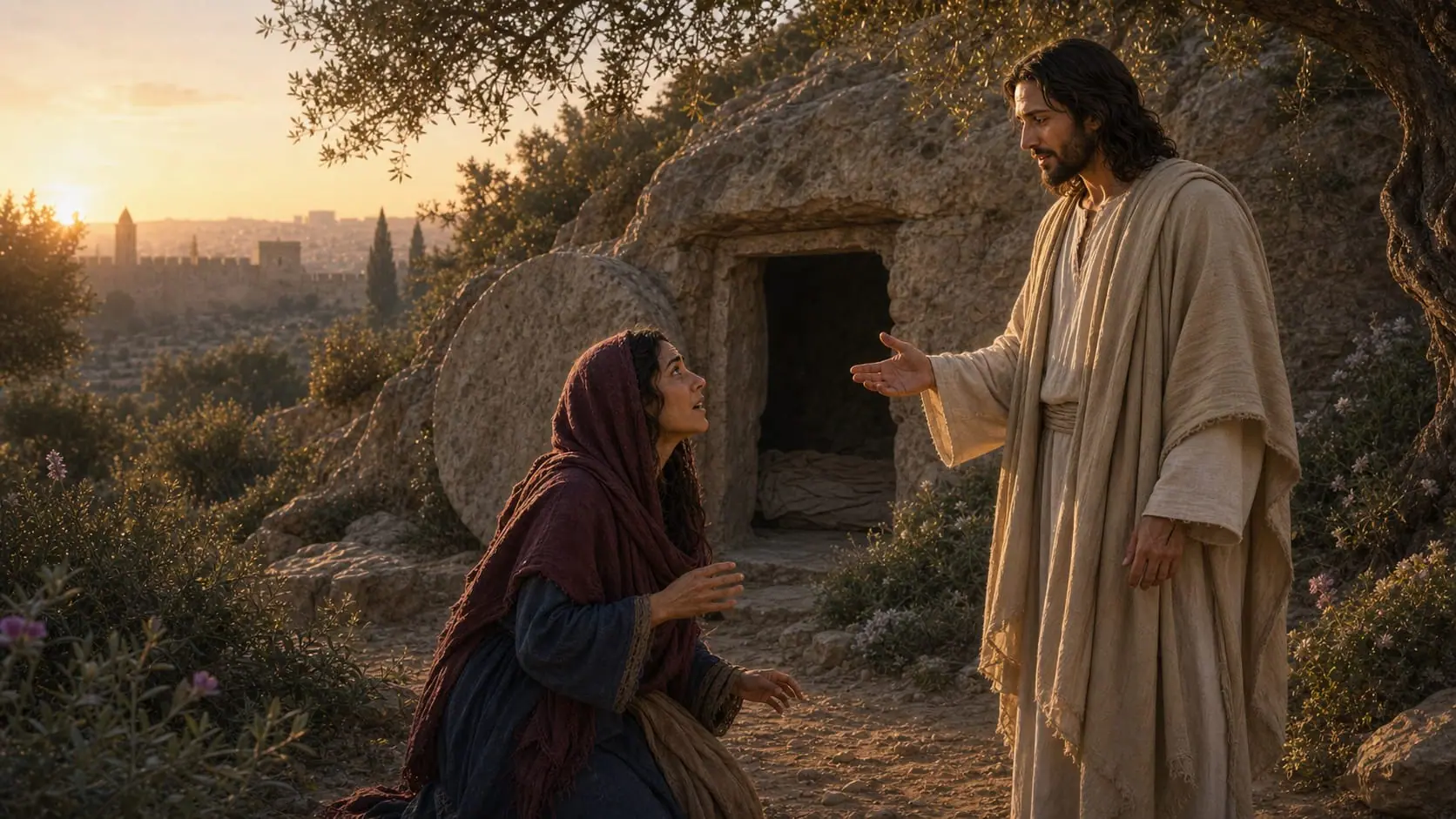
John begins while it is still dark. Mary sees the stone removed and runs to Peter and the disciple Jesus loved. At this point she thinks someone has taken Jesus’ body away; she is not yet announcing the resurrection. The two disciples inspect the tomb and go home. Mary remains outside weeping, sees two angels inside, and then turns toward Jesus without recognizing him. She supposes he is the gardener and asks where the body has been taken.
Jesus speaks her name, and she answers Rabboni, which John translates as Teacher. He tells her not to hold him, says he has not yet ascended to the Father, and sends her to his brothers with his message. Mary goes to the disciples and reports that she has seen the Lord and what he said to her. Her encounter is the first appearance of the risen Jesus narrated in John.
Matthew tells of Mary Magdalene and the other Mary meeting Jesus together, taking hold of his feet, and worshiping him. Mark 16:9 explicitly calls Mary the first person to whom he appeared; some manuscripts omit verses 9–20, which is why many Bibles add a note. Mark 16:6 already announces that Jesus has risen.
John 20:1–18; Matthew 28:1–10; Mark 16:6, 9–20 · Compare the empty-tomb accounts and the note on Mark’s ending →
Mary Magdalene, Mary of Bethany, and the unnamed woman
Luke 7 tells of an unnamed woman who weeps at Jesus’ feet in Simon the Pharisee’s house, wipes them with her hair, and anoints them. Luke calls her a sinner, not a prostitute, and does not identify her as Mary Magdalene. John 12 names Mary of Bethany as the woman who anoints Jesus’ feet. She is the sister of Martha and Lazarus; John does not identify her as Magdalene.
A later Western Christian tradition combined these women. A 2016 Vatican explanation of Mary Magdalene’s feast discusses that history, especially the influence of Gregory the Great. This explains a familiar portrayal in art and preaching, but it does not turn the identification into a statement made by Luke or John.
The Gospels do not describe Mary Magdalene as Jesus’ wife or name children belonging to her. They also give no account of her death or her exact age. That silence does not establish that she never married or had a family; it limits what can be said about her biography from the New Testament.
Luke 7:36–8:3; John 11:1–2; 12:1–8; 20:1–18 · Read the Vatican’s 2016 explanation of the later tradition →
Why she is called “apostle to the apostles”
Mary is not one of the Twelve listed in Luke 6. The later Christian title apostle to the apostles honors her role in announcing the risen Jesus to his disciples in John 20. The Vatican’s 2016 explanation uses this title and attributes it to earlier Christian writers. It is a way of recognizing her mission, not an additional name in the Gospel lists of the Twelve.
John’s scene ends with Mary carrying Jesus’ message to the disciples. That is why her witness matters: the woman who was searching for a body now says she has seen the Lord. The illustration above imagines that encounter; the faces, clothing, kneeling pose, and tomb architecture are artistic choices, not details all supplied by John.
A personal name plus a place identifier
What does Mary Magdalene mean?
The Greek name Maria or Mariam corresponds to the Hebrew name Miriam. Magdalene identifies Mary with Magdala, a town near the Sea of Galilee; it is not a modern family surname. The name distinguishes her from other women named Mary. Luke uses this identifier but does not describe her childhood or tell how she first met Jesus.
NAS and Thayer’s Greek lexicons: Magdalene, entry 3094
NAS and Thayer’s Greek lexicons: Maria and Mariam, entry 3137
The life arc in Scripture
Mary Magdalene’s life in brief
Luke 8:1–3
Mary is named among Jesus’ traveling companions
Matthew 27:55–56; Mark 15:40–41
She witnesses the crucifixion
Matthew 27:57–61; Mark 15:42–47
She observes where Jesus is buried
Matthew 28:1–10; Mark 16:1–8; Luke 24:1–12
She comes to the tomb and receives resurrection news
John 20:1–18
Jesus calls Mary by name
Family and companions
Mary Magdalene’s family and relationships
The Gospels identify Mary by her home rather than by a husband, father, or son. Her clearest relationships are with Jesus and the community of women and disciples who followed him. Scripture supplies no marriage or family genealogy.
Jesus
Jesus frees Mary from seven demons; she follows his ministry and becomes a witness to his death, burial, and resurrection.
Joanna
Luke names Joanna with Mary and Susanna among women who supported Jesus and the Twelve from their resources.
Mary, mother of James and Joses
Mark distinguishes her from Mary Magdalene at the cross. He identifies the other Mary by Joses in the burial account and by James in the empty-tomb account.
Peter and the beloved disciple
In John, Mary alerts them to the removed stone; they inspect the tomb before her encounter with Jesus.
What the text says—and does not say
Common questions about Mary Magdalene
Seven demons had gone out from Mary
Luke states the result of her healing but does not narrate the exorcism, name the demons, or connect them with a specific sin.
Luke 8:2The Bible does not call Mary Magdalene a prostitute
The Gospels do not identify her as the unnamed sinful woman in Luke 7 or describe her sins as sexual. That conflation developed in later Western tradition.
Luke 7:36–50; 8:1–3The Bible does not identify her as Mary of Bethany
Mary of Bethany is introduced through her siblings Martha and Lazarus; Mary Magdalene is identified by Magdala. Scripture never says they are the same person.
Luke 10:38–42; John 11:1–2; Luke 8:2The Bible does not say Mary married Jesus
No canonical Gospel describes Jesus and Mary Magdalene as spouses or gives them children. Modern claims of a marriage go beyond the biblical text.
Matthew 27–28; Mark 15–16; Luke 8, 23–24; John 19–20Follow the biblical accounts