%20scale(.87)'%3e%3cg%20transform='rotate(-3%2032%2034)'%3e%3cpath%20d='M10.5%2019.5c7.65-2.35%2014.8-.45%2021.5%205.7%206.7-6.15%2013.85-8.05%2021.5-5.7v27.2c-7.65-2.15-14.8-.45-21.5%205.1-6.7-5.55-13.85-7.25-21.5-5.1V19.5Z'%20fill='%23fff'%20stroke='%23171528'%20stroke-width='4.5'%20stroke-linejoin='round'/%3e%3cpath%20d='M32%2025.2v26.6'%20stroke='%23171528'%20stroke-width='4'%20stroke-linecap='round'/%3e%3cpath%20d='M17.5%2034.5h9M22%2030v9'%20stroke='%23171528'%20stroke-width='3.75'%20stroke-linecap='round'/%3e%3ccircle%20cx='41.5'%20cy='32.5'%20r='2.5'%20fill='%23171528'/%3e%3ccircle%20cx='46.5'%20cy='38'%20r='2.5'%20fill='%23171528'/%3e%3c/g%3e%3c/g%3e%3c/svg%3e)
The quick answer
What happened in the Crucifixion of Jesus story?
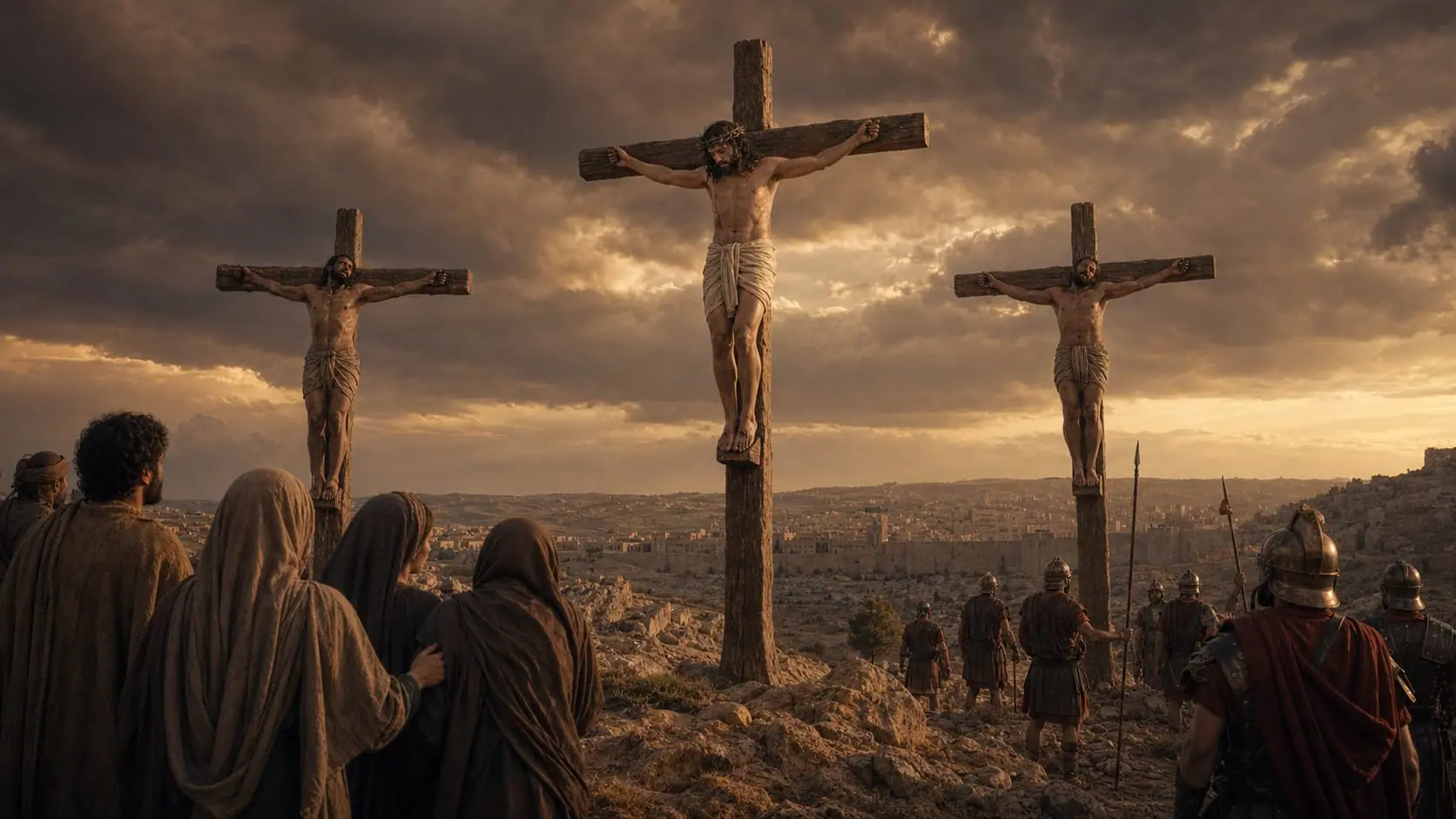
After Jesus was arrested and questioned, he was brought before the Roman governor Pontius Pilate. Pilate released Barabbas and handed Jesus over to be crucified. Roman soldiers mocked Jesus, led him toward Golgotha, and compelled Simon of Cyrene to carry the cross. Jesus was crucified between two criminals under a sign identifying him as the King of the Jews.
The accounts describe Jesus’ words from the cross, darkness, his death, the torn temple curtain, and a centurion’s response. Joseph of Arimathea placed Jesus’ body in a rock-cut tomb. Mary Magdalene is named among the witnesses to the crucifixion and burial. The story continues with the Resurrection of Jesus.
The full story
Jesus Is Crucified and Dies
Jesus is brought before Pontius Pilate
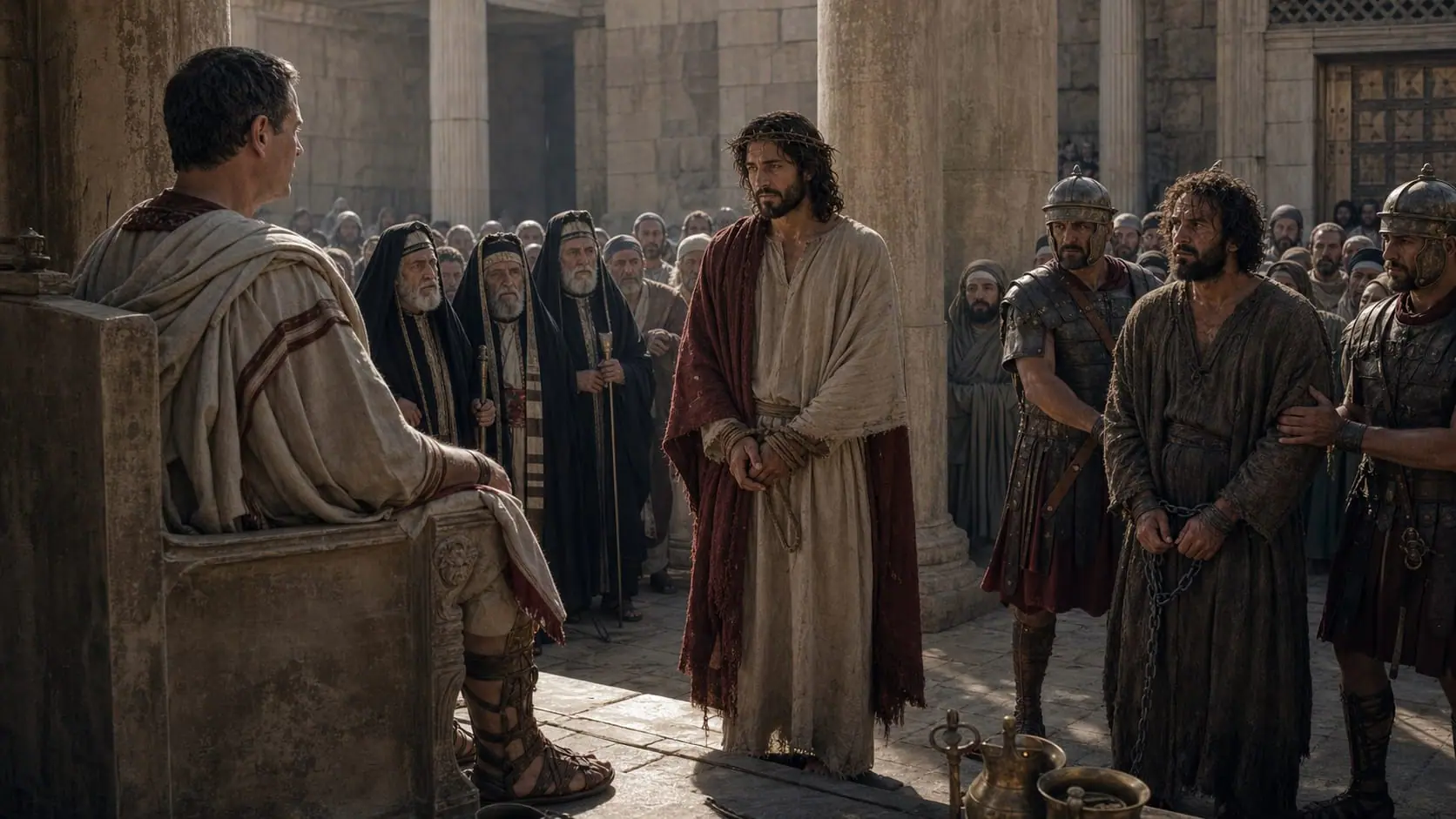
After proceedings before Jewish leaders, Jesus was brought to Pilate, the Roman governor. The accusations presented him as a political threat and a claimant to kingship. Pilate questioned Jesus, and Luke also records Jesus being sent to Herod Antipas before returning to Pilate.
Pilate released Barabbas and handed Jesus over for crucifixion. Luke and John repeatedly record Pilate saying he found no basis for the charges, yet he authorized the execution. Matthew and Mark place the flogging with the handover; John describes the flogging and soldiers’ mockery before Pilate’s final decision. Matthew 27:1–2, 11–26; Mark 15:1–15; Luke 23:1–25; John 18:28–19:16
The soldiers mock the King of the Jews
Roman soldiers dressed Jesus in a robe, placed a crown of thorns on his head, and mocked him with the title “King of the Jews.” They struck him and spat on him. John records Pilate presenting the wounded Jesus to the crowd before the final sentence.
The royal robe, crown, and acclamation were intended as humiliation. Within the Gospel story, however, the mockery also exposes a central irony: Jesus is rejected under a royal title that the narrative continues to take seriously. Matthew 27:27–31; Mark 15:16–20; John 19:1–5
Simon of Cyrene carries the cross
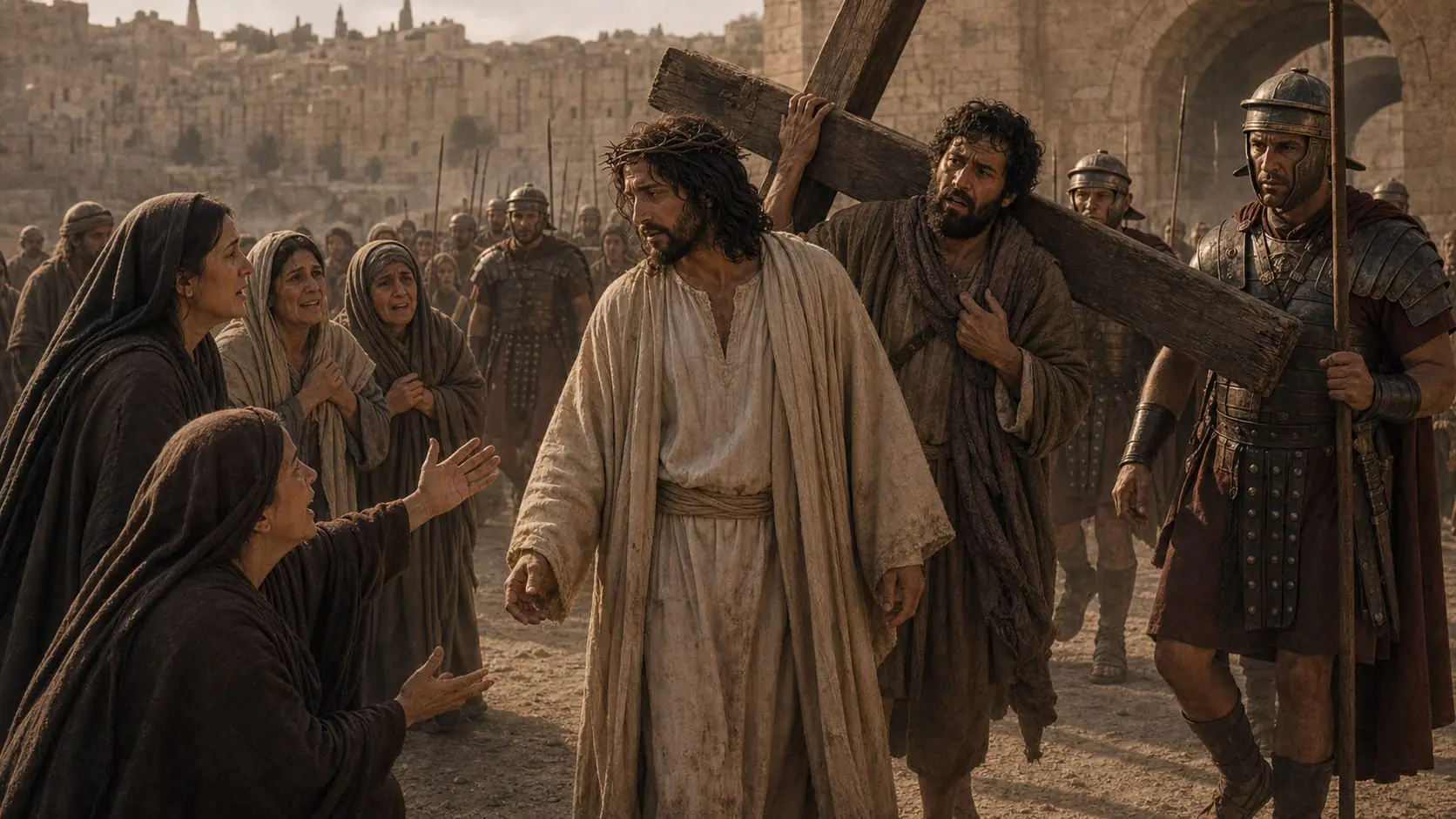
Jesus was led outside toward the execution site. John says Jesus went out bearing the cross. Matthew, Mark, and Luke say the soldiers compelled Simon of Cyrene, a passerby coming from the country, to carry it. Mark identifies Simon as the father of Alexander and Rufus.
The familiar retelling has Simon take over after Jesus carries the cross, but no Gospel describes the handover. Luke says the cross was placed on Simon to carry behind Jesus. Luke also records Jesus telling the mourning women to weep for themselves and their children because terrible days were coming. Matthew 27:31–32; Mark 15:20–21; Luke 23:26–31; John 19:16–17
Jesus is crucified at Golgotha
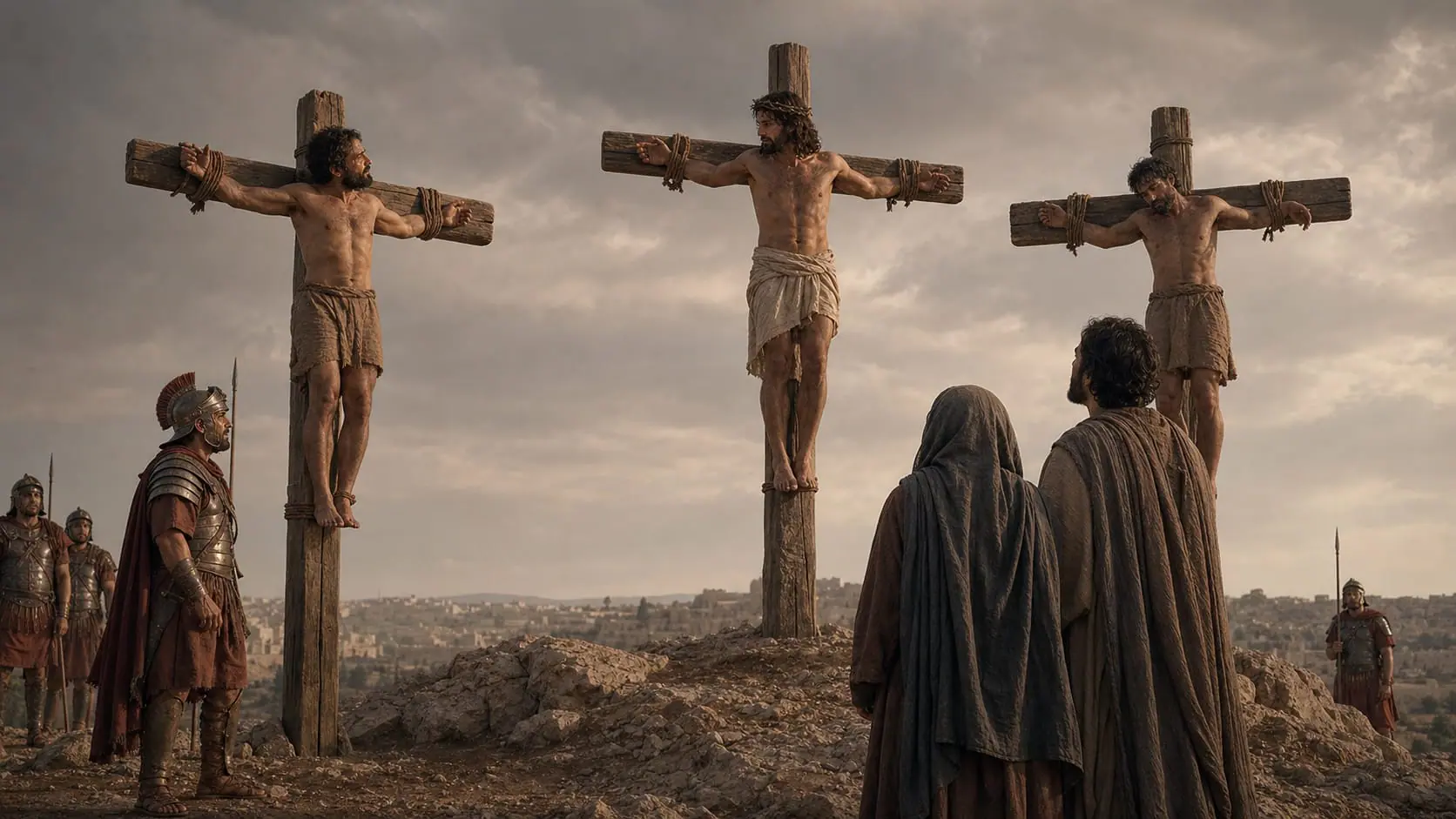
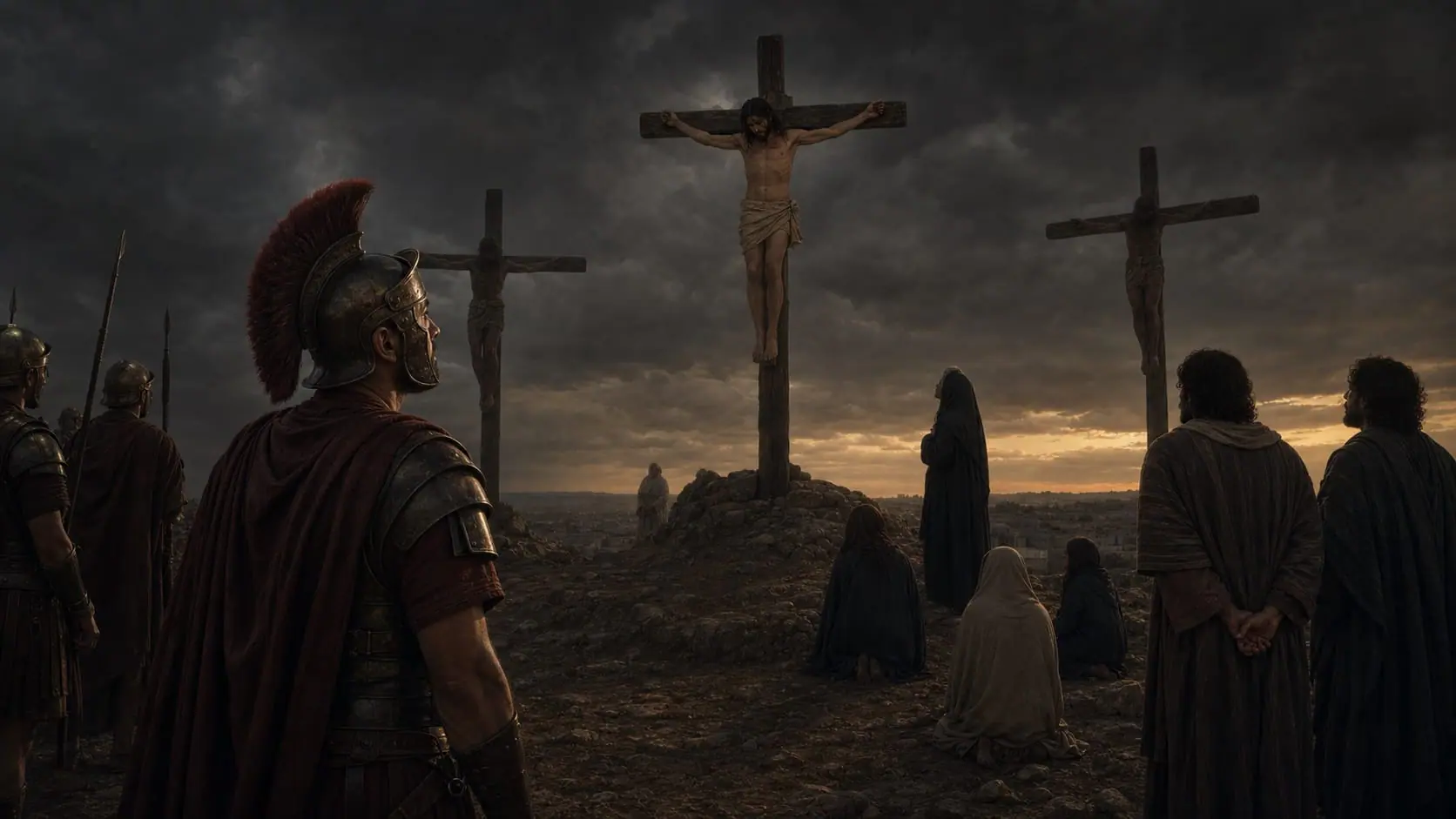
The procession reached Golgotha, “The Place of a Skull.” Jesus was crucified there between two criminals. The soldiers divided his garments by casting lots, and a charge was placed above him identifying him as the King of the Jews.
Matthew and Mark describe both men crucified with Jesus insulting him. Luke records one insulting him and the other rebuking that man, acknowledging his own guilt, and asking Jesus to remember him. Jesus promises him Paradise. These are distinct accounts; none narrates a precise change from both mocking to one repenting. Matthew 27:33–44; Mark 15:22–32; Luke 23:32–43; John 19:17–24
Luke 23:34 includes Jesus’ prayer for forgiveness in the WEB and KJV. Some early manuscripts omit the prayer, which is why other editions mark it with a note. The verse uses “them” without explicitly naming everyone included in the request.
Jesus said, “Father, forgive them, for they don’t know what they are doing.” Dividing his garments among them, they cast lots.
He said to Jesus, “Lord, remember me when you come into your Kingdom.” Jesus said to him, “Assuredly I tell you, today you will be with me in Paradise.”
A four-Gospel harmony
The Seven Last Words of Jesus on the Cross
The traditional “seven last words” are seven sayings, not seven individual words. No Gospel contains the complete list, and the familiar order combines material from Matthew, Mark, Luke, and John:
1. “Father, forgive them”
Jesus asks the Father to forgive “them,” without naming each person included. Some manuscripts omit this prayer, as noted above. Luke 23:34
2. “Today you will be with me in Paradise”
Jesus answers the criminal who asks to be remembered. Luke 23:39–43
3. “Behold, your son” and “Behold, your mother”
Jesus entrusts his mother and the beloved disciple to one another. John 19:26–27
4. “My God, my God, why have you forsaken me?”
Jesus cries out with the opening words of Psalm 22. Matthew 27:46; Mark 15:34
5. “I am thirsty”
John connects Jesus’ thirst with the fulfillment of Scripture. John 19:28–29
6. “It is finished”
John records Jesus declaring that his work has reached its completion. John 19:30
7. “Father, into your hands I commit my spirit”
Luke records Jesus’ final prayer before he breathes his last, echoing Psalm 31:5. Luke 23:46
This order is a devotional arrangement, not a sequence given by any single Gospel. Read each saying in its own passage before using the combined list as a timeline.
Darkness falls and Jesus dies
Matthew, Mark, and Luke describe darkness from about the sixth hour to the ninth—roughly noon to 3 p.m., counting from sunrise. Matthew and Mark record Jesus’ cry from Psalm 22, the offer of sour wine, and a final loud cry. John records him receiving sour wine and declaring, “It is finished!” Luke records his prayer, “Father, into your hands I commit my spirit!”
Each account states that Jesus died, but they do not record an identical sequence of final sayings. John describes him bowing his head and giving up his spirit; Luke says he breathed his last after the prayer. Matthew 27:45–50; Mark 15:33–37; Luke 23:44–46; John 19:28–30
After this, Jesus, seeing that all things were now finished, that the Scripture might be fulfilled, said, “I am thirsty!” Now a vessel full of vinegar was set there; so they put a sponge full of the vinegar on hyssop, and held it at his mouth. When Jesus therefore had received the vinegar, he said, “It is finished!” Then he bowed his head and gave up his spirit.
The curtain is torn and a centurion responds
Matthew and Mark place the tearing of the temple curtain after Jesus’ death; Luke mentions it before his final cry. Matthew also describes an earthquake, split rocks, opened tombs, and raised saints. Matthew specifies that they came out of the tombs and appeared in the city after Jesus’ resurrection, not simply that they all walked through Jerusalem at the moment he died.
Matthew records the centurion and those with him fearing what they saw and calling Jesus God’s Son. Mark records the centurion’s confession; Luke says the centurion praised God and called Jesus righteous. John adds that soldiers did not break Jesus’ legs because he was already dead, and that blood and water came out when one pierced his side. Matthew 27:51–56; Mark 15:38–41; Luke 23:45–49; John 19:31–37
The veil of the temple was torn in two from the top to the bottom. When the centurion, who stood by opposite him, saw that he cried out like this and breathed his last, he said, “Truly this man was the Son of God!”
Joseph of Arimathea buries Jesus
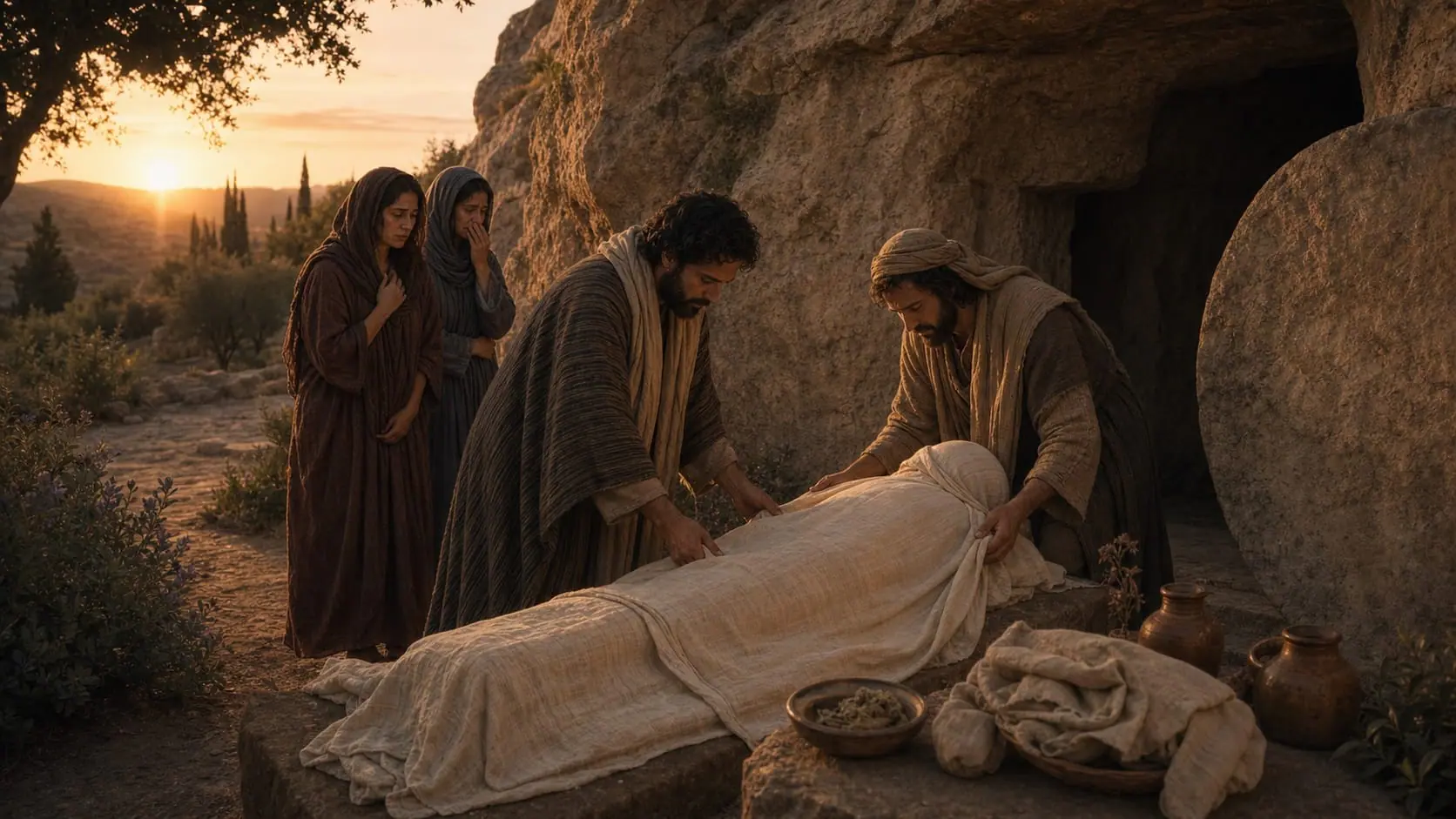
As evening approached, Joseph of Arimathea asked Pilate for Jesus’ body. Mark records Pilate confirming the death with the centurion before granting permission. Joseph wrapped the body in linen and placed it in a rock-cut tomb. Matthew identifies it as Joseph’s own new tomb and describes him rolling a stone against the entrance.
John adds that Nicodemus brought myrrh and aloes for the burial. Matthew, Mark, and Luke describe women seeing where Jesus was laid. Matthew places the request for a guard on the following day, after the burial—not as part of Joseph’s first visit to the tomb. Matthew 27:57–66; Mark 15:42–47; Luke 23:50–56; John 19:38–42
The historical setting
When and Where Was Jesus Crucified?
When did the crucifixion happen?
Mark 15:42 identifies the day as the Preparation Day before the Sabbath, the basis for remembering the crucifixion on Friday. The modern year is not stated. AD 30 and AD 33 are common historical proposals, not dates explicitly given by Scripture. The Last Supper’s relation to Passover is part of the chronology debate.
Mark 15:25 gives the third hour, roughly 9 a.m. when counted from sunrise. John 19:14 gives about the sixth hour while Jesus is still before Pilate—roughly noon on the same system. Different timekeeping systems and approximate reporting have been proposed, but neither passage explains a shared clock system that resolves the difference. It is misleading to present a harmonized timetable as certain.
Where was Golgotha?
Golgotha means “The Place of a Skull”; Calvary comes from the Latin word for skull. Hebrews 13:12 says Jesus suffered outside the gate, and John 19:20 places the site near the city. Neither passage supplies coordinates or confirms a modern archaeological identification.
Read each account carefully
The Crucifixion Story in the Four Gospels
Matthew 27
Matthew emphasizes the fulfillment of Scripture, Judas’ death, Pilate and the crowd, cosmic signs at Jesus’ death, the opened tombs, and the guard placed at the burial site.
Mark 15
Mark presents a concentrated passion narrative, records the third-hour reference, highlights Jesus’ cry from Psalm 22, and gives the centurion’s confession as a climactic response.
Luke 23
Luke includes the hearing before Herod, Jesus’ words to the women of Jerusalem, his prayer for forgiveness, the two criminals, the promise of Paradise, and his final prayer of trust.
John 19
John emphasizes kingship, Jesus bearing the cross, the multilingual inscription, Jesus entrusting his mother to the beloved disciple, “I am thirsty,” “It is finished,” the pierced side, and Nicodemus at the burial.
All four accounts describe the Roman execution, Jesus’ death, and his burial. Their sayings, time references, and surrounding details differ. Comparing them means keeping those distinctions visible, not assuming that every account contains the combined story.
Continue with the Resurrection of Jesus story, or read Bible verses about forgiveness. For a short review of the burial and resurrection accounts, try the 10 questions on Biblical Easter Trivia. Its play button opens the broader Stories of Jesus game, not an Easter-only round.