%20scale(.87)'%3e%3cg%20transform='rotate(-3%2032%2034)'%3e%3cpath%20d='M10.5%2019.5c7.65-2.35%2014.8-.45%2021.5%205.7%206.7-6.15%2013.85-8.05%2021.5-5.7v27.2c-7.65-2.15-14.8-.45-21.5%205.1-6.7-5.55-13.85-7.25-21.5-5.1V19.5Z'%20fill='%23fff'%20stroke='%23171528'%20stroke-width='4.5'%20stroke-linejoin='round'/%3e%3cpath%20d='M32%2025.2v26.6'%20stroke='%23171528'%20stroke-width='4'%20stroke-linecap='round'/%3e%3cpath%20d='M17.5%2034.5h9M22%2030v9'%20stroke='%23171528'%20stroke-width='3.75'%20stroke-linecap='round'/%3e%3ccircle%20cx='41.5'%20cy='32.5'%20r='2.5'%20fill='%23171528'/%3e%3ccircle%20cx='46.5'%20cy='38'%20r='2.5'%20fill='%23171528'/%3e%3c/g%3e%3c/g%3e%3c/svg%3e)
The quick answer
What happened in the Resurrection of Jesus story?
After Jesus was crucified and buried, women went to his tomb early on the first day of the week. The tomb was empty, and messengers announced that he had risen. John follows Mary Magdalene’s encounter with Jesus and his appearances to the disciples, including Thomas. Luke tells of two travelers meeting him on the road to Emmaus; Matthew describes the women meeting him and the eleven receiving his commission in Galilee.
Each Gospel includes different details about the witnesses and their responses. None narrates the exact moment Jesus rose or someone watching him leave the tomb. The scenes below follow the individual accounts rather than supplying a precise combined itinerary. The illustrations imagine these events; clothing, faces, buildings, and the number of figures shown are not a complete record of the people present.
The full story
Jesus Rises from the Dead
The women remember where Jesus was buried
After Jesus died, Joseph of Arimathea obtained permission from Pilate to bury him. Matthew says Joseph placed the body in his own new rock-cut tomb and rolled a stone across the entrance. John adds that Nicodemus brought myrrh and aloes; the two men wrapped the body with spices and placed it in a new tomb in a nearby garden.
Matthew and Mark name Mary Magdalene and another Mary as witnesses at the burial. Luke says the women from Galilee observed the tomb, prepared spices and ointments, then rested on the Sabbath. Mark describes women buying spices after the Sabbath. Both accounts show them preparing to anoint a body, not expecting to meet Jesus alive. Matthew 27:57–61; Mark 15:42–16:1; Luke 23:50–56; John 19:38–42
An early visit to the tomb
Mary Magdalene is named in every empty-tomb account. Matthew begins as the first day of the week is dawning; Mark says the sun has risen, Luke says early dawn, and John begins while it is still dark. These descriptions should not be turned into a single exact arrival time.
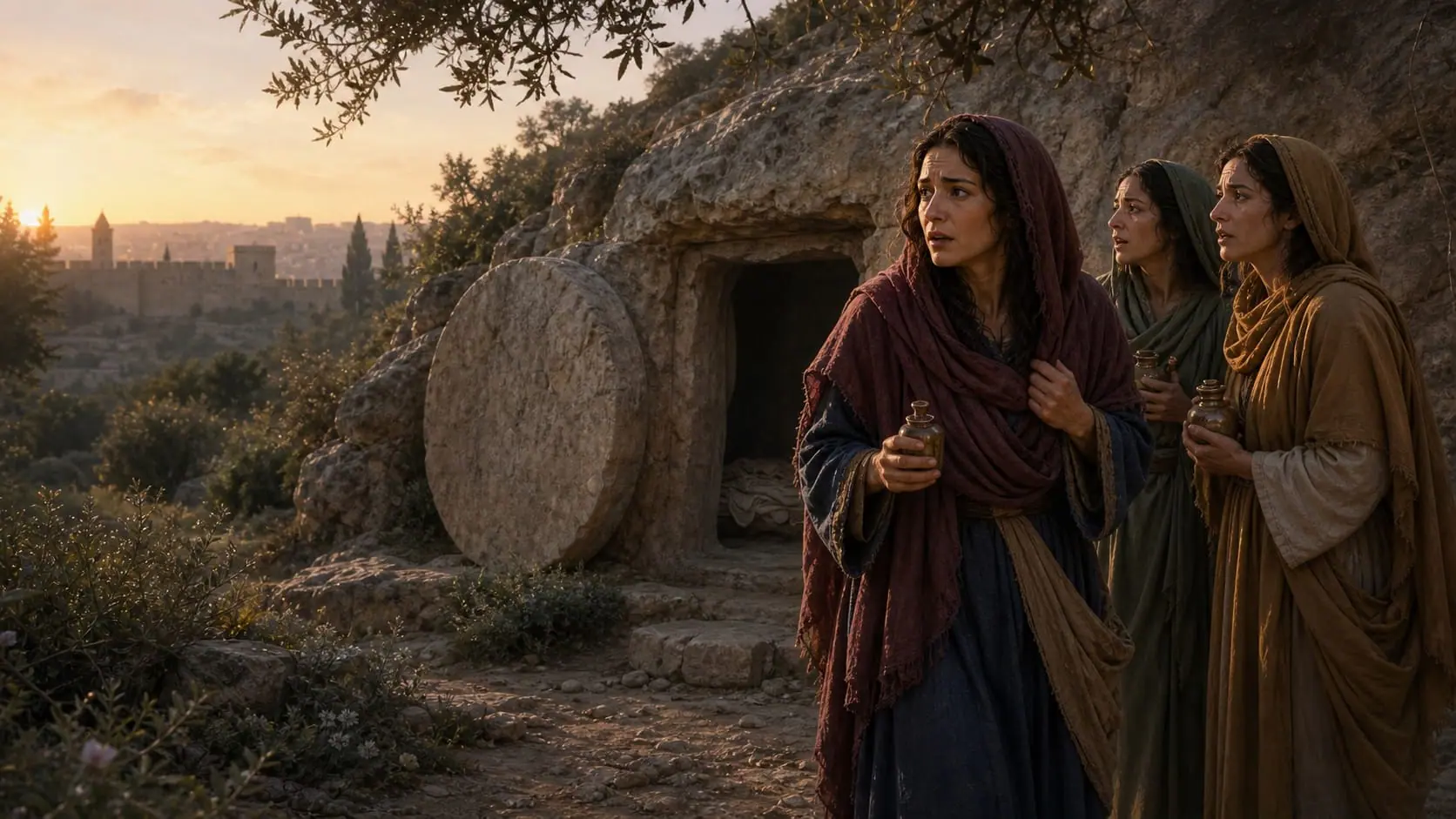
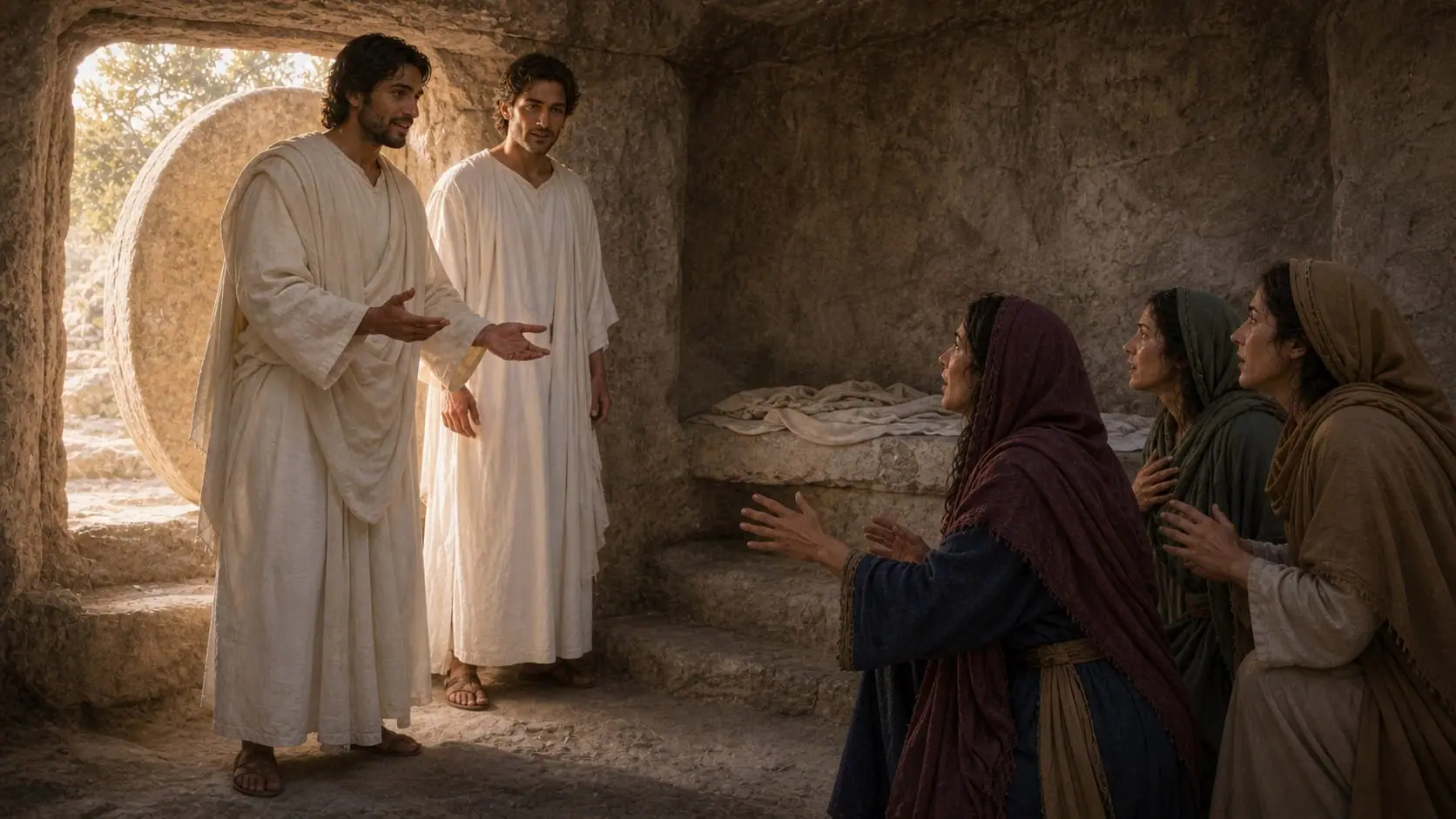
Matthew introduces the women’s visit, then describes an earthquake and an angel rolling away the stone and sitting on it; the guards shake with fear. Mark, Luke, and John describe visitors finding the stone already moved. Mark’s women encounter a young man in a white robe inside the tomb; Luke describes two men in dazzling clothing. John first follows Mary as she runs to Peter and the disciple Jesus loved, thinking someone has removed the body. Matthew 28:1–4; Mark 16:1–5; Luke 24:1–4; John 20:1–2
“He isn’t here, but is risen”
The message at the tomb interprets what the women have found: Jesus has risen as he said. Luke’s messengers ask why they seek the living among the dead and remind them of Jesus’ earlier words about his suffering, death, and resurrection.
In Matthew, the angel tells the women to carry the news; they run with fear and great joy. Mark’s young man tells them to tell the disciples and Peter, but verse 8 ends with the women fleeing in fear and saying nothing to anyone. In Luke, the women remember Jesus’ words and report to the apostles, who initially dismiss their account as nonsense. Matthew 28:5–8; Mark 16:6–8; Luke 24:5–11
Becoming terrified, they bowed their faces down to the earth. The men said to them, “Why do you seek the living among the dead? He isn’t here, but is risen. Remember what he told you when he was still in Galilee, saying that the Son of Man must be delivered up into the hands of sinful men and be crucified, and the third day rise again?”
Peter and the beloved disciple see the burial cloths
John says Peter and the disciple Jesus loved ran to the tomb after Mary’s report. The other disciple arrived first and looked in; Peter entered and saw the linen cloths and the separate cloth that had been on Jesus’ head. The other disciple then entered, saw, and believed.
Luke also records Peter running to the tomb, stooping, and seeing the linen cloths by themselves. The empty space and abandoned burial cloths demanded an explanation, but the disciples still had more to understand. Luke 24:12; John 20:3–10
Jesus appears to Mary Magdalene
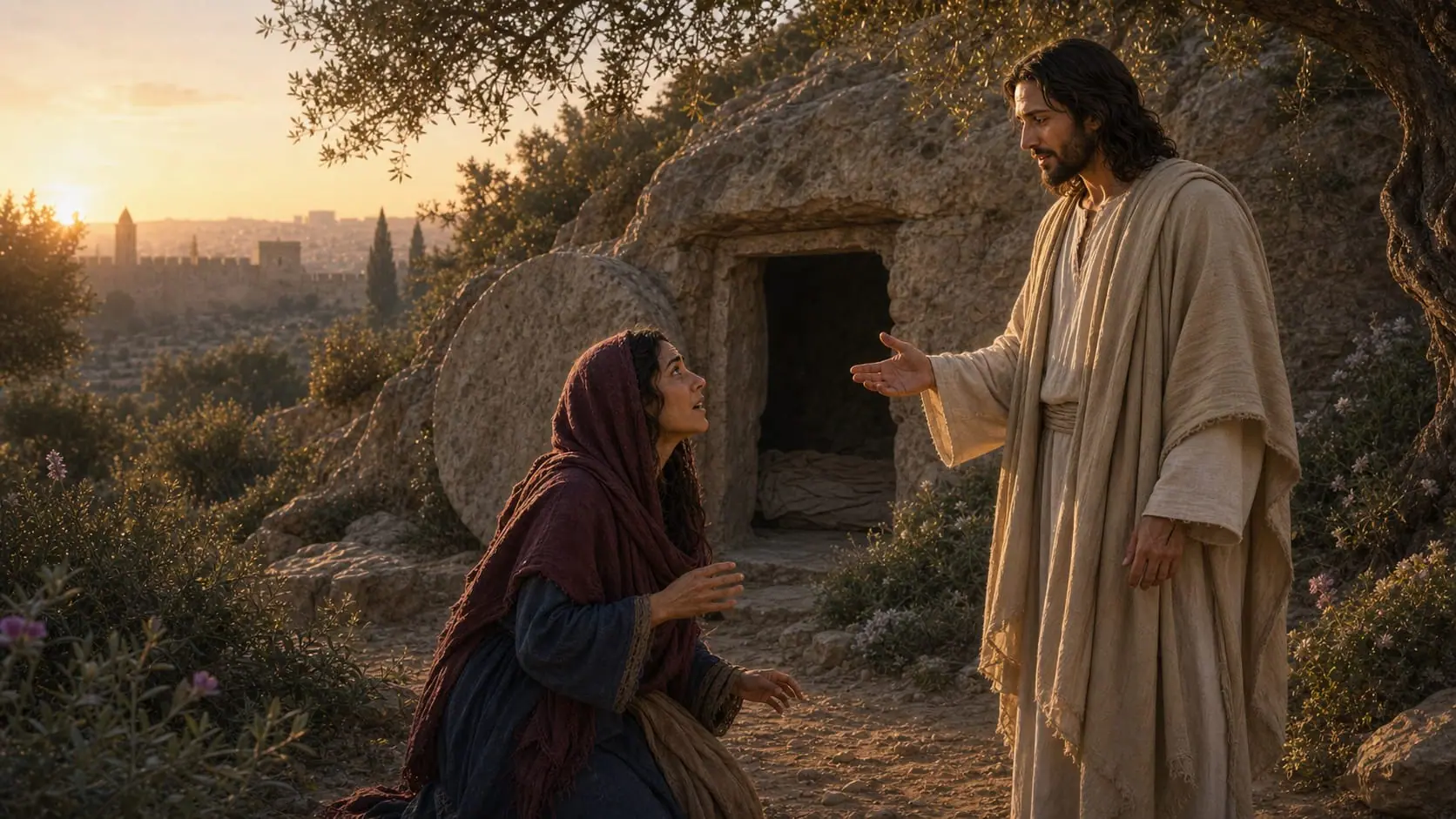
In John’s account, Mary Magdalene remained outside the tomb weeping after the two disciples left. She saw two angels inside and then turned toward Jesus, but did not recognize him. Supposing he was the gardener, she asked where the body had been taken.
Recognition came when Jesus said her name. She answered Rabboni, which John explains means Teacher. Jesus told her not to hold him, spoke of his coming ascent to the Father, and sent her to his brothers. Mary reported the encounter and his message to the disciples. John 20:11–18
Jesus said to her, “Mary.” She turned and said to him, “Rabboni!” which is to say, “Teacher!” Jesus said to her, “Don’t hold me, for I haven’t yet ascended to my Father; but go to my brothers and tell them, ‘I am ascending to my Father and your Father, to my God and your God.’” Mary Magdalene came and told the disciples that she had seen the Lord, and that he had said these things to her.
Jesus walks with two disciples to Emmaus
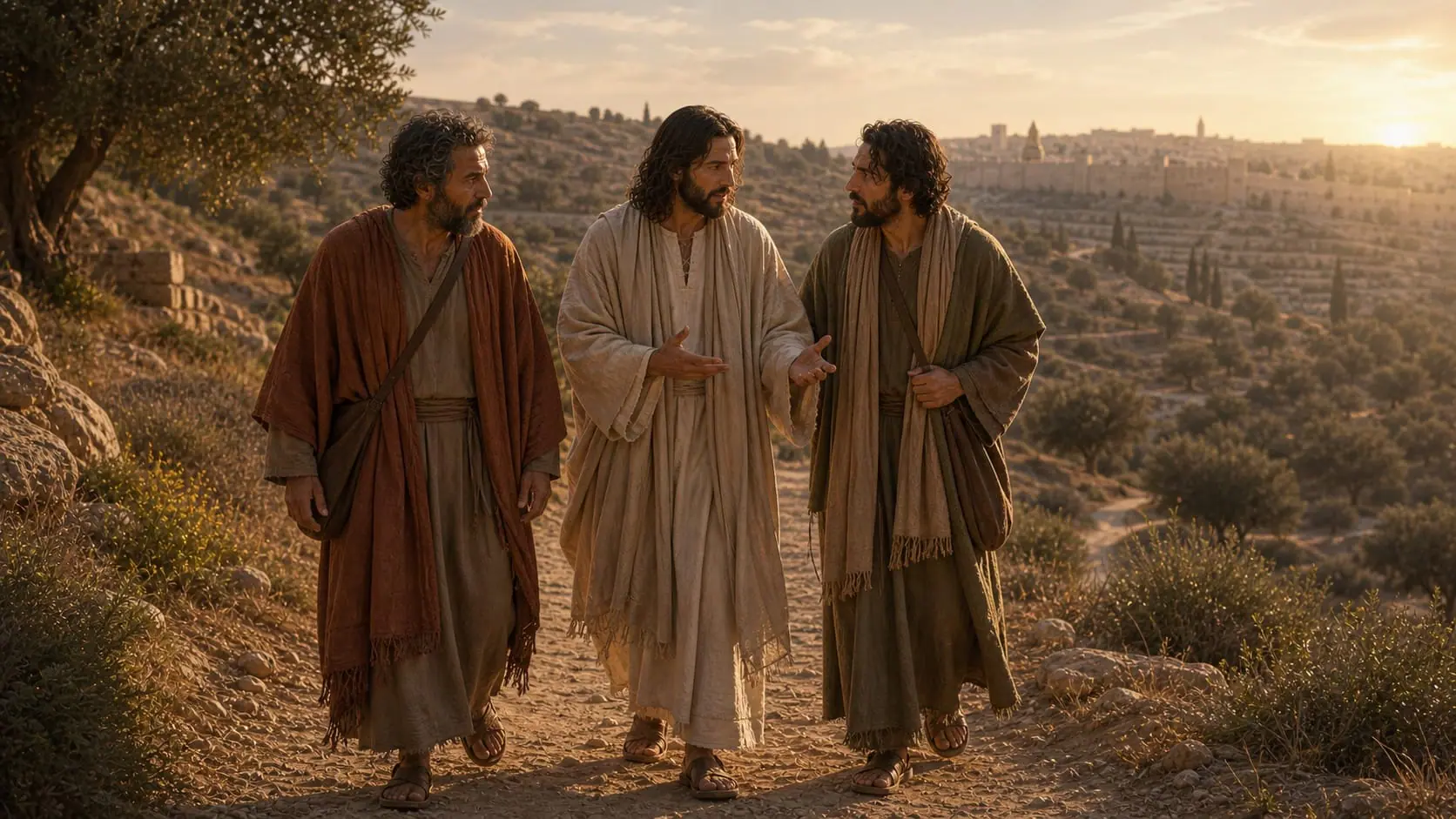
Luke follows two disciples traveling toward Emmaus that same day. One is named Cleopas; the other is not named. Jesus walks with them, but they do not recognize him. They tell him of their lost hope and the women’s report from the tomb. Beginning with Moses and all the prophets, he explains the Scriptures concerning himself.
They invite him to stay. At the table, he gives thanks and breaks bread; they recognize him, and he vanishes from their sight. They speak to each other about their hearts burning as he explained the Scriptures, then return to Jerusalem that hour. The gathered group tells them that the Lord has appeared to Simon. The travelers, in turn, describe their own encounter. Luke 24:13–35
When he had sat down at the table with them, he took the bread and gave thanks. Breaking it, he gave it to them. Their eyes were opened and they recognized him; then he vanished out of their sight. They said to one another, “Weren’t our hearts burning within us while he spoke to us along the way, and while he opened the Scriptures to us?”
Jesus stands among the gathered disciples
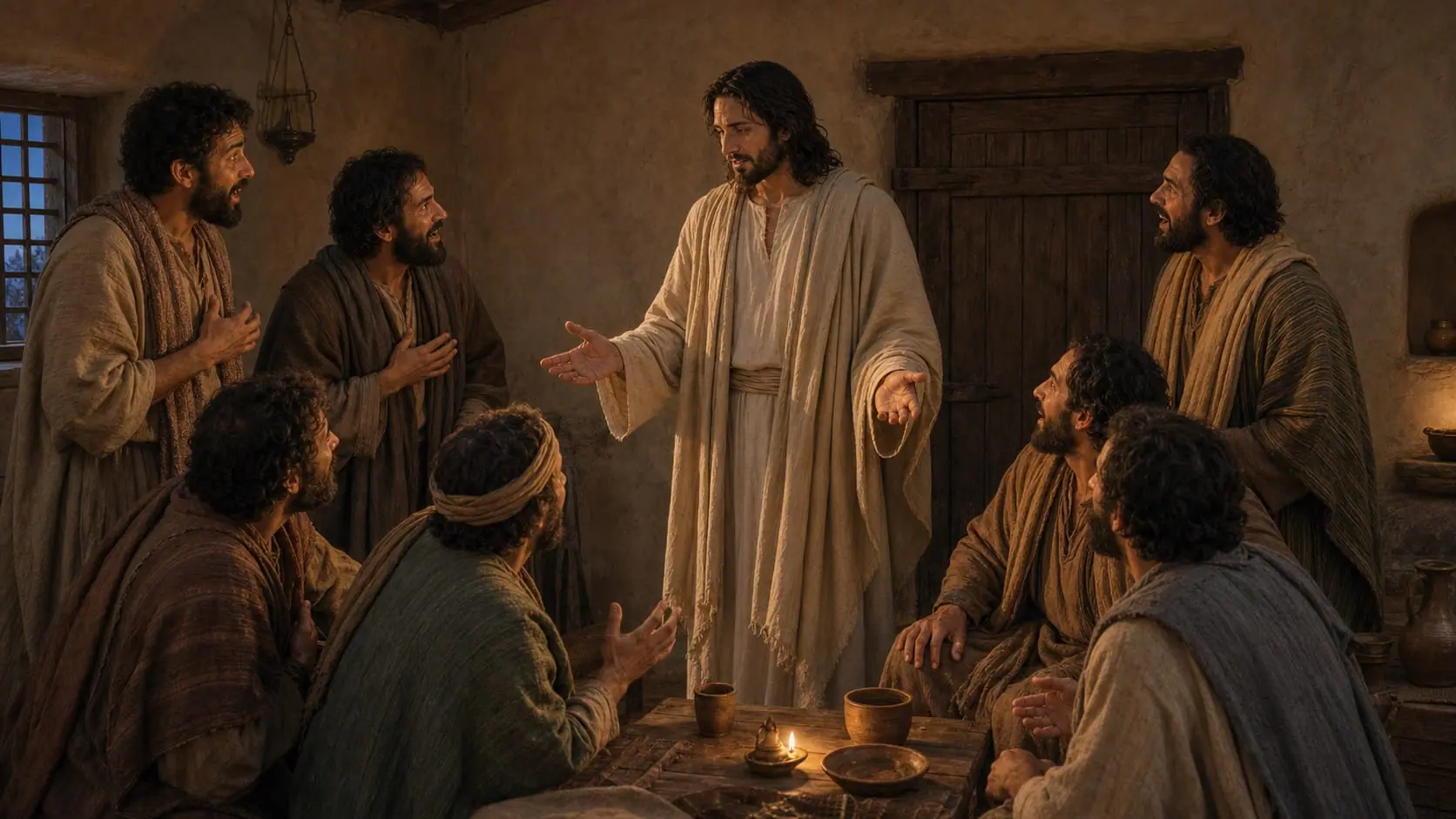
In Luke, Jesus stands among the disciples while the Emmaus travelers are speaking. They are terrified, thinking they see a spirit. He shows his hands and feet, invites them to touch him, and says a spirit does not have flesh and bones as he does. He also eats in front of them. Luke then records his teaching about Scripture, repentance, forgiveness, and their coming role as witnesses.
John places an appearance on the evening of the first day of the week, with the doors locked. Jesus stands among the disciples, speaks peace, and shows his hands and side; they rejoice. He sends them as the Father sent him, breathes on them, and tells them to receive the Holy Spirit. The locked doors come from John’s account; the hands-and-feet invitation and meal come from Luke’s. Luke 24:36–49; John 20:19–23
Thomas sees the risen Jesus
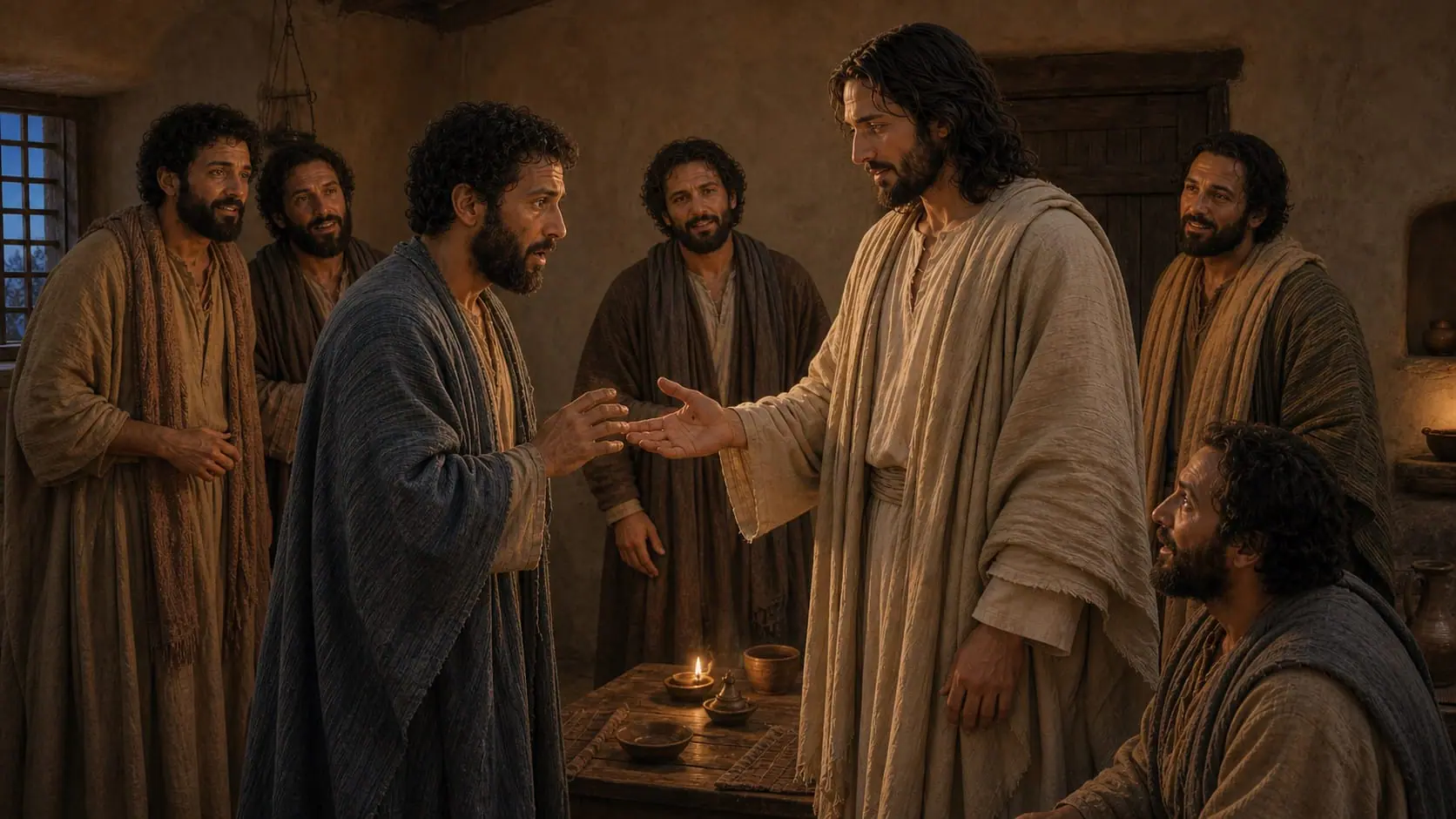
Thomas was absent from the gathering just described in John and said he would not believe without seeing and touching Jesus’ wounds. Eight days later, Jesus again stood among the disciples with the doors shut. He invited Thomas to examine his hands and side and told him not to be unbelieving but believing.
John does not explicitly say Thomas touched the wounds. It records his immediate confession: “My Lord and my God!” Jesus then pronounced a blessing on those who have not seen and yet have believed. John 20:24–29
Then he said to Thomas, “Reach here your finger, and see my hands. Reach here your hand, and put it into my side. Don’t be unbelieving, but believing.” Thomas answered him, “My Lord and my God!” Jesus said to him, “Because you have seen me, you have believed. Blessed are those who have not seen and have believed.”
Jesus appears again and sends his followers
Matthew records the eleven meeting Jesus on a mountain in Galilee. They worship, though some doubt. Jesus declares that all authority in heaven and earth has been given to him, then commissions them to make disciples of all nations, baptize in the name of the Father, Son, and Holy Spirit, and teach obedience to his commands.
John 21 tells of Jesus meeting seven disciples beside the Sea of Tiberias. After a great catch of fish and breakfast, he asks Peter three times about his love and tells him to feed and tend his flock. Christians commonly read this as Peter’s restoration after his denials.
Luke closes with Jesus blessing his followers and ascending. Acts 1:3 supplies the wider time span: Jesus appeared to the apostles over forty days before his ascension. Luke’s short closing scene should not be read as saying that all these events happened on resurrection evening. Matthew 28:16–20; Luke 24:44–53; John 21:1–25; Acts 1:1–12
The resurrection timeline
When Did Jesus Rise from the Dead?
The empty-tomb accounts begin on the first day of the week, Sunday. John says it was still dark when Mary arrived; Mark describes the sun already risen when the women come. No Gospel gives a clock time for Jesus’ resurrection or narrates someone watching it happen.
Mark 8:31 uses after three days, while Luke 9:22 and 1 Corinthians 15:4 use on the third day. Matthew 12:40 compares the Son of Man’s time in the earth with Jonah’s three days and three nights in the fish. The traditional Friday-to-Sunday reading counts parts of days inclusively: burial on the day before the Sabbath, the Sabbath, and the first day of the week. Mark 15:42 and 16:1–2 provide that sequence. Christians discuss how the expressions fit together; they should be read alongside one another rather than replacing Matthew’s wording or inventing a precise number of elapsed hours.
Read each witness carefully
The Resurrection Story in the Four Gospels
Matthew 28
Matthew describes the earthquake, the angel rolling away the stone, the frightened guards, and Jesus meeting the women. He also recounts the chief priests and elders paying the guards to say the disciples stole the body while they slept. This is a cover story within Matthew’s narrative, not his explanation of the empty tomb. The chapter ends with the eleven receiving Jesus’ commission in Galilee.
Mark 16
Mark 16:1–8 describes the women, the moved stone, the young man’s announcement, and their fearful departure. Some manuscripts omit verses 9–20; many include them. The World English Bible includes the passage with a textual note; the NABRE labels it the Longer Ending and explains its textual history and place in Catholic tradition. These notes distinguish manuscripts and editorial decisions; Mark’s announcement that Jesus has risen is already present in verse 6.
Luke 24
Luke includes two men at the tomb, Peter’s visit, the road to Emmaus, Jesus eating before the disciples, teaching from Scripture, and the movement toward the ascension.
John 20–21
John gives extended attention to Mary Magdalene, Peter and the beloved disciple, the closed-room appearances, Thomas, and the later breakfast with disciples beside the sea.
The differences are especially noticeable in the women’s names, the number and description of messengers, and the order of narrated encounters. An account naming one messenger does not by itself say only one was present, but neither should the different scenes be described as identical. John 20:30–31 explicitly says Jesus did other signs not written in that book and explains the purpose of those included: faith in Jesus as the Christ, the Son of God.
For further reading, explore Bible verses about hope and the future or Bible verses about faith. To revisit events from Holy Week and the resurrection through questions, try Biblical Easter Trivia.