%20scale(.87)'%3e%3cg%20transform='rotate(-3%2032%2034)'%3e%3cpath%20d='M10.5%2019.5c7.65-2.35%2014.8-.45%2021.5%205.7%206.7-6.15%2013.85-8.05%2021.5-5.7v27.2c-7.65-2.15-14.8-.45-21.5%205.1-6.7-5.55-13.85-7.25-21.5-5.1V19.5Z'%20fill='%23fff'%20stroke='%23171528'%20stroke-width='4.5'%20stroke-linejoin='round'/%3e%3cpath%20d='M32%2025.2v26.6'%20stroke='%23171528'%20stroke-width='4'%20stroke-linecap='round'/%3e%3cpath%20d='M17.5%2034.5h9M22%2030v9'%20stroke='%23171528'%20stroke-width='3.75'%20stroke-linecap='round'/%3e%3ccircle%20cx='41.5'%20cy='32.5'%20r='2.5'%20fill='%23171528'/%3e%3ccircle%20cx='46.5'%20cy='38'%20r='2.5'%20fill='%23171528'/%3e%3c/g%3e%3c/g%3e%3c/svg%3e)
The quick answer
Who was Reuben in the Bible?
Reuben was Jacob’s firstborn son and Leah’s first child. He appears in the family conflict surrounding Leah and Rachel, commits a serious offense with Bilhah, and later tries to prevent his brothers from killing Joseph. Because he defiled his father’s bed, Reuben lost the birthright associated with the firstborn. His four sons became family lines within the tribe of Reuben.
Why he matters
Why is Reuben important in the Bible?
He is Jacob’s firstborn
Reuben begins the generation that becomes Israel’s twelve tribal families and initially carries firstborn status.
His failure reshapes the inheritance
The Bilhah episode explains why the double portion passes through Joseph’s sons while Judah rises in leadership.
He complicates the Joseph story
Reuben opposes murder and intends a rescue, yet his plan fails and Joseph is sold while he is away.
A name born from being seen
What does the name Reuben mean?
Reuben is the English form of the Hebrew Re’uven, commonly explained as “See, a son!” or “Behold, a son!” (Hebrew name entry). In Genesis 29:32, Leah says that Yahweh has seen her affliction and hopes that Jacob will now love her. Her words explain the naming, but the verse does not say that Jacob’s feelings changed.
Five turning points
Reuben’s life from Paddan Aram to Egypt
Reuben first appears at his birth to Leah. Later scenes show him bringing her mandrakes, wronging his father, and trying to protect his younger brothers.
Genesis 29:31–32
Born as Jacob and Leah’s first son
Genesis 30:14–16
Finds mandrakes during the wheat harvest
Genesis 35:22; 49:3–4
Sins with Bilhah and loses preeminence
Genesis 37:18–30
Tries—but fails—to rescue Joseph
Genesis 42:22, 37–38; 46:8–9
Faces the past and moves to Egypt
Reuben’s family tree
Parents, siblings, and sons
Reuben is the firstborn within Jacob’s large household and the beginning of Leah’s six-son line.
Simeon, Levi, Judah, Issachar & Zebulun
These five brothers also belong to Jacob and Leah.
Dinah
Reuben and Dinah share both parents, but Genesis records no independent scene between them.
Joseph, Benjamin, Dan, Naphtali, Gad & Asher
Rachel, Bilhah, and Zilpah are the mothers of Jacob’s other six sons.
Hanoch, Pallu, Hezron & Carmi
The four sons accompany Jacob’s household to Egypt and later head Reubenite family lines.
A brief scene inside a larger family story
What did Reuben do with the mandrakes?
During the wheat harvest Reuben finds dudaim, commonly translated “mandrakes,” and brings them to Leah. Rachel asks for some, and the sisters make an agreement involving Jacob. The passage reports the plants and the exchange but does not say that the mandrakes caused a pregnancy.
Reuben brings the plants to Leah
The scene begins with a concrete act by Leah’s son during harvest.
Genesis 30:14Rachel asks for the mandrakes
Her request becomes part of the ongoing struggle between the two sisters.
Genesis 30:14–16God listens to Leah and Rachel
The account attributes their conceptions to God listening to them, not to the mandrakes.
Genesis 30:17, 22Leah spends the night with Jacob
Rachel agrees that Jacob will lie with Leah that night in exchange for the mandrakes. Reuben is Leah’s son; the bargain is between the two sisters.
Genesis 30:15–16Text and later interpretation kept distinct
What happened between Reuben and Bilhah?
Genesis 35:22 says Reuben lay with Bilhah, Jacob’s concubine. The same chapter identifies her as Rachel’s servant and the mother of Dan and Naphtali. Jacob hears about the act; in his final words to Reuben, he says that Reuben defiled his bed. Genesis gives neither Reuben’s motive nor Bilhah’s account of what happened.
Reuben lies with Bilhah
The direct wording presents a sexual offense within Jacob’s household.
Genesis 35:22His couch was defiled
Jacob returns to the offense when explaining why Reuben will no longer excel.
Genesis 49:3–4Rearranging Jacob’s bed
Shabbat 55b records a reading in which Reuben rearranges the bed in protest on Leah’s behalf. This is a later interpretation, not an action described in Genesis 35:22.
Babylonian Talmud, Shabbat 55bWhy did Reuben do it?
Genesis does not explain his motive. It records that Jacob heard what had happened and later spoke about its consequences.
Genesis 35:22; 49:3–4The consequence recorded in Chronicles
Why did Reuben lose his birthright?
Reuben lost his birthright because he defiled his father’s bed through the act involving Bilhah. First Chronicles 5:1 states the reason and gives the birthright to Joseph’s sons. Verse 2 distinguishes that inheritance from Judah’s leadership: the ruler came from Judah, but the birthright belonged to Joseph.
Firstborn privilege lost
Reuben remains Jacob’s eldest son, but his act with Bilhah costs him the birthright.
Genesis 49:3–4; 1 Chronicles 5:1The birthright goes to his sons
Ephraim and Manasseh function as two tribal lines, expressing Joseph’s double portion.
Genesis 48:5; 1 Chronicles 5:1Leadership and the ruler
Judah becomes strong among the brothers, and the ruler comes from his line.
Genesis 49:8–10; 1 Chronicles 5:2Two outcomes, not one transfer
The double portion belongs with Joseph; royal leadership belongs with Judah.
Read 1 Chronicles 5:1–2 togetherA rescue that did not go as planned
What happened between Reuben and Joseph?
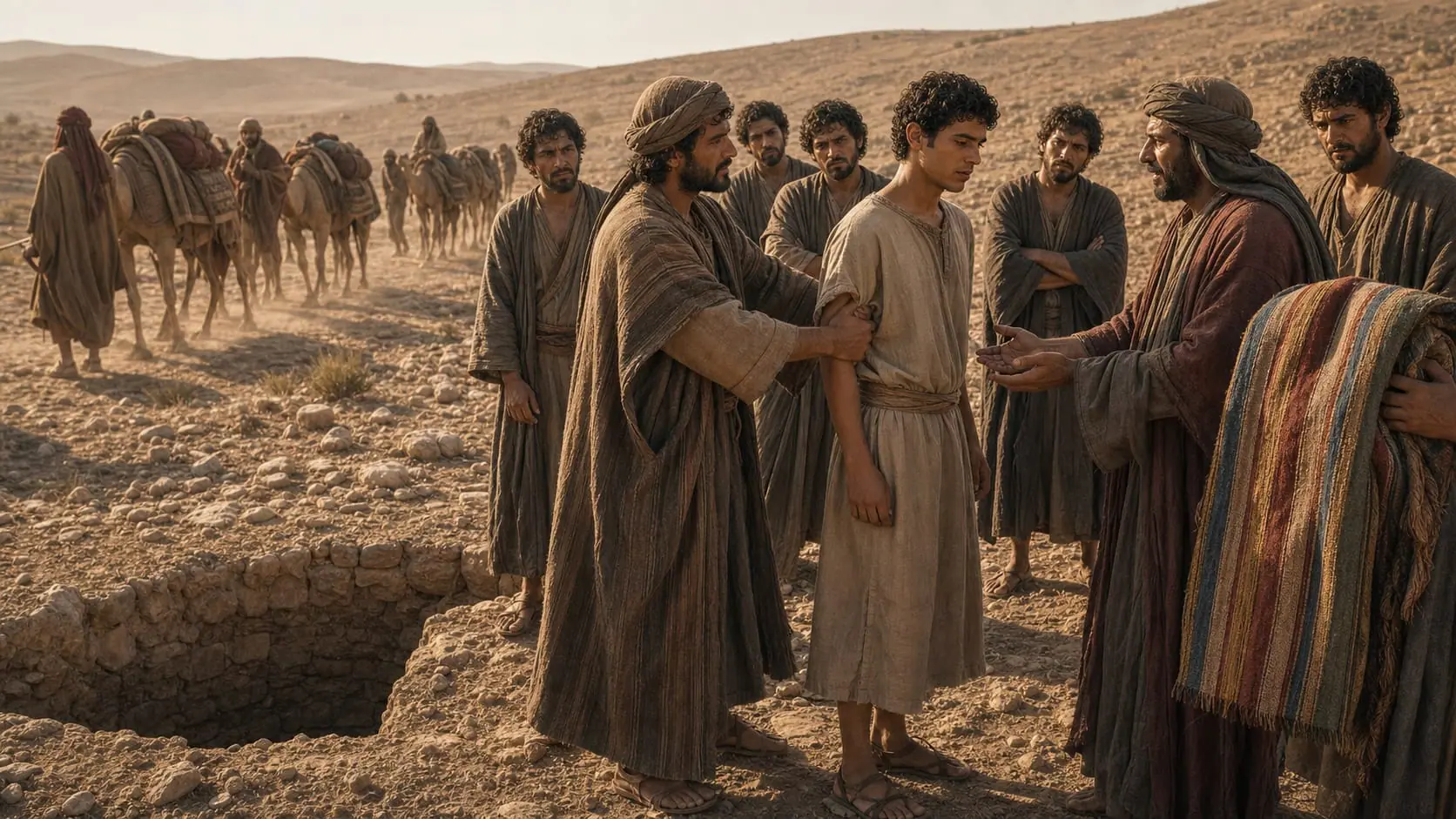
When the brothers plan to kill Joseph, Reuben tells them not to shed blood and suggests putting him in a pit. Genesis explains that Reuben intended to rescue Joseph and return him to Jacob. Yet Joseph is sold while Reuben is absent, and the text never explains where Reuben went.
“Let’s not take his life”
Reuben prevents the brothers’ first plan of direct murder.
Genesis 37:21–22He plans to return Joseph
The narrator, not merely Reuben, states the rescue he has in mind.
Genesis 37:22The pit is empty
Reuben returns, tears his clothes, and asks where he can go now that the boy is gone.
Genesis 37:29–30Where had Reuben gone?
Genesis says he returned to the pit, but does not explain where he had been or why he left.
Genesis 37:29–30Choices and consequences
What were Reuben’s characteristics?
Reuben speaks up when Joseph is in danger and later reminds the brothers of their guilt. But his concern for Joseph sits alongside the wrong he did to his father and his reckless pledge of his sons’ lives.
He resists killing Joseph
Reuben sees the danger, speaks against bloodshed, and devises a rescue plan.
Genesis 37:21–22He grieves and later recalls the warning
His torn clothes and later speech show that Joseph’s loss remains morally serious to him.
Genesis 37:29; 42:22He violates his father’s household
The Bilhah episode permanently reshapes Reuben’s place among the brothers.
Genesis 35:22; 49:3–4He offers the lives of two of his sons
Reuben tells Jacob to kill his two sons if he fails to bring Benjamin home. Jacob refuses to let Benjamin go. Judah later takes personal responsibility and offers to remain a slave in Benjamin’s place.
Genesis 42:37–38; 43:8–9; 44:32–34No personal lifespan is recorded
How old was Reuben, and how did he die?
The Bible gives no lifespan or individual death account for Reuben. Genesis names his four sons but not his wife. Acts 7:15–16 speaks collectively of the ancestors’ deaths in Egypt and burial at Shechem, without naming Reuben separately. Genesis 46:8–9; Exodus 1:6; Acts 7:15–16
Two final poems, two different notes
What blessings did Reuben receive?
Jacob’s words acknowledge Reuben’s original dignity but remove his preeminence. Moses later prays for the survival of Reuben’s tribal line.
Firstborn, might, and strength
Jacob begins by recognizing the rank and potential that belonged to Reuben.
Genesis 49:3“Boiling over like water”
The WEB uses this image; the KJV reads “Unstable as water.” Both lead into Jacob’s judgment that Reuben will not excel because he defiled his father’s bed.
Genesis 49:4, WEB and KJV“Let Reuben live, and not die”
The compact blessing asks for the continuation of Reuben and his people.
Deuteronomy 33:6Jacob remembers Bilhah
Jacob connects the water image to a specific act against his household, not to a medical diagnosis or a named personality type.
Genesis 49:4Later references to Reuben
Reuben in Revelation and the Testament of Reuben
Reuben’s tribe appears in Revelation
Reuben is not an active New Testament character, but his tribe is named among the sealed.
Revelation 7:5There is no Book of Reuben
Genesis records Reuben’s life, but no biblical book bears his name.
Not the same as the Testament of ReubenThe Testament of Reuben
This later work speaks in Reuben’s voice and belongs to the Testaments of the Twelve Patriarchs. It is not part of the Bible.
Later work, not ScriptureBenjamin, not Reuben
Paul names Benjamin as his tribe in his own letters.
Romans 11:1; Philippians 3:5Follow the people and passages
Reuben’s place in Joseph’s story
Reuben tries to rescue Joseph from the pit but returns to find him gone. Later, he speaks again when the brothers face danger in Egypt. Read Joseph’s story alongside Judah’s offer to protect Benjamin to compare their responses.
Joseph Bible Story
Read the pit, sale, journeys to Egypt, Benjamin test, and family reunion as one continuous story.
Read Joseph’s story →Reuben’s motherLeah in the Bible
Read Leah’s words at Reuben’s birth and follow her life with Jacob and Rachel.
Meet Leah →The brother he tried to saveJoseph in the Bible
Follow Joseph’s life in Egypt and meet the two sons who received Reuben’s birthright.
Meet Joseph →Reuben’s fatherJacob in the Bible
See how Reuben fits into Jacob’s family and read about the father who confronted his offense.
Meet Jacob →