%20scale(.87)'%3e%3cg%20transform='rotate(-3%2032%2034)'%3e%3cpath%20d='M10.5%2019.5c7.65-2.35%2014.8-.45%2021.5%205.7%206.7-6.15%2013.85-8.05%2021.5-5.7v27.2c-7.65-2.15-14.8-.45-21.5%205.1-6.7-5.55-13.85-7.25-21.5-5.1V19.5Z'%20fill='%23fff'%20stroke='%23171528'%20stroke-width='4.5'%20stroke-linejoin='round'/%3e%3cpath%20d='M32%2025.2v26.6'%20stroke='%23171528'%20stroke-width='4'%20stroke-linecap='round'/%3e%3cpath%20d='M17.5%2034.5h9M22%2030v9'%20stroke='%23171528'%20stroke-width='3.75'%20stroke-linecap='round'/%3e%3ccircle%20cx='41.5'%20cy='32.5'%20r='2.5'%20fill='%23171528'/%3e%3ccircle%20cx='46.5'%20cy='38'%20r='2.5'%20fill='%23171528'/%3e%3c/g%3e%3c/g%3e%3c/svg%3e)
The quick answer
Who was Ruth in the Bible?
Ruth was a Moabite woman who married into an Israelite family and was widowed. When Naomi returned to Bethlehem, Ruth chose to remain with her, embrace her people and God, and work to support them by gleaning. Boaz recognized Ruth’s loyalty, acted as a family redeemer, and married her. Their son Obed became the grandfather of King David, and Matthew includes Ruth in Jesus’ genealogy.
A Moabite widow who chose Naomi’s people and God
Ruth’s commitment begins before she meets Boaz. After her husband dies, Naomi urges both daughters-in-law to return to their mothers’ homes. Both initially want to go with her, and Naomi acknowledges their kindness. Orpah eventually kisses Naomi goodbye; Ruth insists on staying and promises to share Naomi’s people, God, home, and burial place. Ruth’s familiar words in chapter 1 are spoken to a mother-in-law, not to a romantic partner.
In Bethlehem, Ruth calls herself a foreigner and asks why Boaz has shown her favor. He says he has already heard what she has done for Naomi and how she has left her parents and homeland. The account continues to identify her as a Moabite while describing her welcome into Bethlehem’s community.
Ruth 1:8–18; 2:10–12 · Explore belonging and loyal love across the four chapters of Ruth →
Ruth acts for herself and for Naomi
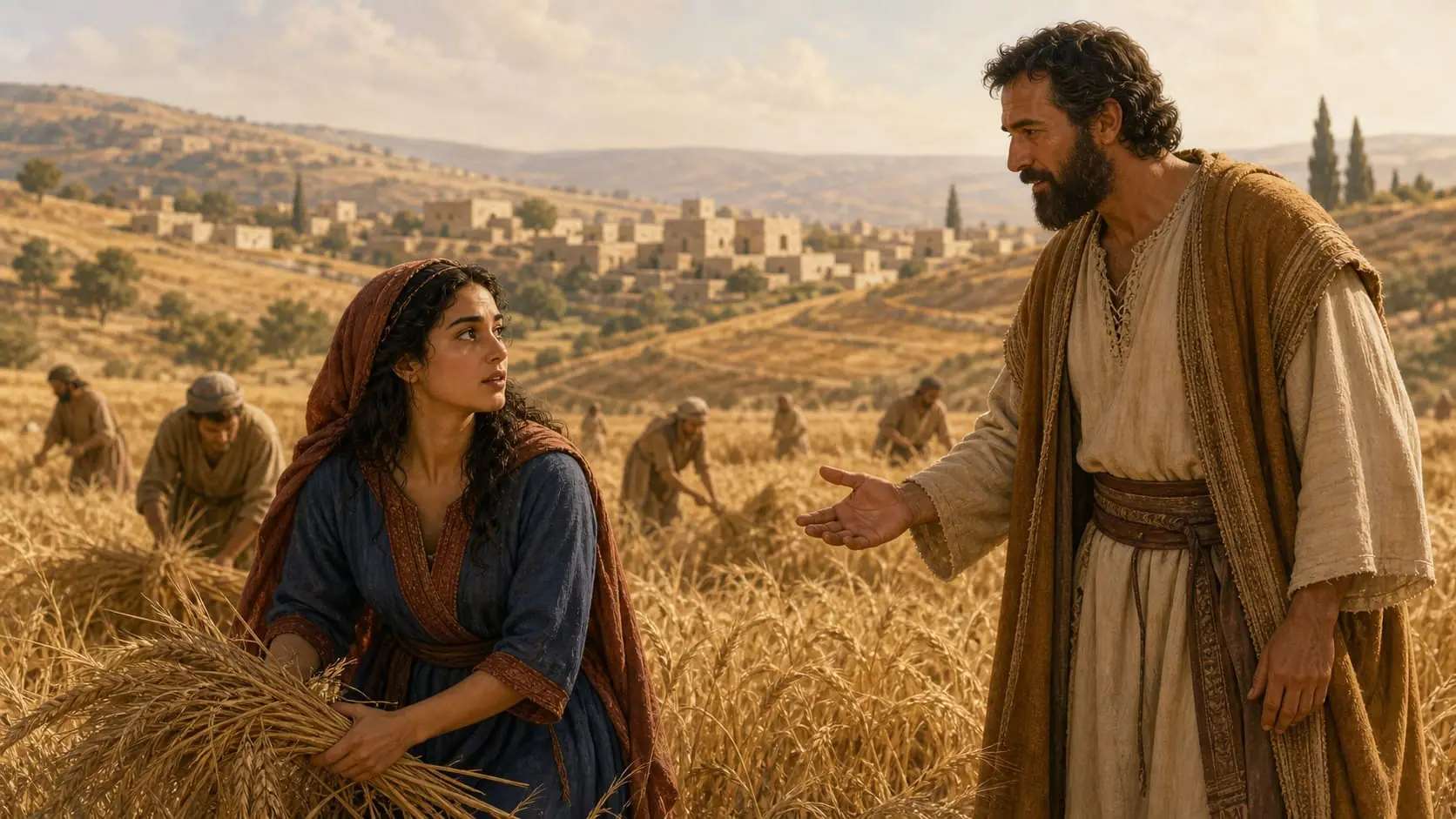
Ruth asks to go gleaning—gathering grain left by the harvesters—and brings grain and leftover food home to Naomi. Leviticus 19:9–10 and Deuteronomy 24:19 provide for poor people, foreigners, and widows through the harvest. Boaz also offers Ruth water and a meal, orders the young men not to touch her, and tells the workers to leave extra grain for her.
Later, Ruth follows Naomi’s instructions and asks Boaz to spread the corner of his garment over her because he is a near kinsman. Boaz is a relative of Naomi’s late husband Elimelech, not Mahlon’s brother. He is willing to act, but another relative has priority. In chapter 4, redeeming the property and marrying Ruth are joined in a transaction intended to preserve Mahlon’s name on his inheritance. This is related to family-preservation laws, but it is not the same situation as a surviving brother’s duty in Deuteronomy 25:5–10.
Ruth 4 identifies Mahlon as her first husband and Obed as her son by Boaz. Obed becomes Jesse’s father and David’s grandfather, making Ruth David’s great-grandmother. When the neighbors speak of a son born to Naomi, Ruth remains the child’s mother; Naomi takes him into her care.
Ruth 2:1–18; 3:9–13; 4:9–17; Leviticus 19:9–10; Deuteronomy 24:19; 25:5–10 · Follow Ruth and Boaz from the harvest field to the city gate →
The name Ruth
What does the name Ruth mean?
The Book of Ruth does not explain her name. Strong’s Hebrew entry 7327 gives “friend” as a probable derivation, while Brown–Driver–Briggs connects it with “friendship.” These are lexical explanations, not a meaning supplied by the biblical narrator; the derivation is not certain.
The life arc in Scripture
Ruth’s life in brief
Ruth 1:4–18; 4:10
Mahlon’s widow chooses to remain with Naomi
Ruth 2:2, 17–18; 3:9
She works and speaks for the household’s future
Ruth 4:13–22; Matthew 1:5
Ruth becomes Obed’s mother and David’s ancestor
Family and companions
Ruth’s family and relationships
Ruth first marries Mahlon, Naomi and Elimelech’s son, and later marries Boaz. Orpah is her sister-in-law through the two brothers. Ruth 2:11 mentions her own father and mother, whom she left in Moab, but does not name them.
Naomi
Ruth travels with her to Bethlehem, shares food with her, and later follows her advice about Boaz.
Mahlon
Naomi’s son dies in Moab, leaving Ruth widowed before the return to Judah.
Boaz
A relative of Elimelech who protects Ruth, redeems family property, and marries her.
Obed
He becomes father of Jesse and grandfather of David.
Orpah
Chilion’s widow initially wants to go with Naomi too. After Naomi urges both women to return home, Orpah kisses her goodbye; Ruth stays (Ruth 1:4–15; 4:10).
Not named
Boaz says Ruth left her father, mother, and homeland. The book gives no further account of her parents (Ruth 2:11).
What the text says—and does not say
Common questions about Ruth
Ruth was a Moabite woman
Her foreign identity is repeated throughout the book even after she joins Naomi in Bethlehem.
Ruth 1:4, 22; 2:2, 21; 4:5, 10Mahlon was Ruth’s first husband
Ruth 4 identifies the deceased husband connected with Ruth and the redeemed family property.
Ruth 4:10Ruth’s parents are not named
Boaz explicitly mentions her father and mother, but the book does not give their names or identify any siblings.
Ruth 2:11Ruth’s age and death are unknown
The narrative calls Ruth a young woman but gives no number for her age, later lifespan, death, or burial.
Ruth 2:5; 3:10–11Follow the biblical accounts