%20scale(.87)'%3e%3cg%20transform='rotate(-3%2032%2034)'%3e%3cpath%20d='M10.5%2019.5c7.65-2.35%2014.8-.45%2021.5%205.7%206.7-6.15%2013.85-8.05%2021.5-5.7v27.2c-7.65-2.15-14.8-.45-21.5%205.1-6.7-5.55-13.85-7.25-21.5-5.1V19.5Z'%20fill='%23fff'%20stroke='%23171528'%20stroke-width='4.5'%20stroke-linejoin='round'/%3e%3cpath%20d='M32%2025.2v26.6'%20stroke='%23171528'%20stroke-width='4'%20stroke-linecap='round'/%3e%3cpath%20d='M17.5%2034.5h9M22%2030v9'%20stroke='%23171528'%20stroke-width='3.75'%20stroke-linecap='round'/%3e%3ccircle%20cx='41.5'%20cy='32.5'%20r='2.5'%20fill='%23171528'/%3e%3ccircle%20cx='46.5'%20cy='38'%20r='2.5'%20fill='%23171528'/%3e%3c/g%3e%3c/g%3e%3c/svg%3e)
The quick answer
What happened in the Ruth and Boaz Bible story?
After Ruth and her mother-in-law Naomi both lost their husbands, Ruth left Moab to accompany Naomi to Bethlehem. To provide food, Ruth gleaned leftover grain in a field belonging to Boaz, a relative of Naomi’s late husband. Boaz already knew of Ruth’s loyalty to Naomi. He offered her protection, food, and extra grain.
At Naomi’s direction, Ruth asked Boaz to act as a near kinsman. Boaz was willing but first honored the claim of a closer relative. When that man declined, Boaz publicly redeemed the family property and married Ruth. Their son Obed became the grandfather of King David.
The story
Ruth 1–4: Loss, Loyalty, and Redemption
Naomi’s family leaves Bethlehem for Moab
During the time of the judges, famine struck the land. Elimelech left Bethlehem with his wife Naomi and their two sons, Mahlon and Chilion, and settled in Moab. Elimelech died, and the two sons married Moabite women named Orpah and Ruth.
The family lived in Moab for about ten years, and Mahlon and Chilion also died. Naomi was left without her husband and sons. When she heard that Yahweh had given food to his people in Judah, she began the journey back to Bethlehem. The book does not explain what caused these deaths. Ruth 1:1–7
Ruth refuses to leave Naomi
Naomi urged both daughters-in-law to return to their mothers’ homes and prayed that they would find rest in new marriages. Both women wept and initially wanted to go with her. After Naomi urged them again, Orpah kissed her goodbye and returned. Ruth stayed. Naomi had praised both women’s kindness; Orpah’s departure followed Naomi’s own advice.
This declaration is sometimes used at weddings, yet its first setting is not romantic marriage. It is a widowed daughter-in-law making a costly promise of loyalty to another widow. Ruth 1:8–18
Ruth said, “Don’t urge me to leave you, and to return from following you, for where you go, I will go; and where you stay, I will stay. Your people will be my people, and your God my God. Where you die, I will die, and there I will be buried. May Yahweh do so to me, and more also, if anything but death parts you and me.”
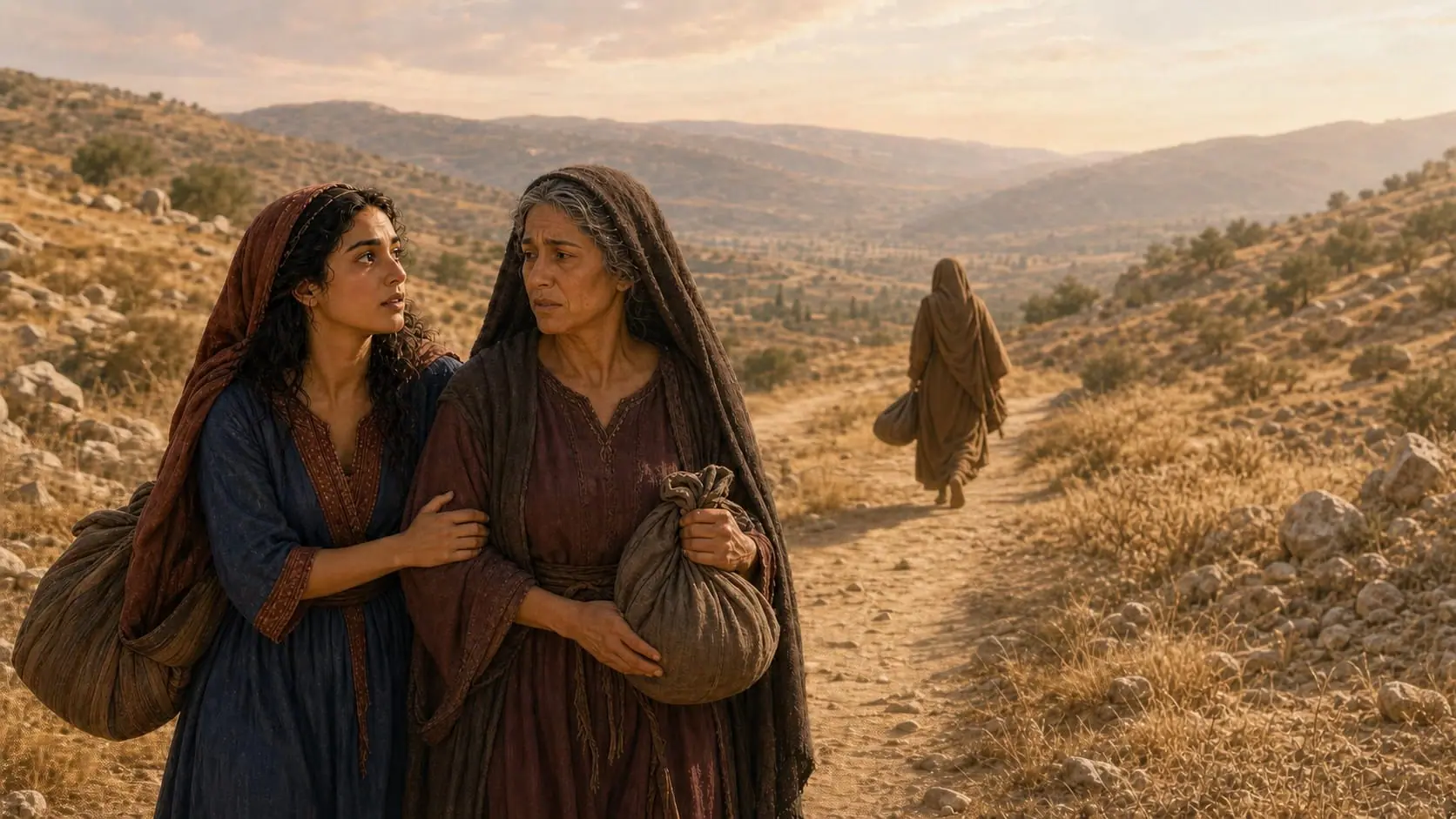
Ruth and Naomi arrive at the barley harvest
The two women reached Bethlehem at the beginning of the barley harvest. The city stirred at Naomi’s return. She asked the women to call her Mara, a name she associated with bitterness, because she believed the Almighty had afflicted her. She described herself as going away full and returning empty.
Ruth was there beside her. Naomi’s words express her grief; they are not a statement that she had returned alone. The narrator continues to call her Naomi and identifies her companion as Ruth the Moabite. Ruth 1:19–22
Ruth gleans in the field of Boaz
Ruth asked Naomi’s permission to go gleaning, then asked to gather grain behind the reapers. Gleaning meant collecting what remained after the harvesters. Leviticus 19:9–10 required owners to leave field edges and gleanings for the poor and foreigners; Deuteronomy 24:19–22 also protected provision for widows and the fatherless.
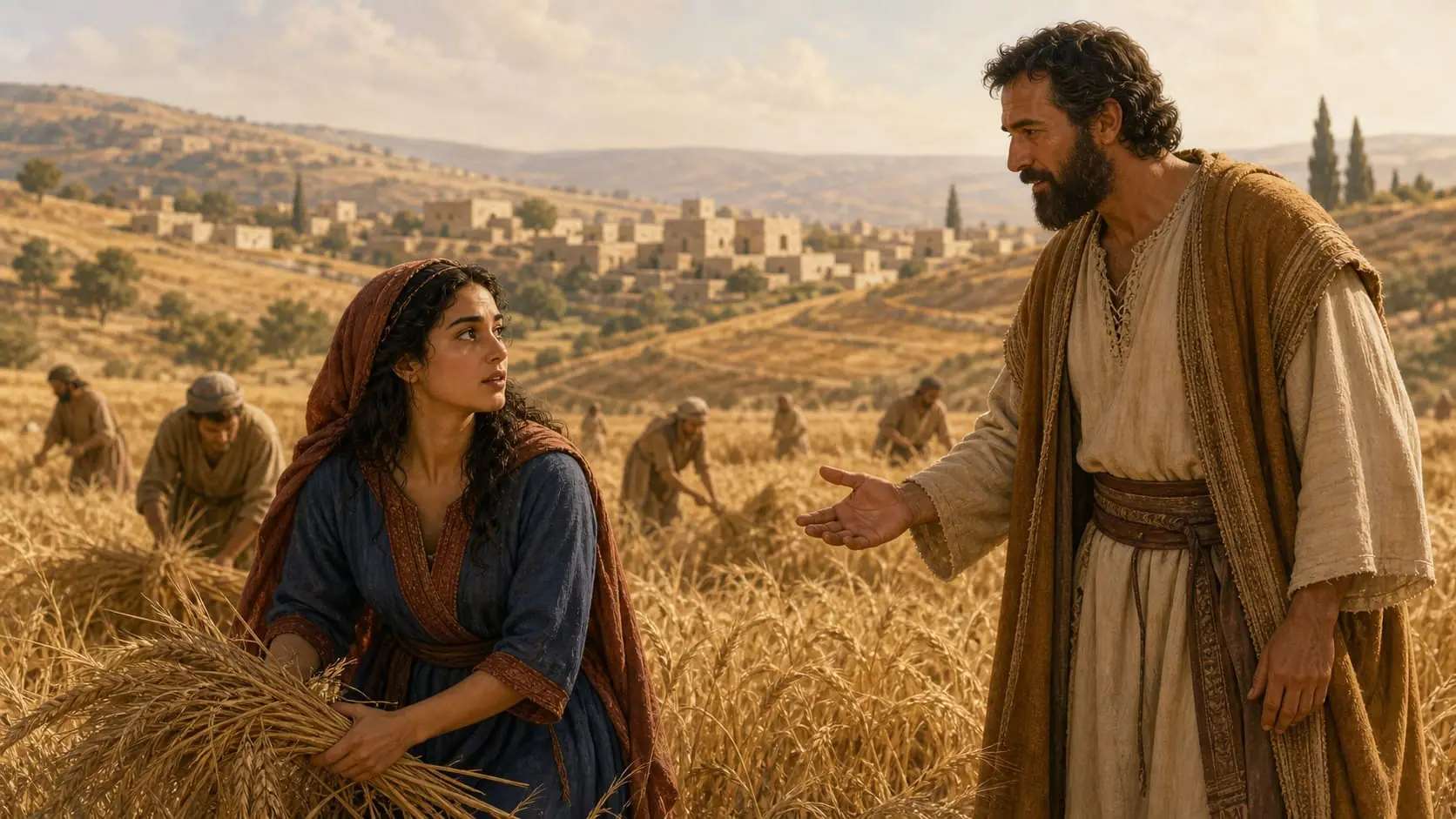
Ruth happened to enter a field belonging to Boaz, a prosperous relative from Elimelech’s family. The supervisor described her work since morning, with a short rest. When Boaz spoke to Ruth, he told her he had already heard how she had left her homeland and cared for Naomi. Ruth 2:1–11
Boaz gives Ruth protection, food, and extra grain
Boaz told Ruth to stay close to the women working in his field. He commanded the young men not to touch her and gave her access to their water. At mealtime he invited her to eat with the workers, and afterward instructed the harvesters to pull out extra grain for her without shaming her.
Ruth asked why he noticed her even though she was a foreigner. Boaz answered by honoring her loyalty and describing her as someone who had taken refuge under the wings of Israel’s God. Ruth 2:8–16
Boaz answered her, “I have been told all about what you have done for your mother-in-law since the death of your husband, and how you have left your father, your mother, and the land of your birth, and have come to a people that you didn’t know before. May Yahweh repay your work, and a full reward be given to you from Yahweh, the God of Israel, under whose wings you have come to take refuge.”
Naomi recognizes a near kinsman
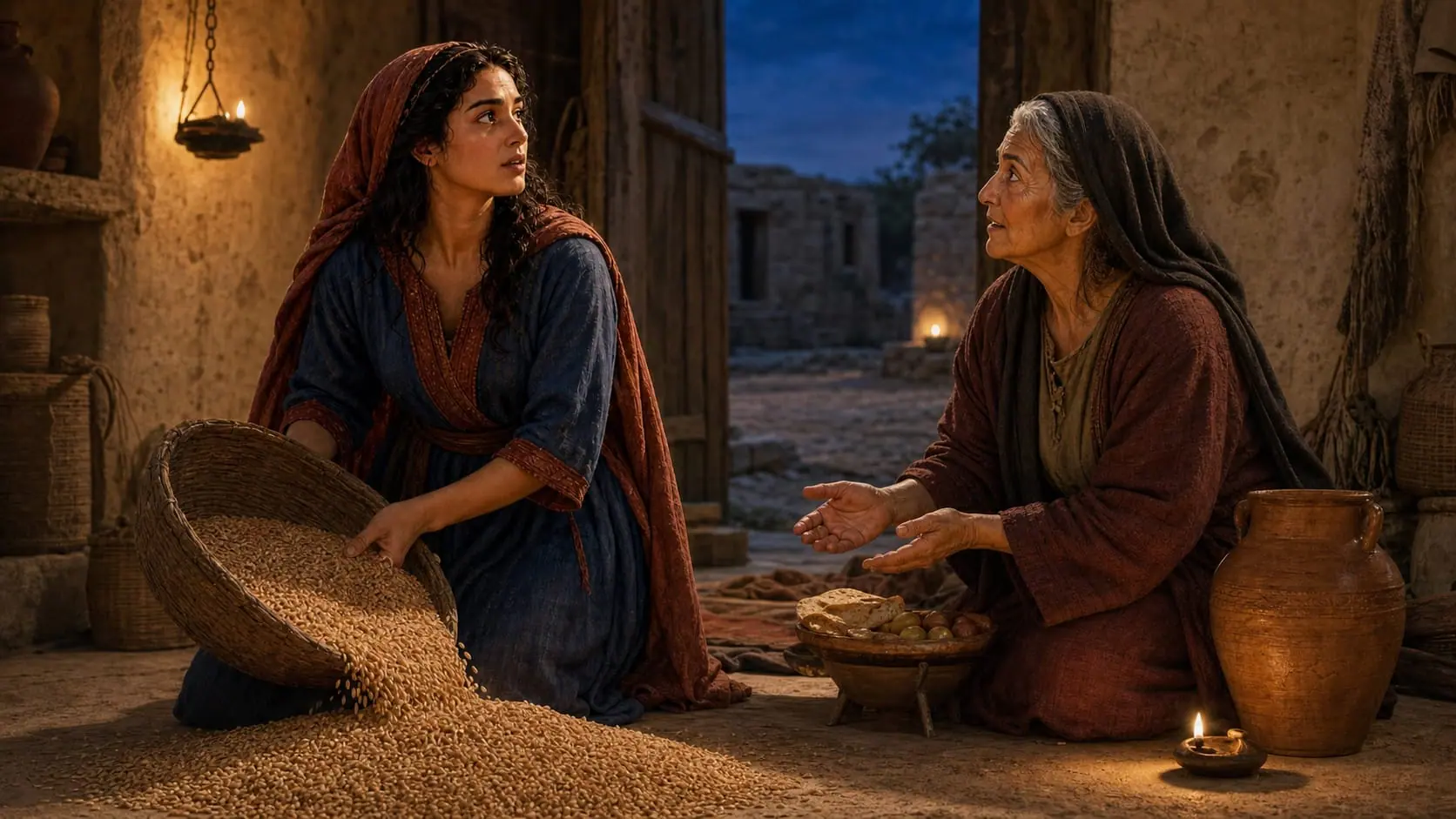
Ruth gleaned until evening and beat out about an ephah of barley. She brought it home and gave Naomi the food left from her meal. When Ruth named the field’s owner, Naomi recognized Boaz as one of their near kinsmen, a relative who could help redeem family property.
Naomi blessed the kindness shown to both the living and the dead. Ruth continued gleaning safely through the barley and wheat harvests while living with her mother-in-law. Ruth 2:17–23
Ruth asks Boaz to spread his garment over her
Naomi wanted Ruth to find a secure home. She told Ruth to wash, anoint herself, get dressed, and go to the threshing floor where Boaz would winnow barley that night. Ruth was to wait until he had eaten, drunk, and lain down, then uncover his feet and lie there. She followed Naomi’s instructions. At midnight Boaz was startled, turned, and found a woman at his feet.
Ruth identified herself and asked him to spread the corner of his garment over her because he was a near kinsman. In the context of Naomi’s plan and the later marriage, this is a request for family protection and marriage. Boaz praised her kindness in not pursuing younger men and called her a worthy woman. He was willing to act as redeemer, but said another relative had the prior right. Ruth 3:1–13
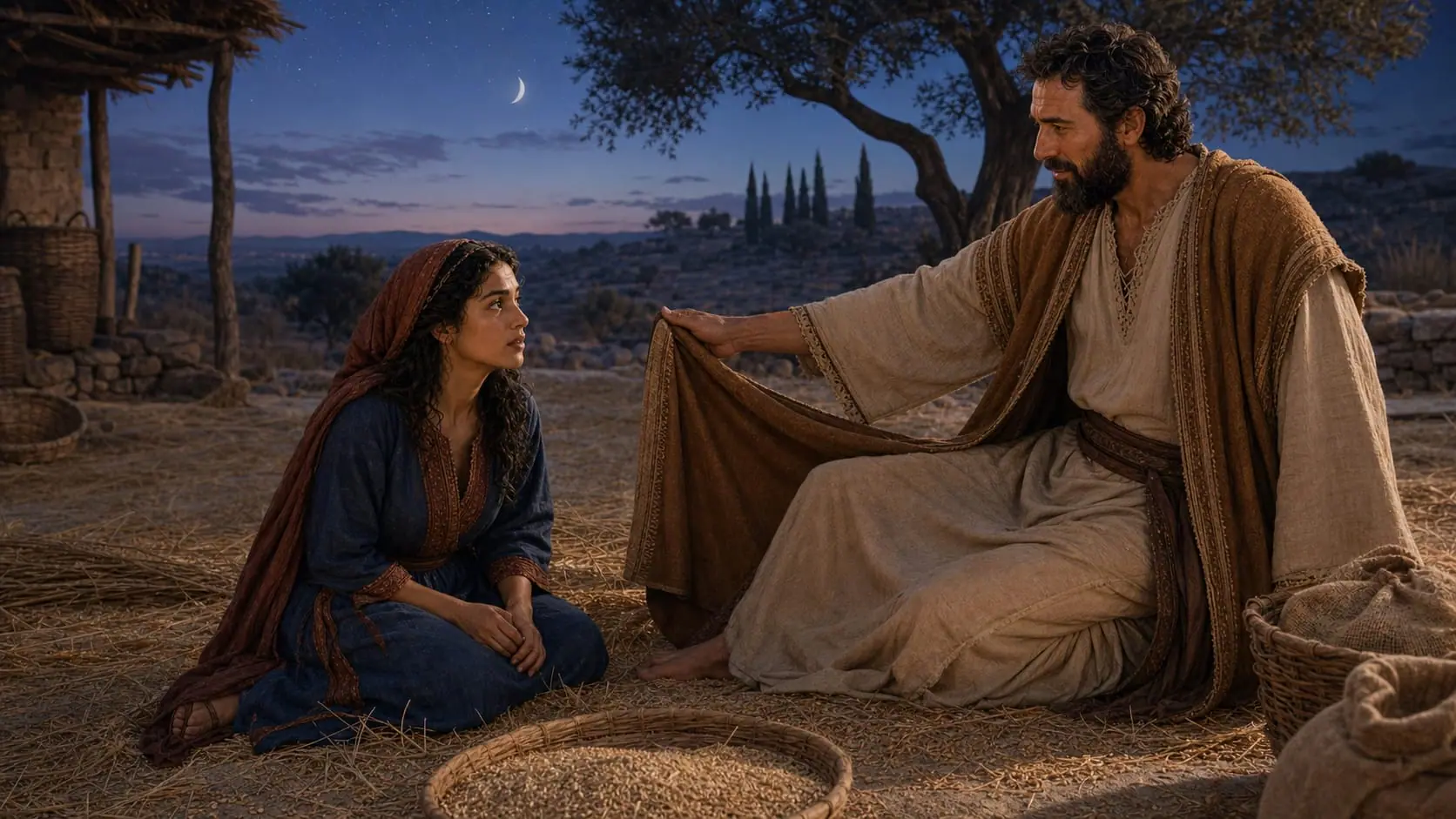
Now, my daughter, don’t be afraid. I will do to you all that you say; for all the city of my people knows that you are a worthy woman.
Boaz protects Ruth’s reputation
Ruth remained at Boaz’s feet until early morning and rose before people could recognize one another. Boaz said her visit should not be made known and gave her six measures of barley so she would not return to Naomi empty-handed. The unit for these six measures is not named.
The narrative does not explicitly describe sexual intercourse that night; it does so after their marriage in Ruth 4:13. When Ruth returned and told Naomi what had happened, Naomi told her to wait. It was Naomi who said Boaz would not rest until he had settled the matter that day. Ruth 3:14–18; 4:13
The nearer relative declines at the city gate
Boaz went to Bethlehem’s gate, where public business was conducted, and gathered ten elders. He first offered the nearer relative the opportunity to redeem Elimelech’s land. The man agreed until Boaz explained that the matter also involved Ruth and preserving the name of the deceased with his inheritance.
Concerned about endangering his own inheritance, the nearer relative transferred his right to Boaz. In the custom described by the narrator, he removed his sandal to confirm the transaction before the witnesses. Ruth 4:1–8

Boaz marries Ruth, and Obed is born
Boaz declared before the elders that he had bought the property of Elimelech, Chilion, and Mahlon from Naomi and acquired Ruth as his wife to preserve her late husband Mahlon’s name with his inheritance. The witnesses blessed Ruth by invoking Rachel and Leah, and blessed the household with reference to Perez, the son Tamar bore to Judah.
Ruth became Boaz’s wife. The account says Yahweh enabled her to conceive, and she bore a son. Naomi held the child and cared for him. The neighboring women named him Obed and celebrated his place in Naomi’s household; they were not identifying Naomi as his biological mother. The book ends with a genealogy from Perez to David: Obed became Jesse’s father and David’s grandfather. Ruth 4:9–22
The women, her neighbors, gave him a name, saying, “A son is born to Naomi”. They named him Obed. He is the father of Jesse, the father of David.
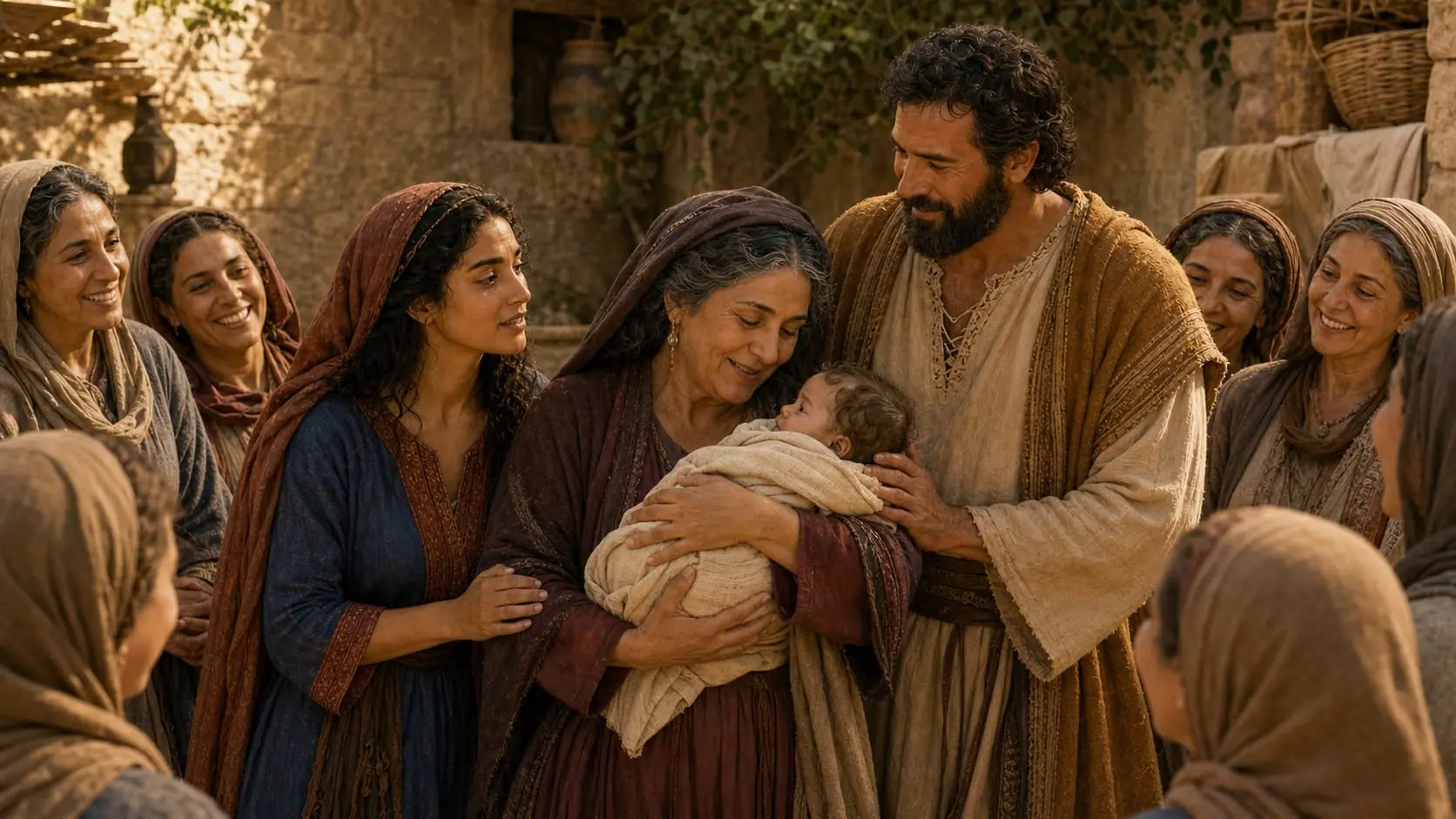
From loss to a restored household
Why does Ruth’s story end with a genealogy?
The closing names carry the reader beyond the harvest and the marriage: Obed becomes the father of Jesse, and Jesse the father of David. Ruth is therefore David’s great-grandmother. Matthew 1:5–16 later includes Ruth and Boaz in the genealogy leading to Joseph, Mary’s husband, and identifies Mary as the mother of Jesus. Ruth 4:17–22; Matthew 1:5–16
For the four-chapter outline, setting, literary themes, and a reading plan, explore the Book of Ruth guide.
The legal and family setting
What Is a Kinsman-Redeemer?
A kinsman-redeemer was a relative who could act to recover family property. Leviticus 25:25 provides for a near relative to redeem land sold because of poverty. Ruth 4 brings property redemption together with marriage and preserving the deceased husband’s name. Boaz does not bypass the nearer relative: he presents the matter publicly and acts after that man declines.
This also resembles the concern behind Deuteronomy 25:5–10, where a surviving brother is to marry his childless brother’s widow. The situations are not identical. Boaz is a relative of Elimelech, not Mahlon’s brother. In Ruth 4, the man removes his own sandal to confirm a transaction; Ruth does not remove it and spit in his face as in Deuteronomy’s refusal procedure. The story should not be read as a rule requiring every male relative to marry a widow.
More than romance
Is the story of Ruth and Boaz a love story?
Marriage is part of the story, and Boaz openly admires Ruth’s character. But her best-known pledge, “where you go, I will go,” is addressed to Naomi, not Boaz. The book follows a widowed household’s need for food, protection, and a future, rather than describing a modern courtship.
Neither Ruth’s nor Boaz’s exact age is given. His address “my daughter” and mention of younger men suggest an age difference, but do not establish its size (Ruth 3:10). Their marriage is a particular outcome in this story, not a promise that every faithful person will marry or have a child.
How are Naomi, Mahlon, Obed, and David connected to Ruth? Explore her family relationships in Ruth in the Bible. To review people from other biblical accounts, try the Bible Characters Quiz; the five questions below focus just on this story.