%20scale(.87)'%3e%3cg%20transform='rotate(-3%2032%2034)'%3e%3cpath%20d='M10.5%2019.5c7.65-2.35%2014.8-.45%2021.5%205.7%206.7-6.15%2013.85-8.05%2021.5-5.7v27.2c-7.65-2.15-14.8-.45-21.5%205.1-6.7-5.55-13.85-7.25-21.5-5.1V19.5Z'%20fill='%23fff'%20stroke='%23171528'%20stroke-width='4.5'%20stroke-linejoin='round'/%3e%3cpath%20d='M32%2025.2v26.6'%20stroke='%23171528'%20stroke-width='4'%20stroke-linecap='round'/%3e%3cpath%20d='M17.5%2034.5h9M22%2030v9'%20stroke='%23171528'%20stroke-width='3.75'%20stroke-linecap='round'/%3e%3ccircle%20cx='41.5'%20cy='32.5'%20r='2.5'%20fill='%23171528'/%3e%3ccircle%20cx='46.5'%20cy='38'%20r='2.5'%20fill='%23171528'/%3e%3c/g%3e%3c/g%3e%3c/svg%3e)
The quick answer
What is the Book of Ruth about?
The Book of Ruth follows two widows, Naomi and her Moabite daughter-in-law Ruth, from Moab to Bethlehem. Ruth gathers leftover grain in Boaz’s field to feed them. Boaz, a relative of Naomi’s late husband Elimelech, later redeems family property and marries Ruth after a nearer relative declines. Their son Obed becomes the grandfather of David. Across four chapters, the book connects their need for food and family with loyalty, God’s care, and the ancestry of Israel’s king.
Literary and historical setting
How the Book of Ruth fits into the Bible
Ruth 1:1 places the events during the time of the judges, before Israel’s monarchy. A famine sends Elimelech, Naomi, and their two sons from Bethlehem to Moab. Elimelech dies; Mahlon and Chilion marry Moabite women, Ruth and Orpah, and later die too. The book does not explain the cause of these deaths or name the judge who was ruling.
The setting is not the same as the date of writing. The book does not name its author or give a date of composition. Ruth 4:7 explains an earlier sandal custom, and the closing genealogy ends with David. The Babylonian Talmud, Bava Batra 14b:12, attributes Ruth to Samuel; that is a later Jewish tradition, not a claim made within Ruth itself.
Harvest laws help explain Ruth’s work. Leviticus 19:9–10 tells landowners to leave field edges and gleanings for poor people and foreigners; Deuteronomy 24:19 also names widows and orphans. Ruth gathers behind the harvesters rather than owning the field. Boaz’s instructions to leave extra grain, his invitation to eat, and his protection of Ruth make his help concrete.
Summary by chapter
Book of Ruth outline
Loss, loyalty, and return to Bethlehem
After losing her husband and sons, Naomi hears that the Lord has provided food for his people and sets out for Judah. She urges both daughters-in-law to return to their mothers’ homes. Orpah tearfully parts from her; Ruth stays and pledges herself to Naomi’s people and God. They reach Bethlehem as the barley harvest begins. Naomi speaks of coming home empty because of her losses, even though Ruth is beside her.
Ruth gleans in the field of Boaz
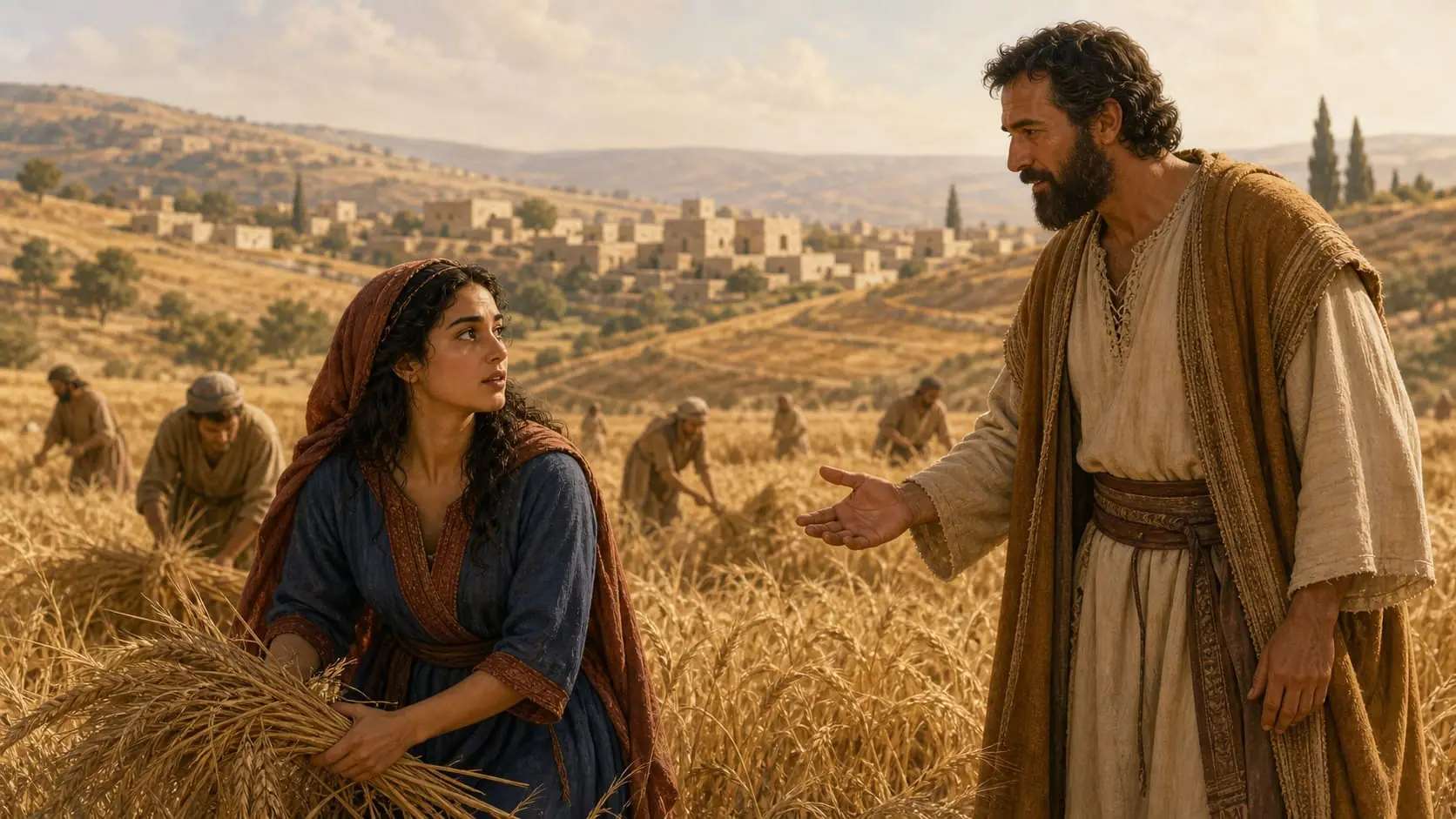
Ruth happens to glean in Boaz’s field. He has already heard about her care for Naomi and the parents and homeland she left. He gives her access to water, shares a meal, orders the young men not to touch her, and tells the workers to leave extra grain. Ruth takes grain and leftover food to Naomi. She continues gleaning through the barley and wheat harvests.
A request at the threshing floor
Following Naomi’s instructions, Ruth goes to the threshing floor, uncovers Boaz’s feet, and lies down. When he wakes, she asks him to spread his garment over her because he is a near kinsman. He praises her kindness and agrees to act if the nearer relative will not. She leaves before people can recognize one another, with six measures of barley; the unit is not specified. Naomi tells her to wait for the matter to be settled.
Redemption at the gate and the birth of Obed
Before ten elders and other witnesses, the nearer relative declines the redemption after Boaz explains that it includes Ruth and preserving her late husband’s name. Boaz announces the purchase of the family property and his agreement to marry Ruth. They marry, and the Lord enables Ruth to conceive. Their son is named Obed. Naomi cares for him, and the book ends with the family line from Perez to David.
Themes to look for
Main themes in the Book of Ruth
Kindness and loyalty
Naomi acknowledges both daughters-in-law’s kindness before Orpah leaves. Ruth stays with Naomi, and Boaz later praises Ruth’s kindness. These acts give substance to the Hebrew word hesed, expressed as dealing kindly or showing kindness in English.
Ruth 1:8; 3:10Food, work, and God’s care
Naomi hears that the Lord has provided food; Ruth then gathers grain and shares what she has. Later, the narrator explicitly says that the Lord enables Ruth to conceive. The book speaks of God’s action as well as human help.
Ruth 1:6; 2:14–18; 4:13Property, marriage, and a family name
The redemption joins family property with marriage to Ruth and preserving Mahlon’s name. Leviticus 25:25 provides background for a relative redeeming land. Deuteronomy 25:5–10 concerns a surviving brother’s marriage duty; Boaz is a relative of Elimelech, not Mahlon’s brother. Ruth 4 describes its own public transaction and sandal custom, not an identical ceremony.
Ruth 2:1; 4:1–10; Leviticus 25:25; Deuteronomy 25:5–10A Moabite in David’s family
Ruth calls herself a foreigner, yet Boaz recognizes her care for Naomi and her refuge under Israel’s God. Her son Obed becomes Jesse’s father and David’s grandfather. Her Moabite origin remains part of the story.
Ruth 1:22; 2:10–12; 4:13–22People in the book
Key characters in Ruth
Ruth
Mahlon’s Moabite widow, who stays with Naomi, gleans in Bethlehem, and later marries Boaz.
Naomi
Elimelech’s widow and Mahlon and Chilion’s mother. She returns to Bethlehem with Ruth and later cares for Obed.
Boaz
A wealthy relative of Elimelech. He protects Ruth in his field, redeems the family property, and marries her.
Orpah
Naomi’s other Moabite daughter-in-law. She initially wants to accompany Naomi but returns home after Naomi urges both women to do so.
The nearer relative
An unnamed man with priority over Boaz. He first agrees to redeem the land, then declines because he fears harming his own inheritance.
Obed
The son of Ruth and Boaz, father of Jesse, and grandfather of David.
Meaning and application
Why does the Book of Ruth matter?
The opening losses are not treated as trivial. Naomi speaks bitterly about them, and Ruth must ask permission to gather food. The later wedding and birth bring joy to this household without explaining why the earlier deaths happened. This is not a promise that every faithful widow will remarry or every grieving family will have a child.
The genealogy takes the reader beyond the household: Ruth becomes David’s great-grandmother. Christian readers also meet her in Matthew 1:5–6. Matthew traces that line through David to Joseph, whom he calls Mary’s husband in 1:16, rather than Jesus’ biological father. Ruth’s place in the book is therefore about family, belonging, and the history leading to David—not only romance.
A short reading plan
How to read the Book of Ruth
- Day 1
Read Ruth 1
Compare Naomi’s advice with Orpah’s and Ruth’s responses. What has Naomi lost, and who is still beside her when she reaches Bethlehem?
- Day 2
Read Ruth 2
List what Ruth does and what Boaz provides. Read Leviticus 19:9–10 and Deuteronomy 24:19 alongside the harvest scene.
- Day 3
Read Ruth 3
Distinguish Naomi’s instructions, Ruth’s request, and Boaz’s promise. Why must Ruth wait for the nearer relative’s decision?
- Day 4
Read Ruth 4
Follow the witnesses, the sandal exchange, and the marriage agreement. Trace Obed → Jesse → David, then compare Matthew 1:5–6, 16.
Check the sources
Scripture and further references
Read Ruth 1–4 in the World English Bible
Harvest provision: Leviticus 19:9–10 and Deuteronomy 24:19–22
Compare the family laws: Leviticus 25:25 and Deuteronomy 25:5–10
Ruth in Matthew’s genealogy: Matthew 1:5–6, 16
Later authorship tradition: Babylonian Talmud, Bava Batra 14b:12
Direct answers
Book of Ruth FAQ
What is the main message of the Book of Ruth?
Ruth shows kindness and loyalty through particular actions: staying with a bereaved relative, sharing food, protecting a foreign widow, and preserving a family name. It also speaks of the Lord’s care and ends by connecting Ruth and Boaz’s son with David’s ancestry. It does not promise every reader the same marriage or family outcome.
Who wrote the Book of Ruth?
The book does not identify its author. The later Jewish tradition recorded in the Babylonian Talmud, Bava Batra 14b:12, attributes it to Samuel. That attribution is not stated in Ruth itself.
When was the Book of Ruth written?
No exact composition date is given. Ruth 1:1 places the events in the time of the judges, while 4:7 explains a former custom and 4:17–22 connects the family with David. The time in which the story is set should not be treated as a stated date of writing.
How many chapters are in Ruth?
Ruth has four chapters: the journey to Bethlehem, gleaning in Boaz’s field, the threshing-floor request, and the redemption and birth of Obed.
Was Ruth an Israelite?
Ruth was Moabite by origin. In Ruth 1:16 she commits herself to Naomi’s people and God, and the book later places her in David’s family. Her Moabite origin is still explicitly named in Ruth 4:10; origin and commitment are different parts of her identity.
Who was the kinsman-redeemer?
Boaz acted as redeemer after the nearer relative declined. Ruth 4 connects the land transaction with marriage to Ruth and preserving Mahlon’s name. Boaz is a relative of Elimelech, not Mahlon’s brother, so the scene is not an exact instance of the brother-in-law marriage law in Deuteronomy 25:5–10.
Was Obed Naomi’s son?
Ruth and Boaz are Obed’s parents (Ruth 4:13, 17). Naomi takes him into her care. The neighbors’ words about a son born to Naomi celebrate the child’s place in her family; they do not make Naomi his biological mother.