%20scale(.87)'%3e%3cg%20transform='rotate(-3%2032%2034)'%3e%3cpath%20d='M10.5%2019.5c7.65-2.35%2014.8-.45%2021.5%205.7%206.7-6.15%2013.85-8.05%2021.5-5.7v27.2c-7.65-2.15-14.8-.45-21.5%205.1-6.7-5.55-13.85-7.25-21.5-5.1V19.5Z'%20fill='%23fff'%20stroke='%23171528'%20stroke-width='4.5'%20stroke-linejoin='round'/%3e%3cpath%20d='M32%2025.2v26.6'%20stroke='%23171528'%20stroke-width='4'%20stroke-linecap='round'/%3e%3cpath%20d='M17.5%2034.5h9M22%2030v9'%20stroke='%23171528'%20stroke-width='3.75'%20stroke-linecap='round'/%3e%3ccircle%20cx='41.5'%20cy='32.5'%20r='2.5'%20fill='%23171528'/%3e%3ccircle%20cx='46.5'%20cy='38'%20r='2.5'%20fill='%23171528'/%3e%3c/g%3e%3c/g%3e%3c/svg%3e)

The quick answer
What is the story of Adam and Eve?
Genesis describes Adam and Eve as the first man and woman in its account of human beginnings. God placed Adam in the Garden of Eden to cultivate and care for it, gave him permission to eat from the garden’s trees, and set one boundary: he was not to eat from the tree of the knowledge of good and evil. God then made Eve as Adam’s corresponding partner.
A serpent questioned God’s command and told Eve that eating the forbidden fruit would open their eyes. Eve ate and gave some to Adam, who also ate. They became aware of their nakedness, hid, and tried to shift blame when God confronted them. The narrative describes judgment, changed relationships, hard labor, mortality, clothing provided by God, and their departure from Eden.
The full story
Adam and Eve in the Garden of Eden
God creates Adam and places him in Eden
Genesis 2 pictures God forming the man from the dust of the ground and breathing into him the breath of life. God planted a garden in Eden, where trees grew that were pleasing to see and good for food. A river flowed from Eden, and Adam was placed in the garden “to cultivate and keep it.”
Adam could freely eat from the garden’s trees except one: the tree of the knowledge of good and evil. God warned him that eating from it would bring death. Genesis 2:7–17
Yahweh God formed man from the dust of the ground, and breathed into his nostrils the breath of life; and man became a living soul.
Eve is created as Adam’s partner
God said it was not good for the man to be alone. After Adam named the animals, no corresponding partner had been found among them. God caused him to fall into a deep sleep and made a woman from one of his ribs, as the World English Bible translates it. Adam recognized her as “bone of my bones, and flesh of my flesh.” Genesis closes the scene with the couple together, naked and unashamed. Genesis 2:18–25
Yahweh God made a woman from the rib which he had taken from the man, and brought her to the man. The man said, ‘This is now bone of my bones, and flesh of my flesh. She will be called “woman,” because she was taken out of Man.’

The serpent questions God’s command
Genesis 3 introduces the serpent as more subtle than the other animals. It began by questioning what God had said, then told Eve that they would not die and that the fruit would make the couple like God, knowing good and evil.
Eve saw that the tree appeared good for food, pleasing to the eyes, and desirable for gaining wisdom. She took its fruit and ate. She also gave some to Adam, who was with her, and he ate. Genesis never identifies the fruit as an apple. Genesis 3:1–6
When the woman saw that the tree was good for food, and that it was a delight to the eyes, and that the tree was to be desired to make one wise, she took some of its fruit, and ate. Then she gave some to her husband with her, and he ate it, too.
The forbidden tree
What Was the Tree of the Knowledge of Good and Evil?
Genesis names the tree of the knowledge of good and evil alongside the tree of life in the middle of Eden. God allowed Adam to eat from the garden’s other trees but commanded him not to eat from this one, warning that disobedience would bring death. Genesis 2:9, 2:16–17
The Bible does not identify the tree’s species or its fruit. Eve saw it as desirable for gaining wisdom. Genesis 3:22 later describes the humans as knowing good and evil, but that knowledge did not remove the consequences of disobeying God.
After Adam and Eve ate, their eyes were opened, but the immediate result was awareness of their nakedness, followed by fear and hiding from God. Their access to the tree of life was then guarded when they left Eden. Genesis 3:1–7, 3:22–24
They hide and shift responsibility
Their eyes were opened, and they realized they were naked. They sewed fig leaves into coverings and hid among the trees when they heard God in the garden. When questioned, Adam said that the woman God had given him had offered him the fruit. Eve said the serpent had deceived her. Both also admitted that they had eaten. Genesis 3:7–13
Why Adam and Eve left the Garden of Eden
God cursed the serpent and announced hostility between its offspring and the woman’s offspring. He told the woman of increased pain in childbirth and of her husband ruling over her. These words describe consequences of disobedience, not a command to mistreat a spouse.
God cursed the ground because of Adam: it would produce thorns and thistles, and he would labor for food until he returned to dust. Work itself was not new—Adam had already tended Eden—but painful toil and death now marked his future. Adam named his wife Eve, and God clothed them both in garments of animal skins. Genesis 3:14–21
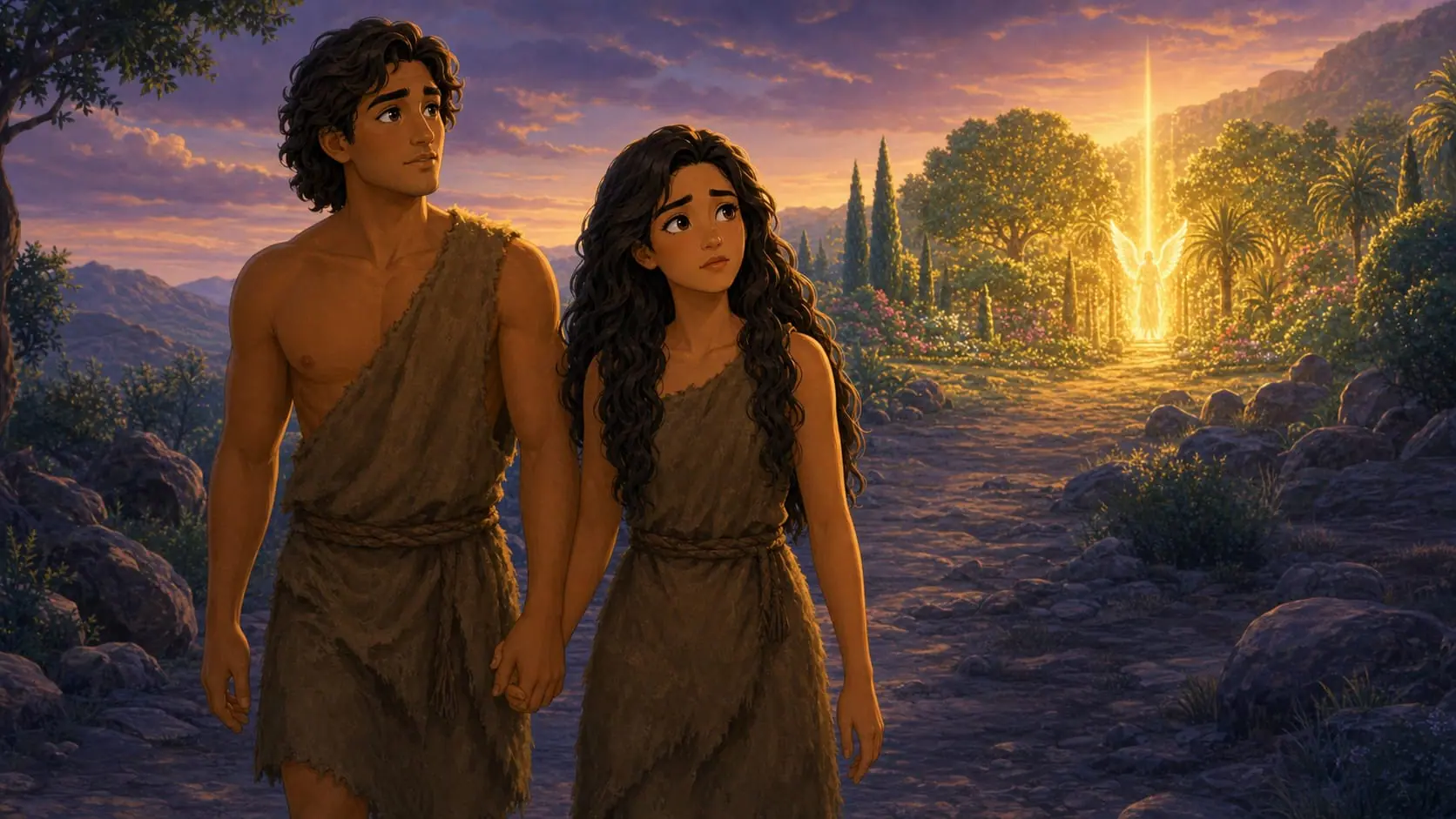
Because they had disobeyed God’s command, they were sent from Eden to work the ground from which Adam had been taken. Cherubim and a flaming sword guarded the way to the tree of life, preventing them from eating its fruit and living forever. Their life outside Eden continues in the story of Cain and Abel. Genesis 3:22–24; 4:1–2
Therefore Yahweh God sent him out from the garden of Eden, to till the ground from which he was taken.