%20scale(.87)'%3e%3cg%20transform='rotate(-3%2032%2034)'%3e%3cpath%20d='M10.5%2019.5c7.65-2.35%2014.8-.45%2021.5%205.7%206.7-6.15%2013.85-8.05%2021.5-5.7v27.2c-7.65-2.15-14.8-.45-21.5%205.1-6.7-5.55-13.85-7.25-21.5-5.1V19.5Z'%20fill='%23fff'%20stroke='%23171528'%20stroke-width='4.5'%20stroke-linejoin='round'/%3e%3cpath%20d='M32%2025.2v26.6'%20stroke='%23171528'%20stroke-width='4'%20stroke-linecap='round'/%3e%3cpath%20d='M17.5%2034.5h9M22%2030v9'%20stroke='%23171528'%20stroke-width='3.75'%20stroke-linecap='round'/%3e%3ccircle%20cx='41.5'%20cy='32.5'%20r='2.5'%20fill='%23171528'/%3e%3ccircle%20cx='46.5'%20cy='38'%20r='2.5'%20fill='%23171528'/%3e%3c/g%3e%3c/g%3e%3c/svg%3e)
The quick answer
What happened in the David and Goliath story?
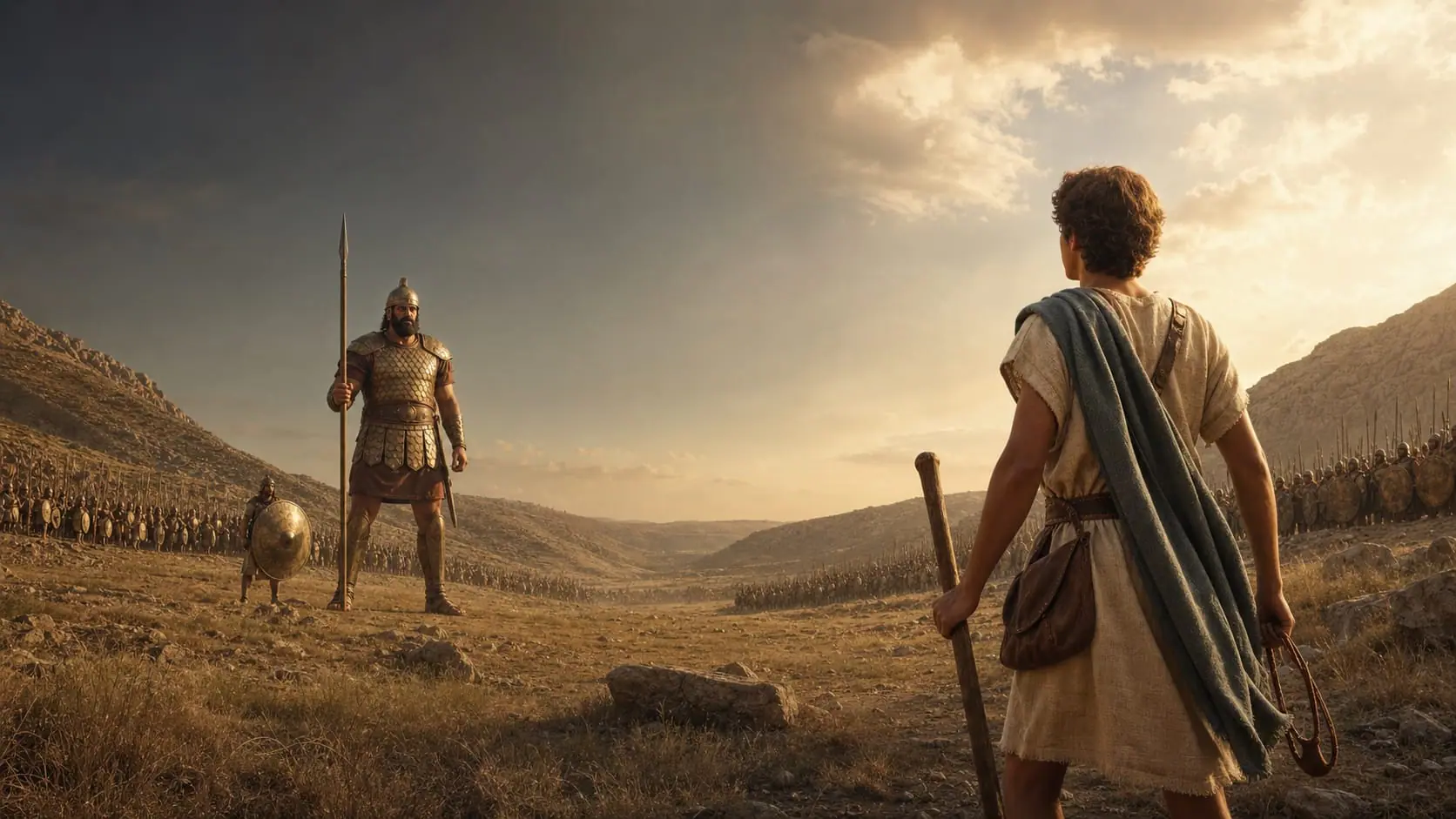
Israel and the Philistines faced each other across the Valley of Elah. For forty days, the heavily armed Philistine champion Goliath challenged Israel to send one man to fight him. Saul and the army were afraid. David, Jesse’s youngest son, arrived with food for his older brothers and heard Goliath defy the armies of the living God.
David told Saul that Yahweh, who had delivered him from a lion and a bear, would deliver him from Goliath. He took off Saul’s armor because he was not used to it, chose five smooth stones, and approached with his sling. One stone struck Goliath’s forehead, and he fell face down. David then drew Goliath’s sword and cut off his head. The Philistine army fled when they saw their champion was dead.
The full story
David vs. Goliath in the Valley of Elah
Two armies face each other across a valley
The Philistines gathered near Socoh, while Saul and Israel camped in the Valley of Elah. One army occupied one hill and the other army the opposite hill, with the valley between them.
From the Philistine line came Goliath of Gath, a champion equipped with a bronze helmet, heavy armor, bronze leg protection, a javelin, and a spear. A shield bearer went ahead of him. The chapter describes his size and equipment before giving his challenge. 1 Samuel 17:1–7
Goliath challenges Israel for forty days
Goliath proposed single combat: if an Israelite killed him, the Philistines would serve Israel; if Goliath won, Israel would serve the Philistines. He framed the challenge as a public humiliation of Saul’s army.
Saul and all Israel were dismayed and greatly afraid. Goliath came forward morning and evening for forty days, and no Israelite accepted. 1 Samuel 17:8–16
The Philistine said, ‘I defy the armies of Israel today! Give me a man, that we may fight together!’ When Saul and all Israel heard those words of the Philistine, they were dismayed and greatly afraid.
David arrives with food for his brothers
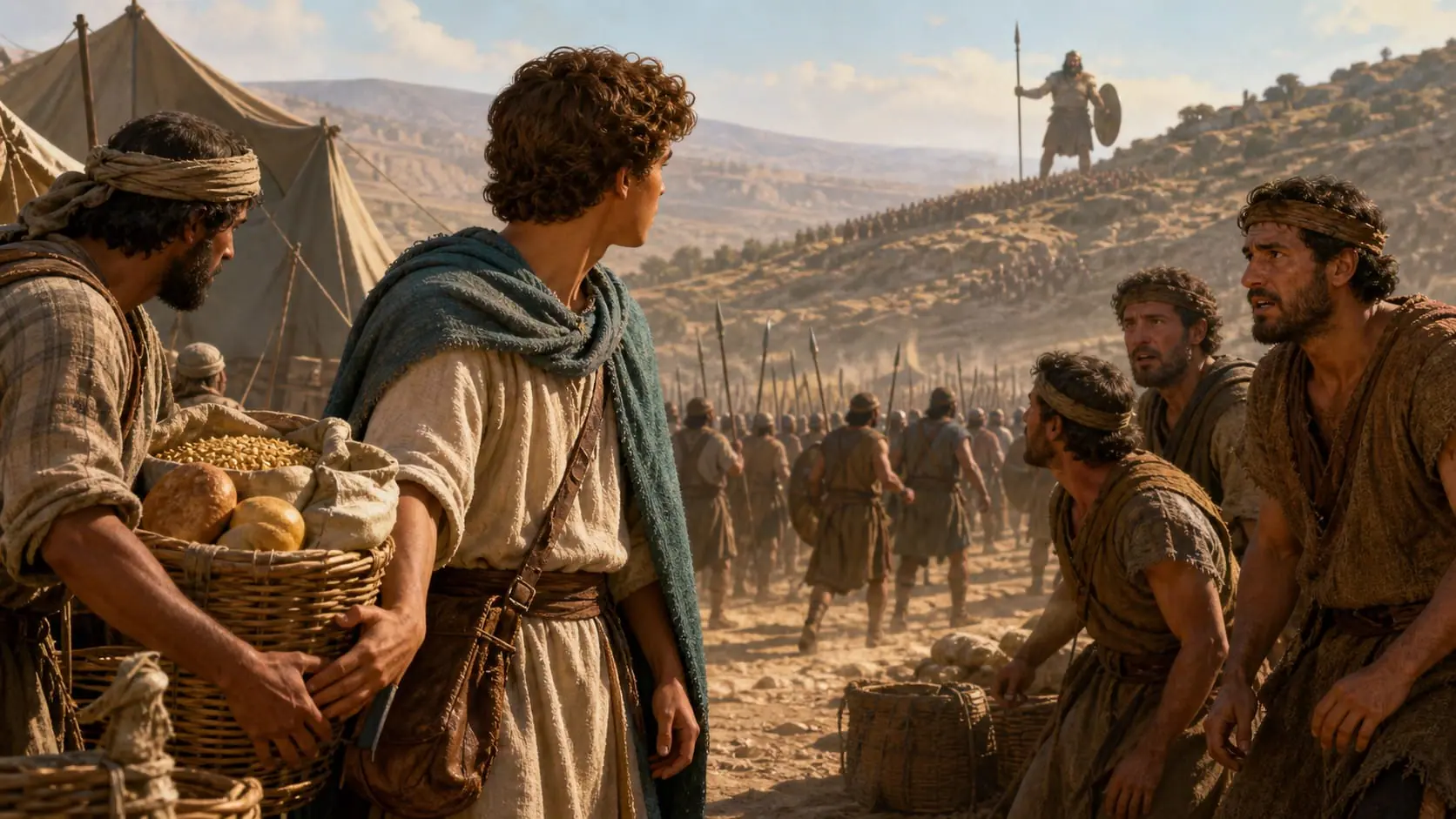
David was Jesse’s youngest son. His three oldest brothers served with Saul, while David moved between Saul and his father’s sheep at Bethlehem. Jesse sent grain and ten loaves for the brothers, ten cheeses for their commander, and asked David to bring back news. David left the sheep with a keeper before going.
At the camp, David left the provisions with the baggage keeper and greeted his brothers. He heard Goliath’s challenge and saw Israel’s soldiers flee. The men reported a royal reward of wealth, marriage to the king’s daughter, and freedom from taxes for the victor’s father’s household. David asked about it and challenged Goliath’s defiance of the living God. Eliab angrily accused David of pride; that is Eliab’s accusation, not the narrator’s explanation of David’s motives. 1 Samuel 17:12–30
David tells Saul he will fight
David’s words reached Saul, who sent for him. David offered to fight, but Saul objected: David was a youth, while Goliath had been a warrior from his youth.
David answered from his experience as a shepherd. When a lion or bear took a lamb, he pursued and struck it. He believed the same Yahweh who delivered him from those dangers would deliver him from Goliath. Saul permitted him to go. 1 Samuel 17:31–37
David said, ‘Yahweh, who delivered me out of the paw of the lion and out of the paw of the bear, will deliver me out of the hand of this Philistine.’ Saul said to David, ‘Go! Yahweh will be with you.’
David refuses Saul’s armor
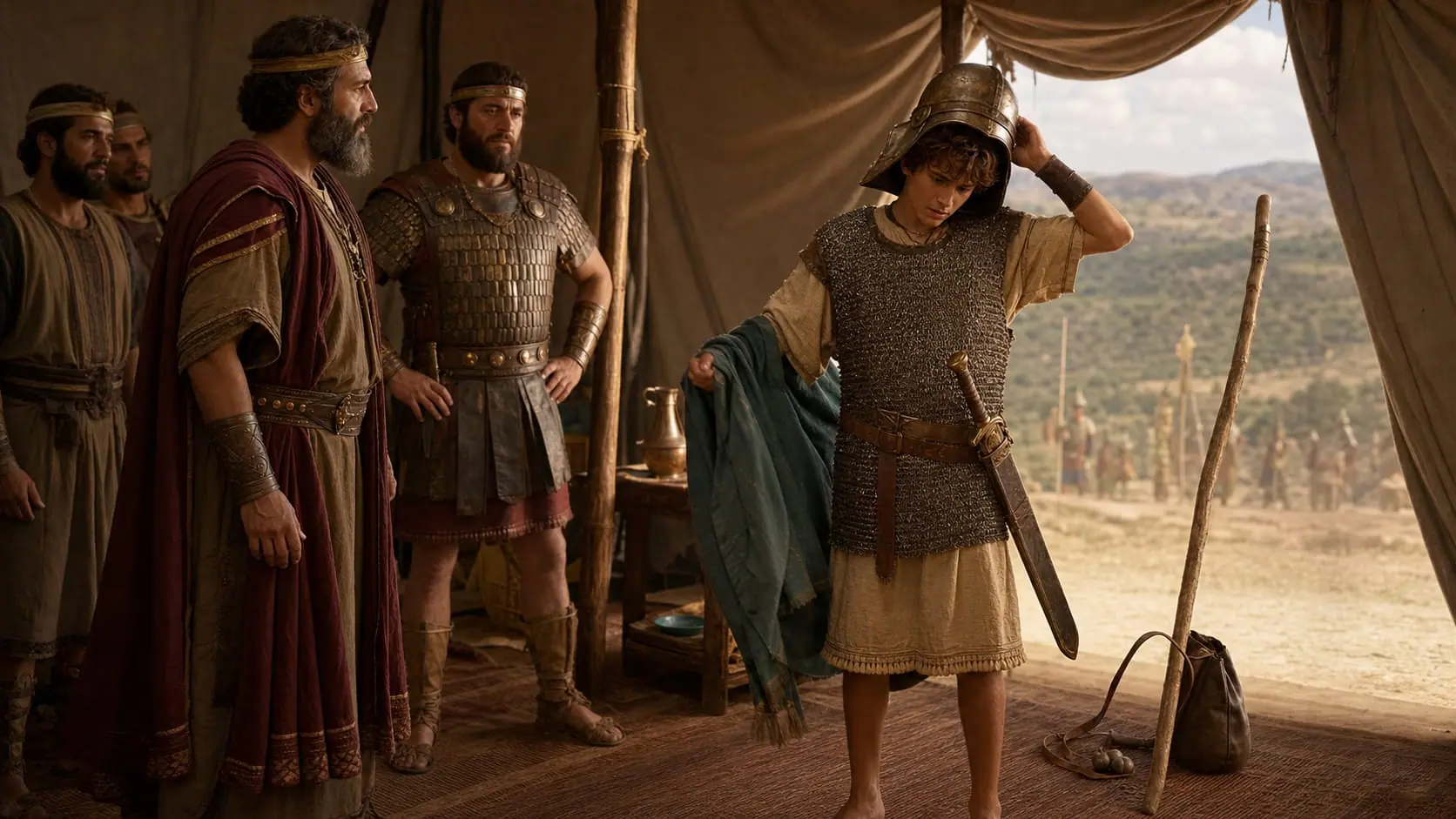
Saul dressed David in his own clothing, placed a bronze helmet on his head, and gave him a coat of mail. David strapped on a sword and tried to move, but he had not tested the equipment.
David said he could not go in the equipment because he had not tested it—he was not accustomed to using it. He took it off. The passage does not say the armor was defective or that wearing armor showed a lack of faith. 1 Samuel 17:38–39
David chooses five smooth stones
David took his staff, selected five smooth stones from the brook, and placed them in his shepherd’s pouch. With his sling in hand, he approached Goliath.
The chapter tells us exactly how many stones David selected, but not why he chose five. Explanations assigning symbolic meanings to the stones—or connecting the number to other warriors—are later interpretations rather than statements in 1 Samuel 17. 1 Samuel 17:40
To try aiming a sling after reading the story, play the David and Goliath game. Its eight levels add target practice, obstacles, and wind; these are game mechanics, not extra events from 1 Samuel 17. The first level gives three stones and the later levels give five each. In the biblical confrontation, David brings Goliath down with one stone.

“The battle is Yahweh’s”
Goliath despised David’s youth and appearance and cursed him by the Philistine gods. David answered that Goliath came with sword, spear, and javelin, but David came in the name of Yahweh of Armies.
David expected the victory to show both armies that Israel’s God saves without dependence on sword and spear. His confidence was not merely positive thinking about an intimidating opponent; it was a public claim about whose battle this was. 1 Samuel 17:41–47
Then David said to the Philistine, “You come to me with a sword, with a spear, and with a javelin; but I come to you in the name of Yahweh of Armies, the God of the armies of Israel, whom you have defied. Today, Yahweh will deliver you into my hand. I will strike you and take your head from off you. I will give the dead bodies of the army of the Philistines today to the birds of the sky and to the wild animals of the earth, that all the earth may know that there is a God in Israel, and that all this assembly may know that Yahweh doesn’t save with sword and spear; for the battle is Yahweh’s, and he will give you into our hand.”
David’s sling brings Goliath down
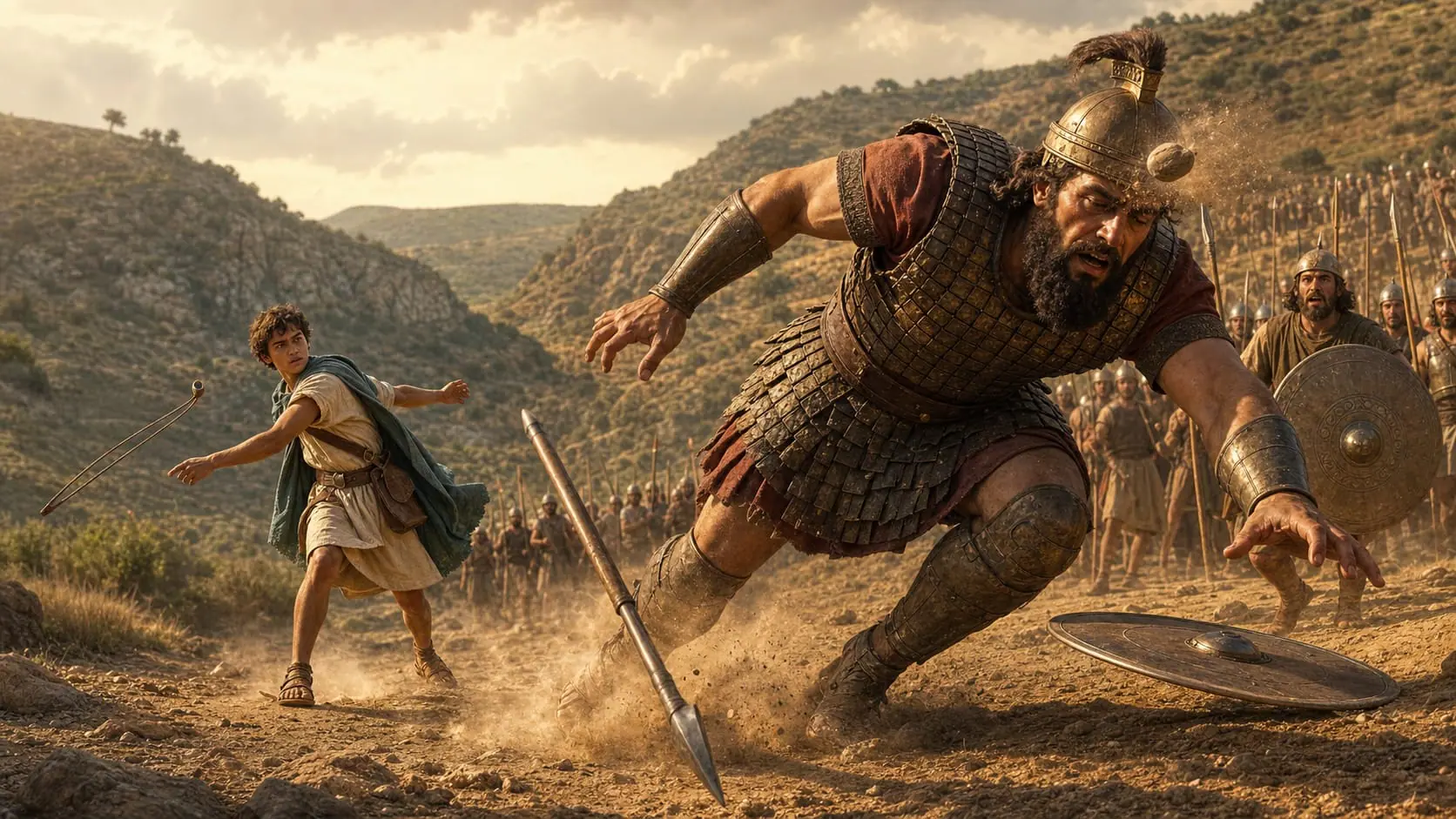
As Goliath moved forward, David hurried and ran toward the battle line. He took one stone from his bag, slung it, and struck Goliath in the forehead. The stone sank in, and Goliath fell face down.
Verse 50 summarizes the victory with the sling and stone and notes that David had no sword. Verse 51 gives the sword action: David draws Goliath’s own weapon, kills him, and cuts off his head. The NET note on verse 50 explains the summary followed by the more detailed account. This is a battlefield killing, not simply Goliath being knocked unconscious. 1 Samuel 17:48–51
David put his hand in his bag, took a stone and slung it, and struck the Philistine in his forehead. The stone sank into his forehead, and he fell on his face to the earth. So David prevailed over the Philistine with a sling and with a stone, and struck the Philistine and killed him; but there was no sword in David’s hand.
Israel pursues the Philistines
When the Philistines saw their champion was dead, they fled. Israel and Judah shouted, pursued them, and returned to plunder the camp. The WEB names Gai and Ekron in the pursuit and describes the fallen along the road to Gath and Ekron. Verse 54 says David brought Goliath’s head to Jerusalem and put the armor in his tent; it does not date the Jerusalem journey.
The chapter closes with Saul asking whose son David was and David identifying Jesse of Bethlehem as his father. Chapter 16 has already described David serving Saul, so this question raises a difficulty the narrator does not explain. Some ancient Greek copies omit this closing exchange, as the NET textual notes record. The victory does not make David king immediately: follow his later service, flight, and reign in David’s life story. 1 Samuel 17:51–58
A major textual question
How Tall Was Goliath?
The World English Bible follows the traditional Hebrew reading: six cubits and a span. Using an approximately eighteen-inch cubit, its measurement note estimates about 9 feet 9 inches, or 2.97 meters.
The ancient Samuel manuscript 4QSamᵃ from the Dead Sea Scrolls and Greek textual witnesses instead read four cubits and a span—roughly 6 feet 9 inches, or 2.06 meters using the same eighteen-inch cubit. The NET textual note discusses the readings and the variation in cubit lengths. Both the textual reading and the measurement assumption matter; the pictures cannot establish a precise height.
What Scripture does—and does not—say
How Old Was David When He Fought Goliath?
1 Samuel 17 never gives a number. Saul calls David a youth, Goliath despises him as a youth, and David is still tending Jesse’s sheep rather than serving continuously with his three oldest brothers in the army.
Those details show that David was young, but they do not establish whether he was fifteen, sixteen, seventeen, or another age. The artwork’s portrayal of his age is an artistic choice.
Continue with Bible verses about strength and courage, explore Bible verses about faith in hard times, or read more facts about King David.