%20scale(.87)'%3e%3cg%20transform='rotate(-3%2032%2034)'%3e%3cpath%20d='M10.5%2019.5c7.65-2.35%2014.8-.45%2021.5%205.7%206.7-6.15%2013.85-8.05%2021.5-5.7v27.2c-7.65-2.15-14.8-.45-21.5%205.1-6.7-5.55-13.85-7.25-21.5-5.1V19.5Z'%20fill='%23fff'%20stroke='%23171528'%20stroke-width='4.5'%20stroke-linejoin='round'/%3e%3cpath%20d='M32%2025.2v26.6'%20stroke='%23171528'%20stroke-width='4'%20stroke-linecap='round'/%3e%3cpath%20d='M17.5%2034.5h9M22%2030v9'%20stroke='%23171528'%20stroke-width='3.75'%20stroke-linecap='round'/%3e%3ccircle%20cx='41.5'%20cy='32.5'%20r='2.5'%20fill='%23171528'/%3e%3ccircle%20cx='46.5'%20cy='38'%20r='2.5'%20fill='%23171528'/%3e%3c/g%3e%3c/g%3e%3c/svg%3e)
The quick answer
What happened between Elijah and the prophets of Baal?
During a severe drought, Elijah challenged Israel on Mount Carmel to stop wavering between the Lord and Baal. He proposed two sacrifices without human fire: the prophets of Baal would call on their god, Elijah would call on the Lord, and the God who answered by fire would be recognized as God.
Baal’s prophets cried out for hours without an answer. Elijah repaired the Lord’s altar, drenched the sacrifice with water, and prayed. Fire consumed the offering, wood, stones, dust, and water. The people fell down and confessed that the Lord is God. Elijah then had Baal’s prophets seized and killed them at Kishon. Afterward, he went back up Carmel, and rain ended the drought.
The full story
1 Kings 18: The Contest on Mount Carmel
A severe drought has gripped the land
Earlier, Elijah had announced that there would be no dew or rain except at his word during Ahab’s reign. First Kings 18:1 places God’s command to return to Ahab in the third year. Luke 4:25 and James 5:17 describe the period without rain as three years and six months; the wording in Kings should not be turned into a claim that the whole drought lasted exactly three years.
The famine was severe in Samaria. Ahab and his palace administrator Obadiah searched the land for grass to keep the royal horses and mules alive. Obadiah, who feared the Lord, had also hidden one hundred prophets from Jezebel in two caves and supplied them with food and water.
1 Kings 17:1; 18:1–6; Luke 4:25; James 5:17
Elijah meets Obadiah and confronts Ahab
Elijah met Obadiah on the road and told him to announce his presence to Ahab. Obadiah feared that the Lord’s Spirit might carry Elijah away before Ahab arrived, and that the king would kill him when Elijah could not be found. Elijah promised to appear that day.
Ahab greeted Elijah as the troubler of Israel. Elijah reversed the charge: Ahab’s house had abandoned the Lord’s commandments and followed the Baals. He called for Israel and the prophets supported at Jezebel’s table to gather on Mount Carmel.
1 Kings 18:7–19
Elijah asks Israel how long it will waver
Before arranging the sacrifices, Elijah addressed the people: if the Lord is God, follow him; if Baal is God, follow him. The issue was not simply whether Israel believed one deity existed. Elijah exposed a divided loyalty that tried to move between incompatible allegiances.
The people gave no answer. Elijah said he was the only prophet of the Lord left and proposed a test with two bulls, two prepared offerings, and no human flame. His words are not a complete count of faithful prophets: the narrator has already said that Obadiah hid a hundred of them.
1 Kings 18:20–24
Elijah came near to all the people, and said, “How long will you waver between the two sides? If Yahweh is God, follow him; but if Baal, then follow him.” The people didn’t say a word.
Baal’s prophets call from morning until afternoon
The prophets of Baal prepared their bull and called on Baal from morning until noon. They danced around the altar, but there was no voice and no answer. At noon Elijah mocked the claim that Baal could hear, suggesting that he might be occupied, traveling, or asleep.
They cried louder and cut themselves according to their custom until blood flowed. They continued until the time of the evening offering, yet the narrative repeats its verdict: no voice, no answer, no attention.
1 Kings 18:25–29
Elijah repairs the Lord’s altar and drenches the offering
Elijah invited the people to come near. He repaired a broken altar of the Lord with twelve stones, one for each tribe descended from Jacob, and dug a trench around it. He arranged the wood, cut the bull into pieces, and placed it on the altar.
He ordered four jars to be filled and poured over the offering and wood, then had this done a second and third time: twelve jarfuls in all. Water ran around the altar and filled the trench. The account emphasizes how thoroughly the offering was soaked, but does not explain where the water came from or explicitly give Elijah’s reason for adding it.
1 Kings 18:30–35
The Lord answers Elijah’s prayer with fire
At the time of the evening offering, Elijah prayed to the God of Abraham, Isaac, and Israel. He asked that the people would know the Lord is God, that Elijah was his servant, and that he had acted at God’s word. He also asked that they would know God was turning their hearts back.
Fire fell and consumed not only the sacrifice and wood but also the stones, dust, and water in the trench. The people fell on their faces and confessed, “Yahweh, he is God!”
1 Kings 18:36–39
At the time of the evening offering, Elijah the prophet came near and said, “Yahweh, the God of Abraham, of Isaac, and of Israel, let it be known today that you are God in Israel and that I am your servant, and that I have done all these things at your word. Hear me, Yahweh, hear me, that this people may know that you, Yahweh, are God, and that you have turned their heart back again.” Then Yahweh’s fire fell and consumed the burnt offering, the wood, the stones, and the dust; and it licked up the water that was in the trench. When all the people saw it, they fell on their faces. They said, “Yahweh, he is God! Yahweh, he is God!”
The prophets of Baal are seized
Elijah commanded the people to seize the prophets of Baal. He brought them down to the brook Kishon and killed them there. This violent judgment belongs to the covenant crisis narrated in ancient Israel and should not be turned into permission for religious violence by modern readers.
1 Kings 18:40
A small cloud becomes heavy rain
Elijah told Ahab that rain was coming, then bowed on the summit with his face between his knees. He sent his servant to look toward the sea seven times. On the seventh report, the servant saw a cloud as small as a man’s hand.
The sky soon darkened, wind rose, and heavy rain fell. Empowered by the Lord, Elijah tucked up his clothing and ran ahead of Ahab to the entrance of Jezreel. James 5:17–18 later recalls Elijah’s prayers over the drought and rain. Neither passage makes seven requests a formula that guarantees a particular answer.
1 Kings 18:41–46; James 5:17–18
Count the text carefully
Were There 450 or 850 Prophets on Mount Carmel?
Elijah’s invitation names 450 prophets of Baal and 400 prophets of Asherah who ate at Jezebel’s table—a total of 850 invited prophetic opponents. However, the contest itself repeatedly focuses on the 450 prophets of Baal.
First Kings 18 does not explicitly say whether the 400 prophets of Asherah attended, and verse 40 specifically says the prophets of Baal were seized. It is therefore inaccurate to say the chapter clearly reports that all 850 were killed.
Geography and context
Why Mount Carmel Mattered
The servant looks toward the sea from Carmel, then watches a storm approach. The NABRE note on 1 Kings 18:1–45 explains Baal’s association with storms, rain, and fertility. That background helps explain why a drought and the returning rain matter in this confrontation.
The repaired altar and twelve stones frame the event as a covenant appeal to all Israel. Elijah’s prayer asks not merely for spectacle but for the people to know the Lord and return in heart.
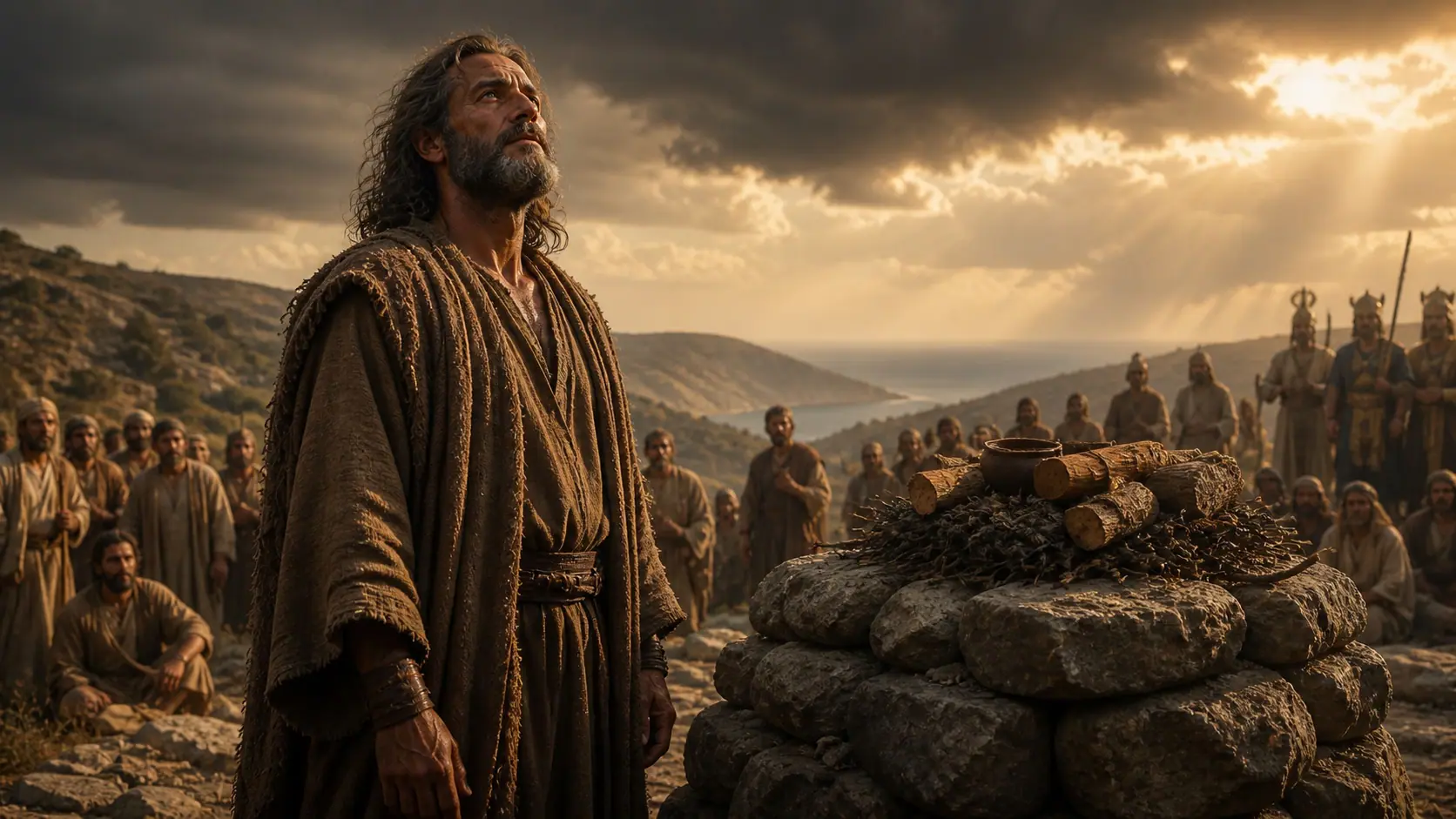
The cover illustration imagines Elijah beside an altar. It does not show the complete sacrifice, water-filled trench, or pouring described in the chapter. The bowl, clothing, faces, and sky are artistic details.