%20scale(.87)'%3e%3cg%20transform='rotate(-3%2032%2034)'%3e%3cpath%20d='M10.5%2019.5c7.65-2.35%2014.8-.45%2021.5%205.7%206.7-6.15%2013.85-8.05%2021.5-5.7v27.2c-7.65-2.15-14.8-.45-21.5%205.1-6.7-5.55-13.85-7.25-21.5-5.1V19.5Z'%20fill='%23fff'%20stroke='%23171528'%20stroke-width='4.5'%20stroke-linejoin='round'/%3e%3cpath%20d='M32%2025.2v26.6'%20stroke='%23171528'%20stroke-width='4'%20stroke-linecap='round'/%3e%3cpath%20d='M17.5%2034.5h9M22%2030v9'%20stroke='%23171528'%20stroke-width='3.75'%20stroke-linecap='round'/%3e%3ccircle%20cx='41.5'%20cy='32.5'%20r='2.5'%20fill='%23171528'/%3e%3ccircle%20cx='46.5'%20cy='38'%20r='2.5'%20fill='%23171528'/%3e%3c/g%3e%3c/g%3e%3c/svg%3e)
The quick answer
What happened to Elijah and the chariot of fire?
Elijah and Elisha traveled from Gilgal to Bethel, Jericho, and the Jordan while groups of prophets warned Elisha that his master would be taken away. Elisha refused to leave Elijah. At the river, Elijah struck the water with his mantle, and the two crossed on dry ground.
Elisha asked for a double portion of Elijah’s spirit. As they continued talking, a chariot of fire with horses of fire separated them, and Elijah went up to heaven in a whirlwind. Elisha tore his clothes in grief, picked up Elijah’s fallen mantle, crossed the Jordan, and was recognized as Elijah’s successor.
The full story
2 Kings 2: Elijah’s Ascent and Elisha’s Succession
Elisha refuses to leave Elijah
The chapter begins by announcing that the Lord was about to take Elijah up by a whirlwind. Elijah told Elisha to remain at Gilgal while he went to Bethel, but Elisha answered with an oath that he would not leave him.
The pattern repeated at Bethel and Jericho. Each time Elijah proposed that Elisha stay behind, and each time Elisha chose to continue. His repeated answer reveals steadfast loyalty before any transfer of prophetic responsibility.
2 Kings 2:1–6
The sons of the prophets know Elijah will be taken
At Bethel and Jericho, groups called the sons of the prophets came to Elisha. They asked whether he knew the Lord would take his master from over him that day. Elisha said that he knew and asked them to be quiet.
Here, sons of the prophets refers to members of a prophetic community, not a claim that these men were Elijah’s biological sons. Their repeated question and Elisha’s reply show that he knew about the coming separation.
2 Kings 2:3–5
Elijah parts the Jordan with his mantle
Fifty prophetic disciples watched from a distance as Elijah and Elisha stood beside the Jordan. Elijah rolled up his mantle and struck the water. The river divided, allowing both men to cross on dry ground.
The dry-ground crossing recalls Israel crossing the Jordan under Joshua in Joshua 3:14–17. Here, Elijah and Elisha cross away from the watching group before their final conversation.
2 Kings 2:7–8; Joshua 3:14–17
Elisha asks for a double portion
Elijah invited Elisha to ask what he should do before being taken away. Elisha requested a double portion of Elijah’s spirit. A common interpretation connects this with a firstborn son’s double inheritance in Deuteronomy 21:17: Elisha asks to be Elijah’s principal prophetic heir. The chapter does not define it as twice as much power or provide a count of miracles.
Elijah called it a hard request and gave a condition: if Elisha saw him being taken, it would be granted; if he did not, it would not.
2 Kings 2:9–10; Deuteronomy 21:17
When they had gone over, Elijah said to Elisha, “Ask what I shall do for you, before I am taken from you.” Elisha said, “Please let a double portion of your spirit be on me.” He said, “You have asked a hard thing. If you see me when I am taken from you, it will be so for you; but if not, it will not be so.”
Fire separates the prophets and a whirlwind takes Elijah
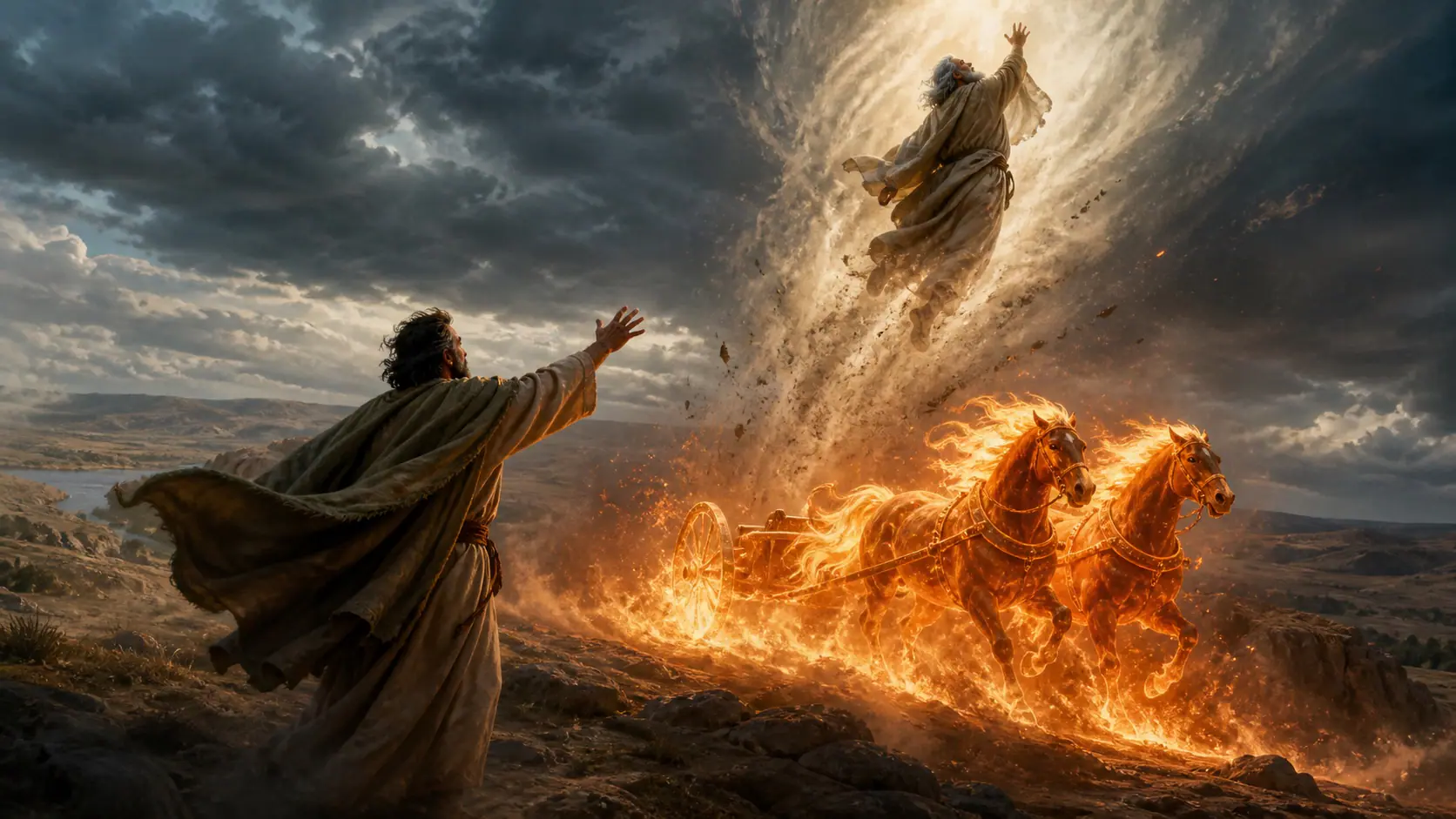
As Elijah and Elisha walked and talked, a chariot of fire and horses of fire suddenly appeared and separated the two men. Elijah then went up by a whirlwind into heaven while Elisha watched.
Elisha cried out, “My father, my father, the chariots of Israel and its horsemen!” When he could no longer see Elijah, he tore his clothes in two, an expression of grief.
2 Kings 2:11–12
As they continued on and talked, behold, a chariot of fire and horses of fire separated them; and Elijah went up by a whirlwind into heaven.
Elisha picks up Elijah’s mantle and crosses back
Elijah’s mantle had fallen from him. Elisha picked it up, returned to the Jordan, and struck the water while calling on the God of Elijah. The river divided again, and Elisha crossed back.
The watching prophets concluded that Elijah’s spirit rested on Elisha. They bowed before him, recognizing the succession that the journey and the parted waters had confirmed.
2 Kings 2:13–15
The searchers return without finding Elijah
The prophetic disciples urged Elisha to let fifty strong men search in case the Lord’s Spirit had placed Elijah on a mountain or in a valley. Elisha initially refused, but they pressed until he agreed.
The men searched for three days and did not find Elijah. When they returned to Elisha at Jericho, he reminded them that he had told them not to go. The account reports their search and its failure; it does not locate Elijah on a particular mountain or in a valley.
2 Kings 2:16–18
Read the wording closely
Did Elijah Ride the Chariot of Fire?
Second Kings 2:11 does not say Elijah climbed into or rode the chariot. It says the chariot and fiery horses separated Elijah and Elisha, while Elijah went up in a whirlwind.
“Elijah’s chariot of fire” is understandable shorthand for the scene, but an accurate retelling keeps the chariot’s action and the whirlwind’s action distinct.
The illustration keeps Elijah separate from the chariot. Its two horses, clothing, faces, and arrangement of clouds are artistic choices; the passage does not give a horse count or describe those details.
Inheritance and succession
What Did Elisha’s Double Portion Mean?
The NABRE note on 2 Kings 2:9 explains the inheritance reading: as a firstborn receives a double share, Elisha asks to be the principal prophetic successor. This is an interpretation of the request, not a statement that Elijah is his biological father. First Kings 19:19 names Elisha’s father as Shaphat.
The gift is not Elijah’s to control independently; the sign depends on whether Elisha sees the taking. Afterward, the mantle, divided Jordan, and recognition by the prophetic community confirm the succession.