%20scale(.87)'%3e%3cg%20transform='rotate(-3%2032%2034)'%3e%3cpath%20d='M10.5%2019.5c7.65-2.35%2014.8-.45%2021.5%205.7%206.7-6.15%2013.85-8.05%2021.5-5.7v27.2c-7.65-2.15-14.8-.45-21.5%205.1-6.7-5.55-13.85-7.25-21.5-5.1V19.5Z'%20fill='%23fff'%20stroke='%23171528'%20stroke-width='4.5'%20stroke-linejoin='round'/%3e%3cpath%20d='M32%2025.2v26.6'%20stroke='%23171528'%20stroke-width='4'%20stroke-linecap='round'/%3e%3cpath%20d='M17.5%2034.5h9M22%2030v9'%20stroke='%23171528'%20stroke-width='3.75'%20stroke-linecap='round'/%3e%3ccircle%20cx='41.5'%20cy='32.5'%20r='2.5'%20fill='%23171528'/%3e%3ccircle%20cx='46.5'%20cy='38'%20r='2.5'%20fill='%23171528'/%3e%3c/g%3e%3c/g%3e%3c/svg%3e)
The quick answer
What happened in the Good Samaritan story?
A man traveling from Jerusalem to Jericho was attacked by robbers and left half dead. A priest saw him and passed on the other side. A Levite did the same. Then a Samaritan saw the wounded traveler, was moved with compassion, treated his wounds, put him on his own animal, and brought him to an inn. He paid for his care and promised to repay any additional cost.
Jesus told the parable after a lawyer asked, “Who is my neighbor?” At the end, Jesus asked which traveler had become a neighbor to the injured man. The lawyer answered, “He who showed mercy on him.” Jesus replied, “Go and do likewise.”
The full story
Luke 10:25–37: The Parable of the Good Samaritan
A lawyer asks Jesus about eternal life
A lawyer—an expert in the law of Moses—stood up to test Jesus and asked what he must do to inherit eternal life. Jesus directed him back to Scripture: “What is written in the law? How do you read it?”
The lawyer answered by joining commands from Deuteronomy 6:5 and Leviticus 19:18: love God with all your heart, soul, strength, and mind, and love your neighbor as yourself. Jesus said he had answered correctly and told him to do this and live. The command to love one’s neighbor comes from Israel’s Scriptures; it is not a new rule set against them. Luke 10:25–28
He answered, “You shall love the Lord your God with all your heart, with all your soul, with all your strength, and with all your mind; and your neighbor as yourself.” He said to him, “You have answered correctly. Do this, and you will live.”
“Who is my neighbor?”
The lawyer then wanted to justify himself. His next question attempted to define the boundary of the command: “Who is my neighbor?” Jesus did not answer with a list of people who qualified. Instead, he told a story that would change the direction of the question.
A certain man was going down from Jerusalem to Jericho when he fell among robbers. They stripped him, beat him, and went away, leaving him half dead. Jesus does not identify the traveler’s name, occupation, ethnicity, or religion. Luke 10:29–30

A priest sees him and passes by
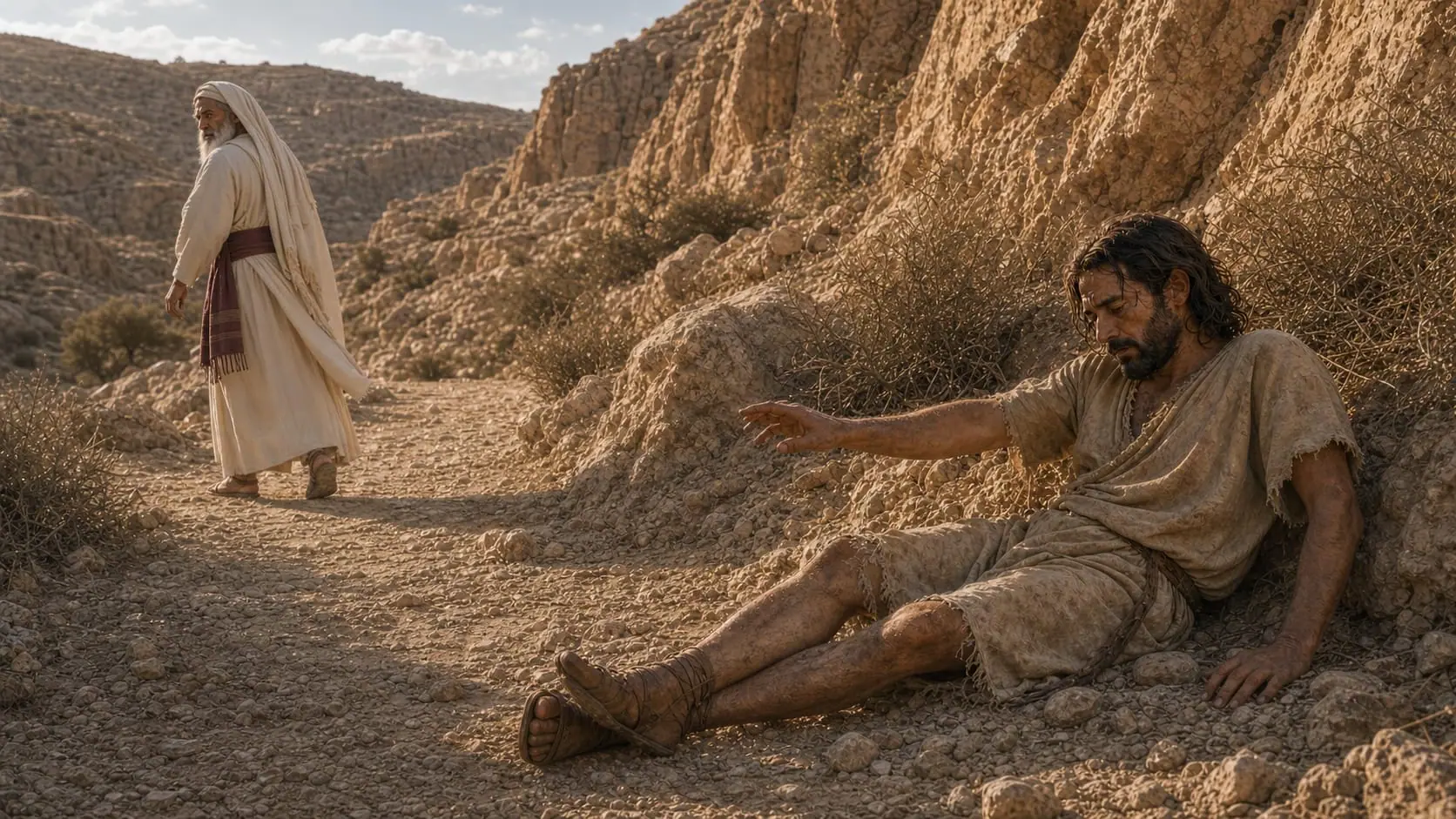
By chance, a priest was traveling down the same road. He saw the wounded man, but he passed by on the other side. The detail is brief and deliberate: the priest saw the need but did not move toward it.
Jesus does not explain why the priest passed by. Suggestions about fear, time, safety, or ritual purity are interpretations rather than reasons stated in the parable. Luke 10:31
A Levite also passes on the other side
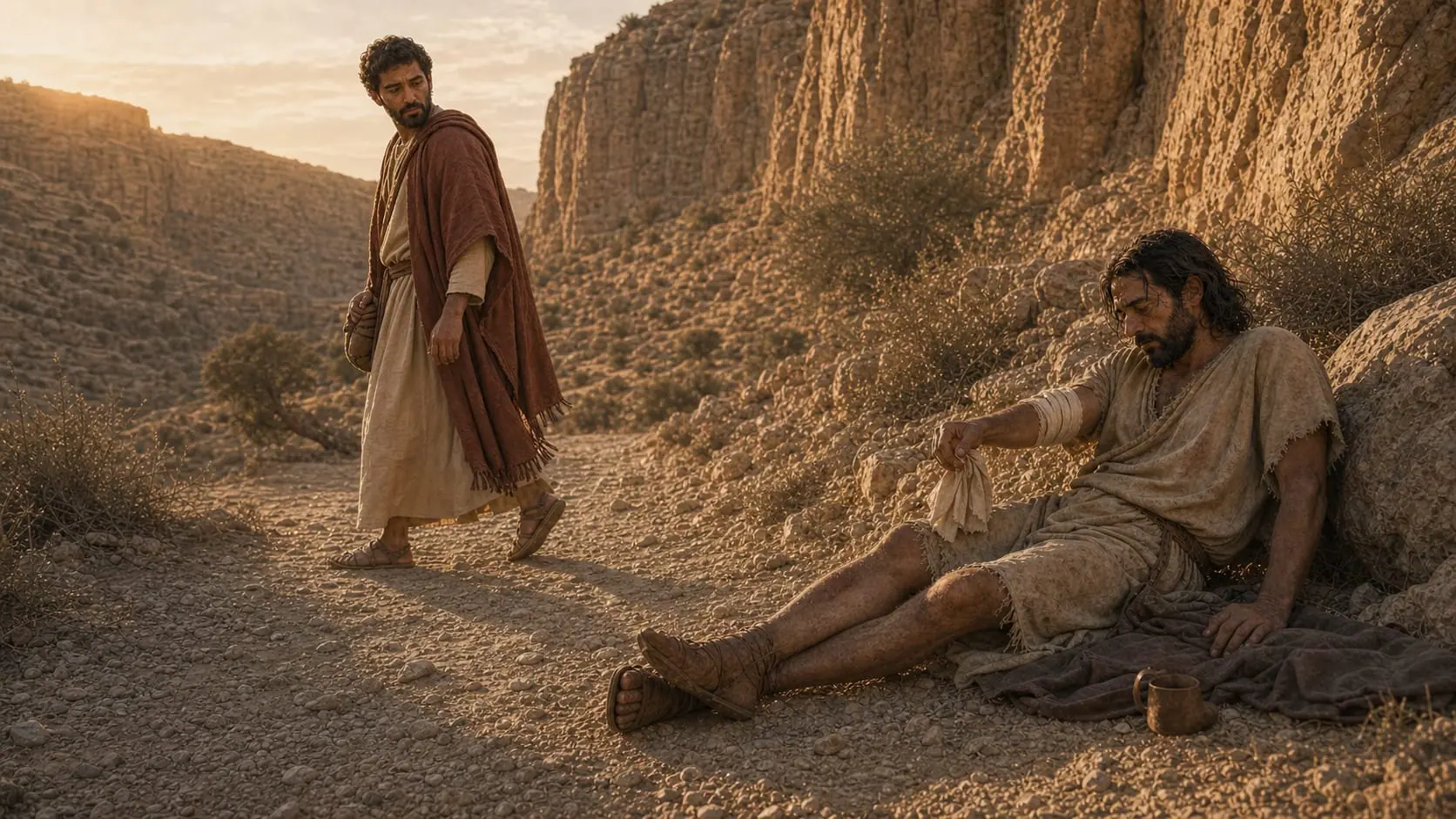
Next a Levite came to the place. He too saw the injured traveler and passed by on the other side. The repeated pattern creates an expectation: two men associated with Israel’s worship have seen the need, yet neither has acted as a neighbor.
The text again gives no motive. Its focus remains on the contrast between seeing without helping and seeing with compassion. Luke 10:32
A Samaritan is moved with compassion
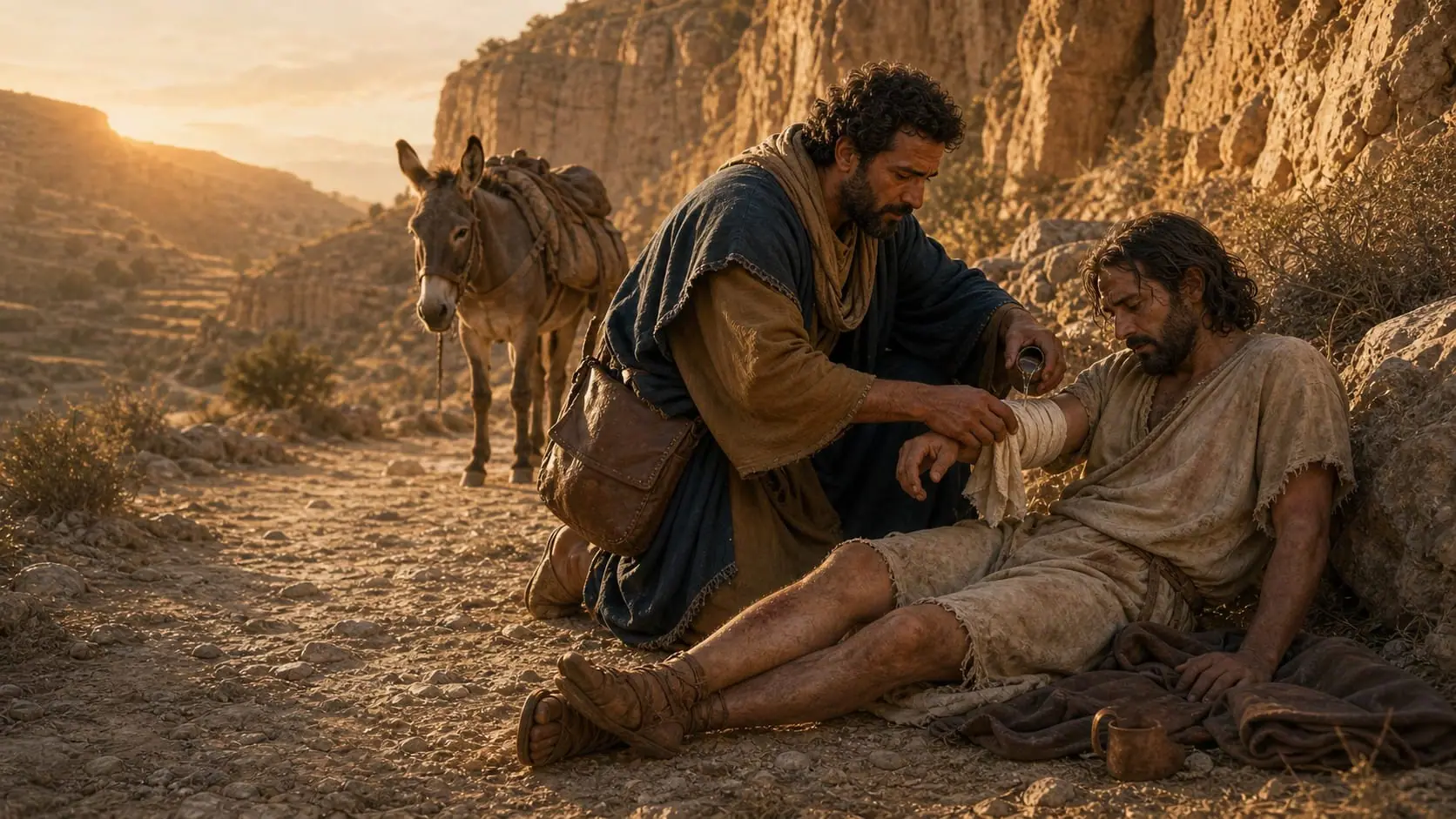
Then a Samaritan traveling the road came to the wounded man. When he saw him, he was moved with compassion. That response became action: he approached instead of creating distance.
The Samaritan bound the man’s wounds and poured on oil and wine. He placed him on his own animal, brought him to an inn, and cared for him. The donkey in the illustrations is an artistic choice: Luke does not name the kind of animal. Luke 10:33–34
But a certain Samaritan, as he traveled, came where he was. When he saw him, he was moved with compassion, came to him, and bound up his wounds, pouring on oil and wine. He set him on his own animal, brought him to an inn, and took care of him. On the next day, when he departed, he took out two denarii, gave them to the host, and said to him, ‘Take care of him. Whatever you spend beyond that, I will repay you when I return.’
The Samaritan pays for continuing care
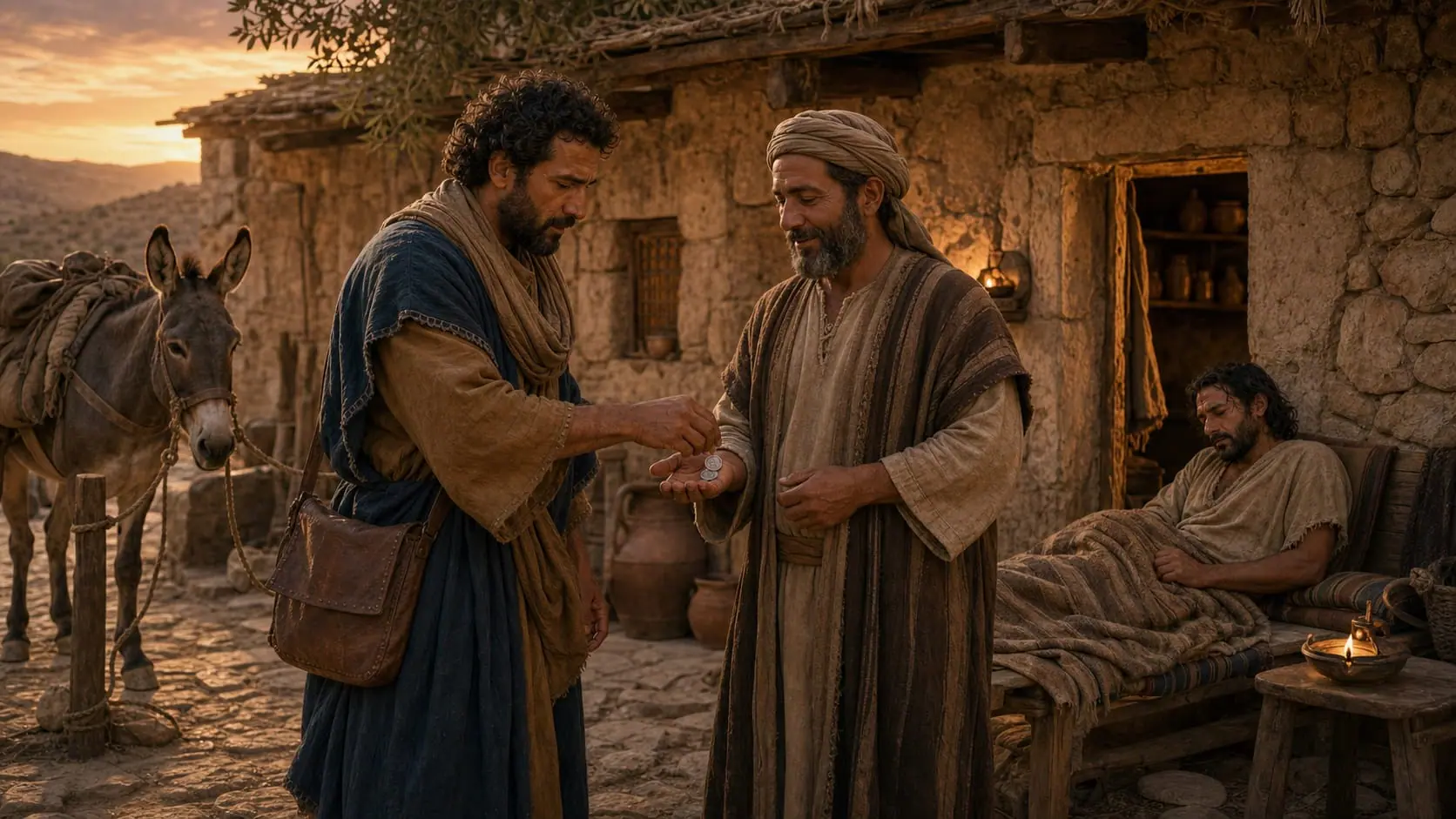
The Samaritan stayed to care for the man. The next day, as he left, he gave the innkeeper two denarii and asked him to continue that care. He promised to repay any further expense when he returned.
A denarius was a silver coin roughly equivalent to a laborer’s daily wage; Matthew 20:2 uses that rate in another parable. Two denarii do not mean two days at the inn. Luke does not give a room price, a recovery time, or a modern cash equivalent. The story ends without describing the Samaritan’s return or the traveler’s recovery. Luke 10:35–37
Jesus turns the question around
Jesus asked which of the three had seemed to be a neighbor to the man who fell among robbers. The lawyer answered, “He who showed mercy on him.” Luke does not explain why he used those words rather than saying “the Samaritan.”
The lawyer began by asking who his neighbor was. Jesus asked him to recognize who had acted as a neighbor, then told him to do the same. His answer calls for mercy, not just a correct definition. Luke 10:36–37
Now which of these three do you think seemed to be a neighbor to him who fell among the robbers?” He said, “He who showed mercy on him.” Then Jesus said to him, “Go and do likewise.”
The phrase and its source
What Is a Good Samaritan?
Today, Good Samaritan usually means a person who helps someone in distress without expecting a reward. The phrase comes directly from this parable, but Jesus’ story calls the helper “a certain Samaritan.” “Good Samaritan” is the traditional title that later readers gave him.
Here, Samaritan identifies a person from the Samaritan community, not a job or a name for a charity worker. John 4:9 describes the divide between Jews and Samaritans. In Jesus’ story, the Samaritan is the one who fulfills the command to love a neighbor, despite the tension between their communities.
Three responses to one need
The Priest, Levite, and Samaritan
The priest, Levite, and Samaritan all traveled the same road, and all three could see the injured man. The decisive difference was not access to information but response. The first two moved away; the Samaritan moved closer.
The parable gives no private motive for the priest or Levite and does not condemn every member of either group. Jesus himself and the expert discussing the law are Jewish. The contrast is between the travelers’ actions, not between a supposedly loveless Judaism and a loving Christianity.
A road hearers could picture
The Road from Jerusalem to Jericho
Jerusalem stood high in the Judean hills, while Jericho lay far below near the Jordan Valley. Traveling “down” from Jerusalem therefore describes a real descent through rugged, exposed country. The setting makes an ambush believable and stopping costly.
The geography strengthens the story without becoming its message. Jesus’ question remains ethical and personal: when another person’s need interrupts the road, what does neighbor-love do?
Jesus also tells of unexpected mercy in the Prodigal Son, where a father welcomes his returning son and appeals to his angry older son. For more reading, see Bible verses about love. To recall this parable alongside Jesus’ other teachings and miracles, try Jesus Trivia.