%20scale(.87)'%3e%3cg%20transform='rotate(-3%2032%2034)'%3e%3cpath%20d='M10.5%2019.5c7.65-2.35%2014.8-.45%2021.5%205.7%206.7-6.15%2013.85-8.05%2021.5-5.7v27.2c-7.65-2.15-14.8-.45-21.5%205.1-6.7-5.55-13.85-7.25-21.5-5.1V19.5Z'%20fill='%23fff'%20stroke='%23171528'%20stroke-width='4.5'%20stroke-linejoin='round'/%3e%3cpath%20d='M32%2025.2v26.6'%20stroke='%23171528'%20stroke-width='4'%20stroke-linecap='round'/%3e%3cpath%20d='M17.5%2034.5h9M22%2030v9'%20stroke='%23171528'%20stroke-width='3.75'%20stroke-linecap='round'/%3e%3ccircle%20cx='41.5'%20cy='32.5'%20r='2.5'%20fill='%23171528'/%3e%3ccircle%20cx='46.5'%20cy='38'%20r='2.5'%20fill='%23171528'/%3e%3c/g%3e%3c/g%3e%3c/svg%3e)
The quick answer
What happened at the burning bush?
Moses was shepherding Jethro’s flock near Horeb when he saw a bush burning without being consumed. God called him by name, told him to remove his sandals on holy ground, and announced that he had seen Israel’s suffering in Egypt.
God sent Moses to Pharaoh and promised to be with him. When Moses asked for God’s name, the answer included “I AM WHO I AM” and the name Yahweh. Moses repeatedly objected, so God gave signs and appointed Aaron to speak with him. The brothers then gathered Israel’s elders, who believed and worshiped.
Follow a fictional Israelite household through six chapters and Scripture puzzles, from Goshen to Sinai, in the Exodus Journey Game.
The story in Exodus
Moses’ Call at the Burning Bush
A shepherd turns aside at Horeb
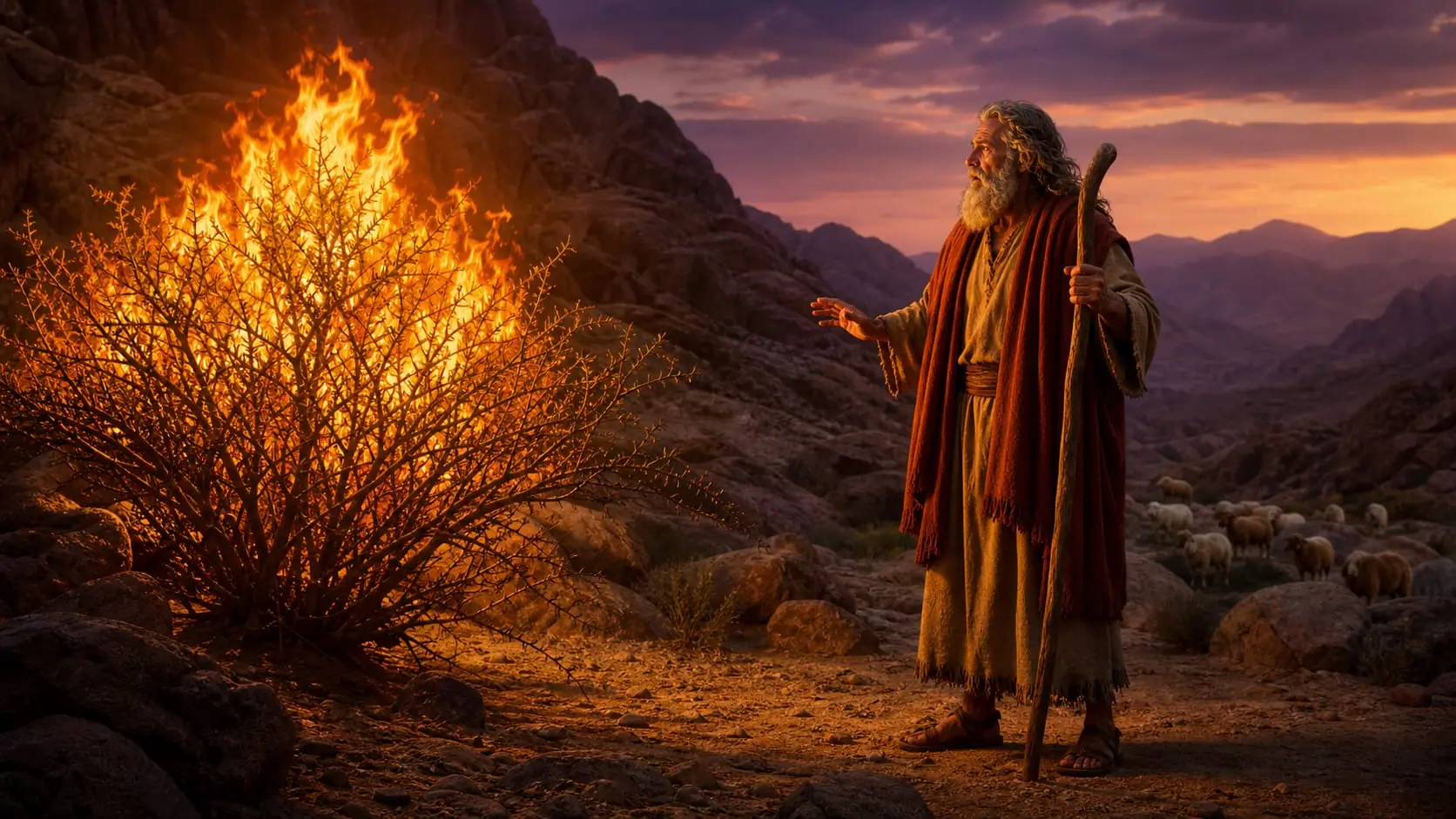
Moses had fled Egypt and built a life in Midian. While keeping the flock of Jethro, his father-in-law, he led the animals beyond the wilderness to Horeb. There Yahweh’s angel appeared in a flame from within a bush. Moses looked: the bush burned, yet was not consumed.
Moses decided to turn aside and understand the sight. When God saw him approach, he called, “Moses! Moses!” Moses answered, “Here I am.” Exodus 2:15–25; 3:1–4
Yahweh’s angel appeared to him in a flame of fire out of the middle of a bush. He looked, and behold, the bush burned with fire, and the bush was not consumed. Moses said, “I will go now, and see this great sight, why the bush is not burned.”
“Take your sandals off”
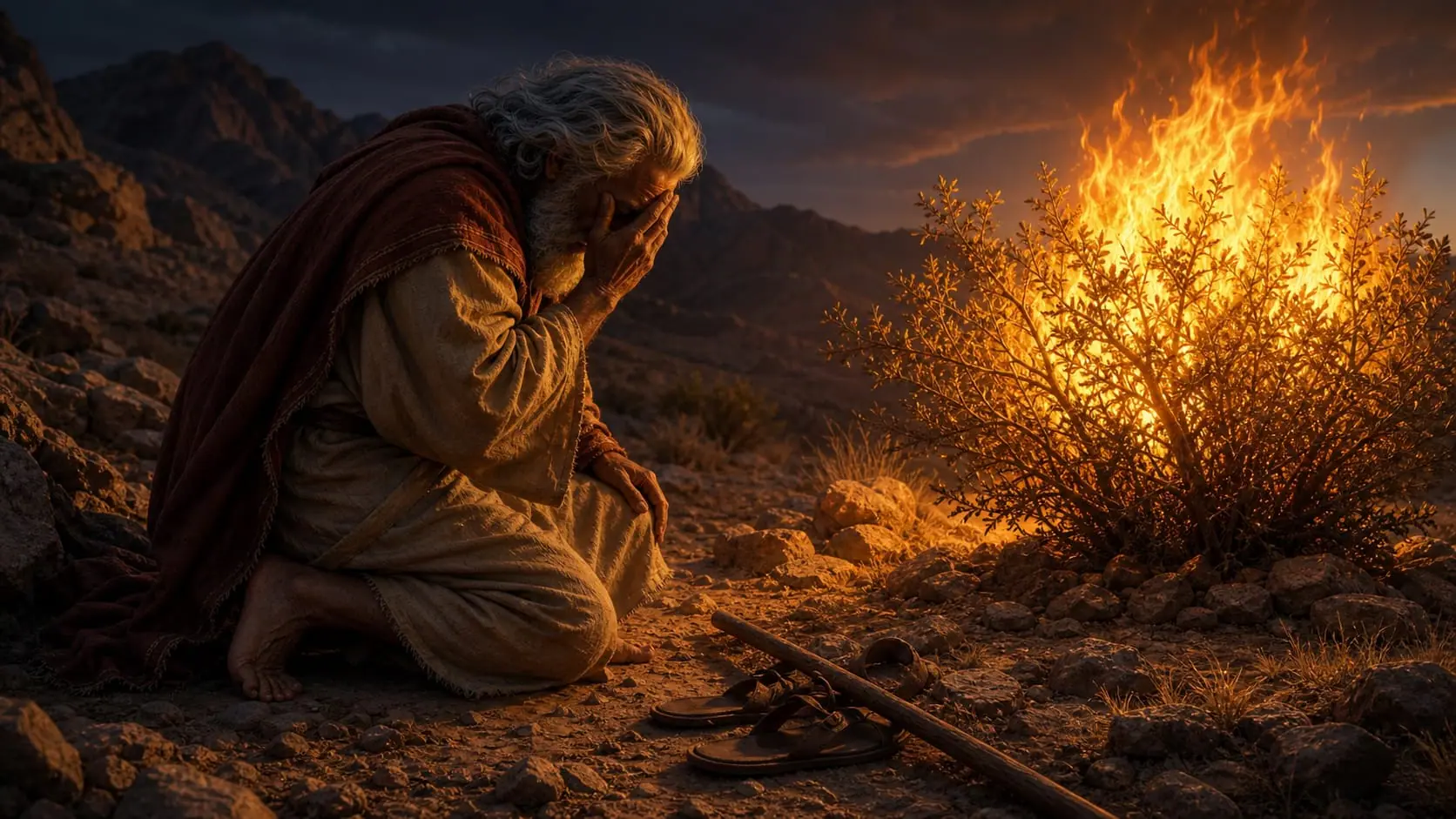
God told Moses not to come closer. He was to remove his sandals because he stood on holy ground. God identified himself as the God of Abraham, Isaac, and Jacob, and Moses hid his face because he was afraid to look at God.
Moses had come to investigate a strange fire. Now he was being addressed by the God of his ancestors, with a command to stop and listen. Exodus 3:5–6
He said, “Don’t come close. Take off your sandals, for the place you are standing on is holy ground.”
God sees Israel’s suffering
God said he had seen the affliction of his people, heard their cry, and knew their sorrows. He would deliver them from Egypt and bring them to a good land. Then the call became personal: Moses was to go to Pharaoh and bring Israel out.
Moses asked, “Who am I?” God did not answer by praising Moses’ abilities. The promise was, “Certainly I will be with you.” The sign would come after obedience: Israel would worship God at that mountain. Exodus 3:7–12
He said, “Certainly I will be with you. This will be the token to you, that I have sent you: when you have brought the people out of Egypt, you shall serve God on this mountain.”
“I AM WHO I AM”
Moses anticipated Israel asking for the name of the God who sent him. God answered, “I AM WHO I AM,” and told Moses to say, “I AM has sent me to you.” In the next verse, God gives the name Yahweh and identifies himself as the God of Abraham, Isaac, and Jacob.
The Hebrew expression uses the verb “to be.” The NET translation note discusses both “I am” and “I will be” readings. The surrounding promises help explain its significance: God will be with Moses, has not forgotten Israel, and will deliver them. The WEB uses Yahweh where many English Bibles print LORD in capital letters. Exodus 3:12–17
God told Moses to gather the elders and ask Pharaoh to let the people travel into the wilderness to worship. He also warned that Pharaoh would resist before finally letting them go. Exodus 3:18–22
God said to Moses, “I AM WHO I AM,” and he said, “You shall tell the children of Israel this: ‘I AM has sent me to you.’”
Moses objects—and Aaron is appointed
Moses feared Israel would not believe him. His staff became a snake and then a staff again; his hand became diseased and was restored. God also instructed him to pour Nile water onto dry ground, where it would become blood, if the people did not believe the first two signs. That third sign was an instruction for Egypt, not water fetched from the Nile at Horeb.
Moses then said he was slow of speech. God answered that he made the mouth and would teach Moses what to say. When Moses still asked for someone else, God’s anger burned, yet he appointed Aaron as spokesman. Moses would give Aaron the words and carry the staff. Exodus 4:1–17
Moses returns to Egypt and meets Aaron
With Jethro’s permission, Moses set out for Egypt with his wife and sons. God warned him again about Pharaoh’s resistance. On the journey, Exodus also records a dangerous encounter at a lodging place, where Zipporah circumcised her son. Exodus 4:18–26
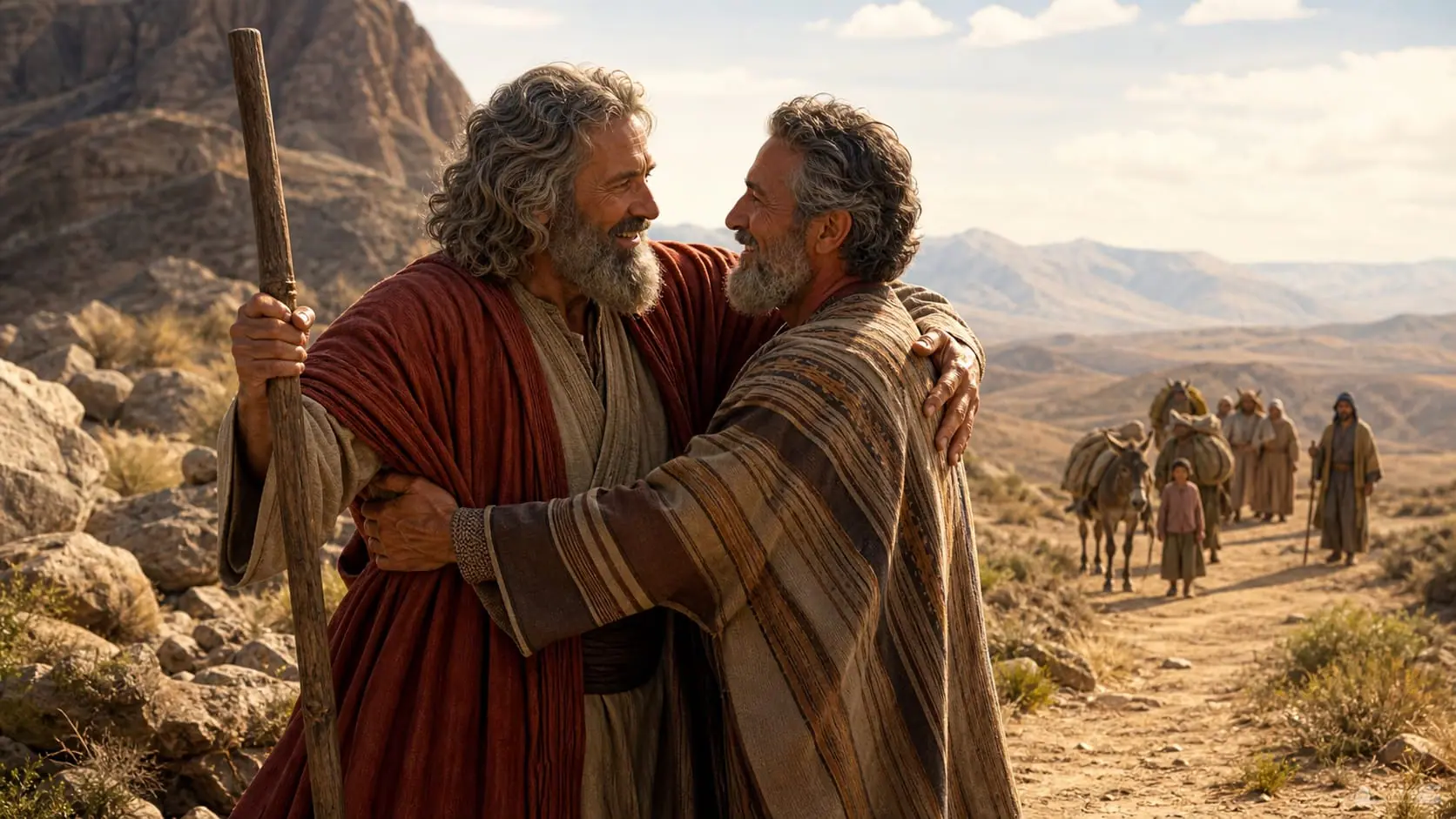
God sent Aaron to meet Moses at the mountain of God. Aaron greeted him with a kiss, and Moses told him the words and signs he had received. Together they gathered Israel’s elders. Aaron delivered God’s words, and the signs were performed before the people. They believed, bowed down, and worshiped when they heard that God had seen their suffering. Exodus 4:27–31
Follow the conflict with Pharaoh in the Ten Plagues of Egypt. For Moses’ life before and after this call, read the story of Moses.