%20scale(.87)'%3e%3cg%20transform='rotate(-3%2032%2034)'%3e%3cpath%20d='M10.5%2019.5c7.65-2.35%2014.8-.45%2021.5%205.7%206.7-6.15%2013.85-8.05%2021.5-5.7v27.2c-7.65-2.15-14.8-.45-21.5%205.1-6.7-5.55-13.85-7.25-21.5-5.1V19.5Z'%20fill='%23fff'%20stroke='%23171528'%20stroke-width='4.5'%20stroke-linejoin='round'/%3e%3cpath%20d='M32%2025.2v26.6'%20stroke='%23171528'%20stroke-width='4'%20stroke-linecap='round'/%3e%3cpath%20d='M17.5%2034.5h9M22%2030v9'%20stroke='%23171528'%20stroke-width='3.75'%20stroke-linecap='round'/%3e%3ccircle%20cx='41.5'%20cy='32.5'%20r='2.5'%20fill='%23171528'/%3e%3ccircle%20cx='46.5'%20cy='38'%20r='2.5'%20fill='%23171528'/%3e%3c/g%3e%3c/g%3e%3c/svg%3e)
The quick answer
What happened when Moses received the Ten Commandments?
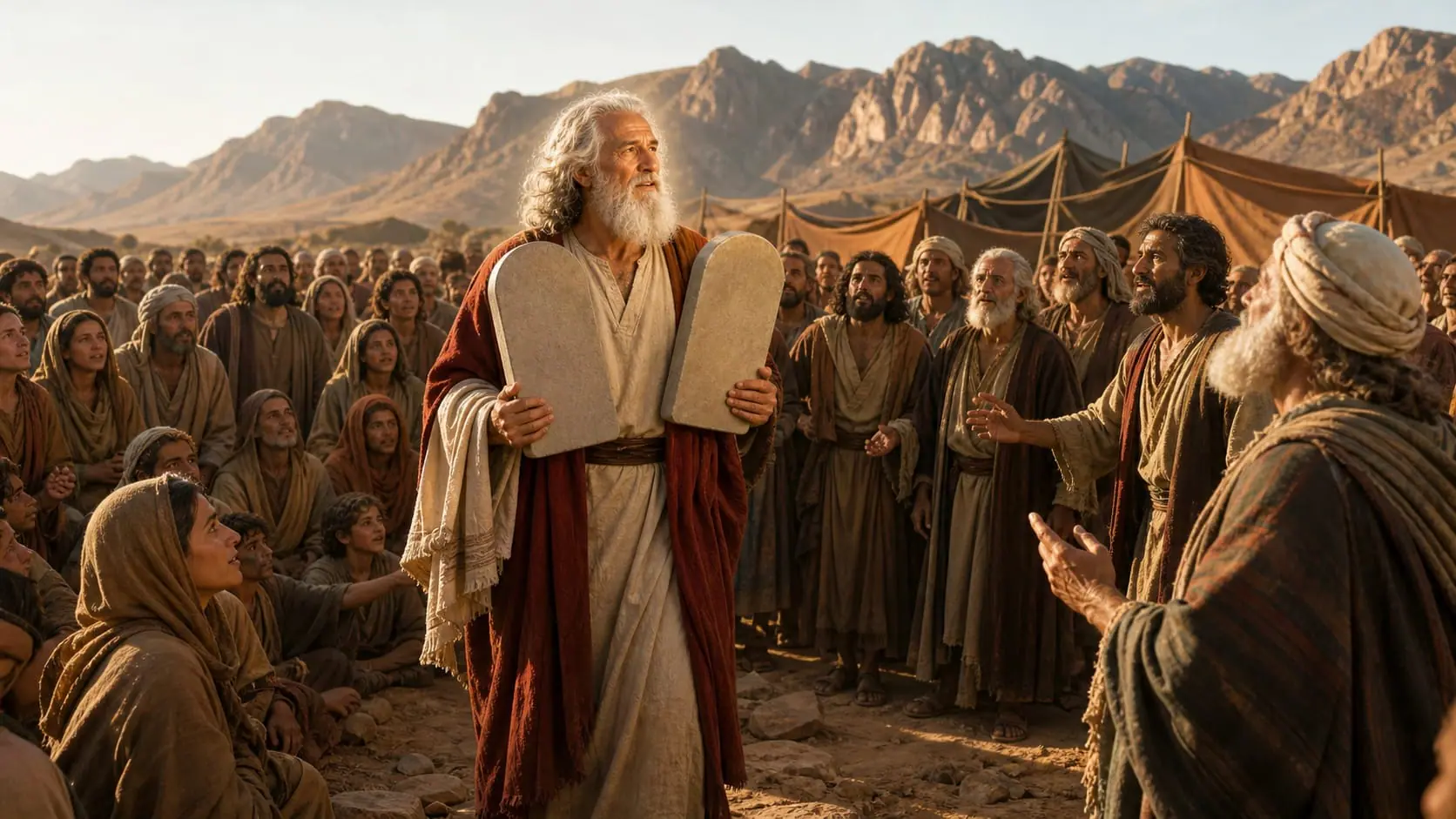
After Israel left Egypt, the people camped at Mount Sinai. God called them to keep his covenant as his treasured people. With thunder, lightning, cloud, fire, and a trumpet blast surrounding the mountain, God spoke the Ten Commandments.
Moses later received two stone tablets written by God. While he was on the mountain, the people worshiped a golden calf. Moses pleaded for them before descending; when he saw the calf and dancing, he broke the tablets and destroyed the idol. After further judgment and intercession, God renewed the covenant. Moses cut two new stones, and God wrote the words again.
Explore the journey leading to Sinai through six selected chapters and puzzles in the Exodus Journey Game. Its household and map activities are a learning adaptation, not a retelling of every event in Exodus.
The Sinai account
Covenant, Broken Tablets, and Renewal
Israel arrives at Mount Sinai
In the third month after leaving Egypt, Israel camped before the mountain. God reminded them that he had carried them out of Egypt and called them to keep his covenant. The people answered together that they would do all Yahweh had spoken.
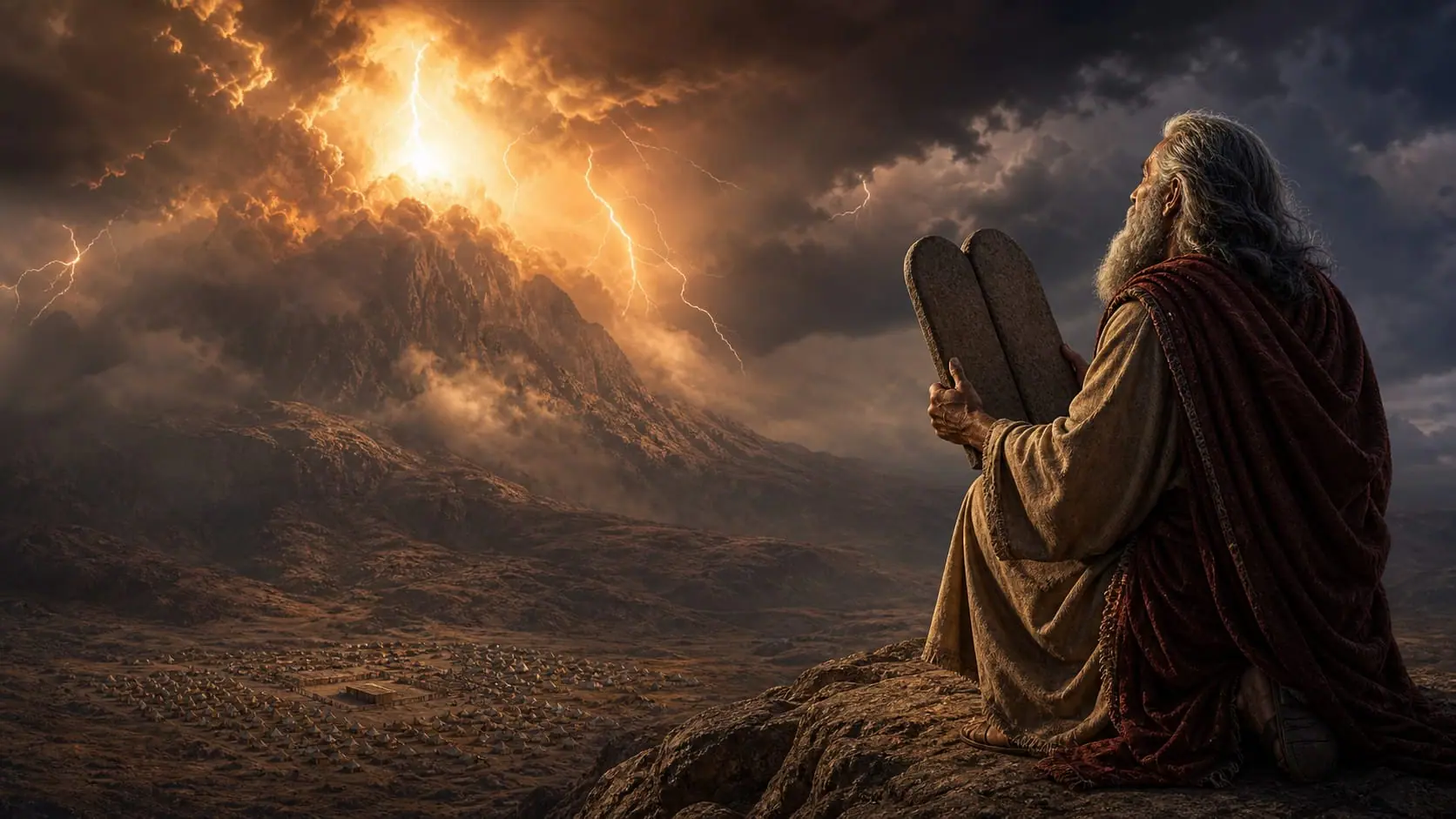
Boundaries were placed around the mountain. On the third day, thunder, lightning, thick cloud, a loud trumpet, smoke, and trembling announced God’s holy presence. Moses spoke, and God answered him. Exodus 19
Now therefore, if you will indeed obey my voice and keep my covenant, then you shall be my own possession from among all peoples; for all the earth is mine; and you shall be to me a kingdom of priests and a holy nation.’ These are the words which you shall speak to the children of Israel.”
God speaks the covenant words
The commandments begin with identity and deliverance: “I am Yahweh your God, who brought you out of the land of Egypt.” Israel’s obedience was a response to rescue, not a method for earning release from slavery.
The words ordered Israel’s worship, time, family honor, treatment of life, marriage, property, truth, and desire. The people stood at a distance in fear while Moses approached the thick darkness. Exodus 20
God spoke all these words, saying, “I am Yahweh your God, who brought you out of the land of Egypt, out of the house of bondage. “You shall have no other gods before me.
A concise list
The Ten Commandments in Order
1. You shall have no other gods before me.
2. You shall not make or worship an idol.
3. You shall not misuse Yahweh’s name.
4. Remember the Sabbath day and keep it holy.
5. Honor your father and your mother.
6. You shall not murder.
7. You shall not commit adultery.
8. You shall not steal.
9. You shall not give false testimony against your neighbor.
10. You shall not covet what belongs to your neighbor.
These are brief summaries, not a full quotation of Exodus 20:3–17. The numbering follows one common Christian grouping; Jewish and Christian traditions divide the opening words, the image prohibition, and the coveting clauses differently.
The two biblical versions also have differences in wording and emphasis. Exodus 20:8–11 connects Sabbath rest with creation. Deuteronomy 5:12–15 recalls Israel’s slavery and deliverance and stresses rest for servants too. Compare Exodus 20:1–17 with Deuteronomy 5:6–21.
The covenant is confirmed
Moses wrote Yahweh’s words, built an altar with twelve pillars for the tribes, and read the covenant book to the people. They again promised obedience. He sprinkled sacrificial blood on the altar and on the people as part of the covenant ceremony.
Moses, Aaron, Nadab, Abihu, and seventy elders then went up, saw the God of Israel, and ate and drank. Joshua accompanied Moses up the mountain; the account then describes Moses entering the cloud. He was on the mountain forty days and nights. At the end of God’s instructions, he received two stone tablets written with God’s finger. Exodus 24; 31:18
Israel worships the golden calf
When Moses delayed, the people asked Aaron to make gods to lead them. Aaron collected gold earrings, fashioned a calf, built an altar, and announced a feast to Yahweh. God told Moses what had happened and threatened to consume the people. Moses appealed to God’s promises to Abraham, Isaac, and Israel, and God relented from destroying the nation. Exodus 32:1–14
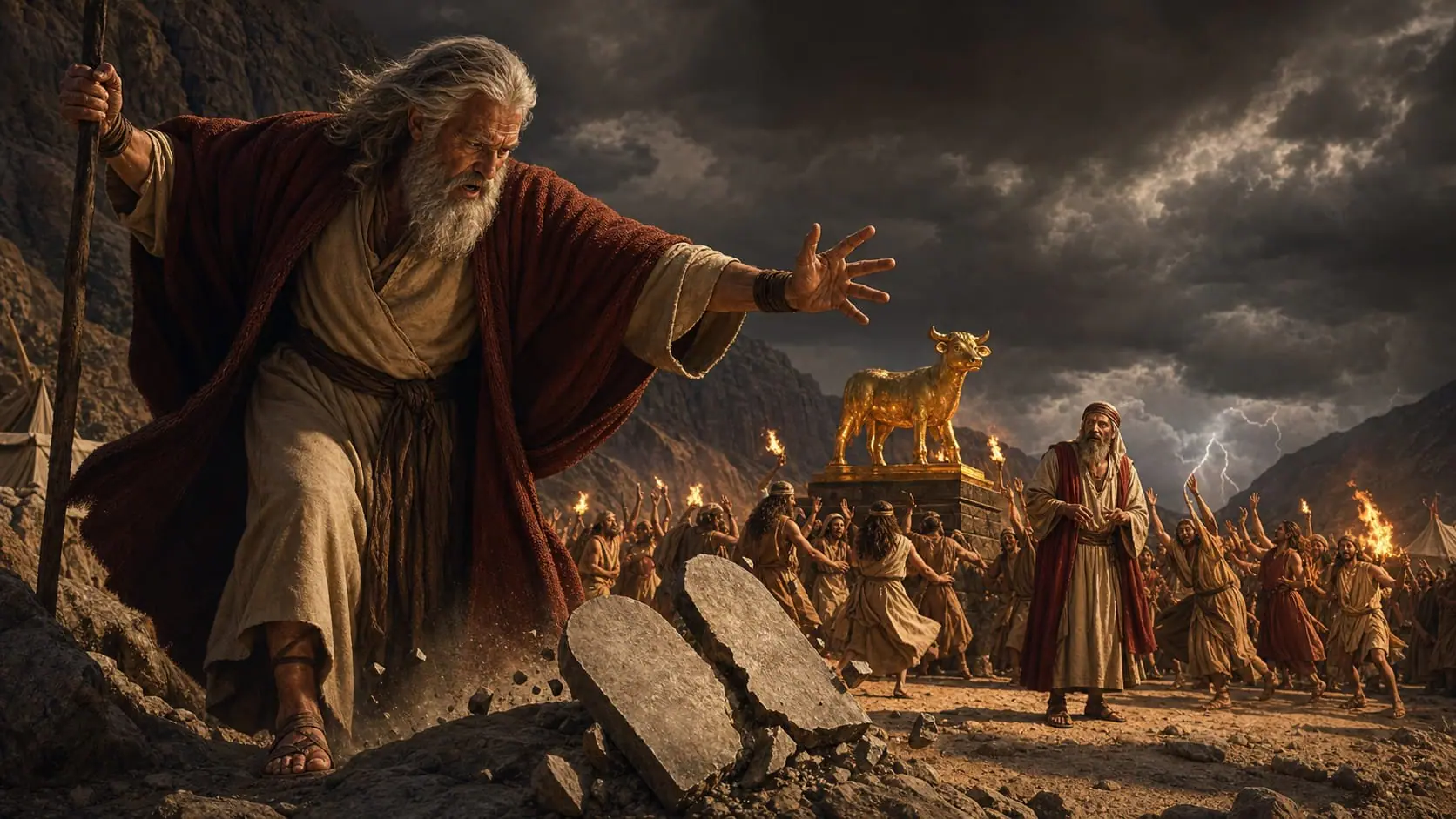
As Moses approached the camp and saw the calf and dancing, his anger burned. He threw the tablets down and broke them at the mountain’s foot. He burned and ground the calf, scattered it on water, and made Israel drink. At Moses’ command, the Levites killed about three thousand men that day. The chapter also records a plague because of the calf. The nation was spared from destruction, but the people still suffered judgment. Exodus 32:15–35
As soon as he came near to the camp, he saw the calf and the dancing. Then Moses’ anger grew hot, and he threw the tablets out of his hands, and broke them beneath the mountain.
Moses intercedes and the covenant is renewed
Moses returned to plead for Israel. In Exodus 33, God agreed that his presence would go with them. When Moses asked to see God’s glory, God promised to make his goodness pass before him, shielding him in a cleft of rock; Moses would not see God’s face. God then told Moses to cut two tablets like the first and climb Sinai alone. Exodus 32:30–33:23; 34:1–4
On the mountain, Yahweh proclaimed his mercy, patience, faithfulness, and justice. Moses bowed in worship and asked for forgiveness for the people. God renewed the covenant, and Moses remained there forty days and nights without eating or drinking. Deuteronomy 10:4 says God wrote the same commandments on the new tablets. When Moses descended, his face shone because he had spoken with God. He spoke to Israel without a veil, then covered his face afterward; he also removed the veil when speaking with God. Exodus 34:5–35; Deuteronomy 10:1–5
Yahweh said to Moses, “Chisel two stone tablets like the first. I will write on the tablets the words that were on the first tablets, which you broke.