%20scale(.87)'%3e%3cg%20transform='rotate(-3%2032%2034)'%3e%3cpath%20d='M10.5%2019.5c7.65-2.35%2014.8-.45%2021.5%205.7%206.7-6.15%2013.85-8.05%2021.5-5.7v27.2c-7.65-2.15-14.8-.45-21.5%205.1-6.7-5.55-13.85-7.25-21.5-5.1V19.5Z'%20fill='%23fff'%20stroke='%23171528'%20stroke-width='4.5'%20stroke-linejoin='round'/%3e%3cpath%20d='M32%2025.2v26.6'%20stroke='%23171528'%20stroke-width='4'%20stroke-linecap='round'/%3e%3cpath%20d='M17.5%2034.5h9M22%2030v9'%20stroke='%23171528'%20stroke-width='3.75'%20stroke-linecap='round'/%3e%3ccircle%20cx='41.5'%20cy='32.5'%20r='2.5'%20fill='%23171528'/%3e%3ccircle%20cx='46.5'%20cy='38'%20r='2.5'%20fill='%23171528'/%3e%3c/g%3e%3c/g%3e%3c/svg%3e)
The quick answer
Who was Simeon in the Bible?
Simeon was Jacob and Leah’s second son and the ancestor of the tribe of Simeon. He is best known for acting with Levi after their sister Dinah was violated, for being held by Joseph as a hostage in Egypt, and for receiving Jacob’s severe final words about violence and scattering. This profile focuses on Jacob’s son—not the later Simeon who held the infant Jesus.
One name, several biblical men
Which Simeon is this page about?
The Bible uses the name Simeon for several people. Jacob’s son in Genesis is not the man who meets the infant Jesus in Luke 2.
Simeon, son of Jacob
Leah’s second son, Levi’s partner in Genesis 34, Joseph’s hostage, and a tribal ancestor.
Genesis 29:33Simeon who saw Jesus
A righteous and devout man in Jerusalem who took the infant Jesus in his arms.
Luke 2:25–35Simeon in Jesus’ genealogy
Luke includes a different Simeon among the ancestors in Jesus’ family line.
Luke 3:30Simeon called Niger
A prophet and teacher in the church at Antioch alongside Barnabas and Saul.
Acts 13:1Why he matters
Why is Simeon important in the Bible?
He exposes the danger of uncontrolled anger
Genesis connects Simeon with a response to injustice that becomes deceitful, collective, and deadly.
He becomes Joseph’s hostage
Joseph selects Simeon to remain in Egypt, though Scripture never explains why this brother was chosen.
His tribe receives towns within Judah
The tribe’s military census total falls sharply in the wilderness. Later, its towns lie inside Judah’s allotment, and Chronicles records further settlements and campaigns.
A name connected with hearing
What does the name Simeon mean?
Simeon comes from the Hebrew Shim‘on, associated with shama, “to hear” (Hebrew name entry). In Genesis 29:33, Leah names him after saying that Yahweh has heard that she is unloved and has given her another son. This explains familiar renderings such as “heard” or “he has heard”; the verse emphasizes God hearing Leah.
Five turning points
Simeon’s life from Paddan Aram to Egypt
Genesis moves from Simeon’s birth to his part in the attack at Shechem, then to his detention in Egypt and Jacob’s final words about him.
Genesis 29:33
Born as Jacob and Leah’s second son
Genesis 34:1–31
Attacks Shechem with Levi
Genesis 42:21–24; 43:23
Held by Joseph as a hostage
Genesis 46:8–10
Moves to Egypt with six named sons
Genesis 49:5–7
Receives Jacob’s final judgment
Simeon’s family tree
Parents, siblings, and sons
Reuben was Simeon’s older brother, and Levi was the next son born to Leah. Dinah was their sister. Genesis 46:10 names six sons of Simeon.
Reuben, Levi, Judah, Issachar & Zebulun
These five brothers also belong to Jacob and Leah.
Dinah
Genesis explicitly calls Simeon and Levi Dinah’s brothers during the Shechem episode.
Joseph, Benjamin, Dan, Naphtali, Gad & Asher
Rachel, Bilhah, and Zilpah are the mothers of Jacob’s other six sons.
Jemuel, Jamin, Ohad, Jachin, Zohar & Shaul
Genesis names the family line that accompanies Jacob to Egypt.
Anger at injustice becomes collective violence
What happened between Simeon, Levi, and Dinah?
After Shechem violates Dinah, Jacob’s sons answer the marriage proposal from Shechem and his father Hamor deceitfully. They require every male in the city to be circumcised. On the third day, while the men are in pain, Simeon and Levi kill the city’s males, including Hamor and Shechem, and take Dinah from Shechem’s house. Jacob’s sons then plunder the city and take women and children captive.
The brothers hear and become angry
Genesis calls Shechem’s act an outrageous thing that should not be done.
Genesis 34:1–7Circumcision becomes a weapon
The sons outwardly propose an agreement while planning to exploit the city’s vulnerability.
Genesis 34:13–24The two brothers lead the killing
Genesis names them as the men who enter the city, kill the males, and recover Dinah.
Genesis 34:25–26Rebuke, then a lasting judgment
Jacob first fears that neighboring peoples will destroy his household in retaliation. In his final words, he condemns the brothers’ anger, killing, and cruelty.
Genesis 34:30; 49:5–7A moral question answered from the narrative
Were Simeon and Levi justified?
Genesis does not minimize what happened to Dinah, and Simeon and Levi close the chapter by defending their sister. Yet the story also refuses to treat their response as uncomplicated justice: the agreement is deceitful, the killing extends to every male, the household takes captives and plunder, and Jacob’s final words condemn their anger and violence.
Dinah was grievously wronged
The narrative’s moral language condemns Shechem’s act before describing the brothers’ response.
Genesis 34:7A city pays for one man’s offense
Simeon and Levi kill all the males, and Jacob’s sons take the city’s wealth, children, and women.
Genesis 34:25–29Jacob confronts the danger they created
Jacob says their action has made his household offensive to the surrounding peoples.
Genesis 34:30Jacob curses their anger
Years later his strongest criticism is not forgotten: fierce anger leads to scattering.
Genesis 49:5–7A hostage whose selection is unexplained
What happened between Simeon and Joseph?
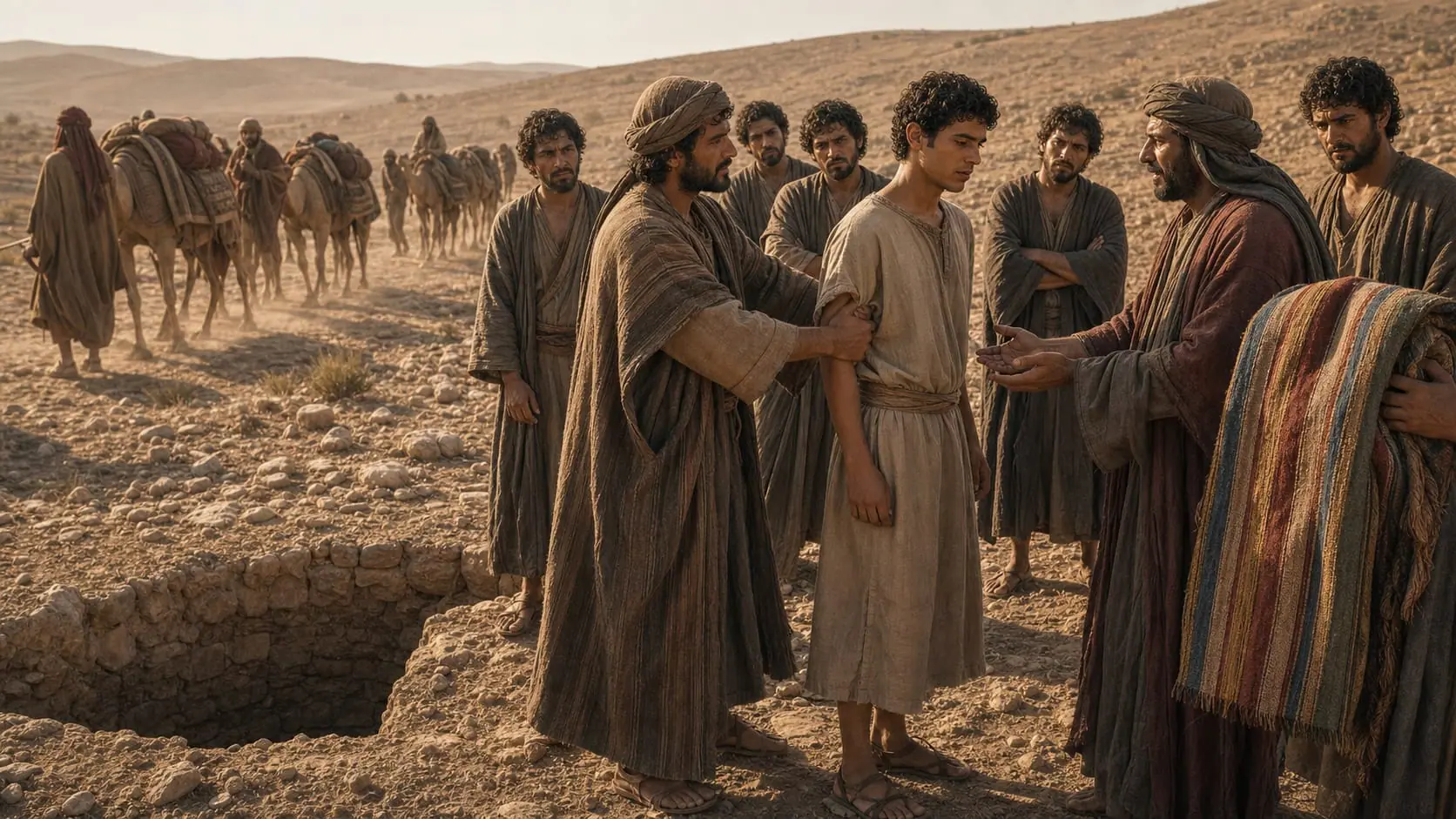
When Joseph’s brothers come to Egypt for grain, he demands that one remain while the others bring Benjamin. After hearing them discuss their guilt over Joseph, he takes Simeon and binds him before their eyes. Simeon is released when the brothers return, but Genesis never states why Joseph selected him.
They remember Joseph’s distress
The brothers connect their Egyptian trouble with their earlier refusal to listen to Joseph.
Genesis 42:21–22Joseph binds Simeon
Simeon remains in Egypt as the concrete guarantee that the brothers will return with Benjamin.
Genesis 42:24Simeon rejoins the family
Joseph’s steward brings Simeon out after the brothers arrive with Benjamin.
Genesis 43:23Genesis does not explain the choice
Joseph requires one brother to remain, but the account does not say why that brother is Simeon. It also does not identify him as the leader in Joseph’s earlier mistreatment.
Genesis 37:18–30; 42:19–24Six names in Genesis, later variants
Who were Simeon’s sons?
Genesis 46:10 names Jemuel, Jamin, Ohad, Jachin, Zohar, and Shaul. Only Shaul is identified here as the son of a Canaanite woman. Exodus repeats the six names, while Numbers and Chronicles give five-name lists with some different forms.
Six sons enter Egypt
Jemuel, Jamin, Ohad, Jachin, Zohar, and Shaul are named in Jacob’s household.
Genesis 46:10The six-name list appears again
The same six forms are repeated when the heads of Israel’s families are introduced.
Exodus 6:15Five clans use variant forms
Nemuel and Zerah appear, and Ohad does not head a clan in the second census.
Numbers 26:12–14Another genealogical arrangement
Nemuel, Jamin, Jarib, Zerah, and Shaul introduce Simeon’s later family record.
1 Chronicles 4:24–27No personal lifespan is recorded
How old was Simeon, and how did he die?
The Bible gives no lifespan or individual death account for Simeon. Genesis names six sons and calls Shaul’s mother a Canaanite woman, without naming her. Acts 7:15–16 speaks collectively of the ancestors’ deaths in Egypt and burial at Shechem, without naming Simeon separately. Genesis 46:10; Exodus 1:6; Acts 7:15–16
A judgment on anger and violence
What did Jacob say about Simeon and Levi?
Jacob’s final words pair the brothers again. He rejects participation in their council, condemns their killing and cruelty, and announces that they will be divided and scattered in Israel.
“Simeon and Levi are brothers”
The line points beyond family relation toward their shared conduct and violent partnership.
Genesis 49:5Jacob rejects their council
He refuses to join their gathering and condemns their killing of men and hamstringing of cattle.
Genesis 49:6Their anger is cursed
Jacob curses their anger because it is fierce and their wrath because it is cruel. He then announces the consequences for Simeon and Levi.
Genesis 49:7Division and scattering
The poem looks toward descendants dispersed within Israel rather than one concentrated position of power.
Genesis 49:7Follow the people and passages
Simeon with Levi, Dinah, and Joseph
Simeon and Levi act together after the assault on Dinah. Years later Simeon is detained in Egypt while his brothers return home; follow that episode in Joseph’s story.
Joseph Bible Story
Read the brothers’ betrayal, Egyptian journeys, Simeon’s detention, Benjamin’s test, and the reunion.
Read Joseph’s story →Simeon’s motherLeah in the Bible
Read why Leah named her second son Simeon and how she described God hearing her distress.
Meet Leah →Simeon’s older brotherReuben in the Bible
Compare Simeon’s detention in Egypt with Reuben’s earlier attempt to save Joseph.
Meet Reuben →Simeon’s fatherJacob in the Bible
Follow Jacob’s family from Paddan Aram to Canaan and finally to Egypt.
Meet Jacob →