What is the best Bible verse about forgiveness?+
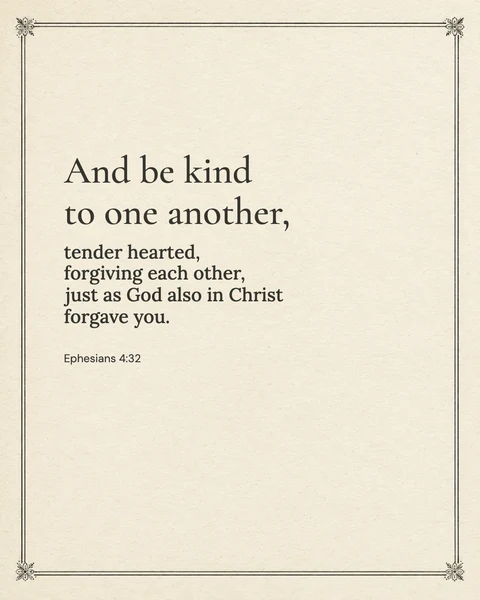
Ephesians 4:32 is a strong starting point because it joins God’s forgiveness in Christ with kindness, compassion, and forgiving others. 1 John 1:9 is especially direct about confession and forgiveness of sins.
What does the Bible say about forgiveness?+
Ephesians 1:7 speaks of forgiveness through Christ’s redemption, and 1 John 1:9 connects forgiveness with confession. Jesus also gives serious teaching about forgiving others in Matthew 6:14–15 and about rebuke, repentance, and repeated forgiveness in Luke 17:3–4. Read these together rather than reducing them to a rule that wrongdoing no longer matters.
Does forgiveness mean forgetting?+
Jeremiah 31:34 promises that God will forgive his people and remember their sin no more. It is not a command for a harmed person to lose memory or pretend nothing happened. First Corinthians 13:6 also says love rejoices with truth, not unrighteousness.
Is forgiveness the same as reconciliation?+
They are related, but forgiving an offense does not by itself repair a relationship. Matthew 5:23–24 urges reconciliation, while Luke 17:3–4 names rebuke and repentance. Romans 12:18 recognizes limits to what one person can accomplish. Restored trust should not be assumed without regard for what has changed or whether contact is safe.
Do I have to trust someone again?+
Forgiveness can be offered without immediately restoring access or trust. Trust is relational and may need to be rebuilt through consistent changed behavior over time.
How many times should I forgive?+
The WEB translates Matthew 18:22 as “seventy times seven”; the NIV main text reads “seventy-seven times” and notes the alternative. Jesus then tells the parable of the unforgiving servant and calls for forgiveness from the heart. The passage is not permission to stop showing mercy after a set number of offenses.
Can I forgive someone who never apologized?+
Romans 12:19–21 rejects personal revenge without making that command depend on an apology. Luke 17:3–4 explicitly speaks of rebuke and repentance. Christians differ in how they describe forgiveness before repentance, but neither passage requires pretending the wrong was harmless or forcing restored trust.
Does forgiveness require staying in an unsafe relationship?+
No. Forgiveness does not require denying danger, removing consequences, avoiding authorities, or giving someone continued access. Seek immediate local help if you or someone else is unsafe.
What about the unforgivable sin?+
Matthew 12:22–37 and Mark 3:20–30 place Jesus’ warning about blasphemy against the Holy Spirit in a dispute over the source of his power. His opponents attribute his work to the ruler of demons; Mark explicitly connects the warning with their saying he had an unclean spirit. This is a serious warning, not a basis for this page or its quiz to declare an individual beyond forgiveness. Read the full accounts, alongside passages such as 1 John 1:9–2:2.
Which Bible translation is used here?+
The Scripture selections use the World English Bible (WEB), a public-domain translation. Some verse ranges begin or end within longer sentences or speeches. We note important wording or manuscript differences and provide passage links. Context notes, quiz explanations, and the example prayer are our own writing, not additional Scripture.
%20scale(.87)'%3e%3cg%20transform='rotate(-3%2032%2034)'%3e%3cpath%20d='M10.5%2019.5c7.65-2.35%2014.8-.45%2021.5%205.7%206.7-6.15%2013.85-8.05%2021.5-5.7v27.2c-7.65-2.15-14.8-.45-21.5%205.1-6.7-5.55-13.85-7.25-21.5-5.1V19.5Z'%20fill='%23fff'%20stroke='%23171528'%20stroke-width='4.5'%20stroke-linejoin='round'/%3e%3cpath%20d='M32%2025.2v26.6'%20stroke='%23171528'%20stroke-width='4'%20stroke-linecap='round'/%3e%3cpath%20d='M17.5%2034.5h9M22%2030v9'%20stroke='%23171528'%20stroke-width='3.75'%20stroke-linecap='round'/%3e%3ccircle%20cx='41.5'%20cy='32.5'%20r='2.5'%20fill='%23171528'/%3e%3ccircle%20cx='46.5'%20cy='38'%20r='2.5'%20fill='%23171528'/%3e%3c/g%3e%3c/g%3e%3c/svg%3e)