%20scale(.87)'%3e%3cg%20transform='rotate(-3%2032%2034)'%3e%3cpath%20d='M10.5%2019.5c7.65-2.35%2014.8-.45%2021.5%205.7%206.7-6.15%2013.85-8.05%2021.5-5.7v27.2c-7.65-2.15-14.8-.45-21.5%205.1-6.7-5.55-13.85-7.25-21.5-5.1V19.5Z'%20fill='%23fff'%20stroke='%23171528'%20stroke-width='4.5'%20stroke-linejoin='round'/%3e%3cpath%20d='M32%2025.2v26.6'%20stroke='%23171528'%20stroke-width='4'%20stroke-linecap='round'/%3e%3cpath%20d='M17.5%2034.5h9M22%2030v9'%20stroke='%23171528'%20stroke-width='3.75'%20stroke-linecap='round'/%3e%3ccircle%20cx='41.5'%20cy='32.5'%20r='2.5'%20fill='%23171528'/%3e%3ccircle%20cx='46.5'%20cy='38'%20r='2.5'%20fill='%23171528'/%3e%3c/g%3e%3c/g%3e%3c/svg%3e)
Sight, mobility, skin disease, fever, bleeding, hearing, speech, and other physical conditions.
16 entries in this listQuick answer
How many miracles did Jesus perform?
33 listed here
The Gospels do not give a total. John 20:30–31 explicitly says that other signs were not recorded in that book; Matthew 4:23–24 summarizes many healings. The entries below are selected reading passages, not a complete count of Jesus’ miracles.
What the signs reveal
Read what happens around the miracle
At Nain, Jesus has compassion on a grieving mother and gives her son back to her (Luke 7:11–17). In Matthew 12:28, he connects casting out demons with the arrival of God’s kingdom. John 20:30–31 explains that the recorded signs are meant to lead readers to believe that Jesus is the Christ, the Son of God.
The responses are not always welcoming. After the man born blind receives sight, he is questioned and cast out before Jesus finds him again (John 9:13–38). The withering fig tree also belongs in the list; not every account is a healing or a scene of comfort. Read the surrounding passage rather than turning one outcome into a promise that faith guarantees health or acceptance.
Four groups for browsing
Types of miracles Jesus performed
Food and wine provided, wind and water stilled, catches of fish, and a fig tree that withers.
9 entries in this listAccounts that explicitly describe Jesus casting out demons or unclean spirits. Healing and deliverance sometimes overlap.
5 entries in this listThe widow’s son, Jairus’s daughter, and Lazarus are raised from death. Jesus’ own resurrection is discussed separately.
3 entries in this listA broad reading sequence
Miracles of Jesus in order
The order is a reading aid, not an exact timeline. Parallel passages are grouped for comparison, with one category per entry even where healing and deliverance overlap. Other episodes, such as the healing at Bethesda (John 5:1–15) and the man who was blind and unable to speak (Matthew 12:22–28), are outside this selection. Read Jesus’ resurrection separately. Each reference link opens the World English Bible; the artwork is an illustration, not a historical portrait.- 01Provision & nature
Water turned into wine at Cana
John 2:1–11At a wedding, servants fill six stone jars with water. John calls this the beginning of Jesus’ signs and says it revealed his glory.
- 02Healing
Official’s son healed at a distance
John 4:46–54Jesus speaks in Cana while the boy is sick in Capernaum. The father learns that the fever left at the hour Jesus said his son would live.
- 03Deliverance
Unclean spirit driven out in Capernaum
Mark 1:21–28; Luke 4:31–37Jesus commands the spirit to leave a man in the synagogue. The listeners are astonished at his authority.
- 04Healing
Peter’s mother-in-law healed
Matthew 8:14–15; Mark 1:29–31; Luke 4:38–39Her fever leaves, and she gets up and serves. Mark identifies the house as belonging to Simon and Andrew.
- 05Provision & nature
A miraculous catch of fish
Luke 5:1–11After an unsuccessful night, Simon lets down the nets at Jesus’ word. The catch fills two boats; Simon, James, and John leave everything and follow him.
- 06Healing
A man with leprosy cleansed
Matthew 8:1–4; Mark 1:40–45; Luke 5:12–16Jesus touches the man and makes him clean. He tells him to show himself to the priest and make the offering Moses commanded.
- 07Healing
A paralyzed man healed
Matthew 9:1–8; Mark 2:1–12; Luke 5:17–26Jesus forgives the man’s sins and tells him to get up and carry his mat. Mark and Luke describe him being lowered through the roof; Matthew does not include that detail.
- 08Healing
A man’s withered hand restored
Matthew 12:9–14; Mark 3:1–6; Luke 6:6–11Jesus heals on the Sabbath while opponents watch for a reason to accuse him. Luke specifies the man’s right hand.
- 09Healing
A centurion’s servant healed
Matthew 8:5–13; Luke 7:1–10The centurion trusts Jesus to heal by a word. Matthew presents his conversation with Jesus; Luke describes Jewish elders and friends carrying his requests.
- 10Restoration to life
A widow’s son raised at Nain
Luke 7:11–17Jesus meets a funeral procession at the city gate. Moved with compassion for the widow, he raises her only son and gives him back to her.
- 11Provision & nature
A storm calmed on the lake
Matthew 8:23–27; Mark 4:35–41; Luke 8:22–25The disciples wake Jesus as their boat is in danger. He rebukes the wind and water, leaving them asking who he is.
- 12Deliverance
Deliverance among the tombs
Matthew 8:28–34; Mark 5:1–20; Luke 8:26–39Matthew describes two men possessed by demons; Mark and Luke focus on one man and use the name Legion. All three accounts describe the demons entering pigs. Their details should not be treated as identical.
- 13Healing
A woman healed after twelve years of bleeding
Matthew 9:20–22; Mark 5:25–34; Luke 8:43–48She touches Jesus’ clothing while he is on the way to the ruler’s daughter. Jesus addresses her as daughter and acknowledges her faith.
- 14Restoration to life
Jairus’s daughter raised
Matthew 9:18–26; Mark 5:21–43; Luke 8:40–56Mark and Luke name Jairus and report the girl’s death while Jesus is on the way. In Matthew, the unnamed ruler says she has already died when he first asks for help.
- 15Healing
Two blind men receive sight
Matthew 9:27–31The men call Jesus Son of David. He touches their eyes after asking whether they believe he can heal them.
- 16Deliverance
A man unable to speak is delivered
Matthew 9:32–34The man speaks after the demon is cast out. The crowd marvels, but the Pharisees attribute Jesus’ power to the ruler of demons.
- 17Provision & nature
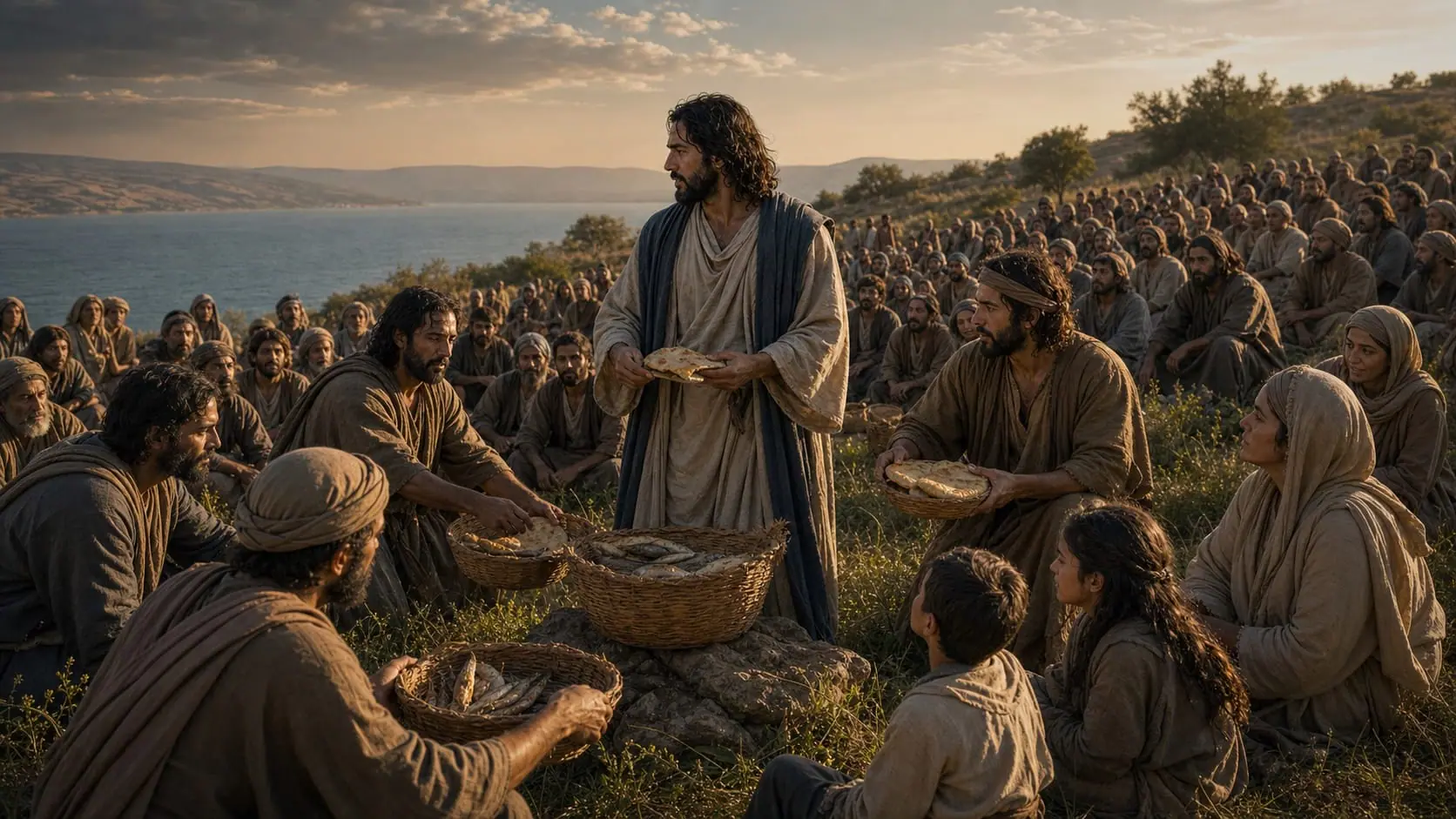
Five thousand fed
Matthew 14:13–21; Mark 6:30–44; Luke 9:10–17; John 6:1–15Five loaves and two fish feed the crowd, with twelve baskets left over. Matthew counts about five thousand men, besides women and children; John identifies the boy with the food.
- 18Provision & nature
Jesus walks on water
Matthew 14:22–33; Mark 6:45–52; John 6:16–21Jesus comes to the disciples on the water after the feeding. Only Matthew includes Peter stepping out, beginning to sink, and being caught by Jesus.
- 19Deliverance
A woman’s daughter freed from a demon
Matthew 15:21–28; Mark 7:24–30Matthew calls the mother Canaanite; Mark describes her as Greek and Syrophoenician by origin. After her reply about the crumbs, Jesus grants her request for her daughter.
- 20Healing
A deaf man with a speech difficulty healed
Mark 7:31–37Jesus takes him aside from the crowd, touches his ears and tongue, and speaks. The man can hear and speak clearly.
- 21Provision & nature
Four thousand fed
Matthew 15:32–39; Mark 8:1–10Seven loaves and a few fish feed the crowd, with seven baskets left over. Matthew specifies four thousand men, besides women and children. This is distinct from the feeding of the five thousand.
- 22Healing
A blind man healed at Bethsaida
Mark 8:22–26The man first sees people indistinctly, like walking trees. After Jesus lays his hands on his eyes again, he sees clearly.
- 23Deliverance
A boy delivered after the transfiguration
Matthew 17:14–21; Mark 9:14–29; Luke 9:37–43The disciples have been unable to help. Jesus rebukes the spirit and restores the boy; in Mark, the father asks for help with his unbelief. These accounts do not identify every illness or seizure as demonic.
- 24Provision & nature
Jesus directs Peter to a coin in a fish’s mouth
Matthew 17:24–27Jesus tells Peter that the first fish he catches will hold a coin for their tax payment. Matthew records the instruction but does not go on to narrate Peter catching the fish or paying the collectors.
- 25Healing
A man born blind receives sight
John 9:1–41Jesus rejects the disciples’ proposed blame of the man or his parents for his blindness. After receiving sight, the man is questioned and cast out; Jesus finds him again.
- 26Healing
A woman bent over for eighteen years healed
Luke 13:10–17Jesus lays his hands on her, and she stands upright. He calls her a daughter of Abraham whom Satan had bound, defending her release on the Sabbath.
- 27Healing
A man with swelling healed on the Sabbath
Luke 14:1–6At a Pharisee leader’s house, Jesus heals a man whose condition is called dropsy in the WEB. He challenges objections to helping someone on the Sabbath.
- 28Healing
Ten men with leprosy cleansed
Luke 17:11–19They are cleansed while going to show themselves to the priests. One, a Samaritan, returns to thank Jesus; all ten were cleansed, not only the man who returned.
- 29Restoration to life
Lazarus raised from the tomb
John 11:1–44Lazarus has been in the tomb four days when Jesus arrives. Jesus weeps, prays to the Father, and calls him out; Lazarus emerges still wrapped in burial cloths.
- 30Healing
Blind people healed near Jericho
Matthew 20:29–34; Mark 10:46–52; Luke 18:35–43Matthew describes two men as Jesus leaves Jericho. Mark names Bartimaeus as Jesus leaves; Luke describes an unnamed man as Jesus approaches. These accounts are compared here without inventing a single shared location or head count.
- 31Provision & nature
A fig tree withers
Matthew 21:18–22; Mark 11:12–25Matthew describes the tree withering immediately. Mark places the temple action between Jesus’ words to the tree and the disciples seeing it withered the next morning.
- 32Healing
The high priest’s servant’s ear healed
Luke 22:47–53During the arrest, a disciple cuts off the servant’s right ear. Luke records Jesus touching and healing it, not endorsing the attack.
- 33Provision & nature
A miraculous catch after the resurrection
John 21:1–14At the Sea of Tiberias, seven disciples catch 153 large fish after Jesus tells them where to cast the net. The net is not torn, and he invites them to breakfast.
John’s first sign
Water into wine
The wine runs out at a wedding. The servants know where the new wine came from, but the feast’s steward does not. John says the sign reveals Jesus’ glory and his disciples believe in him.Read the Cana storyAll four Gospels
Feeding the 5,000
Five loaves, two fish, and twelve baskets of leftovers: compare the four accounts, including John’s description of the crowd trying to make Jesus king by force.Read the feeding storyAt Bethany
Raising Lazarus
Martha and Mary grieve for their brother. Jesus calls Lazarus out of the tomb; many witnesses believe, while some report to the Pharisees. John 11:45–53 then describes the plot to kill Jesus.Read the Lazarus storyRead one event in more detail
Four illustrated miracle stories
Each story includes Bible passages and a five-question check. For questions across Jesus’ life and teaching, try Jesus Trivia; it is not a quiz covering all 33 entries here.
Direct answers
Miracles of Jesus FAQ
How many miracles did Jesus perform?
The Gospels do not give a total. John 20:30 says Jesus did other signs not recorded in that book, and Matthew 4:23–24 summarizes many healings without counting them individually. Our 33 entries are a selection, not an exhaustive total. Other lists differ in how they group parallel accounts, summary healings, the transfiguration, and Jesus’ own resurrection.
What was the first miracle of Jesus?
John 2:11 calls the water becoming wine at Cana the beginning of Jesus’ signs. John says this revealed his glory and that his disciples believed in him. That is the first sign John identifies, not a dated inventory of everything Jesus ever did.
What was Jesus’ last miracle before the crucifixion?
The last individual healing narrated before Jesus’ death is the healing of the high priest’s servant’s ear during the arrest, in Luke 22:50–51. This describes the order of the recorded accounts, not proof that nothing else happened. John 21:1–14 records a catch of fish after Jesus’ resurrection.
Which miracle appears in all four Gospels?
All four narrate the feeding of the five thousand: Matthew 14:13–21, Mark 6:30–44, Luke 9:10–17, and John 6:1–15. It should not be confused with the feeding of the four thousand. All four Gospels also proclaim Jesus’ resurrection, which is not counted among this page’s 33 entries.
Did Jesus perform miracles to prove himself on demand?
No. In Mark 8:11–13, Jesus refuses a demand for a sign intended to test him. Luke 23:8–9 says Herod hopes to see a miracle, but Jesus does not even answer his questions. John 20:30–31 gives a different purpose for the recorded signs: belief that Jesus is the Christ, the Son of God.
Are the miracles listed in exact chronological order?
No. This is a broad reading sequence from Cana to the post-resurrection catch of fish. Parallel passages are grouped for comparison, not treated as identical accounts. Matthew, Mark, and Luke sometimes differ in setting, number of people, or the way a sequence is told; the notes preserve those differences.